Schalkholz Passage Grave: A Neolithic Burial Monument
Site at a Glance
- Popularity
- Very Low
- Country
- Germany
- Primary era
- Stone Age
- Eras represented
- Stone Age, Bronze Age, Iron Age
- Civilizations
- Unclassified
- Site type
- Burial
- Remains
- Tomb
On this page12 sections
History
Neolithic origins and later reuse
The Schalkholz Passage Grave is a megalithic tomb in Schalkholz, Germany. It dates to 3500–2800 BCE and is associated with the northern group of the Funnelbeaker culture, a Neolithic farming culture of northern Europe named for its funnel-shaped pottery. A passage grave is a stone burial chamber reached through a passage.
In the late Bronze Age or early Iron Age, people used the tomb again for a burial and enlarged its mound. An urn from this period may relate to that enlargement.
Disturbance, excavation, and return
In 1876, the mound was disturbed and partly removed. The district council later purchased the monument and placed it under protection. Two pottery vessels, probably recovered during the disturbance or soon afterward, were published by Kurt Langenheim in 1935. In August 1943, the German prehistorian Ernst Sprockhoff measured the grave for his atlas of megalithic tombs. The site is listed as number 139 in his catalogue.
An excavation led by J. Kühl took place in winter 1969–70. Afterward, the burial chamber was moved with help from Germany’s armed forces to a municipal park in Heide, about 11 km west-southwest of its original location. In July 2021, the German Federal Agency for Technical Relief, a civil protection and disaster-relief agency, returned the chamber to Schalkholz.
Remains
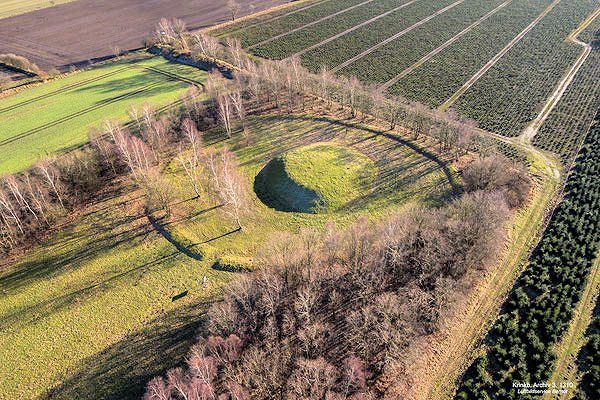
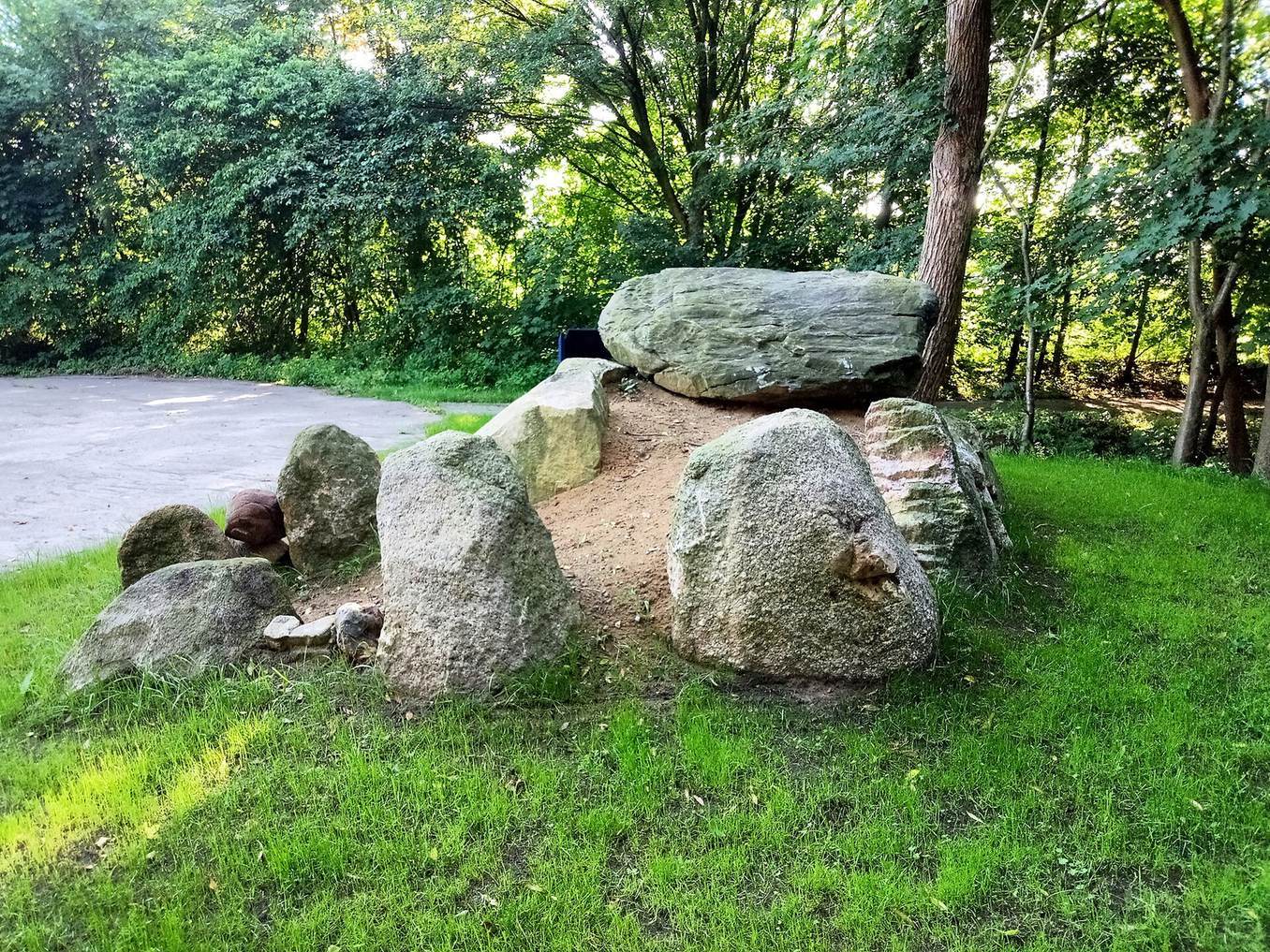
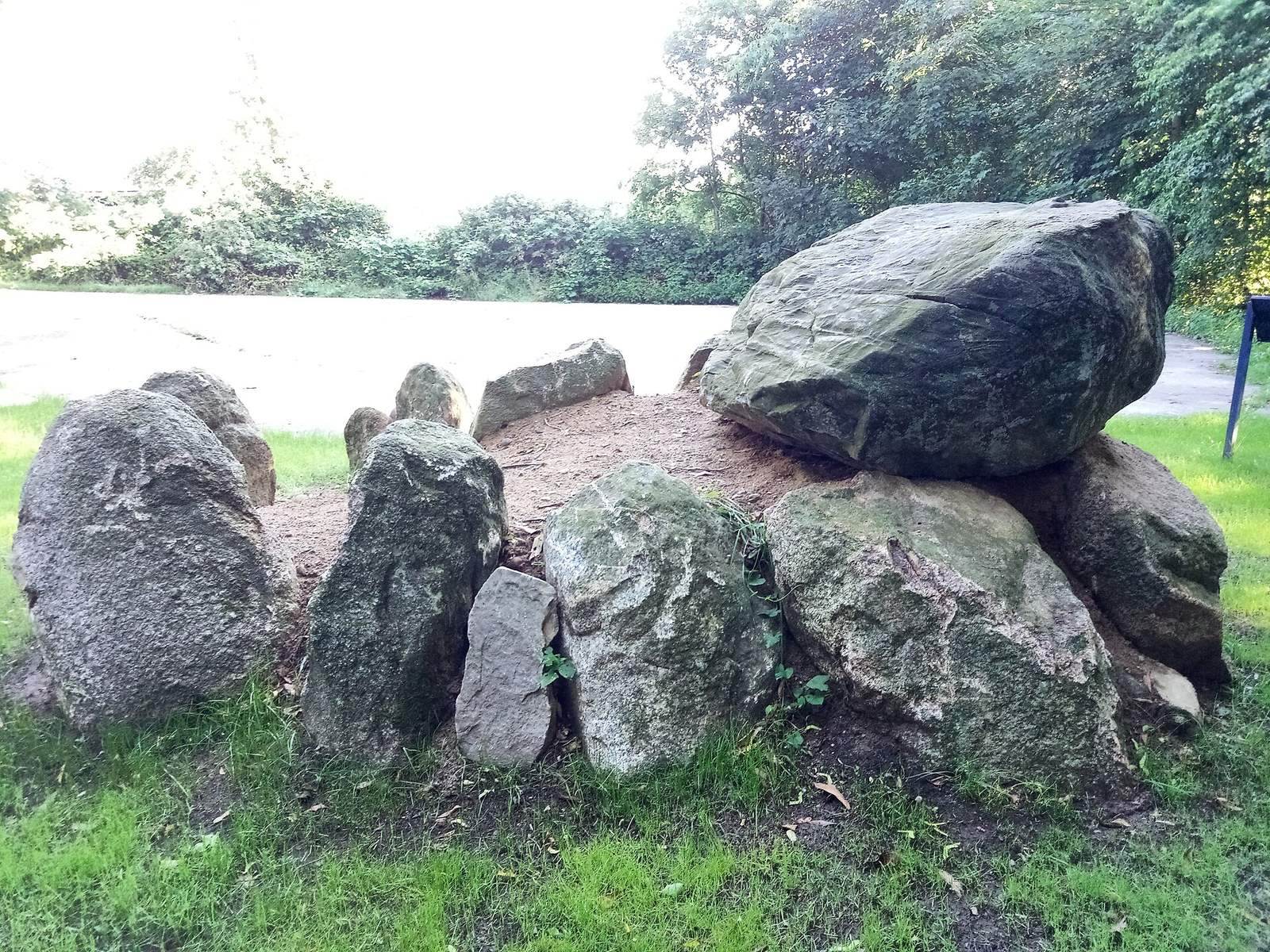
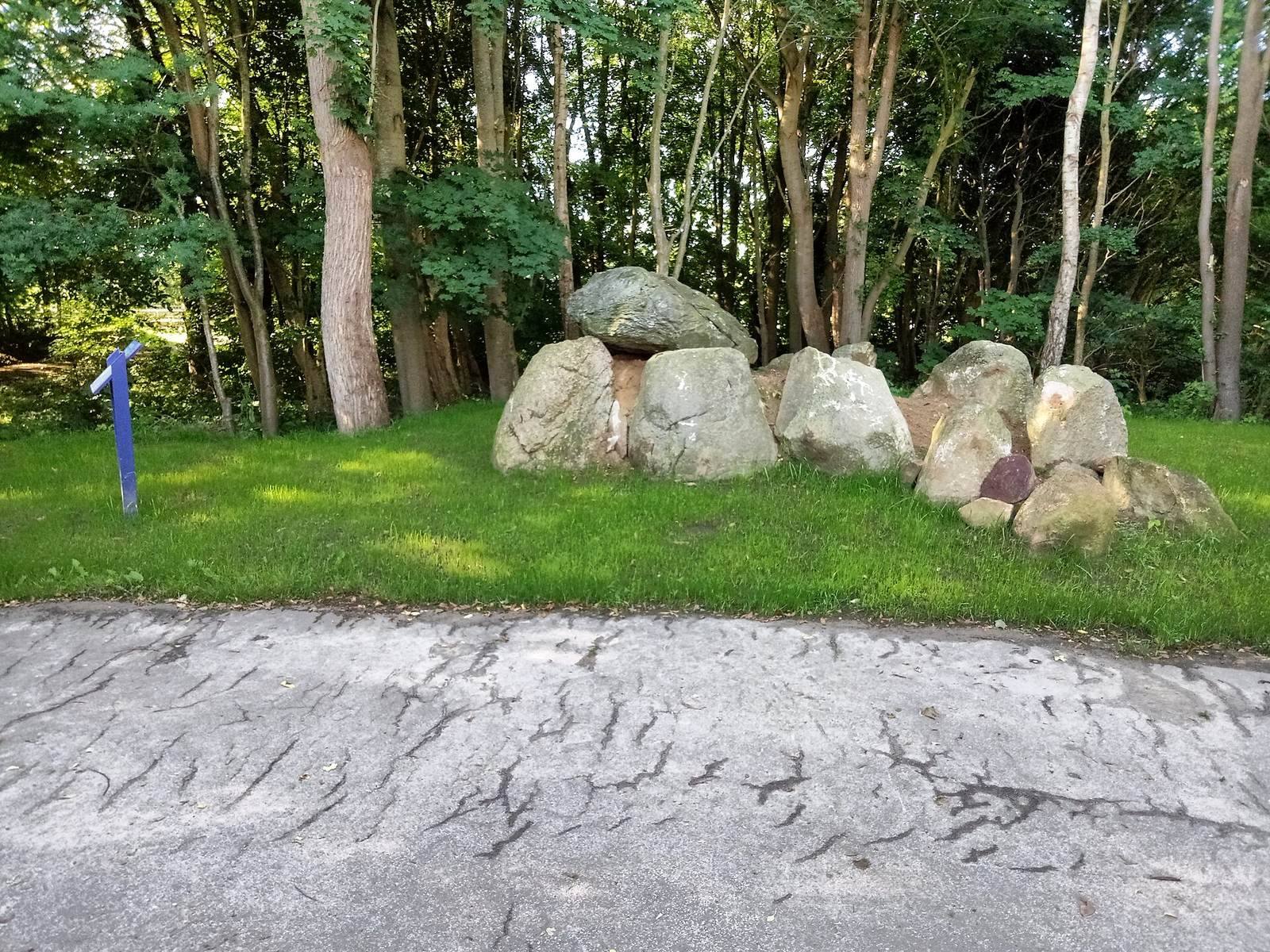
The monument is organized around a circular mound containing an oval stone chamber, with a short passage approaching from the southwest. The chamber now stands in a small green space in northern Schalkholz, at the eastern end of Kreuzberg Road. Its original location was about 1 km west of Schalkholz’s center, near the Vierth farmstead and just south of the road to Rederstall.
Mound
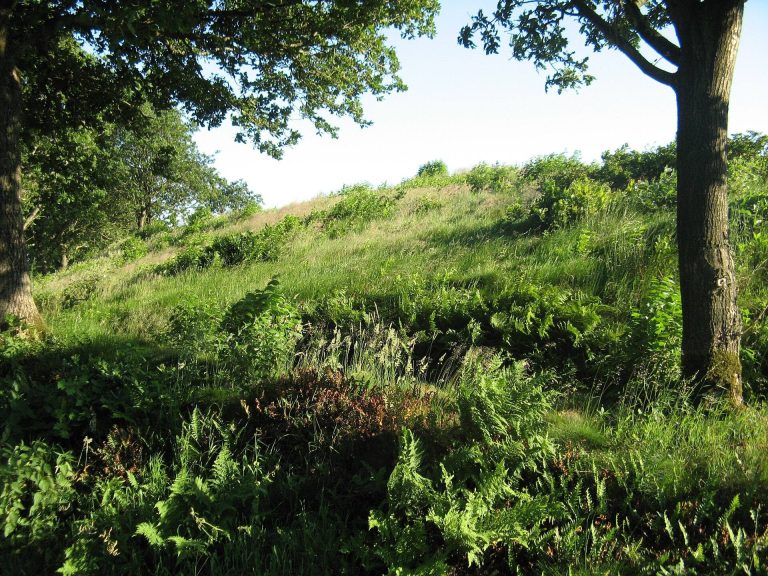
The surviving circular mound measures 16 m across and stands 1.6 m high. Sections, especially on the eastern side and at the center, were removed in 1876. Excavation distinguished two phases of construction. The earlier mound was 14 m across and 0.8 m high, reaching the top of the Neolithic chamber; its uppermost 0.1 m consisted of strongly leached soil. A later layer, 0.8 m thick, was added above it.
Burial chamber
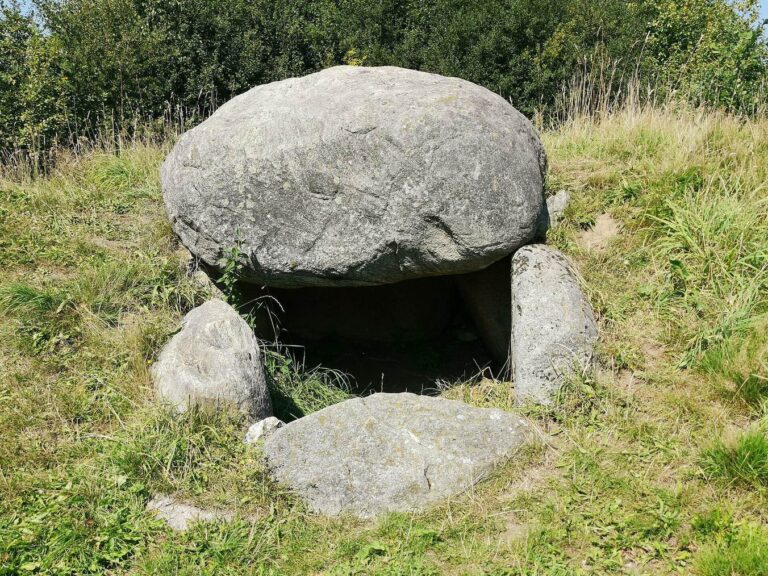
The chamber belongs to the Holstein-chamber subtype, a regional form of passage grave. Oriented north-northwest to south-southeast, it has an approximately oval plan and internal measurements of 3.5 m long, 2.2 m wide, and 1 m high. All nine wall stones survive. They meet at a right angle only at the northeast corner; elsewhere, the long and short sides curve into one another. The northern capstone remains in place on the walls.
The chamber was set about 0.4 m below the natural ground surface. In its northern floor, dressed stone slabs form a lower layer beneath an upper layer of burnt flint. Sandstone slabs, laid without mortar, filled the spaces between the wall stones. Clay covered the chamber’s exterior, which was faced with sandstone slabs and rounded stones.
Entrance passage
The entrance is at the southern end of the chamber’s western long side. A passage 1 m long and 0.6 m wide approaches diagonally from the southwest. Two wall stones line its northwest side and one its southeast side. A threshold stone rises 0.35 m above the floor. Two smaller stones placed on it left an original opening measuring 0.6 by 0.6 m. A clay floor layer on the passage side and displaced slabs in front of the passage may indicate that the entrance was closed after the chamber fell out of use.
Archaeological finds
Pottery from the mound disturbance
Two vessels probably recovered during the 1876 disturbance or soon afterward are a strongly profiled funnel beaker and a shallow bowl with an outward-flaring rim.
Finds from the chamber
The 1969–70 excavation recovered another funnel beaker, an undecorated shoulder vessel, fragments of a baking plate, and an arrowhead from the chamber. A decorated pottery sherd and several undecorated sherds came from disturbed chamber fill and the entrance area.
Flint blades
A group of 63 flint blades lay about 1.2 m north of the chamber and 0.6 m below the top of the mound’s original phase. Their position suggests they were probably placed there during mound construction. The blades were closely grouped, perhaps once held in an organic container or wrapping, and were struck from at least nine different flint cores.
Later urn
An urn dating to the late Bronze Age or early Iron Age was found near the mound’s center, set about 0.3 m into it. It may be connected with the later enlargement of the mound.