Hinterfrankenberg Castle: Medieval Fortress Ruins in Germany
Site at a Glance
- Popularity
- Low
- Country
- Germany
- Primary era
- Medieval
- Eras represented
- Medieval
- Civilizations
- Holy Roman Empire
- Site type
- Military
- Remains
- Castle
On this page10 sections
History
Hinterfrankenberg Castle is a medieval fortress ruin in Weigenheim, Germany, first built around 1166. A local Franconian name for the site translates as “Old Castle.”
Early castle and rebuilding
The first stronghold was reportedly destroyed by Emperor Frederick I Barbarossa, Holy Roman Emperor from 1155 to 1190, as a robber’s castle. Its remains were later covered by Probsteiwald Castle. Around 1200, Bishop Konrad von Querfurt built a four-part complex here. In 1225, the castle was described as a fortified place. A separate prehistoric or early historic fortification stood at Hexenstuhl, about 500 metres to the east, by Carolingian times.
Territorial control and decline
In 1254, the burgraves of Nuremberg, castle-based governors, built Vorderfrankenberg below the site as a counter-castle during territorial power struggles. In 1271, Gottfried von Hohenlohe, a relative of the burgraves, became protector of Hinterfrankenberg. Würzburg’s Prince-Bishop Manegold von Neuenburg, who held both religious and secular authority, then transferred it to the Seinsheim brothers, who were based at Vorderfrankenberg. In 1290, Manegold granted the castle to Cathedral Provost Heinrich II von Weichmar.
The castle had fallen into disrepair by 1344. In 1397, cathedral provosts, senior officers of the cathedral chapter, were required to contribute 40 gulden toward its upkeep.
Damage, rebuilding, and ruin
A feud between the Prince-Bishop and the Margrave severely damaged the castle in 1450. Sigismund von Schwarzenberg set it on fire in 1462, and Cathedral Provost Kilian von Bibra rebuilt it between 1481 and 1488. During the Margrave’s War, a conflict in the German lands in the 1550s, Margrave Albrecht Alcibiades destroyed Hinterfrankenberg and Hohenlandsberg Castle in 1554. Hinterfrankenberg then fell into ruin, although a forester lived in its gatehouse in 1600.
The lords of Hutten, who lived at Vorderfrankenberg, tried to acquire the ruin in 1674 and 1719 for use as a quarry. From 1803 to 1806, Baron von Pöllnitz, owner of Schloss Frankenberg, leased usable land within the castle area and earned enough to purchase it. Beginning in 1811, he had the ruined structures dismantled for building stone.
Remains
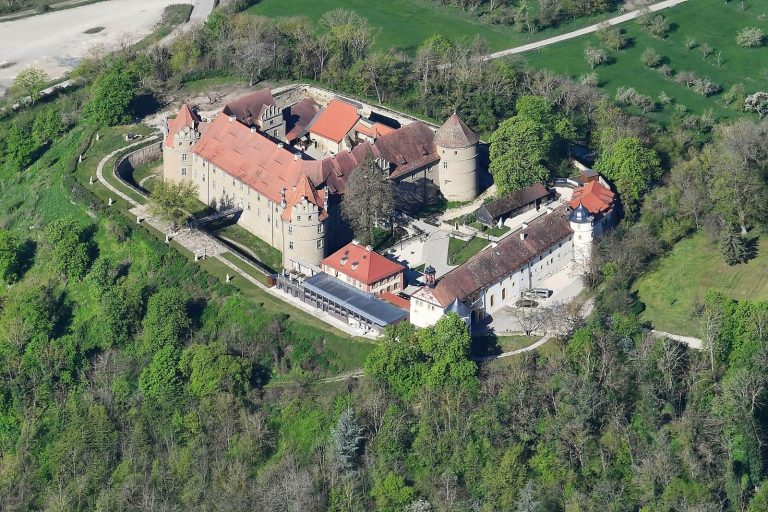
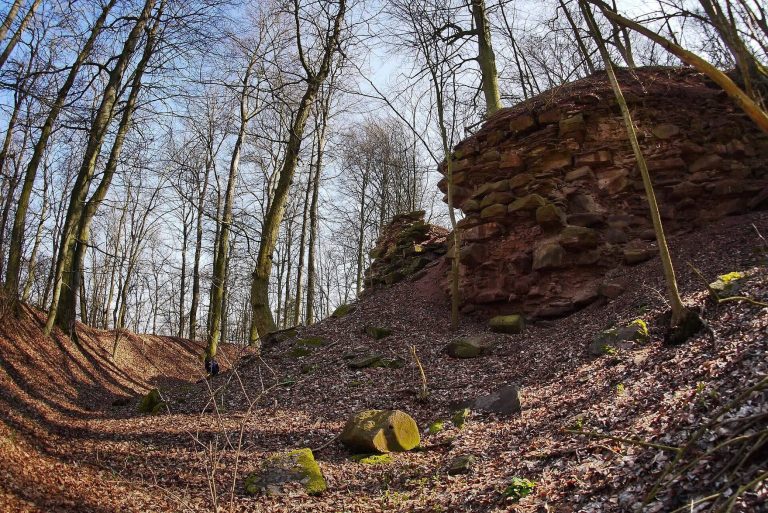
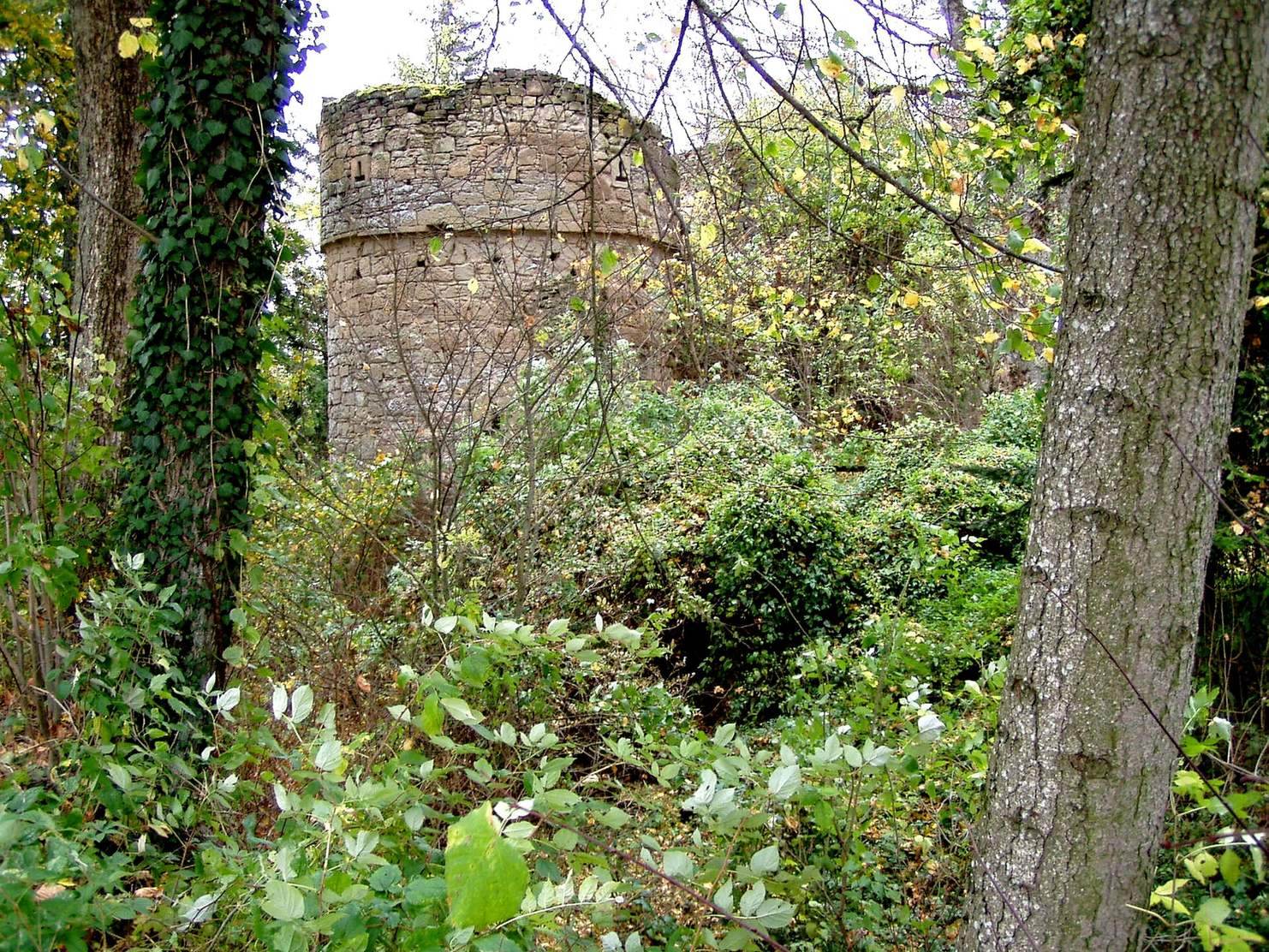
The remains occupy a densely overgrown hilltop at about 426 metres above sea level on Herrschaftsberg, also called Waschbuck of the Scheinberg. The site lies about 200 metres northeast and above Vorderfrankenberg. Its four-part plan comprised a main castle divided into two sections and two eastern outer wards, or enclosed defensive areas, protected by dry ditches.
Masonry and plateau features
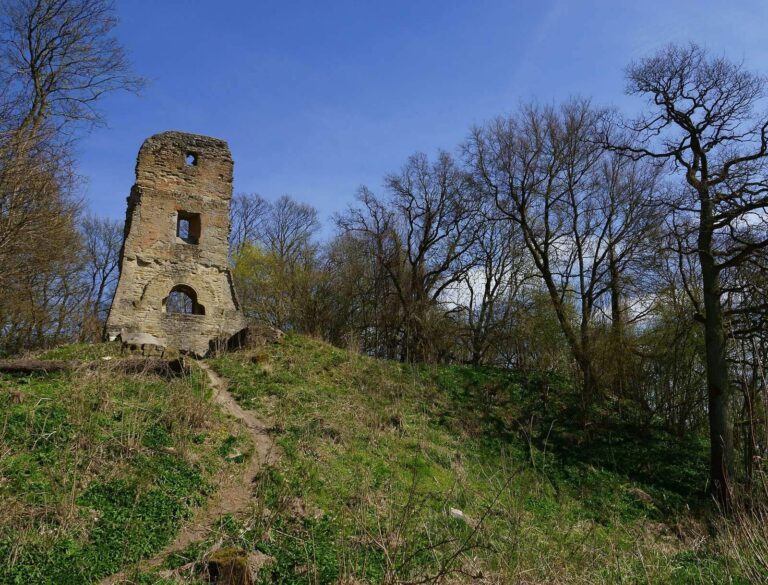
The castle’s original fabric included an enclosing wall of bossed ashlar, stone blocks with roughly dressed projecting faces, a round keep, the principal fortified tower, and a residential hall. Remains on the plateau include a double tower, a well, and sections of wall. A fragment at the northern corner of the main castle indicates that it had round corner towers.
Perimeter remains
A section of wall survives at the northeast short side of the perimeter buildings. On the southeast side, a projecting triangular pier remains.
Castle entrances
Northwest double-tower gate
A gate with two towers, built around 1430–1440, stood midway along the northwest side above the older enclosing wall. The towers projected almost as full circles. A bridge and drawbridge led to the entrance between them, with the round keep behind.
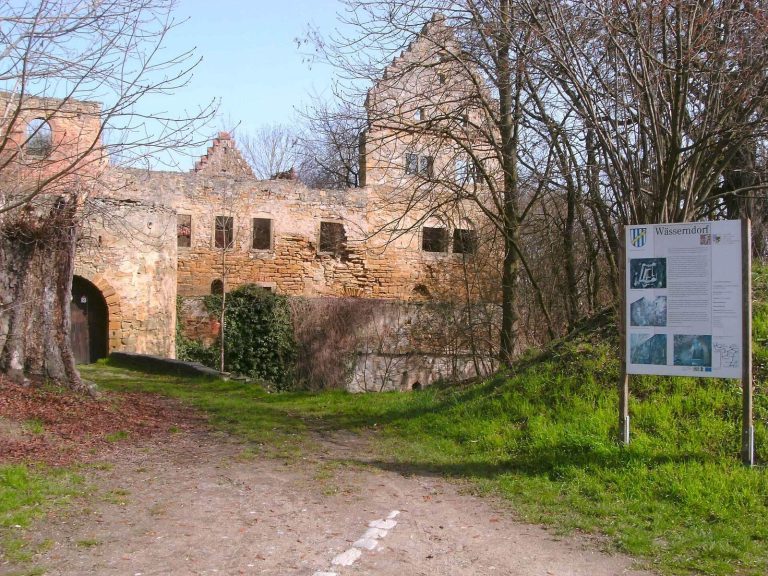
Southwest gatehouse
Between 1480 and 1488, the entrance was moved to the southwest side, where a gatehouse was built behind a narrow defensive passage. An inscription giving the date 1480 was once visible on the gatehouse.