D36: A Funnel Beaker Passage Grave in the Netherlands
Site at a Glance
- Popularity
- Very Low
- Country
- Netherlands
- Primary era
- Stone Age
- Eras represented
- Stone Age
- Civilizations
- Unclassified
- Site type
- Burial
- Remains
- Tomb
On this page6 sections
History
D36 is a passage grave south of Valthe in the Netherlands, assigned to the Western Group of the Funnel Beaker culture and dated to 3470–2760 BC. The Funnel Beaker culture was a Neolithic archaeological culture named for its distinctive funnel-shaped pottery; its Western Group is a regional classification. D36 and nearby D37 are known together as the Valther Twins.
Early records and protection
The tombs first appeared on the Hottinger map of 1788–1792. In 1822, Dutch antiquarian Nicolaas Westendorp described both and noted that people had dug into them. Leonhardt Johannes Friedrich Janssen, curator of Dutch antiquities at the Rijksmuseum van Oudheden, visited in 1847. The following year, he published an overview of Dutch megalithic tombs that included descriptions and simple plans.
In 1871, the province of Drenthe bought D36 and D37 from Valthe’s local communal landholding association. Three years later, Janssen’s successor Willem Pleyte and photographer Jan Goedeljee made a systematic photographic record of Drenthe’s tombs; Pleyte also produced lithographs from the photographs. In 1877, museum director Conrad Leemans visited D36 and D37, with plans prepared by Jan Ernst Henric Hooft van Iddekinge. Leemans’s report was not published.
Surveys and archaeological work
During the 1870s, concern in Britain that restoration in the Netherlands might alter the tombs’ original appearance prompted the Society of Antiquaries in London to commission a detailed survey. English antiquarians William Collings Lukis and Henry Dryden surveyed D36 on 19 July 1878, as part of their work on 40 tombs. Their report appeared later, when Drenthe archaeologist Wijnand van der Sanden published the work in 2015 and praised its quality.
Physician and amateur archaeologist Willem Johannes de Wilde recorded surviving Dutch megalithic tombs between 1904 and 1906, but his notes on D36 were lost. Dutch archaeologist Albert Egges van Giffen examined D36 and D37 in 1918. A small restoration of D36 followed in 1952.
After accidental digging in a protected area beside the tomb in 2011, the Groningen Institute for Archaeology investigated the area in 2012 with students and volunteers. They recovered 133 pottery sherds decorated with Funnel Beaker motifs and two baking plates, flat implements used for cooking. The work also revealed traces of buildings from the Funnel Beaker period and the Iron Age, the broad archaeological period following the Bronze Age. In 2017, photographs were used to create a three-dimensional record of D36 for an atlas of surviving Dutch megalithic tombs, through a project involving the province of Drenthe, the University of Groningen, and the Gratama Foundation.
Remains
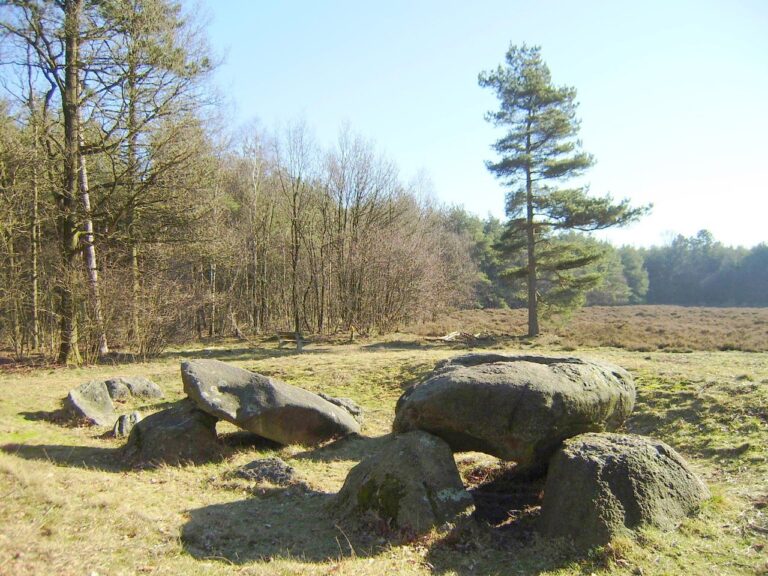
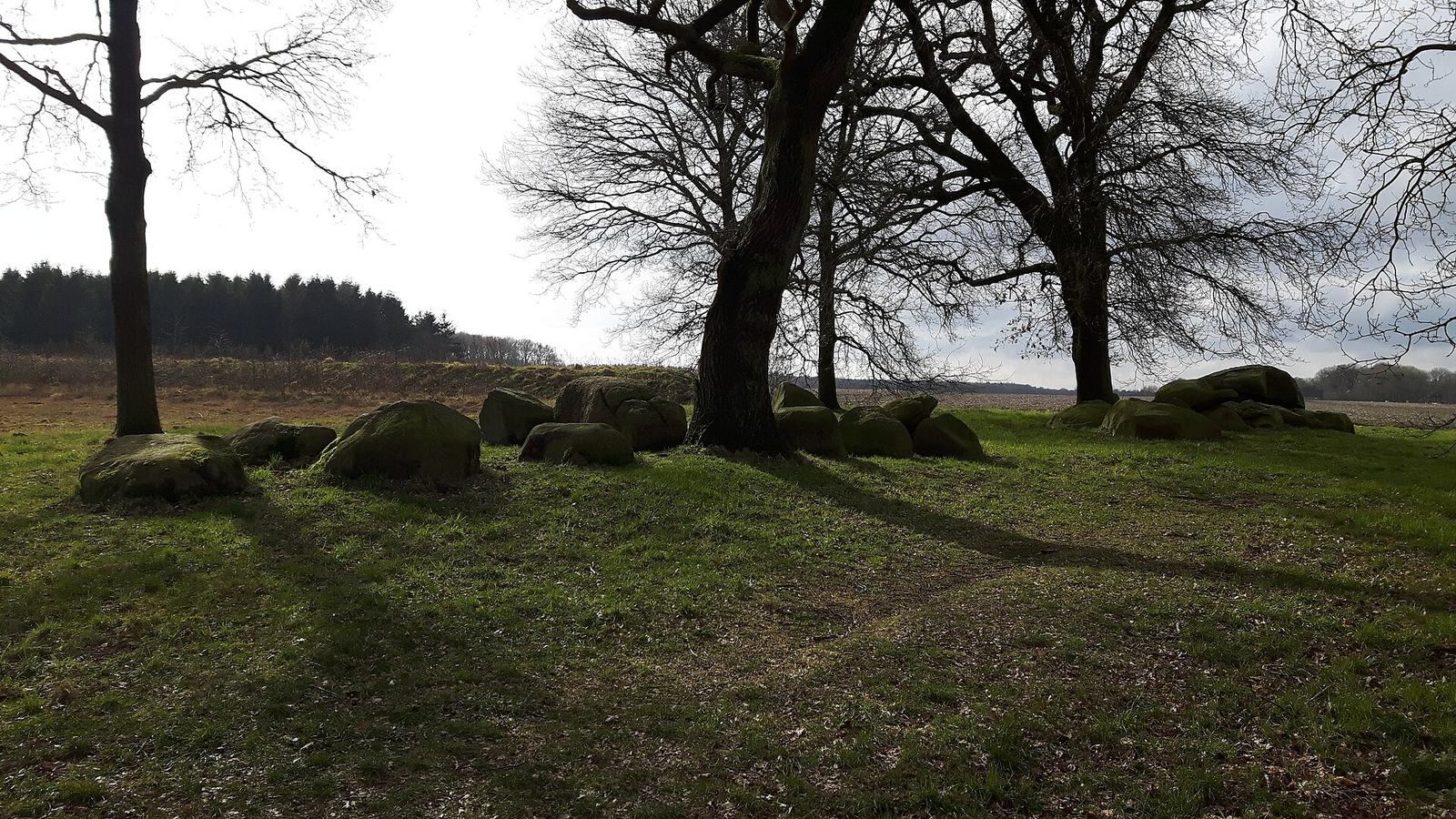
D36 stands at the edge of the Ooster esch, a traditional arable field in the northern Netherlands, and the Kampervenen marsh. It is aligned with D37, and both tombs have south-facing entrances. A prehistoric route probably passed close to D37, and the two tombs may once have shared a covering mound. D36 is oriented east-southeast to west-northwest.
Chamber and entrance
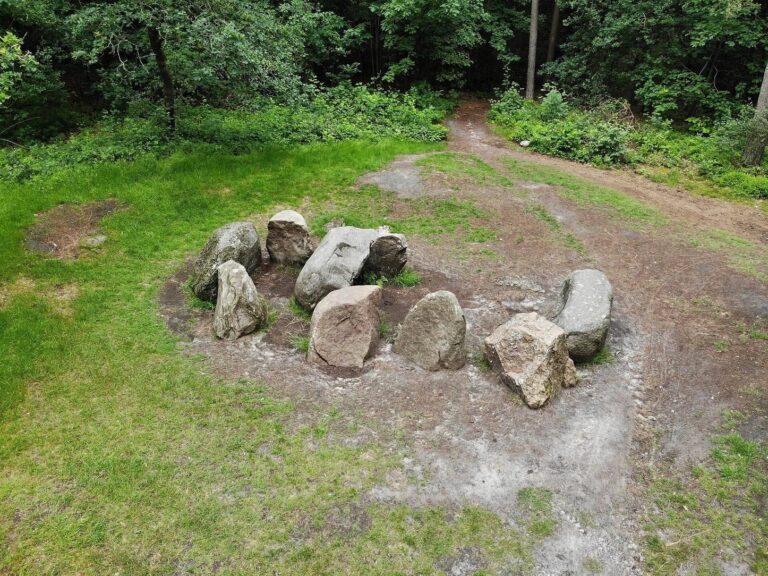
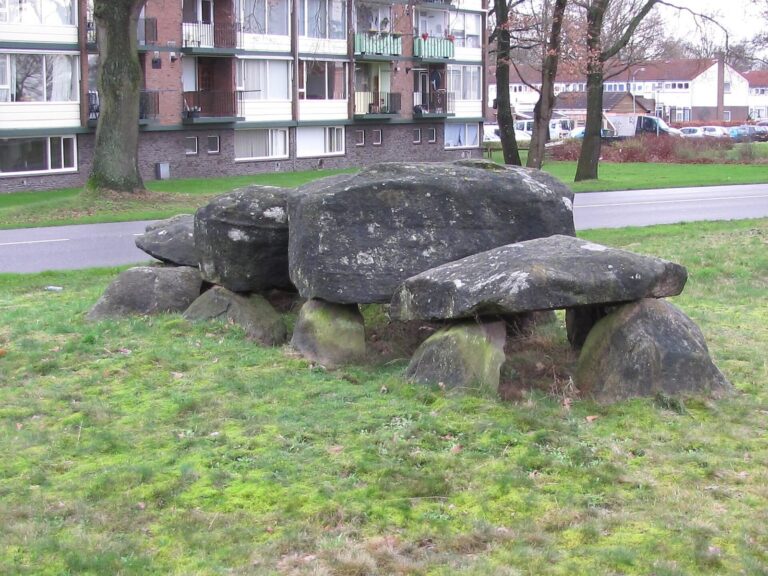
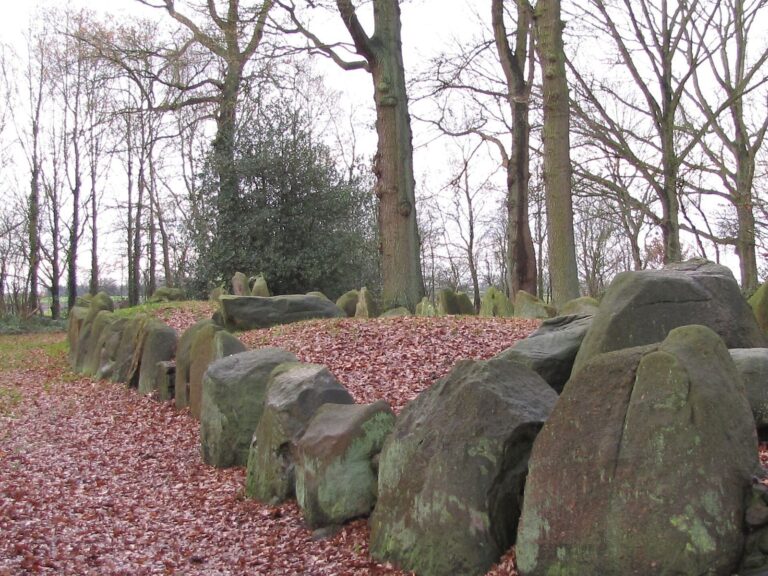
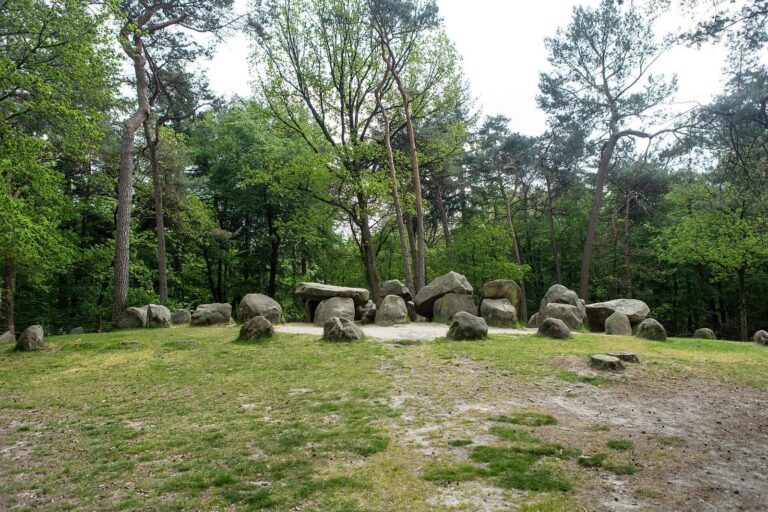
The chamber is 7.9 m long. Its original construction used five pairs of side stones, with an end stone closing each short end. Ten supporting stones and a portal stone remain. The entrance lies between the second and third stones along the southern side, counting from the east. One stone from the passage in front of the entrance survives.
Surviving stones
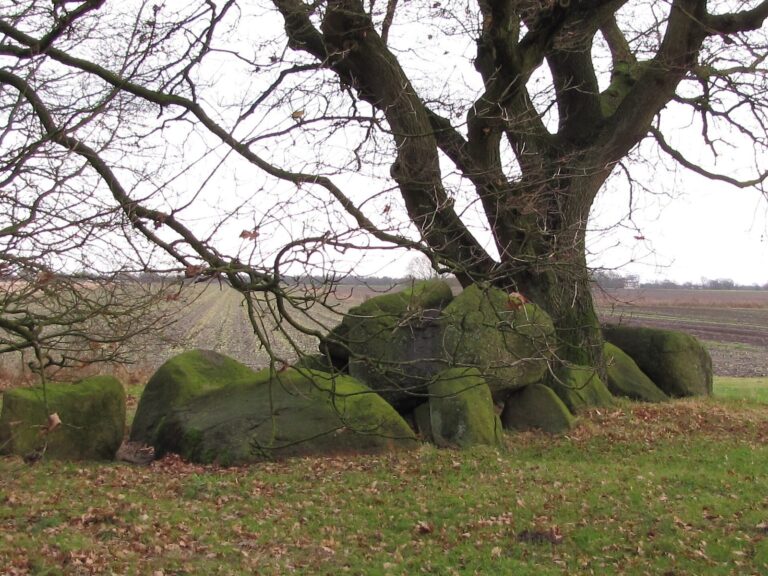
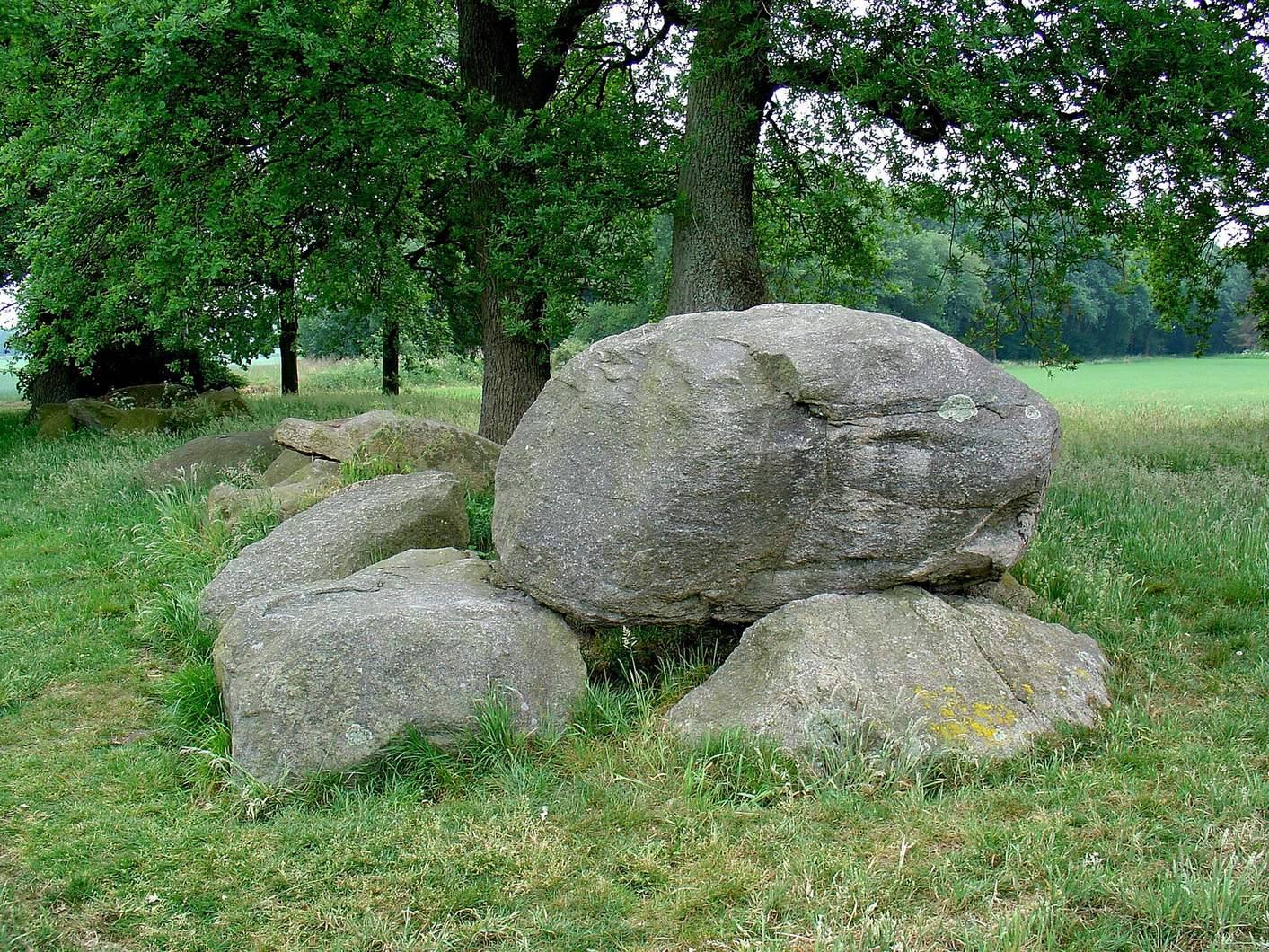
Four of the five original capstones survive. One lies outside the chamber, while three have slipped from their supports. Lukis and Dryden’s 1878 survey showed all five capstones, with the western one in place, three inside the chamber, and the eastern one on the structure’s north side. Two of the 11 supporting stones lay flat, and small oak trees partly obscured the tomb. Van Giffen described D36 as severely neglected and damaged, though the remains of its covering mound could still be made out. Both end stones remained in their original positions, and a broken capstone had drill holes.