Santa Caterina delle Ruote: A Gothic Oratory in Bagno a Ripoli
Site at a Glance
- Popularity
- Low
- Country
- Italy
- Primary era
- Medieval
- Eras represented
- Medieval
- Civilizations
- Republic of Florence
- Site type
- Religious
- Remains
- Chapel
On this page13 sections
History
Construction and early decoration
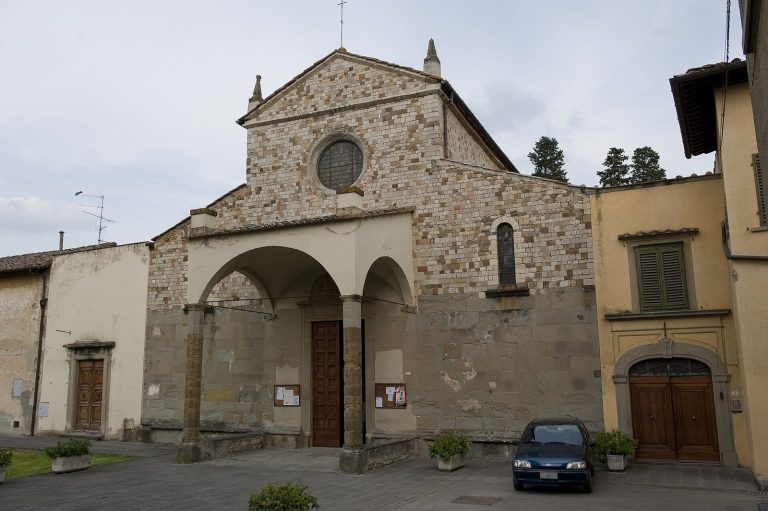
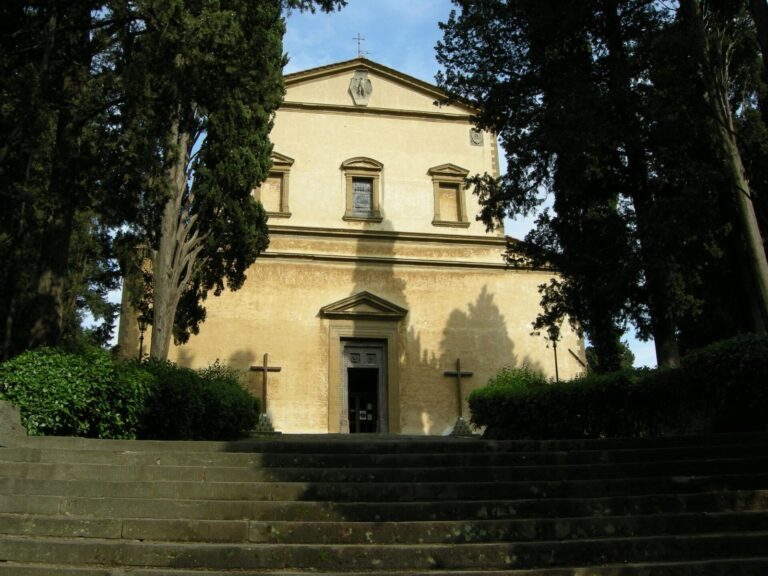
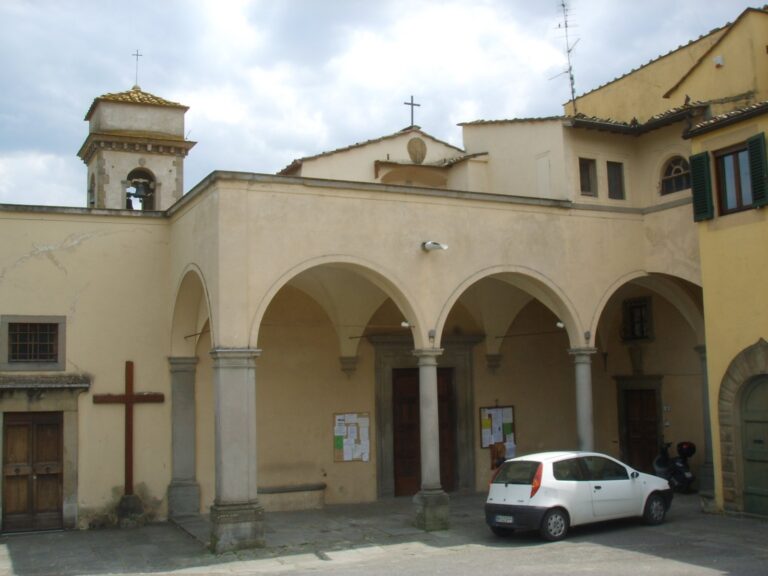
Santa Caterina delle Ruote is a Catholic oratory in Ponte a Ema, in Bagno a Ripoli, Italy, built by the Alberti family in Gothic style between 1348 and 1387. It is dedicated to Catherine of Alexandria, a Christian saint whose medieval legend associates her martyrdom with a wheel. The oratory belongs to the Archdiocese of Florence. The influential Florentine Alberti family also owned the nearby villa Paradiso degli Alberti.
The decoration developed in stages. The frescoes in the sanctuary recess were completed by 1360. Their principal painter is conventionally called the Master of Barberino, an art-historical name for an otherwise unidentified artist; Pietro Nelli also painted parts of the sanctuary decoration.
Late fourteenth-century fresco campaign
Work resumed in the late 1380s, about thirty years after the earlier campaign. Spinello Aretino painted the first bay of the oratory, continuing across its walls and other surfaces. The renewed decoration followed the will of Benedetto di Nerozzo Alberti, a wealthy and influential member of the family who, after political exile, directed that the work be completed.
Restoration and later history
The frescoes received an initial restoration in the nineteenth century, including repainting of the starry sky on the vaults. The original triptych by Agnolo Gaddi was stolen from the oratory in 1921 and later recovered. The Municipality of Bagno a Ripoli has owned the building since 1988 and carried out restoration from 1992 to 2009.
Remains
Plan and exterior
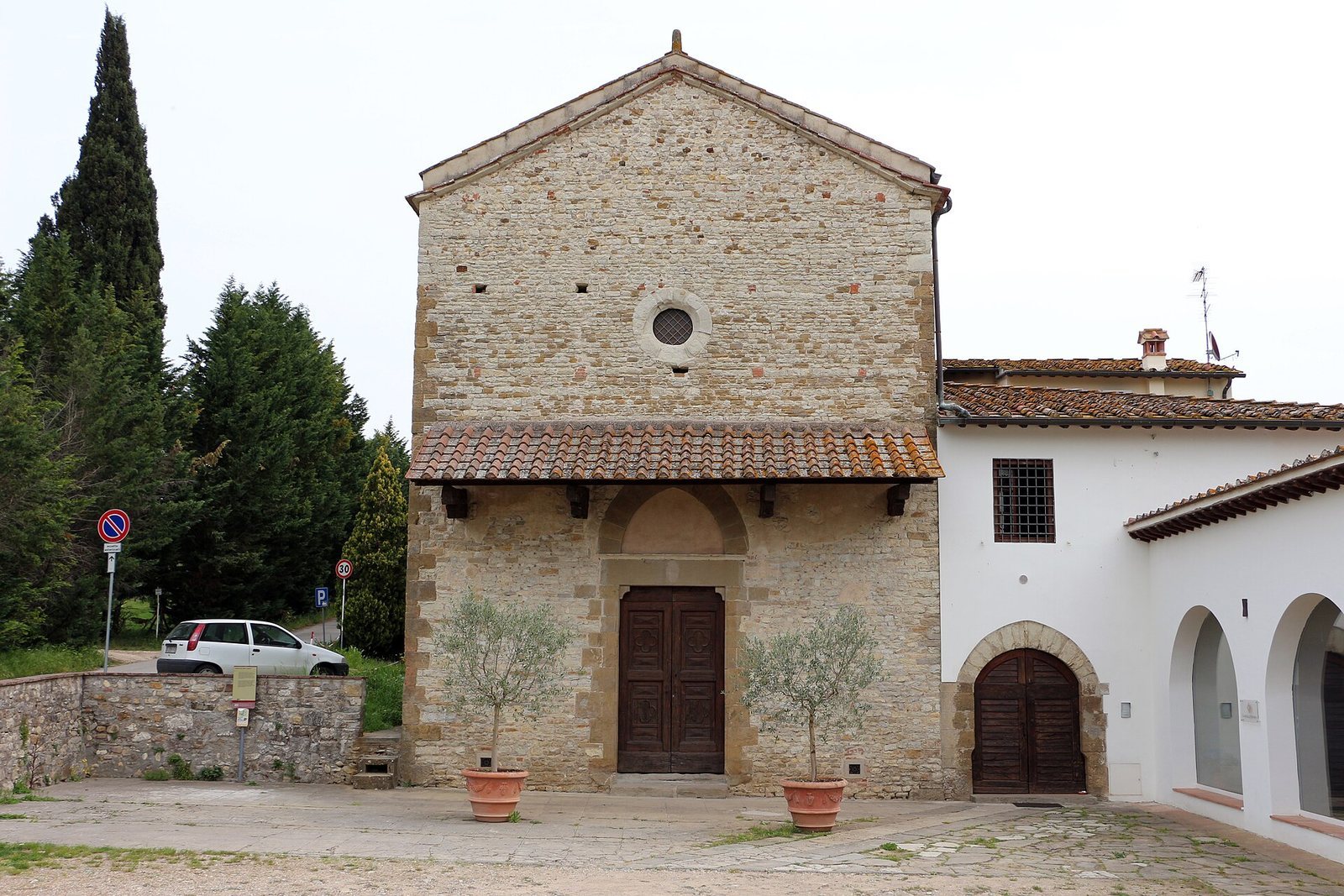
The oratory retains its Gothic structure, with a rectangular plan and a square-ended sanctuary recess. Its exterior is built from blocks of alberese limestone and macigno sandstone, materials used in Tuscan construction. The walls have windows with single openings and pointed arches. A projecting canopy shelters the entrance portal, whose semicircular upper panel once held a fresco of the Madonna and Child with angels by Spinello Aretino. The painting and its preparatory drawing were detached and are kept in storage by Italy’s public heritage-protection authority. The façade was once covered with frescoes.
Interior and painted decoration
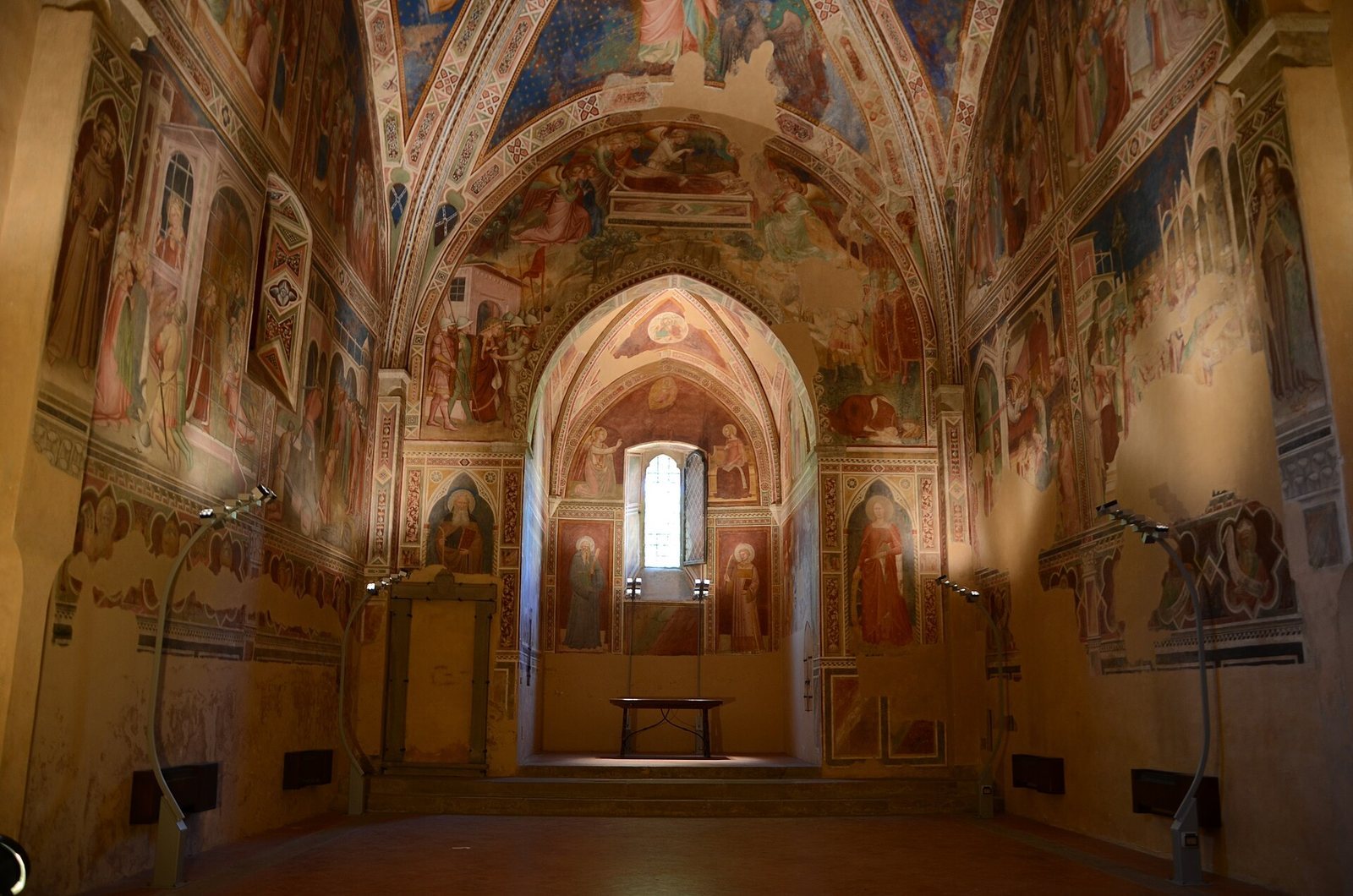
A single nave is divided into two bays by a transverse arch and ends in the sanctuary recess, framed by a pointed arch. The recess has four scenes on its side walls, arranged in two semicircular panels and two rectangular panels. A cross-vault covers it, while cross-vaults with ribs span the main space.
Sanctuary paintings
The sanctuary’s central wall bears an Annunciation, with Saints Benedict and Stephen beside the window. Its paintings also include the side-wall scenes of Catherine refusing to renounce her faith before the emperor, her flagellation and her martyrdom. The Master of Barberino painted these scenes, the central wall, the curved sections of the vault between its ribs, and the underside of the arch, where busts of Apostles and Prophets appear. Pietro Nelli painted the Disputation of Saint Catherine with pagan philosophers in the lower part of the left wall. He also painted Saint Catherine and Saint Anthony Abbot on the outer walls beside the sanctuary arch.
Right wall of the first bay
Spinello Aretino’s frescoes cover the first bay. On its right wall, upper scenes show Catherine’s conversion and baptism by a hermit monk. Below them, she prays, experiences a mystical marriage to the infant Jesus held by the Virgin, and is captured. In the capture scene, she is urged without success to worship a pagan idol in a temple.
Opposite wall of the first bay
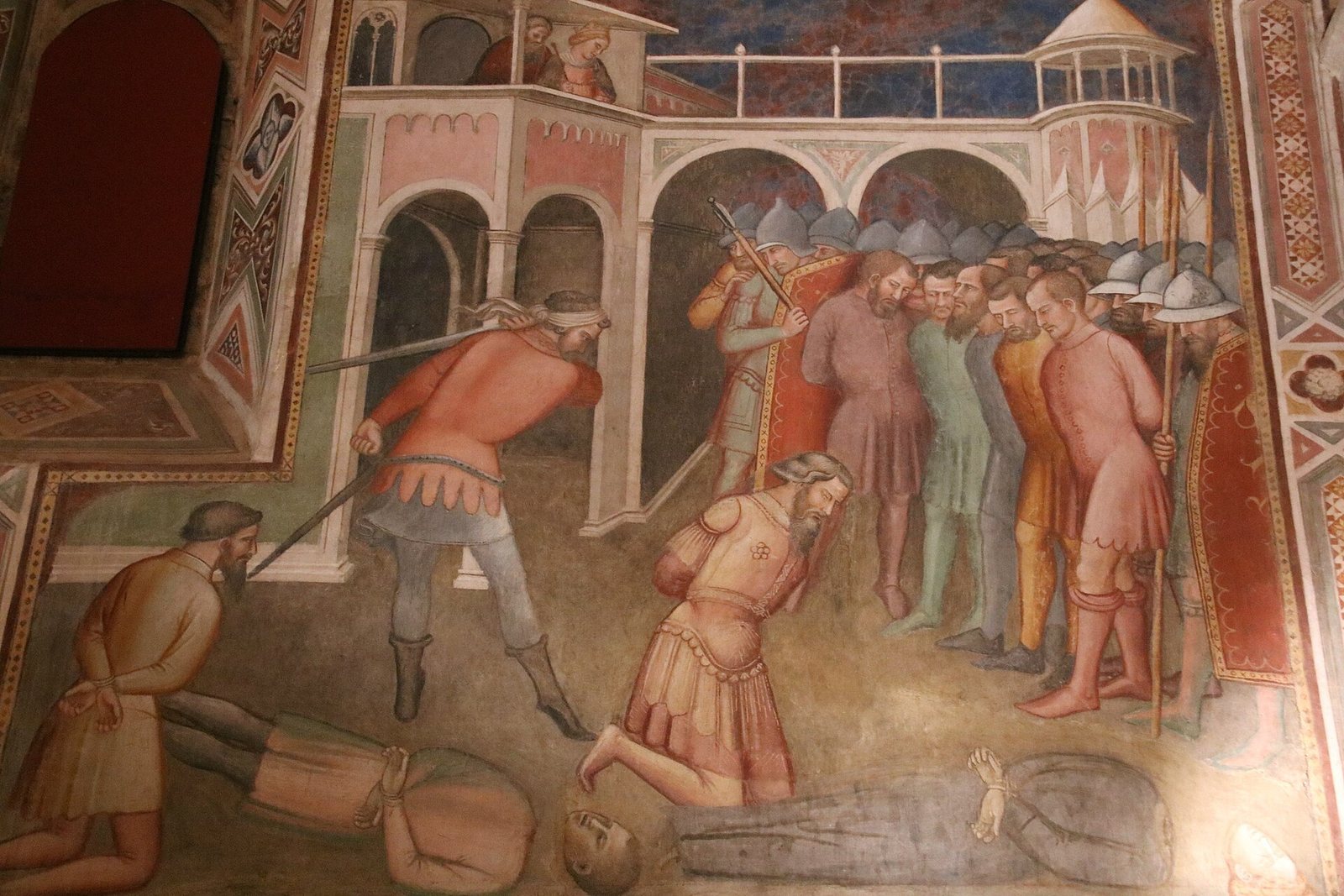
The upper scenes on the opposite wall show Catherine disputing with pagan philosophers and the converted sages being burned. The lower sequence depicts her converting court ladies and a captain of the soldiers while imprisoned, receiving Christ and angels, and the beheading of the head of the guards.
Central wall of the first bay
The central wall shows Catherine leaving prison on her way to martyrdom. In a continuous sequence, the executioner returns his sword to its scabbard after beheading her. Above, angels adore her body in a sarcophagus.
Vaults, arches and piers
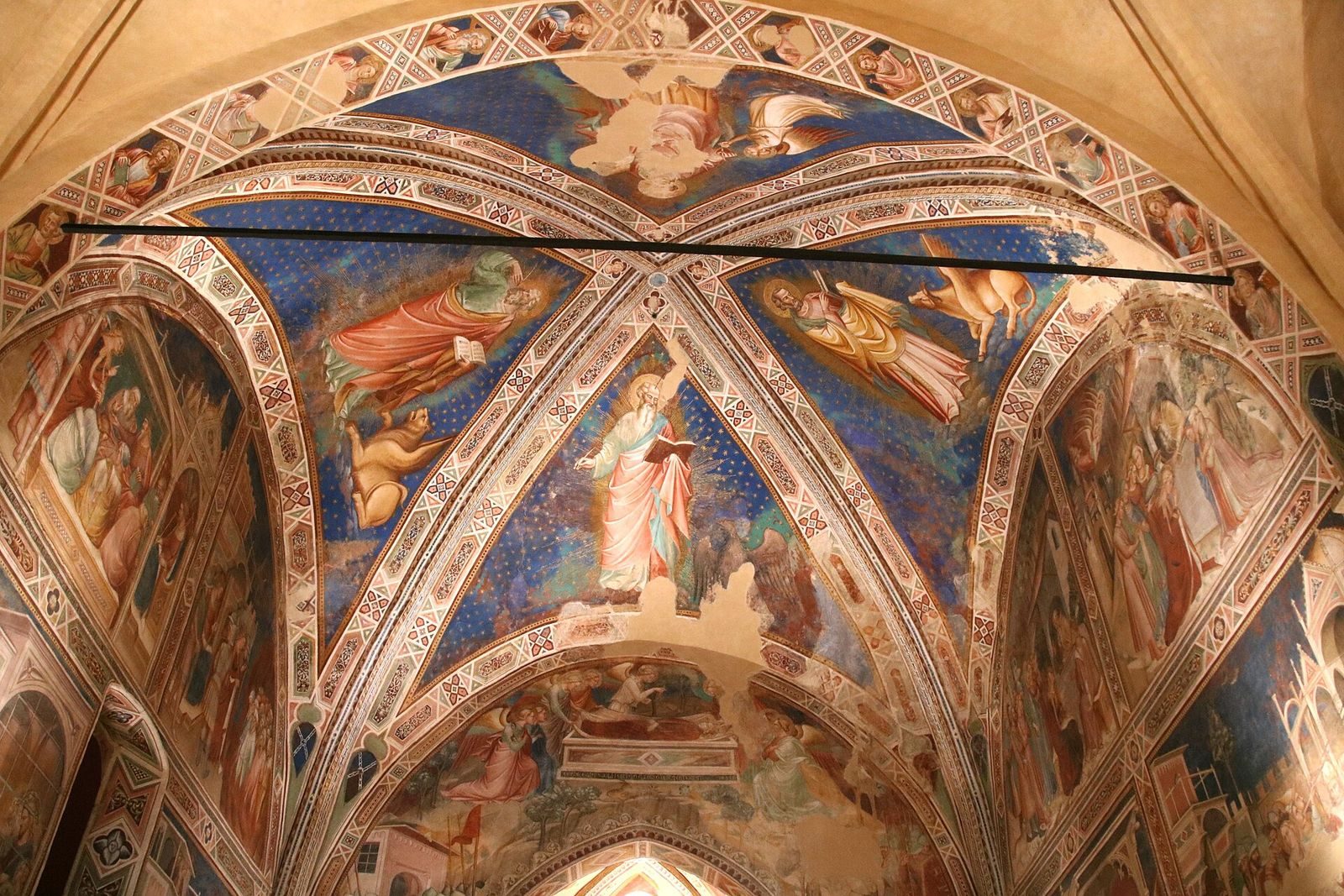
The first bay’s vaults carry figures of the four Evangelists. Medallions of the Twelve Apostles and the Mystic Lamb, a Christian image of Christ as a sacrificial lamb, decorate the arch underside between the bays. Painted niches on the side piers frame Saint Louis of Toulouse, a Franciscan bishop, on the right and Saint Francis of Assisi, founder of the Franciscan movement, on the left. Beneath the sanctuary arch, Saint Anthony Abbot, an early Christian ascetic associated with the origins of monastic life, and Saint Catherine of Alexandria flank the altar. Saints Benedict, a foundational figure in Western monasticism, and Stephen, venerated as Christianity’s first martyr, also appear in the sanctuary paintings. Alberti coats of arms recur across the decoration, each showing four branches of a chain joined by a ring on a blue field.
Altarpieces
The recovered triptych by Agnolo Gaddi, a three-panel altarpiece, is held in storage at the Uffizi, a major Florentine art institution. It lacks its predella, the lower row of panels, and small pilasters, shallow supports projecting from a surface. An Agnolo Gaddi polyptych, an altarpiece with multiple panels, was included in the exhibition held at the conclusion of the oratory’s restoration.