Spezzano Castle: A Medieval Fortress and Renaissance Residence in Italy



Site at a Glance
- Rating
- 4.4
- Popularity
- Low
- Country
- Italy
- Primary era
- Medieval
- External website
- Open
- Eras represented
- Medieval, Early Modern, Modern
- Civilizations
- Holy Roman Empire, Italian
- Site type
- Military
- Remains
- Castle
On this page14 sections
History
Spezzano Castle, also known as Rocca Coccapani, is a medieval fortress in Fiorano Modenese, Italy. It probably existed by the eleventh century, and its earliest known documentary mention appears in the 1225 Sacramentum Extimatoris, a register connected with Modena’s statutes, where it is named Castro Spezani. The castle protected the local population, watched for approaching enemies, and remained a defensive stronghold until at least the fifteenth century.
Medieval stronghold and Este control
The castle endured a fifteen-day siege on 19 May 1355, when forces of the Este family, numbering 2,000 cavalry and 1,000 infantry, attacked it. The Este were the ruling dynasty associated first with Ferrara and later with the duchy of Modena and Reggio. In 1393, Alberto V d’Este, marquis of Ferrara, granted Spezzano as a fief to Marco I Pio, lord of Carpi. After Alberto’s death later that year, his successor, Niccolò III d’Este, confirmed the grant to Marco I Pio in 1405.
During the early sixteenth century, Alessandro Pio di Savoia inherited the castle from his father, Giberto, lord of Sassuolo. He made Spezzano one of five administrative seats. This change reduced its importance as a military installation and increased its use as a political and administrative residence for the ruling lord.
Transformation into a Pio residence
Marco Pio began constructing a palace against the castle walls in 1529. By the end of the sixteenth century, Marco III Pio di Savoia had ordered the demolition of the chapel of Saint Agatha, reusing its materials in the palace. From 1594, he invested heavily in reshaping the complex as a residence appropriate to his political ambitions and the representation of his state.
This transformation included the creation of the Sala delle vedute and the Galleria delle battaglie. The Sala delle vedute expressed princely authority through views of the Pio family’s possessions in the five administrative districts, or podesterie, of Sassuolo, Spezzano, Formigine, Brandola, and Soliera. Its imagery also celebrated the consolidation of Marco Pio’s domains in Sassuolo and territories in Sabina obtained through his marriage to Clelia Farnese and fully available to him from 1595.
After Marco III Pio died in 1599, the castle passed to Cesare d’Este, duke of Modena and Reggio. It remained with the Este family until 1629, when the fief and castle passed to Marquis Guido Coccapani. Alfonso Coccapani, Guido’s son, formally took possession of Fiorano in June 1651. Spezzano remained the capital of the marquisate, while the castle housed the governor, podestà, or commissioner who represented the marquis in civil and judicial administration.
Coccapani rule and the end of public functions
Filippo Antonio Coccapani inherited the castle after Alfonso and held it from 1660 until his death in 1723. He commissioned a chapel dedicated to the Virgin Mary and, in 1699, an altar with an antependium by the Carpi artist Giammarco Mazzelli. Following Filippo Antonio’s death on 5 March 1723, his son Luigi retained the castle until 1755. Luigi was succeeded by his son Ludovico Coccapani, the last feudal lord of Spezzano.
In 1797, the castle received the designation “Rocca” or “National Palace.” Spezzano lost its autonomy in 1809 when it was incorporated into the municipality of Sassuolo, ending the castle’s remaining public functions. The complex then served exclusively as a Coccapani residence, leased from the royal state. Luigi Maria Coccapani regained ownership through a royal decree in 1811. Between 1862 and 1890, the Coccapani family carried out extensive restoration and enlargement works.
Public ownership and modern interpretation
Ownership passed to the Counts Pignatti Morano in the early twentieth century. The municipality of Fiorano Modenese purchased Spezzano Castle in 1982, making it public property. A late twentieth-century restoration uncovered the Galleria delle battaglie by removing plaster that had concealed its frescoes. The date and reasons for that concealment remain unknown, while archival research connected the gallery with the late-sixteenth-century transformation of the castle.
The gallery’s interpretation has changed. Earlier readings associated its scenes with the Italian Wars, including the battles of Polesella in 1509 and Ravenna on 11 April 1512. After a later redating based on archival research, the prevailing interpretation connected several scenes with episodes of the Hungarian War along the Danube, including Marco Pio’s fighting at Esztergom in 1595. Some scenes may also represent battles in Flanders in which Marco III Pio took part.
The castle’s cultural functions expanded further in the late twentieth and early twenty-first centuries. A ceramic museum opened to the public in July 1998 with a section dedicated to the earliest historical period. Five further sections were added to present ceramic production, labor, design, and the development of Italian-made products through the contemporary era. The historical section expanded in May 1999, the contemporary section has been updated since September 2004, and the labor section opened on 13 April 2014. In 2008, the municipality converted the former upper prison into a communal facility for producing traditional balsamic vinegar. Since 2005, the castle has also hosted annual October courses on tasting and introducing traditional balsamic vinegar.
Remains
Fortifications and entrance
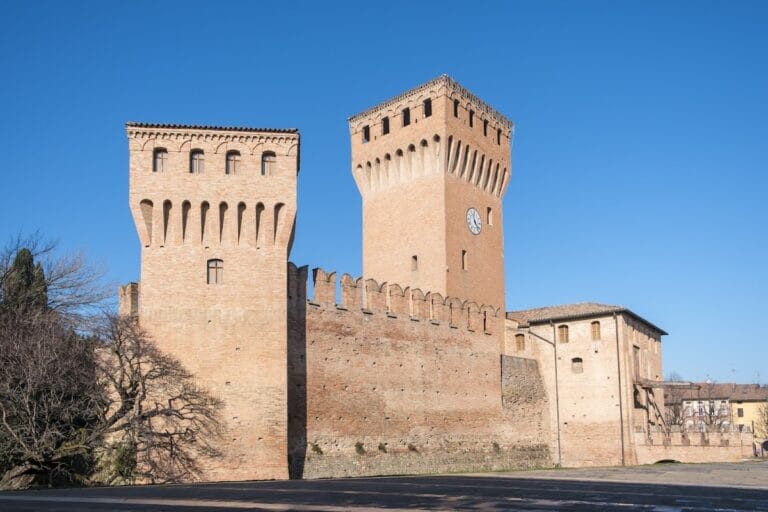
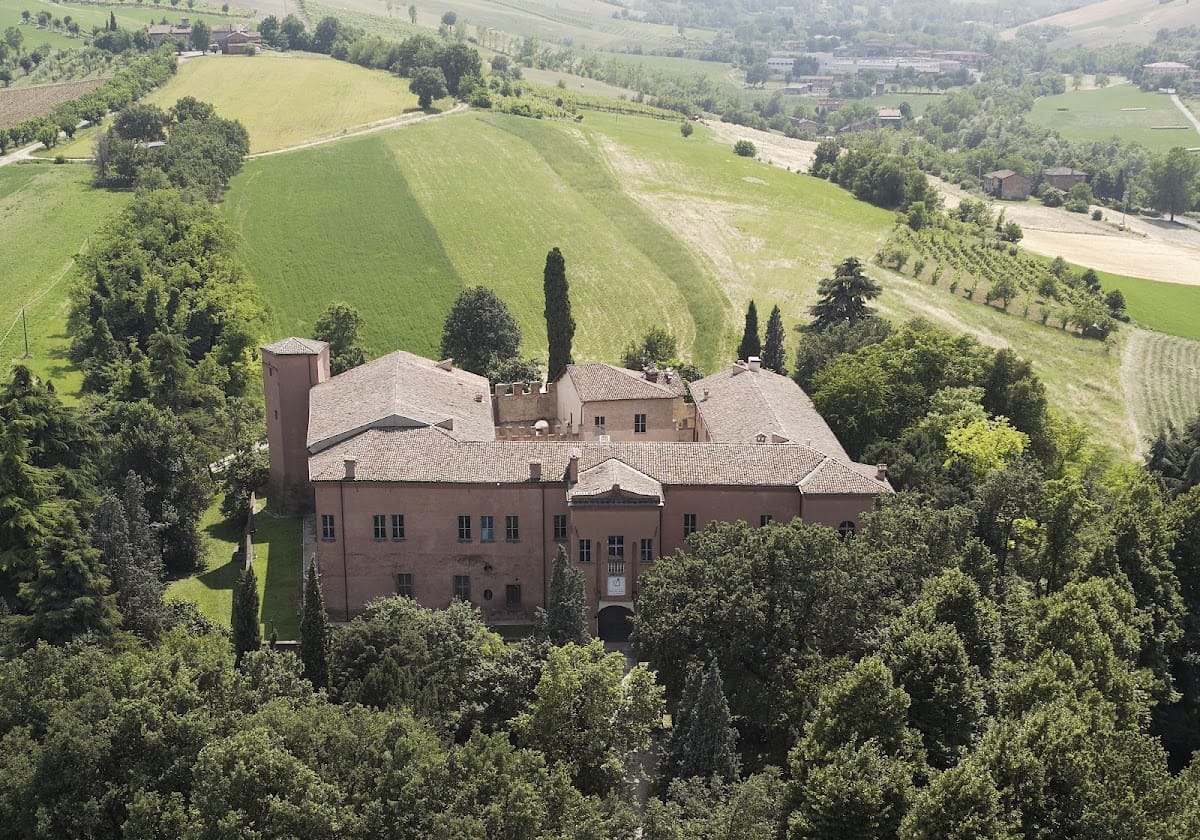
Spezzano Castle is a lowland fortress of brick masonry covered with plaster, standing at approximately 179 metres above sea level at the upper end of Via del Castello. The medieval complex comprised a keep, towers, a surrounding curtain wall, houses, a well, granaries, haylofts, storehouses, and the chapel of Saint Agatha. A moat was excavated in the fourteenth century. The entrance was surmounted by a tower and drawbridge; severe deterioration led to the drawbridge’s demolition and reconstruction in 1795.
Residential and civic interiors
Palace and Camera della Ragione
The palace built against the castle walls from 1529 became the principal residential and political-administrative part of the complex as its military role declined. Immediately inside the drawbridge entrance, on the left, is the Camera della Ragione. From 1629 it was used for meetings of the municipal council. In the early seventeenth century, the room contained two walnut desks, three chairs, and a large writing table. A locked chest held assessment registers, council minutes, law books, and records of expenditure and revenue.
Sala delle vedute
The Sala delle vedute is the largest room in the castle and occupies the ground floor. Its walls carry fifty-seven frescoed views arranged in three registers of lunettes and superimposed panels. They depict surrounding settlements as they appeared during the second half of the sixteenth century. Cesare Baglione probably painted the room for Marco Pio di Savoia in 1595–1596, using rapid brushwork to convey atmospheric depth, natural features, occasional animated figures, and buildings. The frescoes were restored in 1735 at the initiative of Marquis Luigi Coccapani, again in the nineteenth century, and once more in 1990.
Galleria delle battaglie
The Galleria delle battaglie occupies the first floor of the residential wing. Its Renaissance fresco cycle is divided into panels of varying sizes. Approximately 122 square metres survive from an original surface of 184 square metres. Worn cartouches, faces, coats of arms, and generic topographical references make the scenes difficult to identify. The style has been attributed to Giovanni Guerra and reflects the influence of Nicolò dell’Abate and Flemish art.
Prison tower and material collections
Pentagonal prison tower
Four prisons occupied the pentagonal tower at the south-eastern corner of the castle, with one cell on each floor. The prisoners carved inscriptions and other marks into the cell walls. Some of these remain visible after their discovery during restoration work at the end of the twentieth century. The highest former prison now contains three municipal barrel batteries, sequences of barrels used for the gradual maturation of traditional balsamic vinegar.
Ceramic museum
The ceramic museum combines original finds, reconstructions, and laboratories that illustrate changes in ceramic-production technology, working practices, design, and Italian-made products. Its historical section includes archaeological material from excavations conducted by Fernando Malavolti at Fornaci Carani in the 1940s. Four metres below the surface, the excavations revealed remains of a Neolithic settlement, including huts, landing places, hearths, flint tools, polished greenstone artefacts, and pottery.
The historical collections extend from the end of the Neolithic through the Roman era. The museum’s current section covers the period from the end of the Roman era through the prewar period and the 2000s, while the contemporary section is devoted to the years from 2000 onward. In the basement, the labor section occupies 300 square metres and contains historical materials and finds, objects, and machines, accompanied by an interactive multimedia presentation with films and audio recordings.