Krögelstein Castle Ruin: A Medieval Hilltop Castle in Germany
Site at a Glance
- Popularity
- Low
- Country
- Germany
- Primary era
- Medieval
- Eras represented
- Medieval, Early Modern
- Civilizations
- Holy Roman Empire
- Site type
- Military
- Remains
- Castle
On this page9 sections
History
The Krögelstein nobles and Bamberg rule
The free nobles of Krögelstein, a distinct medieval status group whose members could still have feudal ties, appear in records from 1149 to 1239. They may have been related to the Walpoten, another noble family. A castle probably stood here during their period, though its first written mention came in 1328. After the Krögelstein family line ended in the mid-13th century, the castle passed to the Bamberg prince-bishopric, the territory governed by the prince-bishop of Bamberg.
In 1313, Bishop Wulfing von Stubenberg pledged the castle to the Bamberg cathedral chapter, the body of clergy responsible for the cathedral and its institutional affairs. Bamberg officials, who managed the territory, administered it mainly from 1400. The von Aufseß family held it later, followed by the von Giech family.
The Giech family and the castle’s destruction
On 17 October 1500, Prince-Bishop Heinrich III Groß von Trockau recovered the castle from the cathedral chapter and granted it to Dietz von Giech as a male-line fief, a grant inheritable through male heirs. Georg Wolf von Giech was married to Ottilie von Absberg, the sister of the robber knight Hans Thomas von Absberg. Georg Wolf often sheltered Hans Thomas at the castle. The Swabian League, an alliance of political and territorial powers in southwestern Germany, captured and burned it on 4 July 1523. It was not rebuilt.
The castle chapel and parish church
The parish church began as the castle chapel around 1250 and had served the parish since 1421. Georg Dietrich von Giech zu Wiesentfels, Niederlind and Krögelstein was responsible for its present form. He died on 26 July 1607.
Remains
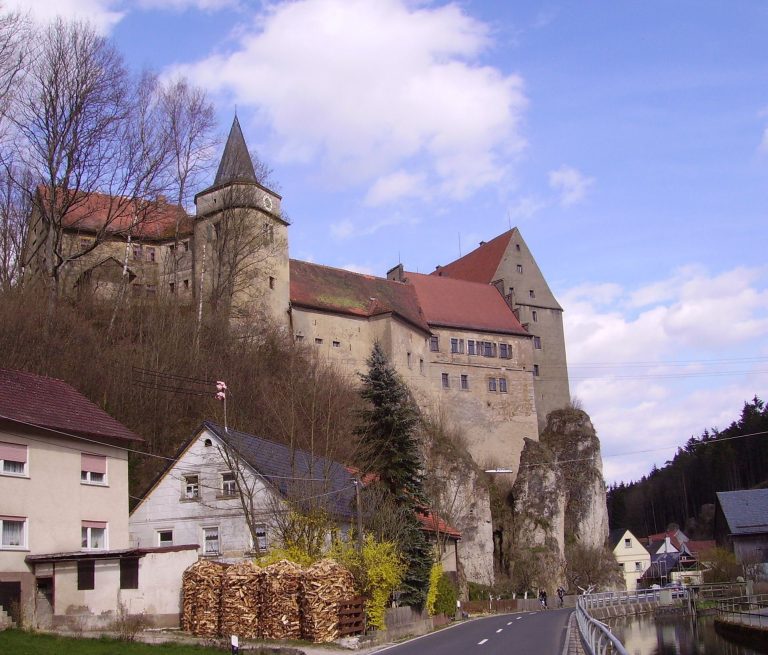
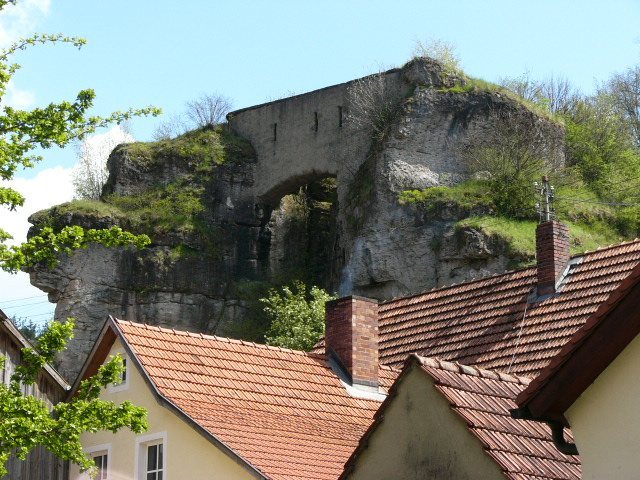
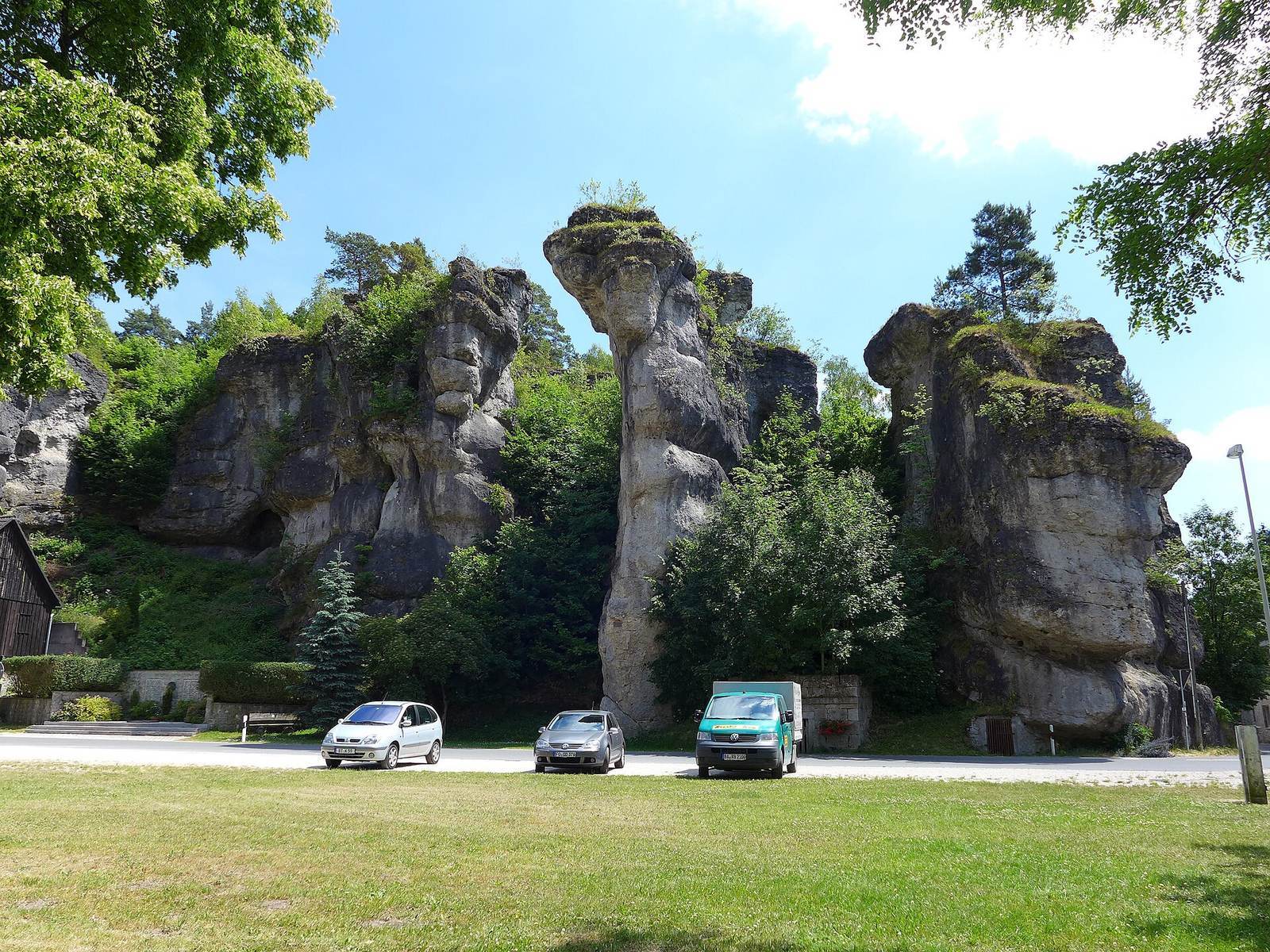
The castle occupied a rocky spur above Krögelstein in the Kaiserbach valley. Its surviving fabric stands on a dolomite outcrop west of the parish church, while a woodcut provides a view of the former complex and its setting.
Surviving features and visual record
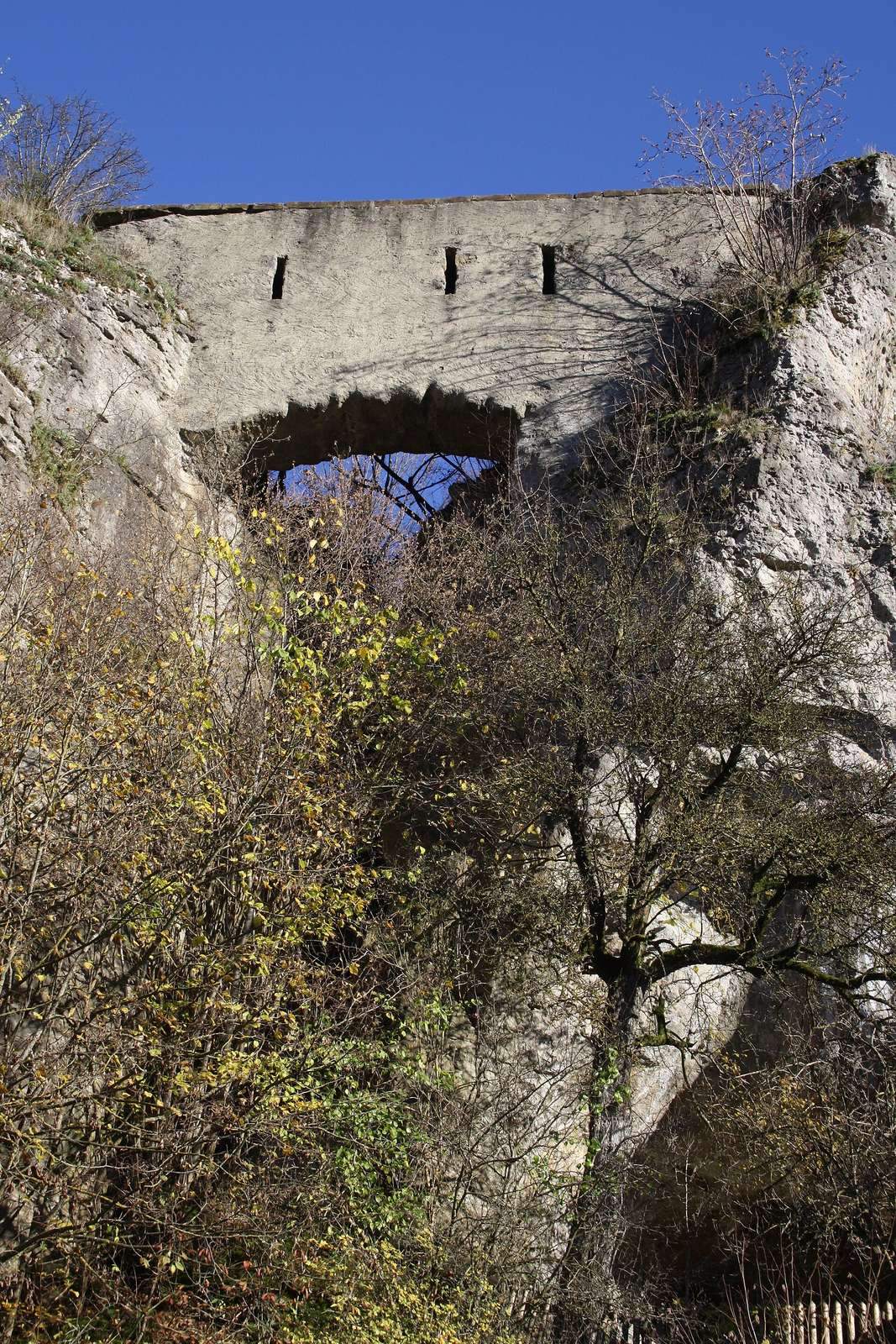
Castle arch
A spanning arch is the surviving castle structure on the rocky outcrop. It contains three narrow window slits.
Parish church
The church contains a bronze memorial to Georg Dietrich von Giech. A keystone dated 1607 bears the Giech family coat of arms and is set in the vaulted ceiling over the choir.
Wandereisen’s woodcut
Hans Wandereisen accompanied the Swabian League’s 1523 punitive expedition as a war correspondent and recorded castle destructions in woodcuts. His image of Krögelstein shows a substantial complex with timber-framed upper floors and a tower topped by four projecting bay windows. League troops carry fuel into the burning castle, while mercenary infantrymen and mounted captains appear nearby. In the valley, the image depicts scattered timber-framed houses, some built against rock formations, and marks the church area with a cross and a memorial post.