Schloss Freienfels: A Baroque Castle in Hollfeld, Germany

Site at a Glance
- Rating
- 4
- Popularity
- Very Low
- Country
- Germany
- Primary era
- Early Modern
- Eras represented
- Medieval, Early Modern
- Civilizations
- Holy Roman Empire
- Site type
- Domestic
- Remains
- Castle
On this page10 sections
History
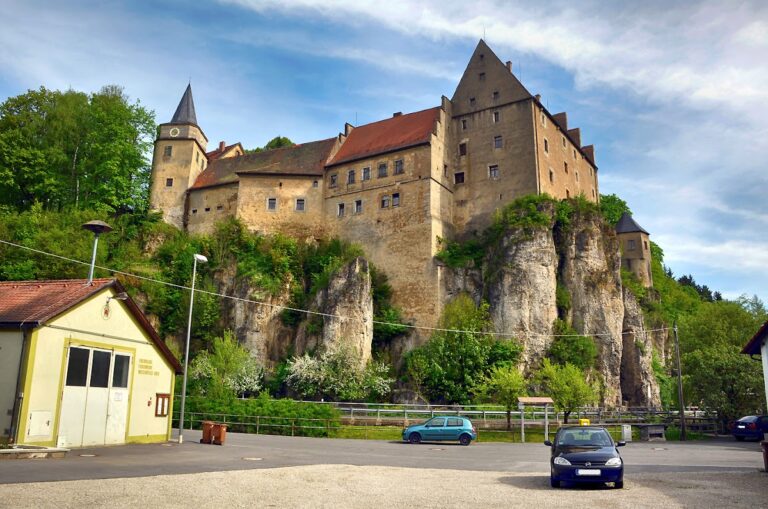
Schloss Freienfels is a Baroque castle complex in Germany, beside the Wiesent in Freienfels, a district of Hollfeld. Built by the von Aufseß family, the present castle dates from 1693 to 1701 and stands on the foundations of an earlier hilltop stronghold. Freienfels held an unusual legal position among the seats of the Wiesent valley because it stood on free land and was subject directly to the emperor and the Holy Roman Empire rather than to an intermediate territorial ruler.
Medieval origins and status
The original castle was established by the barons von Aufseß as their second ancestral seat. Tradition connects its construction with the knight Otto von Aufseß, who lived from 1296 to 1338, and therefore places the foundation in the early fourteenth century. The castle first appears in written records in 1342. A period of family ownership described as lasting 587 years ended in 1867, a span that has also been used to associate the family’s presence with origins around 1280.
Freienfels was distinguished by its direct relationship with the emperor and the Empire. In the language of the period, this was imperial immediacy, a status that placed a territory or lordship under the emperor without an intervening territorial ruler. The castle’s position on what was called “free ground and soil,” or a free rock, gave it a special standing among the fortified seats along the Wiesent.
Destruction and wartime occupations
During the Peasants’ War, the widespread uprising of 1525 against aspects of lordship and rural burdens, insurgent peasants attacked Freienfels in the spring and destroyed it by fire. Knight Pankraz von Aufseß then rebuilt the castle.
Freienfels was drawn into the military upheavals of the Thirty Years’ War, the European conflict of 1618 to 1648 that combined dynastic, territorial, and religious struggles. In 1628, Jakob Siegmund von Schaumburg and Eppenau, the bailiff of Hollfeld, stormed the castle on the claim that its fief had reverted to its superior. A fief was property held from a superior in return for obligations. Four years later, the Redwitz preceptor Heberer captured Freienfels and transferred it to a Swedish commissary. Swedish and Bamberg forces then occupied the castle alternately until the war ended.
Baroque rebuilding
Disputes within the von Aufseß family eventually allowed the Bamberg Prince-Bishopric to take possession of the castle and manor in 1672. This was an ecclesiastical principality in which the bishop of Bamberg exercised both religious and territorial authority. In 1681, the sons of Hans Wilhelm von Aufseß sold Wüstenstein Castle to the margrave. They used the proceeds to redeem Freienfels, recovering it from another holder, and received it again as a fief from the Bamberg bishop.
Carl Siegmund, Baron von Aufseß, who was a canon of Bamberg and Würzburg, bought the castle in 1690. A cathedral canon was a member of a cathedral chapter. By then, the medieval complex had largely fallen into decay. Carl Siegmund demolished it and commissioned the present Baroque castle, which was erected on the medieval foundations between 1693 and 1701.
Ownership after 1867
In 1867, the von Aufseß family sold the estate, measuring about 120 Tagewerk, to the Counts of Giech while retaining the castle. A Tagewerk was a historical regional unit of land area. Later that year, the family sold the castle, three Tagewerk of wasteland, and the Kreuzerwinkel field to Gustav Rewald of Halle for 1,500 gulden. This began a succession of further ownership changes that continued until 1966.
After Rewald died, his widow sold Freienfels in 1871 to Gustav Toepke of Magdeburg for 26,000 gulden. Toepke sold it three years later to Oskar Leonhard Hesse of Loschwitz for 135,000 marks. Wendler, a cathedral provost of Leipzig, acquired it in 1876 for 120,000 marks. In 1887, Ernestine, the wife of Hermann Baron von Aufseß, purchased the castle as a Christmas present for 25,000 marks.
After Ernestine’s death in 1911, an inheritance settlement transferred the Freienfels property to Eckardt Baron von und zu Aufseß. In 1912, he demolished the northern park wall and sold the mill with its associated water rights. The sale removed what was described as the most valuable part of the estate.
Twentieth-century changes
On 31 October 1918, Eckardt von und zu Aufseß sold the property to Arno Scheunert of Munich. Scheunert resold it on 8 July 1920 to Joseph Ferdinand Count von Spreti and his wife Paula. They sold it on 21 April 1921 to Edmund Meinel von Tannenberg of Tannenbergsthal in the Saxon Vogtland, a manufacturer and Privy Councillor of Commerce.
Meinel von Tannenberg restored the castle between 1921 and 1926 and furnished its rooms with historically styled furniture. A supporter of Gustav Stresemann and a member of the Saxon state parliament, he erected a monument to Stresemann in the park in 1930. Stresemann was a German statesman who served as foreign minister and received the Nobel Peace Prize in 1926. The monument commemorated his political role and his association with German foreign policy.
In 1941, Meinel von Tannenberg, who was seriously ill, sold the castle for 350,000 marks to the asset-management company of the German Labour Front in Berlin. The German Labour Front was the Nazi-era organization that replaced independent trade unions and administered labor-related assets. The purchase price was never paid, because the contract provided for settlement with Reich Treasury bonds after a victorious end to the war. Meinel von Tannenberg had established a regional Nazi training institution, known as a Gau school, for political Wehrmacht personnel.
After the war ended in 1945, American military personnel occupied the castle. An incomplete loss list dated 27 May 1947 states that American soldiers used a Buddha figure in the library for target practice. Through legal succession, the State of Bavaria became the owner on 2 March 1949, together with many other state properties in Bavaria. The heirs of Meinel von Tannenberg sought the return of the castle because the 1941 purchase price had not been paid, but the Bavarian state asset administration prevailed after a six-year legal dispute.
The Free State of Bavaria sold Schloss Freienfels to the Roß family in 1966. Since 2013, it has belonged to the Badenheuer-Weiss family, whose members are descendants of the von Aufseß family. Extensive restoration has taken place, and the planned long-term use is a museum of Christian art containing a collection associated with Grete Badenheuer, a master of liturgical vestments.
Remains
Castle and chapel
The surviving Schloss Freienfels is a Baroque complex beside the Wiesent. Its construction between 1693 and 1701 followed the demolition of the medieval hilltop castle, but the newer building retained the earlier foundations. The interiors contain stucco work by Franz Jacob Vogel, a court stucco artist at Bamberg. This decorative work forms part of the castle’s surviving Baroque interior finish.
The former castle chapel now serves as a Catholic parish church. Its stucco decoration bears the von Aufseß coat of arms, while tomb monuments carry heraldic arms. These elements preserve the connection between the religious space and the family that established Freienfels as an ancestral seat.
Park and former estate features
The castle complex included a large park. Its northern boundary changed in 1912, when the northern park wall was demolished, and the park has increasingly become overgrown. The former estate also included a mill and associated water rights. Eckardt Baron von und zu Aufseß sold the mill in 1912, separating this part of the estate from the castle property.
A monument to Gustav Stresemann once stood in the park. Erected by Edmund Meinel von Tannenberg in 1930, it carried a plaque with Stresemann’s likeness, his dates of 1878 to 1929, and the dedication date of 10 May 1930. The plaque commemorated him as Reich Foreign Minister and a pioneer of German freedom. The monument was probably removed after the castle was sold in 1941.
Library and artworks
A Buddha figure stood in the castle library after the Second World War. American soldiers used it for target practice, and its subsequent survival is uncertain.
Meinel von Tannenberg had acquired The Tower of Babel, a painting made in 1595 by the Dutch painter Paul Bril. The state removed the painting from Schloss Freienfels before the 1966 sale. It is now held at the Marienberg Fortress in Würzburg.
Nearby sites