Château de Domfront: A Medieval Fortified Castle in France


Site at a Glance
- Rating
- 4.5
- Popularity
- Medium
- Country
- France
- Primary era
- Medieval
- Eras represented
- Medieval
- Civilizations
- Norman
- Site type
- Military
- Remains
- Castle
On this page15 sections
History
Château de Domfront is a former fortified castle in France, founded in the early eleventh century by the Bellême family during the medieval period. Around 1010 to 1020, Guillaume I de Bellême probably established an initial timber fortification on the western end of a sandstone ridge. By granting privileges, he attracted people to the settlement and helped found the town of Domfront. The castle commanded the southern marches of the Duchy of Normandy, the medieval territory ruled by the dukes of Normandy, and became a major part of the duchy’s southern defence against possible attacks from Anjou.
Bellême rule and Norman conquest
The fortress became involved in the revolt of the Bellême counts against Norman authority. Duke Robert I of Normandy besieged it and starved its defenders. After the Battle of Val-ès-Dunes, a conflict that strengthened William the Conqueror’s position in Normandy, the castle was held by Guillaume II Talvas of Bellême and occupied by forces of Geoffrey Martel, count of Anjou. William the Conqueror besieged and captured it in 1049. The garrison had resisted the duke for fifteen months before surrendering after Alençon fell.
In 1092, the people of Domfront rebelled against Robert II of Bellême and transferred their allegiance to Henri Beauclerc, also known as Henry I of England. Robert attempted to recover the castle but failed. Following his defeat and capture at Tinchebray in 1106, Henri made Domfront one of Normandy’s frontier defences. He replaced the earlier Bellême citadel with a large stone keep in the Romanesque style, a medieval architectural tradition marked by heavy masonry and limited openings.
The Anglo-Norman and Plantagenet stronghold
After Henri Beauclerc died in 1135, Geoffroy Plantagenêt, count of Anjou and later duke of Normandy, conquered Normandy from Étienne de Blois. Henri’s daughter and legitimate heir, Mathilde, also known as Empress Matilda, frequently resided at Domfront during the struggle for the English throne.
The castle later became closely associated with the Plantagenet rulers. In 1162, Aliénor d’Aquitaine gave birth there to her daughter Aliénor. In 1166, Henri II Plantagenêt, king of England and duke of Normandy, made his testament at Domfront while ill and arranged the division of his territories among his sons. In August 1169, he received papal legates who sought to reconcile him with Thomas Becket, the archbishop of Canterbury whose conflict with the king had created a major dispute between the English crown and the Church. Henri remodelled the stronghold in 1180 and held his Christmas court there in 1185. His son Richard Cœur de Lion, Richard I of England, spent his last Christmas at Domfront in 1198.
French royal control and medieval ownership
After Richard’s death in 1199, the town and castle became part of the struggle between supporters of Bérengère and Isabelle d’Angoulême. Gautier de la Ferrière defended the castle for Richard’s brother against Arthur, who was supported by Philippe Auguste, or Philip II of France. Guillaume de Barres and Rainaud, Count of Boulogne, also besieged the town in support of Bérengère.
Domfront was the personal possession of Jean sans Terre, or John, king of England, until Philippe Auguste captured it in 1204 during the annexation of Normandy to the French royal domain. The king first granted the castle to Renaud de Dammartin, Count of Boulogne, and later to Philippe Hurepel. When Jeanne de Clermont, Hurepel’s heir, died in 1251, Domfront returned to the royal domain.
In 1259, Louis IX granted Domfront to Robert II, Count of Artois, as his wife’s dowry. After Robert’s death in 1302, Robert III of Artois received the Norman inheritances and appanages in 1309, following a dispute with his aunt Mahaut. These possessions were confiscated in 1332. In 1342, Philippe VI of France ceded the Domfrontais to the Count of Alençon, who united the viscounty of Domfront with the County of Alençon in 1367.
War, restoration, and destruction
Military conflict continued to shape the castle. In 1356, troops of Charles II of Navarre, commanded by Robert Knolles, captured the stronghold and held it until 1366. Pierre II renovated the castle in 1382, and the work helped it resist attacks by the Duke of Burgundy in 1412, when Domfront was held for the Armagnac faction. The Armagnacs and Burgundians were rival political and military groups during the French civil conflicts of the early fifteenth century.
English forces besieged the castle during the winter of 1417 to 1418. Clément Bigot defended it for eight months before surrendering to Richard Beauchamp on 10 July 1418. Henri V of England then entrusted the stronghold to Edmond Mortimer. The town was raided in 1430, but the French did not retake the castle until 2 August 1450, fifteen days before Cherbourg. Domfront was among the last English-held places in Normandy to fall.
Ownership was disputed again in 1466 and 1467 during the Revolt of the Public Weal, an uprising by powerful princes against the authority of the French king. During the Fifth War of Religion, the Calvinist brothers Le Hérissé seized the keep by surprise in 1574 and opened the gates to Gabriel I, Count of Montgomery, a Protestant commander and distant descendant of the Bellême family. Royal forces under Jacques II de Goyon, Marshal of Matignon, arrived on 9 May, followed by artillery reinforcements ten days later. Montgomery surrendered on 26 May and was beheaded in Paris on 26 June on the queen’s orders.
The stronghold eventually submitted to Henri IV. In 1598, the king ordered the castle to be demolished and the town’s fortifications partly dismantled. Sully ordered the dismantling again in 1608, and the demolition was carried out in 1610. The fortified Romanesque priory chapel of Saint-Symphorien was probably ruined as a consequence. The castle experienced thirteen recorded sieges between 1058 and 1593, including attacks by Geoffrey Martel, William the Conqueror, Henri Beauclerc, Geoffroy Plantagenêt, Philippe Auguste, Burgundian and English forces, Charles VII’s army, and the Marshal of Matignon.
Restoration of the ruins has taken place since 1984 under the Association for the Restoration of Château de Domfront. The keep ruins were listed as a French historic monument in 1875. Protection extended in 1986 to the enclosing walls, ramparts, towers, projecting defensive structures, vaulted fortified spaces, and the former Sainte-Catherine and Saint-Symphorien chapels.
Remains
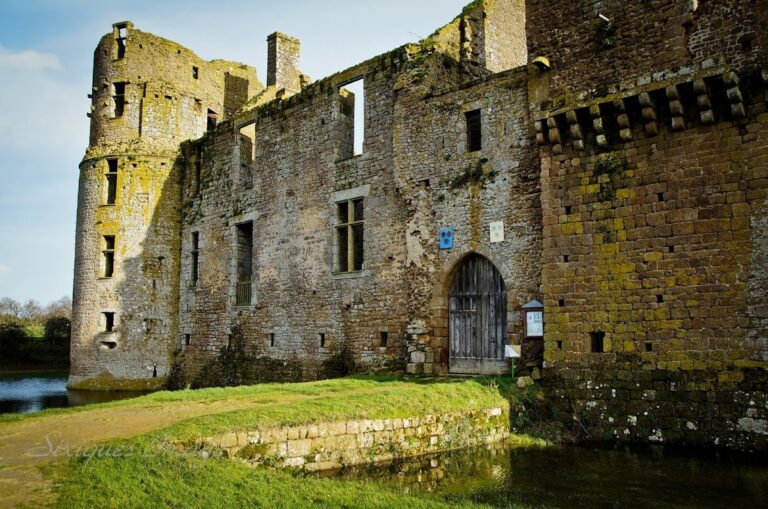
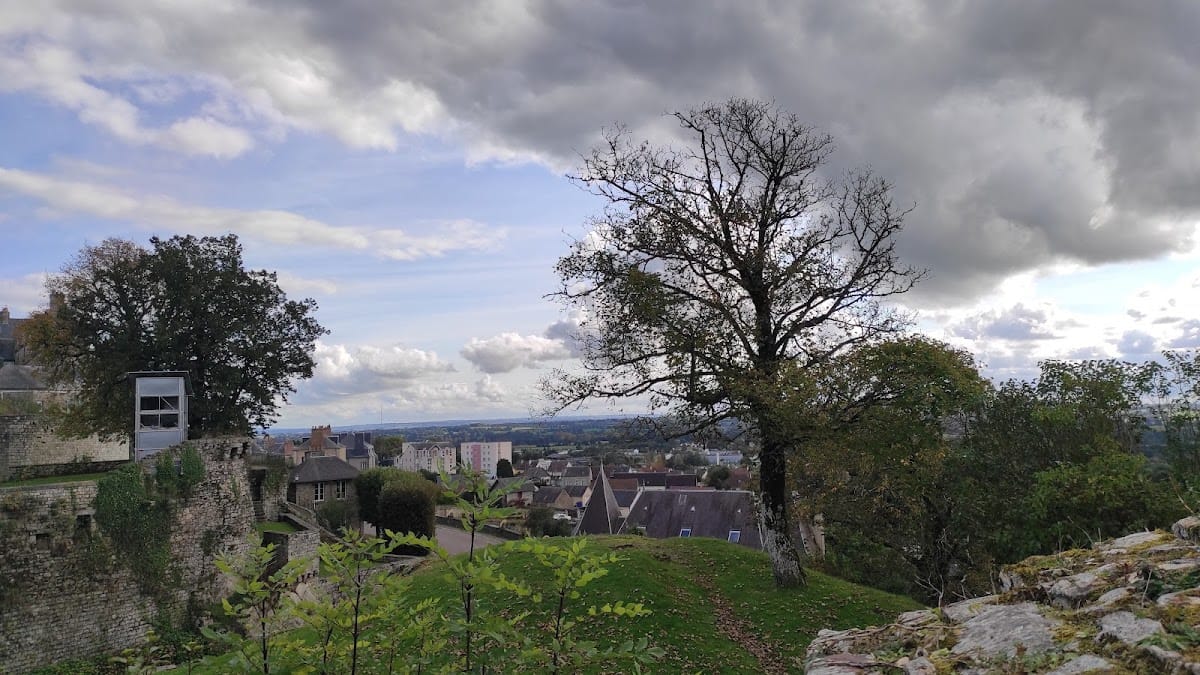
The ruins stand in a public park at the western end of the sandstone ridge occupied by the old town. The castle overlooked the Varenne gorge from more than 70 metres above and was separated from the town by a ditch. Its surviving remains combine the early citadel, Henri Beauclerc’s Romanesque keep, later outer defences, residential buildings, underground fortified spaces, and chapel remains. The fabric is ruined and has been undergoing restoration since 1984.
Citadel and Romanesque keep
Early citadel
Guillaume de Bellême’s early-eleventh-century citadel probably had a square plan with four large corner towers. A deep ditch cut into the rock strengthened the position and separated the fortress from the town. This early arrangement formed the basis of the defensive site that later Norman rulers enlarged.
Romanesque keep
Henri Beauclerc’s replacement keep measured approximately 22.40 by 26.30 metres and rose three or four storeys. Its surviving north and east walls reach 28 metres in height and are approximately 3 metres thick. Small corner turrets contained stairways and chambers, while flat buttresses strengthened the centres of the walls. The entrance was placed at first-floor level, and arrow slits provided defensive openings. Round-headed Romanesque windows lit the second floor.
Outer defences and associated buildings
Gatehouse and curtain wall
The later outer curtain wall, the section of an enclosing defensive wall between towers or other strongpoints, survives along two sides of the castle. Its gatehouse, or châtelet, remains with two powerful towers. To the east, the remains of the citadel’s enclosing wall include towers overlooking the ditch that separated the castle from the town.
Residential building and casemates
The surrounding ruins include a residential building and thirteenth-century underground casemates. Casemates are fortified vaulted spaces used for protection, storage, or weapons. These underground structures form part of the later defensive and domestic complex around the keep.
Priory chapels
Saint-Symphorien Chapel
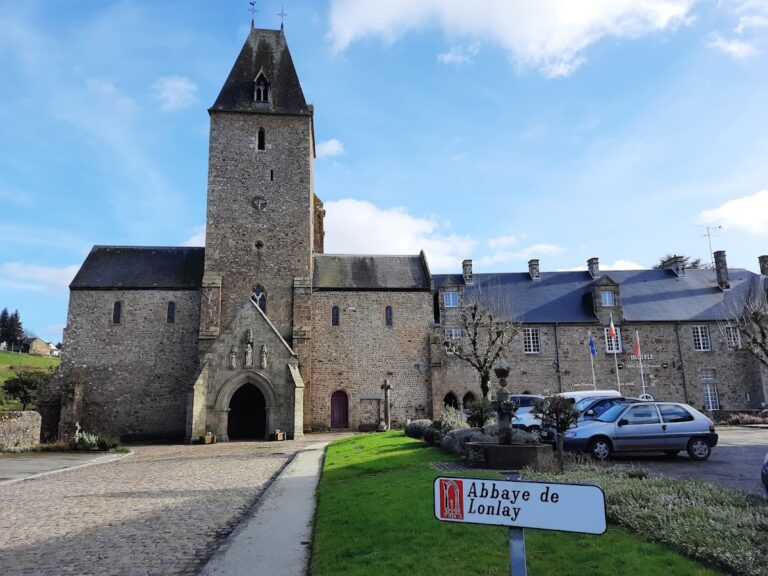
The fortified Romanesque priory chapel of Saint-Symphorien was built around 1100 in the form of a Latin cross. It belonged to Lonlay Abbey until the French Revolution. The chapel was probably ruined during the destruction of the castle ordered at the beginning of the seventeenth century, and its surviving remains are part of the protected ruins.
Sainte-Catherine Chapel
The former Sainte-Catherine chapel is also included among the surviving chapel remains protected at Château de Domfront. Together with Saint-Symphorien, it represents the religious buildings associated with the fortified site.