Rocca d’Olgisio: A Medieval Fortress in Italy



Site at a Glance
- Rating
- 4.5
- Popularity
- Low
- Country
- Italy
- Primary era
- Medieval
- External website
- Open
- Eras represented
- Medieval, Early Modern
- Civilizations
- Unclassified
- Site type
- Military
- Remains
- Castle
On this page17 sections
History
Rocca d’Olgisio is a medieval fortified complex in Italy, standing above Pianello Val Tidone on the watershed between the Val Tidone and Val Chiarone. Tradition places its foundation around AD 550, while the first secure documentary reference to the Castrum Olzisij, a Latin name for a fortified settlement, dates to 1037 or possibly 1073. The fortress later became a feudal possession of powerful northern Italian families and remains associated with the history of the Piacenza and Milanese territories.
Early origins and medieval ownership
Prehistoric communities occupied the surrounding area during the Bronze and Iron Ages, leaving traces in caves near the fortress. A later tradition attributes the castle’s foundation to Giovannato Miles, probably from the Genoa area. The same legend says that his daughters Faustina and Liberata fled with their tutor Marcello to avoid marriages arranged to preserve their father’s noble lineage. They reportedly took refuge at Como, founded the monastery of Sant’Ambrogio, and were later canonized as Saints Faustina and Liberata of Como.
In the eleventh century, Giovanni, a canon of Piacenza Cathedral, transferred the property to the monks of San Savino in Piacenza. The castle changed hands repeatedly thereafter. In 1296 it was sold to Uberto Campremoldo and Raimondo Petraia. A dispute between Petraia and Giacomo Volpe Landi was settled in favor of Alberto della Rocca, to whom Campremoldo transferred the fortress. In 1325 Pietro Radati conveyed it to Bartolomeo Fontana for 1,100 florins.
Siege and Visconti control
In 1326 nobles expelled from Piacenza, including Manfredo Landi, Francesco Volpe Landi, and Corradino Malaspina, besieged the castle. Two papal soldiers inside the fortress helped defend it, while papal officers from Piacenza dispatched about 1,000 men under Azzotto del Balzo. The relieving army defeated the besiegers. Two captured attackers, Calcagno and Rodolfo, were taken to Piacenza, tortured, condemned to death, and buried alive.
In 1352 the fortress became the property of Bernabò Visconti. The Visconti were a ruling dynasty centered on Milan that controlled broad territories in northern Italy. In 1378 Gian Galeazzo Visconti granted the castle and its fief, an estate held through a feudal relationship, to Jacopo Dal Verme, a captain in the Visconti army. Filippo Arcelli seized it in 1408, but Filippo Maria Visconti later returned the property to the Dal Verme family.
The Dal Verme era and French occupation
The Dal Vermes, counts of Bobbio, Voghera, and the Val Tidone, held Rocca d’Olgisio until 1485. Pietro dal Verme survived a major fire at the castle in 1478, but later died by poisoning, probably on the orders of Ludovico Sforza, Duke of Milan. Sforza then granted the castle and its fief to his relative and son-in-law Galeazzo Sanseverino.
At the beginning of the sixteenth century, King Louis XII of France granted the castle to Bernardino da Corte in exchange for delivering Milan’s Castello Sforzesco. Bernardino’s rule ended with his death by poisoning. The Dal Vermes subsequently regained the fortress, but French forces besieged it when the family refused to recognize French sovereignty over territory occupied in the Duchy of Milan, a northern Italian state contested by France and local ruling families. Led first by Galeazzo Sanseverino and later by his brother Giulio, the siege lasted more than a year. French troops finally captured the fortress with help from guards who betrayed it.
After the French occupation ended, the Dal Vermes returned in 1521. That year Count Federico dal Verme bought the fortress for 6,000 ducats from Martinengo, who had administered it while the Sanseverinos were absent. Decorative work undertaken in the final years of the sixteenth century was commissioned by Cardinal Jacopo dal Verme III, a senior official of the Roman Catholic Church.
Later ownership and wartime damage
The Dal Verme family retained the castle until its branch became extinct around the middle of the nineteenth century. It then passed to Giulio Zilieri, who had married the last heiress, Lucrezia dal Verme. Later changes of ownership were accompanied by the complete loss of the interior furnishings. Another tradition holds that Lieutenant Cassio of Parma’s guard corps bought the building during the eighteenth century, that his heirs sold the furnishings, and that Count Camillo Zilieri later acquired the empty building at auction.
During the Second World War, the Italian Resistance, the anti-fascist and anti-German partisan movement in Italy, used the fortress as the headquarters of the Second Partisan Division of Piacenza. German forces attacked twice. Partisans led by Giovanni Lazzetti, known as “Il Ballonaio,” repelled the first assault. During the second, German troops occupied the castle and caused extensive damage, including the collapse of sections of its masonry.
The Bengalli family bought Rocca d’Olgisio in 1979 and subsequently undertook renovation and restoration work. The family retained ownership through 2026. The fortress has Italian national heritage status. The surrounding cliffs form part of a Site of Community Importance and Special Area of Conservation, European designations for habitats and species considered important for conservation.
Remains
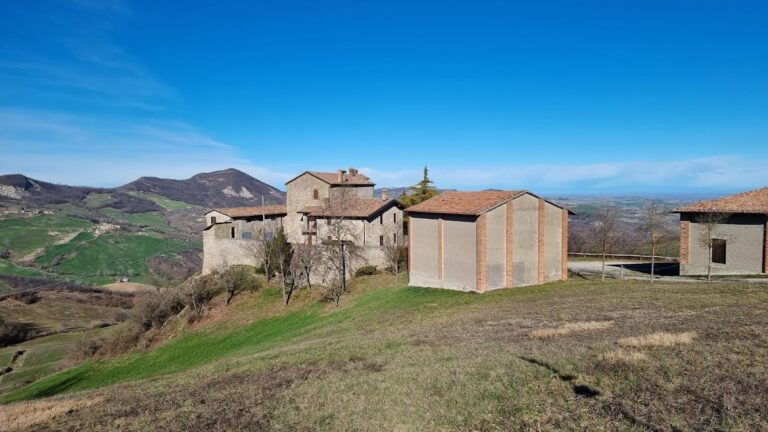
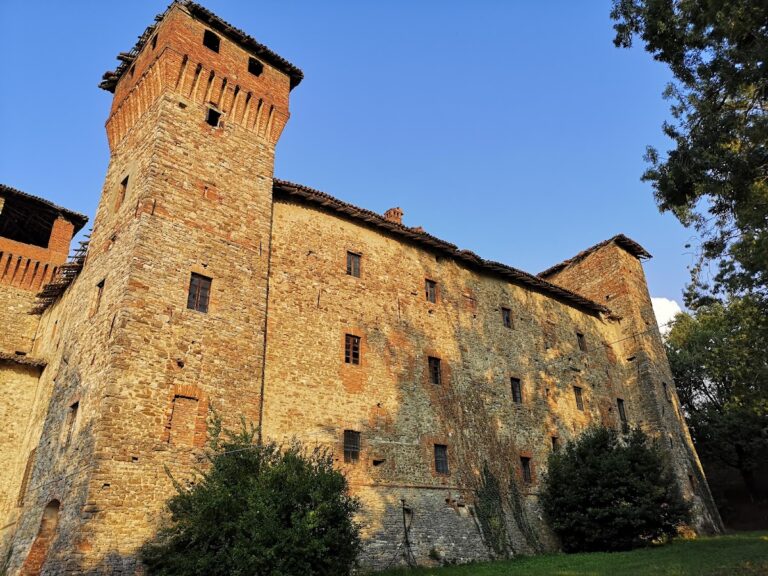
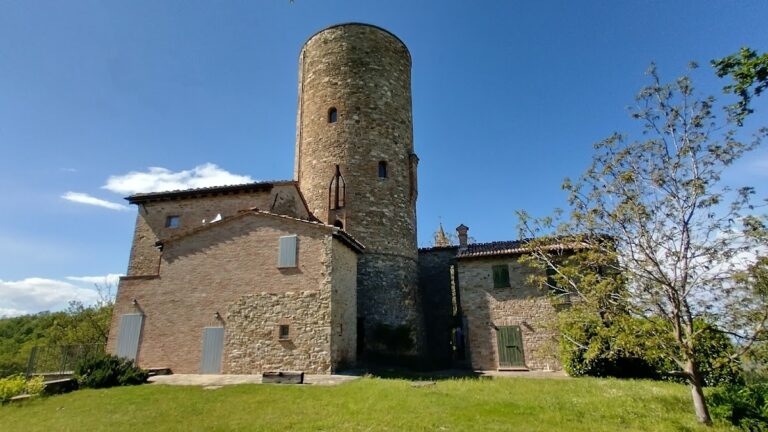
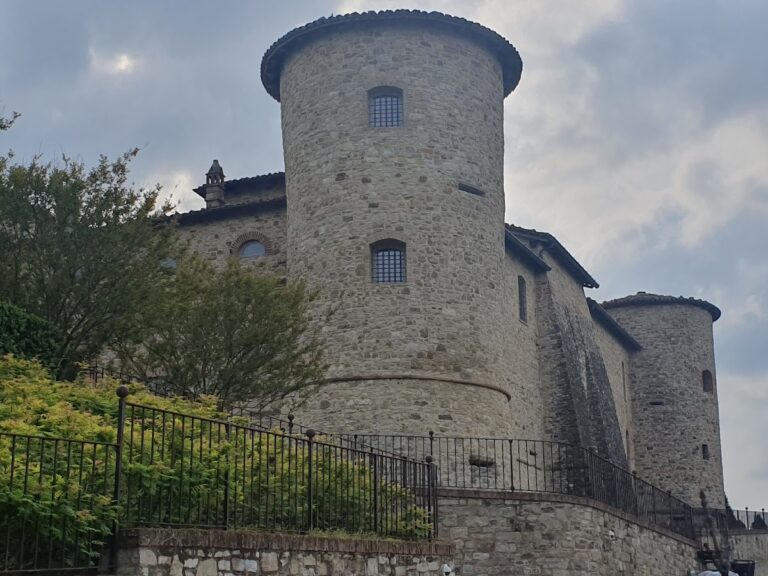
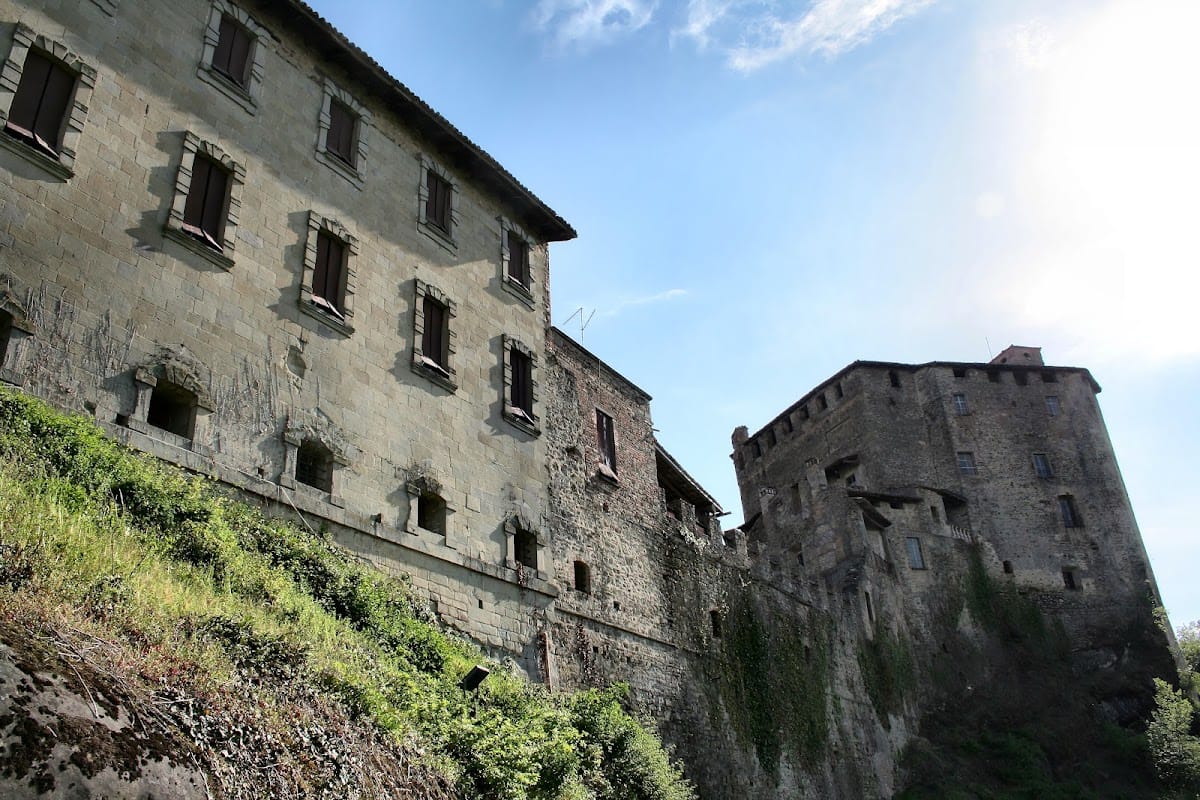
Rocca d’Olgisio occupies a steep rocky spur at approximately 546 metres above sea level, on the ridge between the Val Tidone and Val Chiarone. Its irregular plan follows the terrain. A northern approach marked by granite blocks leads toward six successive defensive lines. Three lines protect the southern side, where the slope is less steep, and each of these enclosures contains several buildings and curtain walls, the defensive walls enclosing a fortified space.
Fortifications and inner courtyard
Walls and entrance
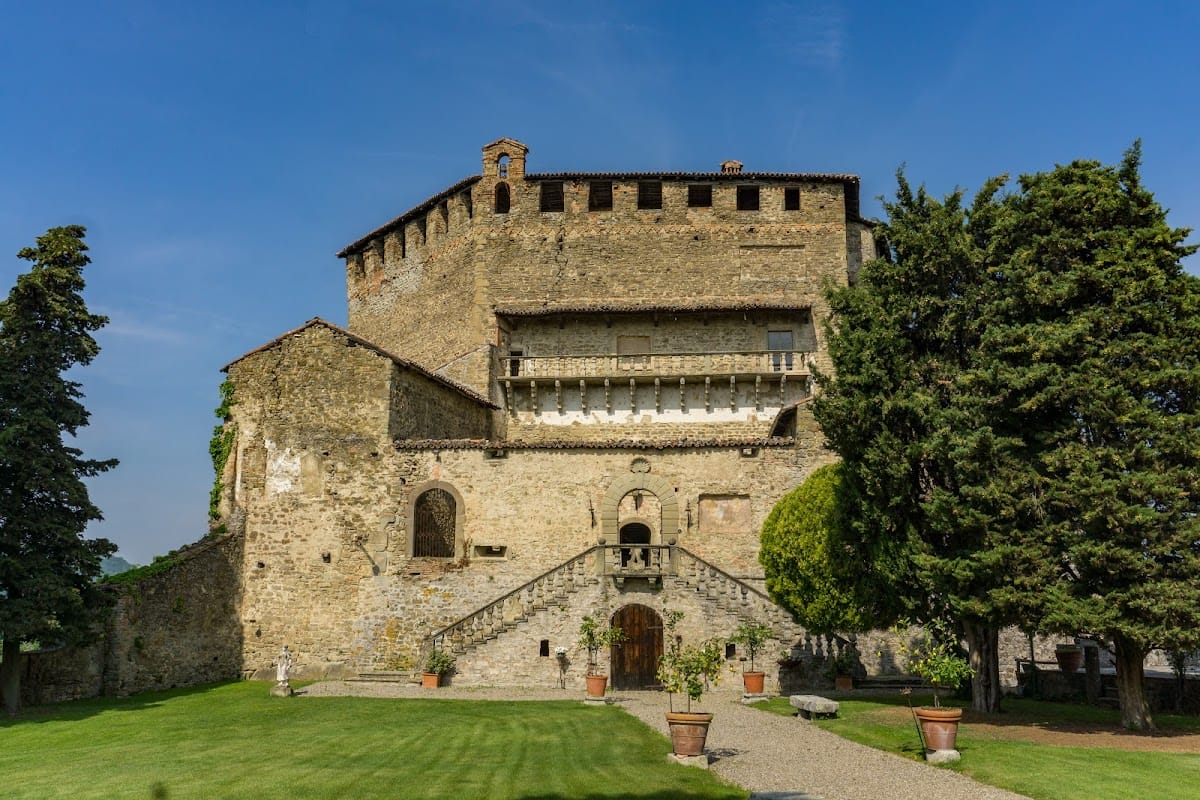
The entrance through the third defensive line leads directly into the inner courtyard. Above it is a rusticated arch decorated with a painting of a saint. The inner doorjamb carries the Latin motto Arx impavida, meaning “fearless fortress.” A drawbridge once controlled the approach, and its fixing recesses survive. The iron portcullis, a vertically raised barrier used to control the entrance, has been lost.
Courtyard well
Inside the courtyard is a well approximately 50 metres deep. Its decoration includes carved representations of mythical and legendary episodes. A local legend claims that a passage opened around the middle of the shaft and provided an escape route during danger or a siege.
Western buildings and keep
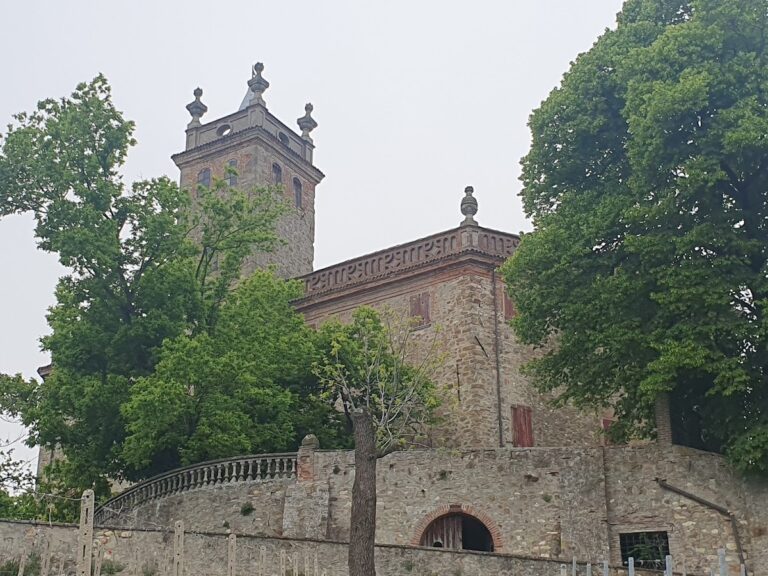
Several structures stand along the western side of the courtyard, including an oratory, a small place for Christian prayer and worship, dedicated to Saints Faustina and Liberata. The rectangular keep, the castle’s principal defensive tower, has an attached bell tower. The tower was originally taller but was substantially lowered during the first years of the nineteenth century so that it could no longer serve as a signal tower for anti-Napoleonic assemblies.
Sixteenth-century decoration
Decorative features from the final years of the sixteenth century include a balustrade supported by 13 masks, several frescoes, and the grand staircase. Cardinal Jacopo dal Verme III commissioned these additions.
Caves and prehistoric features
Several natural caves lie beyond the outermost defensive wall. They contain traces of prehistoric settlement and form a physical link between the fortress and the area’s much earlier occupation.
Saints Faustina and Liberata Cave
One cave is reached by a staircase flanked by stone seats on both sides, whose form suggests human construction. Legend associates the cave with Saints Faustina and Liberata, who were said to have withdrawn there to pray. Inside are several steps, a stone formation with a hollow at its base that may have served as a sacrificial altar, and stylized letters spelling “ADE” on one wall.
Cypress Cave
The Cypress Cave, also called the Drip Cave, contains a basin carved into the rock. Water enters through fissures and collects in the basin. A legend says that condemned prisoners were bound there and killed by the very slow impact of falling droplets.
Black Cave
The Black Cave contains prehistoric traces and a blackened vault, probably darkened by smoke from fires. The smoke-darkened ceiling gives the cave its name.
Conscripts’ Cave
The Conscripts’ Cave served as a refuge for young men evading compulsory military service during the Napoleonic Kingdom of Italy, the French-backed kingdom established by Napoleon in the early nineteenth century.
Protected cliffs and vegetation
The cliffs surrounding the fortress lie on sandy, erosion-prone terrain with southern exposure. These conditions produce a relatively arid habitat favorable to heat-loving plants. Vegetation includes dwarf prickly pear, yellow autumn crocus, Mediterranean species such as man orchid and strawberry tree, and high-Apennine species including dark columbine, Armeria arenaria, and Saxifraga paniculata.