Kalmar Castle: A Medieval Fortress and Renaissance Royal Residence in Sweden


Site at a Glance
- Rating
- 4.6
- Popularity
- Medium
- Country
- Sweden
- Primary era
- Early Modern
- External website
- Open
- Eras represented
- Medieval, Early Modern
- Civilizations
- Swedish
- Site type
- Military
- Remains
- Castle
On this page16 sections
History
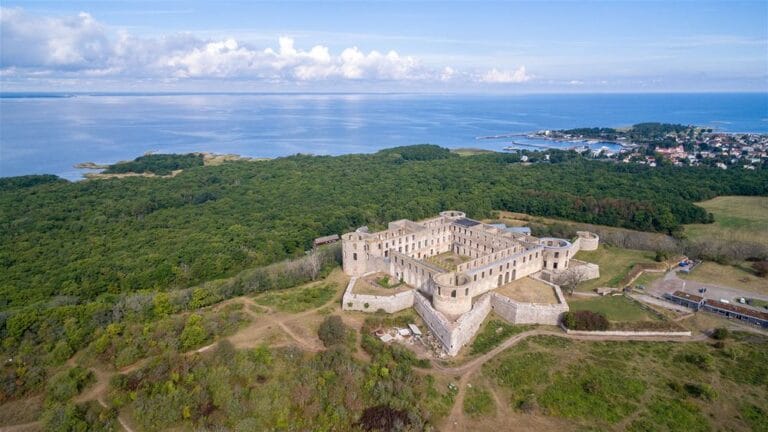
Kalmar Castle is a medieval fortress and Renaissance royal residence in Kalmar, Sweden. It began as a fortified site in the late twelfth century on the already inhabited Slottsholmen, beside the harbor and the Kalmarsund strait between mainland Sweden and Öland. Its position allowed it to protect the harbor and control shipping through the waterway, while its proximity to the Danish frontier made it an important Swedish military outpost.
Medieval foundation and royal expansion
During the reign of Knut Eriksson, a circular defensive tower, known as a kastal, was built as the first defensive core of the castle. By the late thirteenth century, probably between the 1260s and 1280s, a ring wall and most of the medieval castle had been constructed around it. In the 1280s, King Magnus Ladulås ordered a larger defensive castle to be built around the earlier tower.
Kalmar served several functions during the Middle Ages. It was a royal residence, a political center, and a military stronghold. In 1266, its lord received Cardinal Guido, a papal legate, to discuss church lands and political matters. On 10 November 1276, King Magnus Ladulås was married at the castle.
King Magnus Eriksson began another major expansion in 1337. The work added wings, or at least their ground floors, as well as an outer ring wall, small towers, and a projecting defense at the gate. These successive building phases created a complex fortress around the original tower and strengthened Kalmar’s role on the Swedish-Danish frontier.
The Kalmar Union and the sixteenth-century conflicts
In 1397, Kalmar Castle became the setting for the formation of the Kalmar Union. Initiated by Queen Margaret of Denmark, this late-medieval political union placed Denmark, Norway, and Sweden under one monarch while allowing each kingdom to retain its own laws and political institutions. Margaret’s successor, Eric of Pomerania, became the union’s first monarch, and the union lasted for more than 120 years.
The castle became involved in the political and military upheavals that ended Danish rule in Sweden. Gustav Vasa arrived at Kalmar in 1520 after returning from captivity abroad and later continued to Mora, where he began the uprising against Danish rule. Swedish forces captured Kalmar in 1523 after the town fell and the castle capitulated eight days later, allowing Öland to be conquered.
In 1525, the castle was besieged after its appointed governor, Berent von Mehlen, fell out of favor with Gustav Vasa. Gustav eventually took the castle by storm, with heavy losses on both sides. A tradition holds that defenders surrendered in 1525 and 1599 after being promised safe withdrawal, but that many were subsequently executed. The castle resisted the assault associated with Nils Dacke’s rebellion in 1543 and held out until the royal army arrived. Extensive reconstruction followed the suppression of the rebellion.
Transformation into a Renaissance residence
During the sixteenth century, the medieval fortress was reshaped into a Renaissance royal residence while retaining its military purpose. In 1535, Henrik von Cöllen directed the construction of four round corner towers and new wings. Three earlier towers were later remodeled as wings, including the Water Tower, and the original central keep was demolished because it obstructed the new arrangement.
Erik XIV lived at Kalmar from 1557 to 1560 as duke of Kalmar and Kronoberg. He continued the building and furnishing work after leaving. King Johan III carried the project forward under Johan Baptista Pahr and, from 1575, his brother Dominicus Pahr. From 1601, Peter Dionisius served as the castle’s master builder. The new residential and ceremonial interiors were accompanied by additional towers, bastions, and artillery defenses.
War, decline, and changing uses
During the Kalmar War, the 1611–1613 conflict between Sweden and Denmark, a Danish army captured Kalmar and besieged the castle. The Swedish commander Christer Somme capitulated, possibly because of insufficient ammunition or treachery. The castle returned to Sweden in 1613, and its damaged armament was restored. It was besieged more than twenty times between 1672 and 1678 without being captured during those operations. Over 394 years, it faced 22 sieges and was traditionally regarded as a fortress that had never been taken by storm.
After the 1658 peace settlement moved the Swedish-Danish frontier away from Kalmar, the castle lost much of its strategic importance. It ceased to function as a royal center toward the end of the seventeenth century, and Kalmar’s governors eventually moved their residence into the town as the castle deteriorated.
Parts of the castle were used in the eighteenth century as a prison, grain store, and later a crown distillery. Prison conditions were extremely poor. Prisoners lacked adequate clothing and winter fuel, and many suffered from scurvy. A landward ravelin, a detached triangular outer defense, was added in the 1740s. By 1766, the tower roofs had decayed and blown down, floors had rotted, and sections of the walls had collapsed. The former royal castle consequently ceased to function as a fortress and was partly converted into a crown distillery.
Restoration and preservation
Restoration began in 1850 under King Oscar I. The prison was removed in 1852, followed by exterior restoration and the progressive repair or reconstruction of historic interiors and decoration. Work continued in the 1880s under Helgo Zettervall. The Kalmar Museum, founded by Volmar Sylvander in 1870, occupied the castle until 1987, when it moved to a converted former steam mill.
From 1921, Professor Martin Olsson directed detailed restoration and investigations into the castle’s earlier building phases. Archaeological work in and around the castle also examined the former medieval harbor after it had been separated from the sea and drained. Maintenance and restoration have continued, and the complex is regarded as a well-preserved Renaissance castle in Sweden. Kalmar Castle is a Swedish listed historic building complex and cultural monument, owned by the National Property Board of Sweden. Its museum presentation has focused since 1995 on the castle’s history, including the former prison and the history of medieval punishment and witch persecutions.
Remains
Kalmar Castle stands on Slottsholmen beside Slottsfjärden, the inlet associated with medieval Kalmar’s harbor. A narrow channel separates the island from the mainland and served as a moat. The surviving complex is built mainly of brick and limestone and combines medieval fortification with Renaissance residential and representative architecture. Its outer defenses, courtyard, wings, towers, and ceremonial rooms preserve the development of the site over several centuries.
Fortifications and outer defenses
Medieval defensive core
The earliest tower was a circular keep with walls approximately three metres thick. The medieval castle grew around it through the addition of a ring wall, buildings within the enclosure, and a further outer ring wall with towers and a projecting gate defense. The original keep was later demolished during the Renaissance rebuilding, but the surrounding medieval fabric survives in parts of the complex.
Renaissance towers and artillery defenses
The four round corner towers and new wings constructed in 1535 changed the castle’s external form. Renaissance-style roofs or caps were added to the towers, while four corner rondelles, rounded artillery defenses associated with early modern fortifications, were begun during Gustav Vasa’s reign and completed in the early seventeenth century. The castle’s armament eventually comprised 287 cannons.
The Great Staircase was built between 1555 and 1559 by Jacob Richter. During the sixteenth-century reconstruction, new bastions, towers, and a moat were added on the western side. At the landward entrance, the eighteenth-century ravelin forms a detached triangular earthwork placed in front of the gate or wall.
Courtyard and well
The inner courtyard was integrated with the surrounding wings and towers during the Renaissance rebuilding. A finely made well structure dated 1578 stands within it, providing a surviving feature of the courtyard’s early modern arrangement.
Chapel and royal interiors
Castle chapel
The castle chapel occupies the southern part of the complex, where residential rooms were converted on the orders of King Johan III. Construction was completed in 1589–1592. Its exterior wall includes fabric surviving from the thirteenth century, while the interior has a decorated ceiling and sixteenth-century walls bearing Latin prayers. Seventeenth-century royal pews carry the monograms of Gustav II Adolf and Queen Maria Eleonora. Religious services and wedding ceremonies continue to be held in the chapel.
Erik XIV’s chamber
Erik XIV’s chamber preserves richly decorated wooden paneling, intarsia, a technique that forms patterns by fitting contrasting pieces into a surface, stucco, and a colored hunting frieze painted on plaster. A concealed passage beside the fireplace led to the attic.
Variegated Hall
The Variegated Hall takes its name from its multicolored floor. It was built in the 1550s for Johan III, and its ceiling was gilded in the 1580s. Located in the northern part of the castle, the hall was intended for receiving guests and ambassadors.
Great Hall and representative rooms
The eastern wing contains the Great Hall, formerly a banqueting hall, with an area of approximately 400 square metres. Other representative rooms include richly furnished halls, sculpted portals, and a large fireplace said to have room for a mounted knight. A Renaissance hall elsewhere in the castle has a coffered ceiling, divided into recessed ornamental panels, dated to 1576. Historic decorative schemes in the interiors were restored or reconstructed during nineteenth- and twentieth-century campaigns.