Church of the Assumption in Gruta: A Roman Catholic Parish Church in Poland
Site at a Glance
- Popularity
- Very Low
- Country
- Poland
- Primary era
- Medieval
- Eras represented
- Medieval, Early Modern, Modern
- Civilizations
- German, Kingdom of Prussia, Polish–Lithuanian Commonwealth, Teutonic Order
- Site type
- Religious
- Remains
- Church
On this page11 sections
History
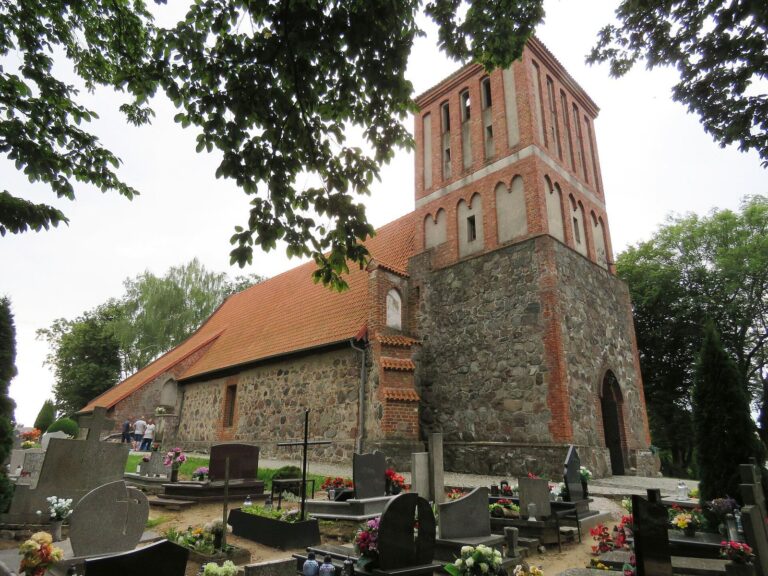
The Church of the Assumption in Gruta is a Roman Catholic parish church in Poland whose construction probably began around 1280 and was completed in the 14th century; it retains some Gothic character. It serves a parish dedicated to the same title and belongs to the Deanery of Radzyń Chełmiński, a parish grouping within the Diocese of Toruń, the territorial jurisdiction of a bishop.
Medieval church and changing dedication
The church was first dedicated to St Nicholas, an early Christian bishop venerated as a saint. In 1647 its dedication changed to the Assumption of the Blessed Virgin Mary, the Catholic belief that Mary was taken body and soul into heaven.
War damage and rebuilding
The Swedish Wars of 1655–1657 caused serious damage to the church. Later, King Michael Korybut Wiśniowiecki ordered the starosts of Rogoźno, local royal administrators, to rebuild and furnish it. A tower and sacristy, a room for preparing services and keeping liturgical objects, were added during this work.
Eighteenth- and nineteenth-century changes
A general renovation began in the mid-18th century. The date 1758 on the metal flag above the tower probably marks its remodelling; the tower had once been considerably taller. A fire in 1846 destroyed the church’s interior, although its bells survived.
A later renovation, undertaken through the efforts of priest Andrzej Czajkowski, a noted preacher and national activist, was associated with construction of a sacristy and a south porch.
Remains
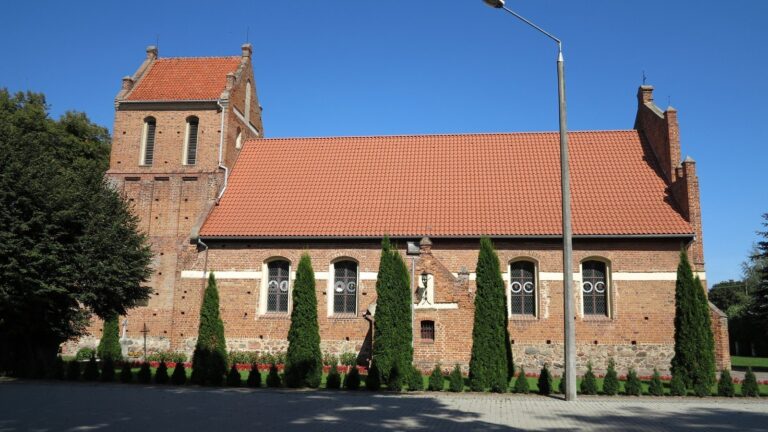
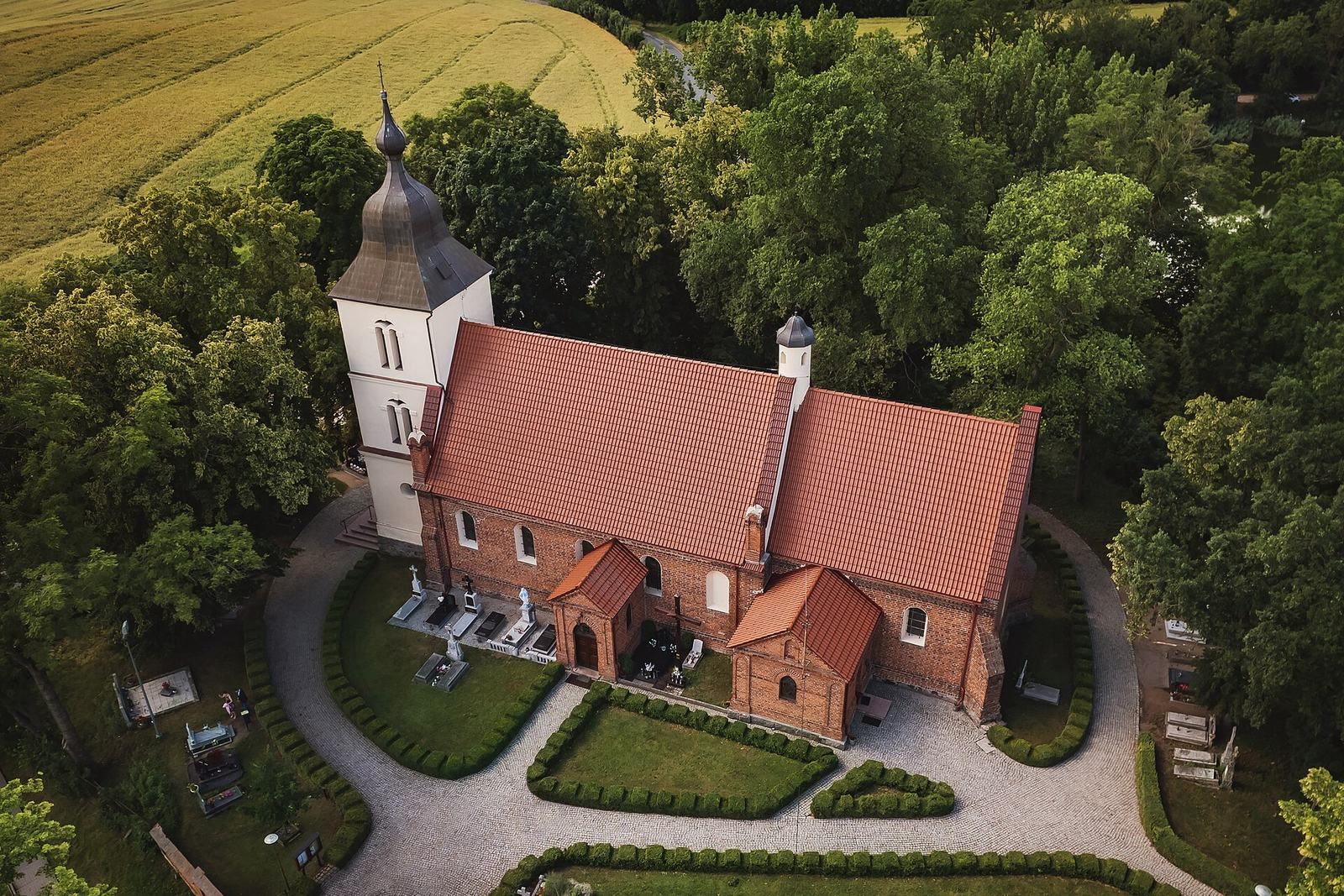
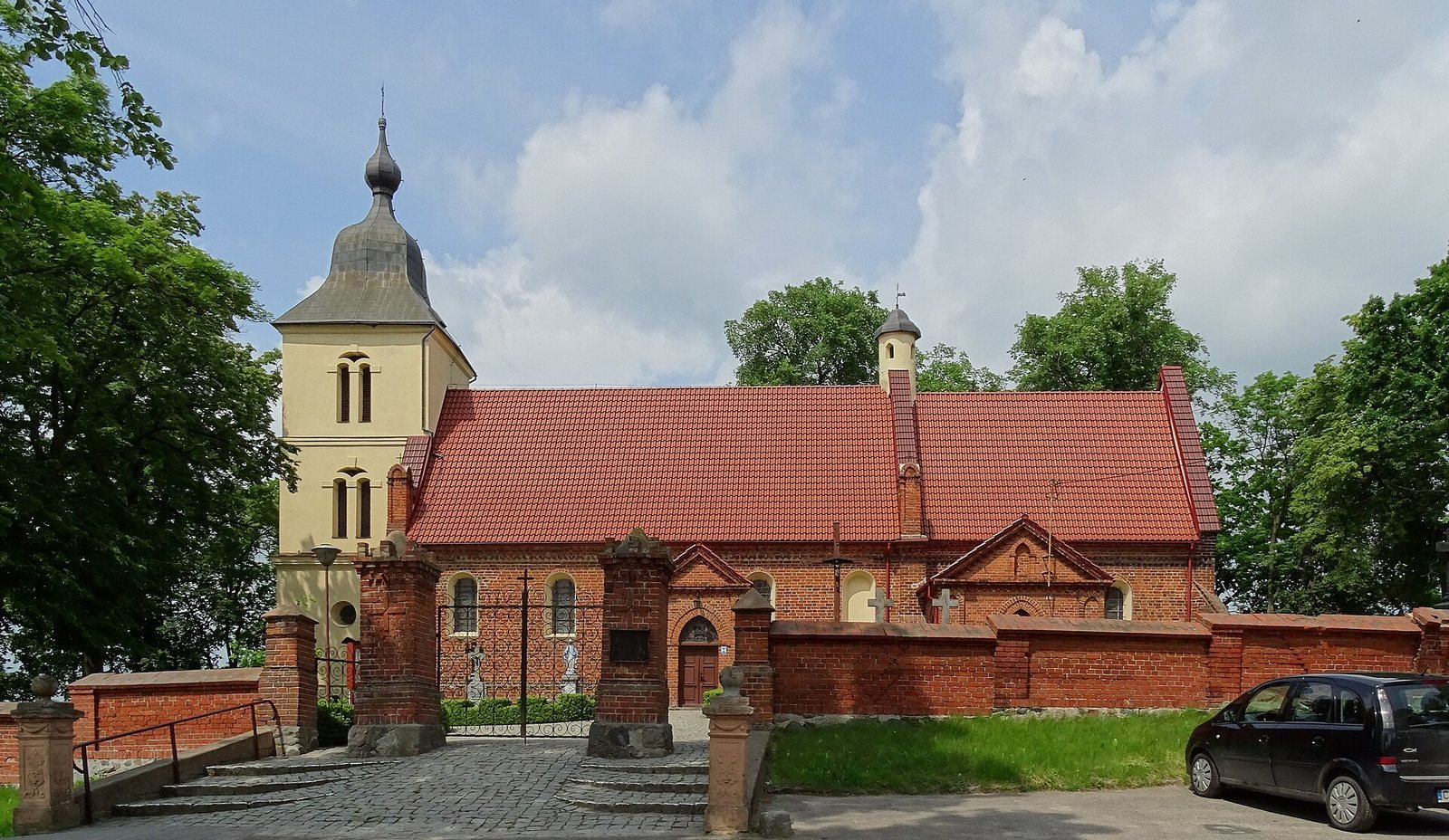
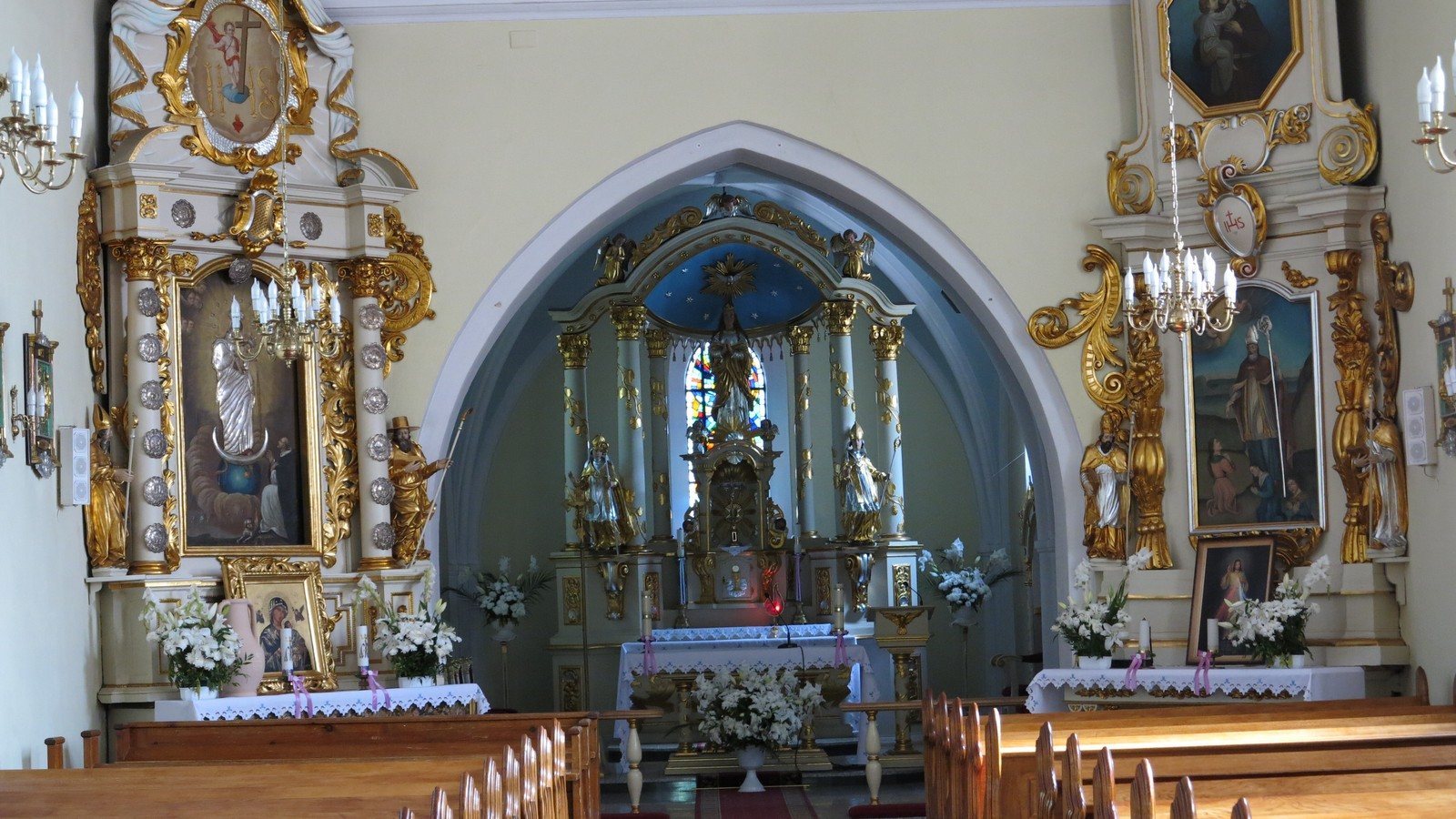
The church has a single nave, the main area for the congregation, and a straight-ended chancel, the area around the altar. Its brick body stands on a stone plinth, with a square, plastered tower at the west end. The building retains elements of Gothic architecture, while its gables are Neo-Gothic, a revival of medieval Gothic forms. Inside, the chancel has a rib vault, a ceiling supported by intersecting ribs, and the nave has a false barrel vault, a ceiling shaped like a barrel vault but not built as a true vault. The church has one tower and three altars. Most of its furnishings are late Baroque and date from the first quarter of the 18th century.
Interior furnishings and objects
Altars and choir gallery
The main altar and two side altars were made around 1730 in the Regency style, an early-18th-century transition from Baroque toward Rococo. The wooden choir gallery, built around the mid-19th century, rests on four posts and has a bowed parapet.
Paintings and processional panels
Two Baroque processional panels from the first half of the 19th century show the Virgin Mary, St Nicholas, and St Stanislaus, a bishop of Kraków and martyr. A late Baroque easel painting of the Transfiguration, the Gospel episode in which Jesus reveals his divine glory to his disciples, dates from the second half of the 18th century.
Sculptures
An enthroned Virgin and Child from the mid-13th century is a late Romanesque work, in a medieval style that preceded Gothic. Other sculptures include a Baroque figure of the Risen Christ from around the turn of the 17th and 18th centuries, a stone figure of Christ carrying the cross from around the mid-19th century, an 18th-century figure of Christ the Savior, and a folk crucifix from the 18th or 19th century.
Organ and bells
A. Terletzki built the organ in Elbląg in 1886. Its case has a Neoclassical design, drawing on ancient Greek and Roman models, and its associated equipment dates from the same period. One bell is dated 1567 and was later recast in 1882; another is dated 1715.
Liturgical vestments
The church preserves several liturgical vestments, garments worn during religious services, in satisfactory condition. A white vestment made in 1698 bears images of the Immaculate Virgin Mary, Christ, and St Benedict, a Christian monastic leader associated with the Benedictine tradition. The collection also includes a red vestment from the first half of the 18th century, a green one made from fabric dating to the turn of the 18th and 19th centuries, and another from the 19th century.