Pokrzywno Castle: A Teutonic Order Commandery Castle in Poland


Site at a Glance
- Rating
- 4.3
- Popularity
- Low
- Country
- Poland
- Primary era
- Medieval
- Eras represented
- Medieval
- Civilizations
- Crusader, Teutonic Order
- Site type
- Military
- Remains
- Castle
On this page10 sections
History
Pokrzywno Castle is a Gothic fortress in Poland, built by the Teutonic Order as the seat of a commandery, a local administrative district headed by a commander. Also known as Engelsburg or Mons Angelorum, meaning “Mountain of Angels,” it developed from the Slavic stronghold of Copriven and became an administrative, military, and residential centre during the medieval period.
From Slavic stronghold to Teutonic commandery
The destroyed stronghold of Copriven was granted to Bishop Christian in 1222. After his mission to convert Prussia failed, the Teutonic Order took control of the site around 1230 or 1231. Its first Teutonic fortification was a simple timber-and-earth stronghold, and Teutonic knights were reportedly living there by 1239.
The main masonry castle probably began in the thirteenth century, possibly during the 1250s. Henry Brabant is identified as the first commander of Pokrzywno and is traditionally associated with the beginning of the permanent masonry complex. The castle then served as the seat of a commandery, apart from a brief interruption, until the death of its last commander, Frederick von Zollern. Günter von Schwarzburg the Younger was among the commanders, while his uncles Günter and Zyghard von Schwarzburg held important offices within the Teutonic Order.
Expansion and use in the fourteenth century
Pokrzywno was remodelled in 1340, including the construction of vaults in the east wing. Between 1345 and 1347, Grand Master Ludwig König used the castle as his retirement residence. This period reflects the complex’s continuing role within the order’s administration and its value as a secure residence for senior officials.
Capture, repair, and confinement
During the Battle of Grunwald in 1410, a major Polish-Lithuanian victory over the Teutonic Order, the castle commander Burchard von Wobecke was killed and Polish forces captured the fortress. Teutonic control was restored in 1411. That year, Grand Master Henry von Plauen began modernising the defences. The fortress was repaired, its walls were raised, and more advanced loopholes were added.
Henry von Plauen was later removed from office in a coup, demoted, and transferred to Pokrzywno. He was confined at the castle in 1413, adding a notable episode of political detention to the site’s military and administrative history.
Polish administration and wartime damage
In 1454, during the Thirteen Years’ War, a conflict that ended with the Teutonic Order surrendering much of its Prussian territory to the Polish crown, troops of the Prussian Confederation took Pokrzywno without a fight. Under the Second Peace of Thorn in 1466, the castle and the wider Chełmno Land were incorporated into Poland.
From 1566, Pokrzywno served as the seat of Polish starosts. A starost was a royal or state-appointed administrator who governed a territorial district and managed its revenues and property. The castle belonged to the Pokrzywnica starosty in 1664 and remained a starost’s seat until the First Partition of Poland in 1772.
A fire damaged the castle in 1611. Between 1626 and 1630, Norbertine sisters from Żukowo lived within the fortress. During the Swedish Deluge, the Swedish invasion and war in the Polish-Lithuanian Commonwealth, Swedish forces captured and burned the complex and desecrated its chapel. The damaged castle was later restored.
Decline and conservation
Under Prussian rule, the complex was sold to a private owner in 1784. Its dismantling for road construction was stopped after Bishop Baier of Chełmno intervened, but the weakened chapel vault collapsed in 1789. Further demolition and gradual decline followed.
Polish conservation authorities recognised the ruins as a monument in 1934. Road reconstruction in 1965 demolished buildings adjoining the southern section of the walls, and the first safeguarding works began in 1967. The ruins are privately owned, and the new owner plans to rebuild the castle.
Remains
Pokrzywno Castle occupies an irregular plan formed by a high castle and two outer baileys. The high castle was the principal fortified and residential section, while the baileys were enclosed subsidiary courts containing additional buildings. The layout reflects the early phase of Teutonic castle building, before more regularised plans had developed, and is therefore more organically arranged than the stricter forms used in later Teutonic castles.
High castle
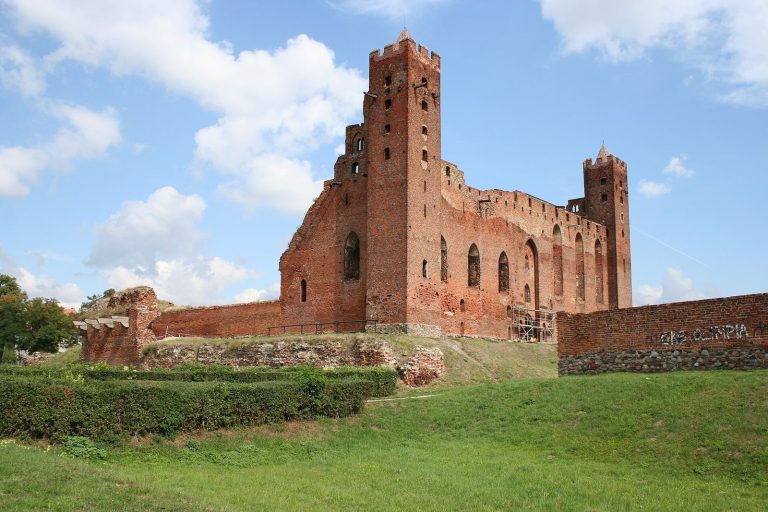
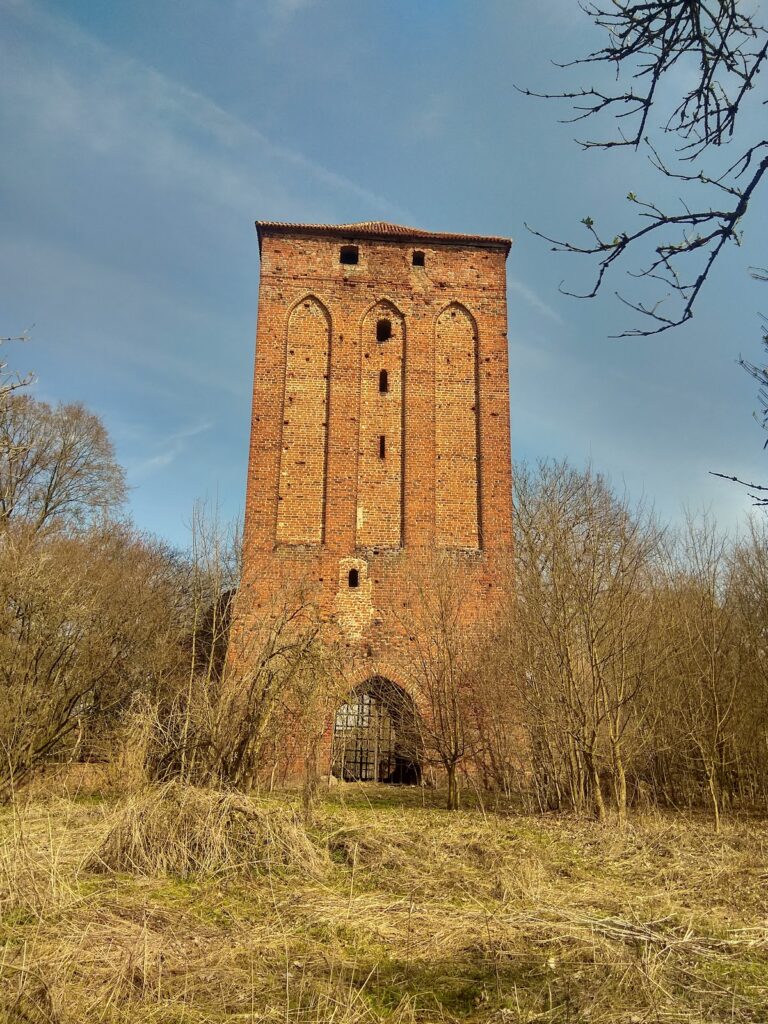
The high castle retains its gatehouse, two wings arranged at an oblique angle, fragments of the principal building, and sections of the defensive walls. The gatehouse is among the best-preserved parts of the complex and incorporates a distinctive two-bay gate chapel above the entrance passage. A two-bay chapel consists of two structural sections, while a gate chapel is placed above or beside a castle entrance. The high-castle remains are in a ruined state, but the gatehouse and portions of the walls continue to convey the form of the principal fortified area.
Inner bailey
The inner bailey preserves a rebuilt or remodelled granary measuring 37 metres in length. An ornamental gate survives at the eastern entrance to this enclosed court. Together with fragments of the high castle, these structures form some of the clearest surviving evidence of the complex’s later working and defensive arrangement.
Outer bailey
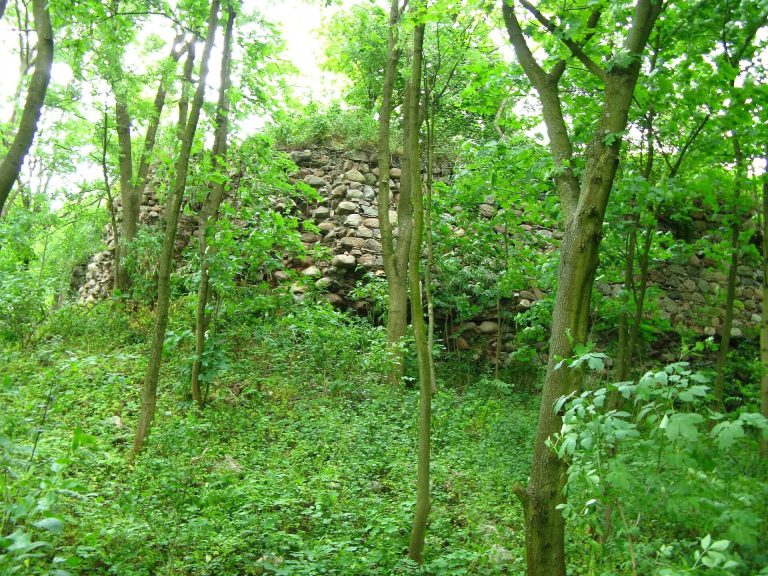
An irregular outer bailey extends east of the inner bailey. It retains two large brick barns and a substantial section of its surrounding wall. These surviving buildings and boundary walls remain part of the ruined complex and show how the castle’s subsidiary spaces extended beyond the high castle and inner court.