Santa Maria Assunta: The Parish Church of Rocca di Papa
Site at a Glance
- Popularity
- Low
- Country
- Italy
- Primary era
- Modern
- Eras represented
- Modern
- Civilizations
- Papal States
- Site type
- Religious
- Remains
- Church
On this page9 sections
History
Santa Maria Assunta is the Catholic parish church of Rocca di Papa, in Lazio, Italy, near Rome. Dedicated to the Assumption of Mary, the belief that she entered heaven body and soul, it belongs to the Diocese of Frascati, a Catholic territory under a bishop, and to that diocese’s pastoral zone II, a grouping of parishes. A replacement church in the Baroque style, associated with dramatic movement and ornament, was begun in 1664; the building now standing reflects later rebuilding.
Earlier church and parish records
A church dedicated to Mary had stood in the town for many years before work began on its replacement. After a decision at the Council of Trent in 1545, a major Catholic council concerned with doctrine and discipline, the parish began keeping records. From 1565, the priest Giovanni Battista Marchigiano entered births, baptisms, marriages, and deaths in the registers.
Construction and rebuilding
Cardinal Girolamo Colonna laid the foundation stone for a new church near the old one in 1664. An architect designed it in the Baroque style, with a planned dedication to Mary and Saint Charles Borromeo. Work stopped after Colonna died in 1666. His successors showed little interest in the project, and the architect’s death also delayed progress. Construction resumed in 1731, but proceeded slowly while the town’s population stood at about 1,300.
The old church had become dilapidated and collapsed during an evening service on 11 September 1747, killing one woman and injuring seven people. Work on the new church then moved faster, and it was completed toward the end of the 18th century after almost a century of construction. An earthquake on 26 August 1806 severely damaged it. The unrepaired building collapsed on 14 October 1814, without fatalities. Reconstruction was paid for through an extraordinary tax on townspeople. The principal works were finished by 1830, and the church was inaugurated in 1845.
Wartime damage and continued use
Allied bombing severely damaged the church on 25 May 1944. It was rebuilt after the war in a form very close to the structure inaugurated in 1845, and it remains in use.
Remains
Architecture and furnishings
Facade and towers
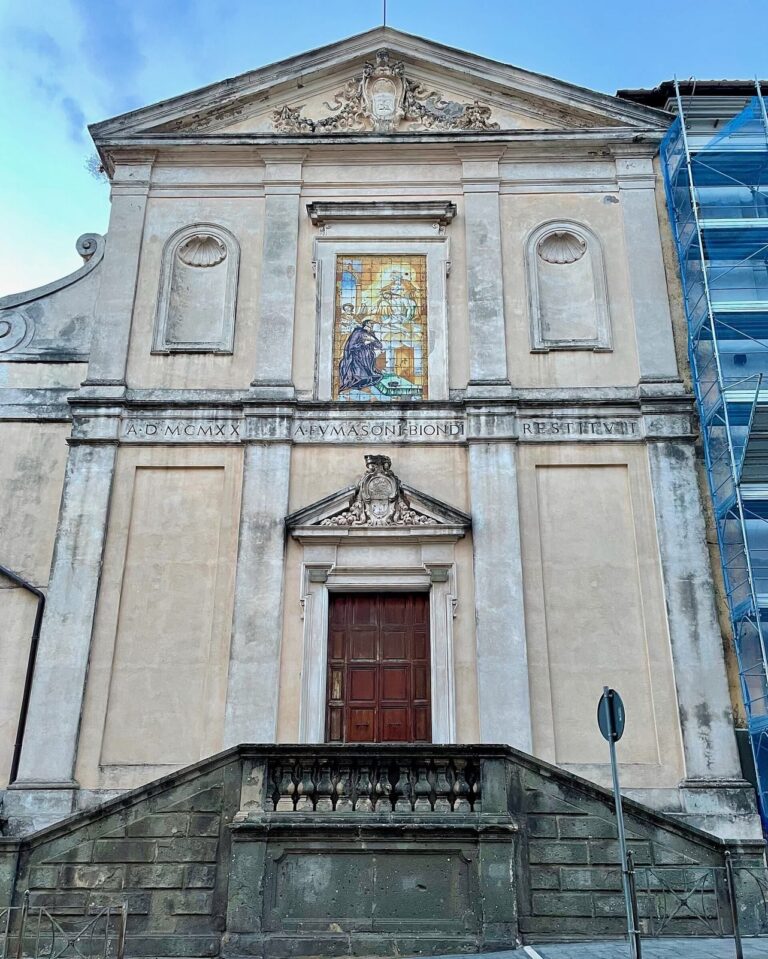
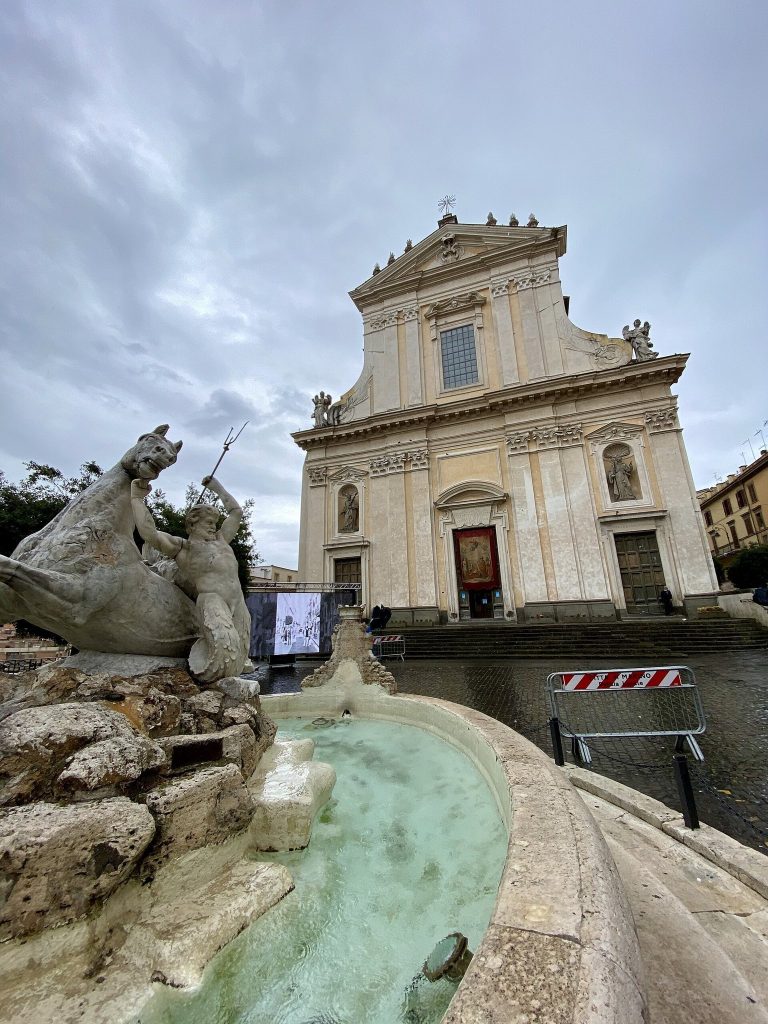
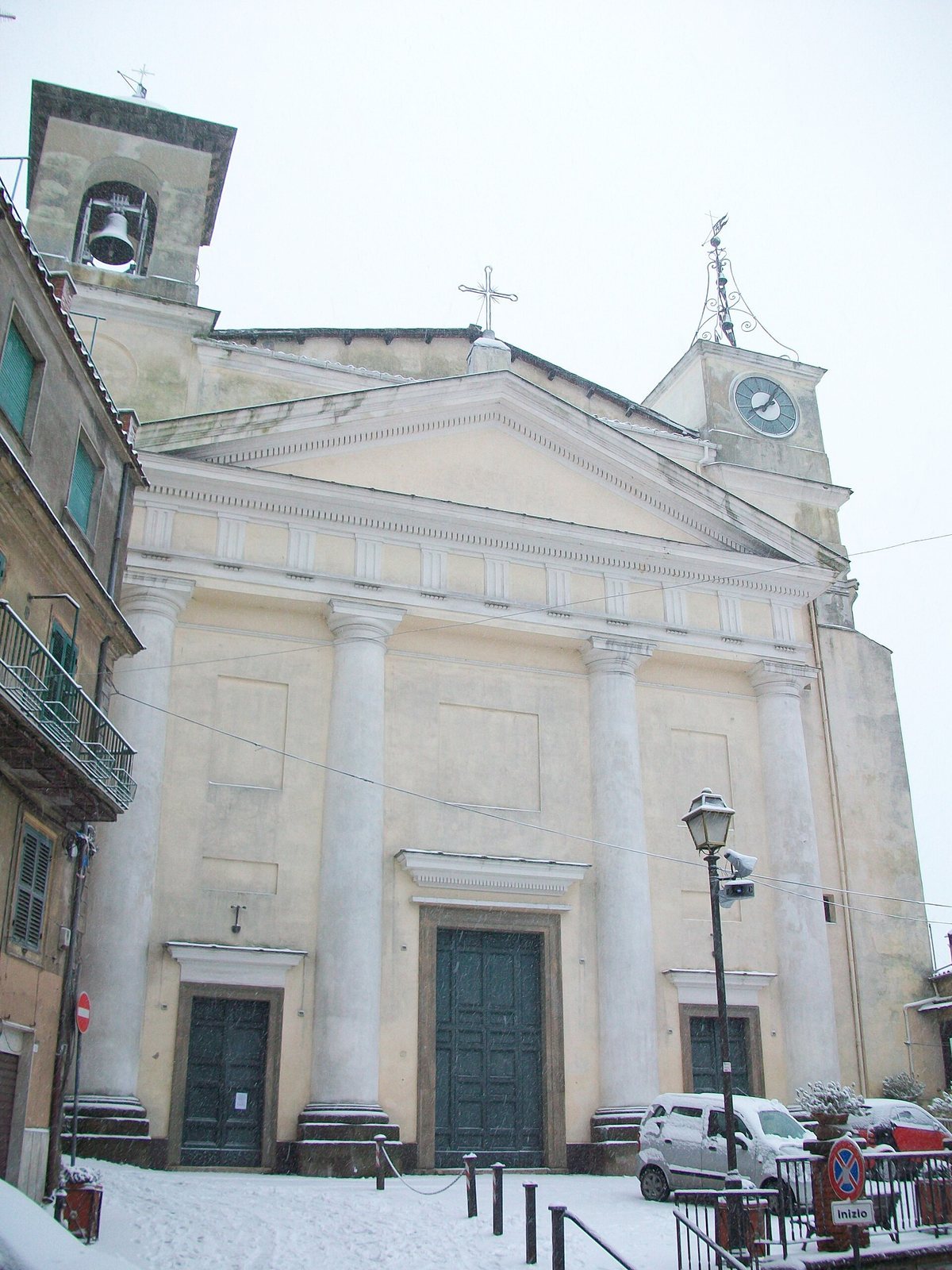
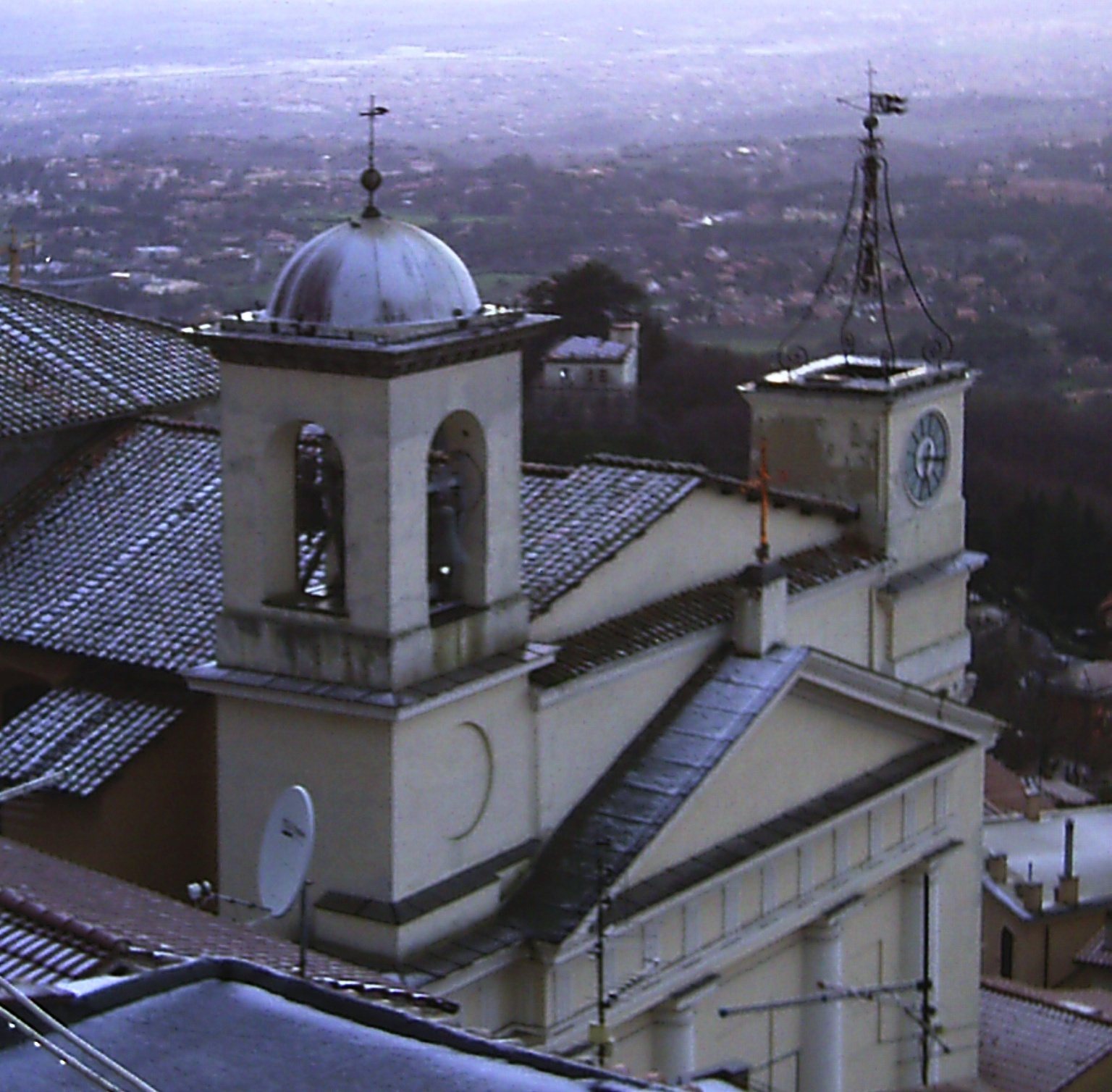
The church has an austere neoclassical façade, which revives classical forms, with Empire-style details, a monumental form of neoclassical design. A tall porch supported by four columns carries a plain triangular upper section topped by a cross. Three doors open onto the façade: the central entrance is larger than the two side doors, which are symmetrically placed. Two similar towers flank the front, though their arrangement is asymmetrical. The left tower holds the bells, while the right contains a clock.
Interior and artworks
The interior has a shallow, dome-shaped ceiling and six chapels. The 1845 structure also included a cemetery beneath the church floor. The dome was modeled on that of the Pantheon in Rome. An image of the All-Seeing Eye, a symbol of divine providence, occupies its center; images of Matthew, Mark, Luke, and John, the four Evangelists, appear on the curved surfaces supporting it. Above the main altar, a richly decorated 19th-century mosaic fills the sanctuary end, or apse, with Empire-style motifs.
Religious paintings from the 18th and 19th centuries include the Assumption of the Virgin, commissioned for the church by Cardinal Pietro Ottoboni the Younger and painted by Corrado Giaquinto. The church also contains a sculptural group by Theodor Wilhelm Achtermann depicting the Pietà, Mary mourning the dead Christ. A large pipe organ survives but is no longer in use.
Parish archive
Dozens of volumes from the parish archive are kept in the sacristy, the room used to store vestments and objects for worship. They include a baptism register covering 1565 to 17 May 1591, with 519 baptisms, and a death register begun in 1593 that notes serious infant mortality. The archive also preserves fragments of 15th-century documents linked to the Confraternity of the Blessed Sacrament, a religious association centered on the consecrated Eucharist in Catholic worship. One fragment is dated 31 December 1462; other records include complaints, marriage contracts, and petitions for clemency.