Santo Rosario: A Roman Catholic Church in Comacchio, Italy
Site at a Glance
- Popularity
- Low
- Country
- Italy
- Primary era
- Early Modern
- Eras represented
- Early Modern, Modern
- Civilizations
- Italian, Papal States
- Site type
- Religious
- Remains
- Church
On this page16 sections
History
Santo Rosario is a Roman Catholic church in Comacchio, Italy, dedicated to Our Lady of the Rosary. The Rosary is a Catholic form of prayer combining repeated prayers with meditation on episodes from the lives of Jesus and Mary. The church’s first construction date is uncertain, although its chapel was rebuilt between 1624 and 1629. Its façade is Baroque, an artistic style associated with elaborate forms and dramatic presentation.
The confraternity and rebuilding
The Confraternity of the Holy Rosary, a devotional association of laypeople, was established in 1572 at the church of Santa Maria in Aula Regia. It later received permission to use the chapel of San Mauro. By 1618, the chapel was known as the chapel of the Rosary, a name reflecting the confraternity’s devotion. In 1622, the association had to relinquish the chapel to the Augustinian Fathers, members of the Catholic Order of Saint Augustine. They rebuilt it between 1624 and 1629.
Tower, parish, and later changes
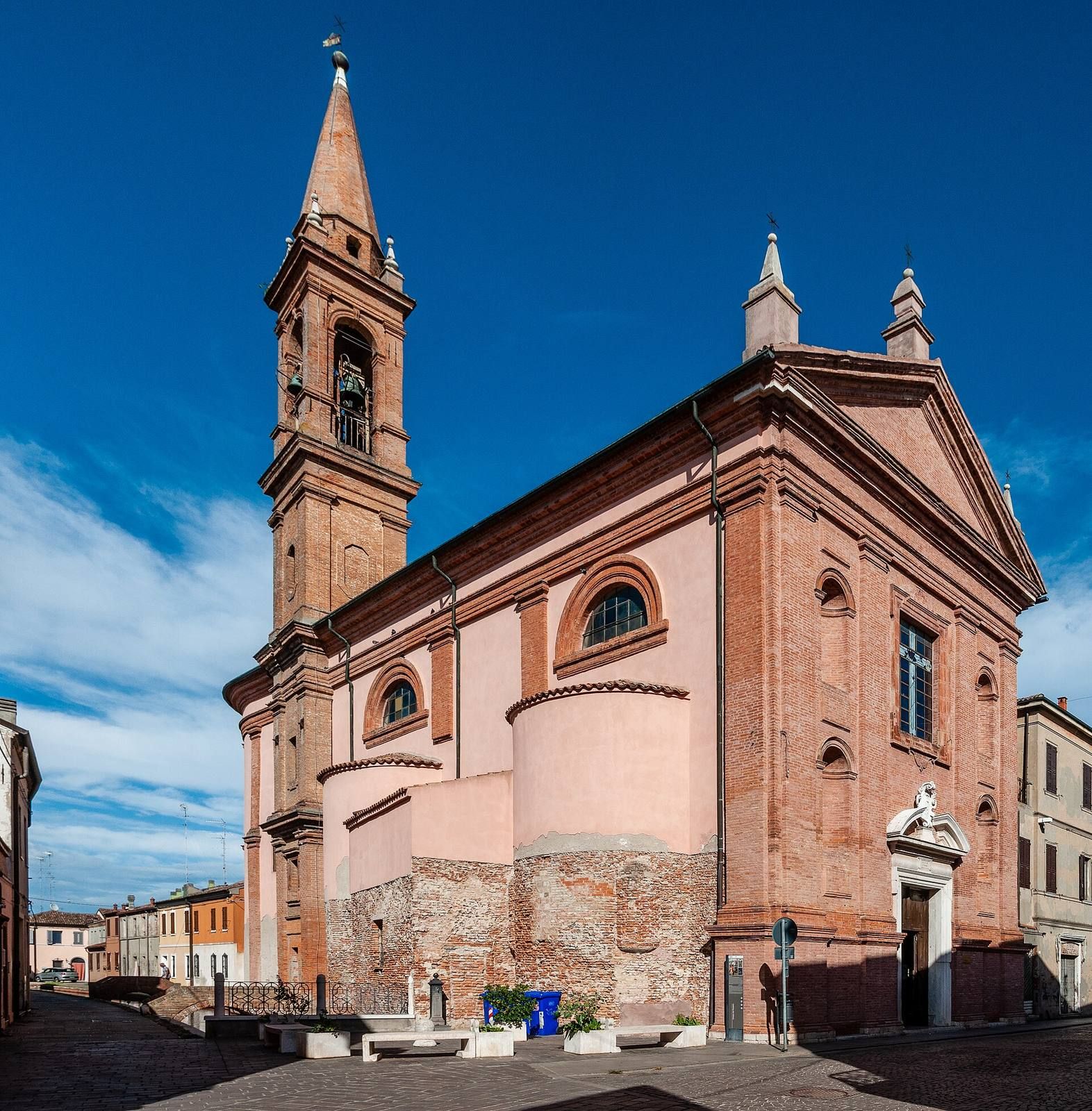
A bell tower was erected in 1632. After it collapsed in 1752, it was rebuilt the following year. Much of the church’s interior decoration was lost during the Second World War. Santo Rosario became a parish on 2 February 1952 and underwent renovation in 1958. It follows the Roman rite, the principal liturgical tradition of the Latin Catholic Church, and belongs to the Archdiocese of Ferrara-Comacchio, led by an archbishop, and the local administrative subdivision known as the Vicariate of San Cassiano.
Remains
Exterior
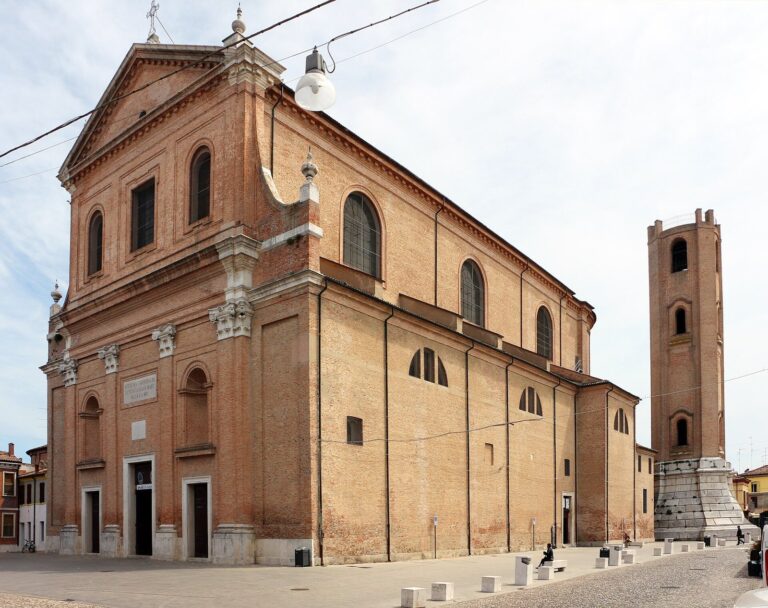
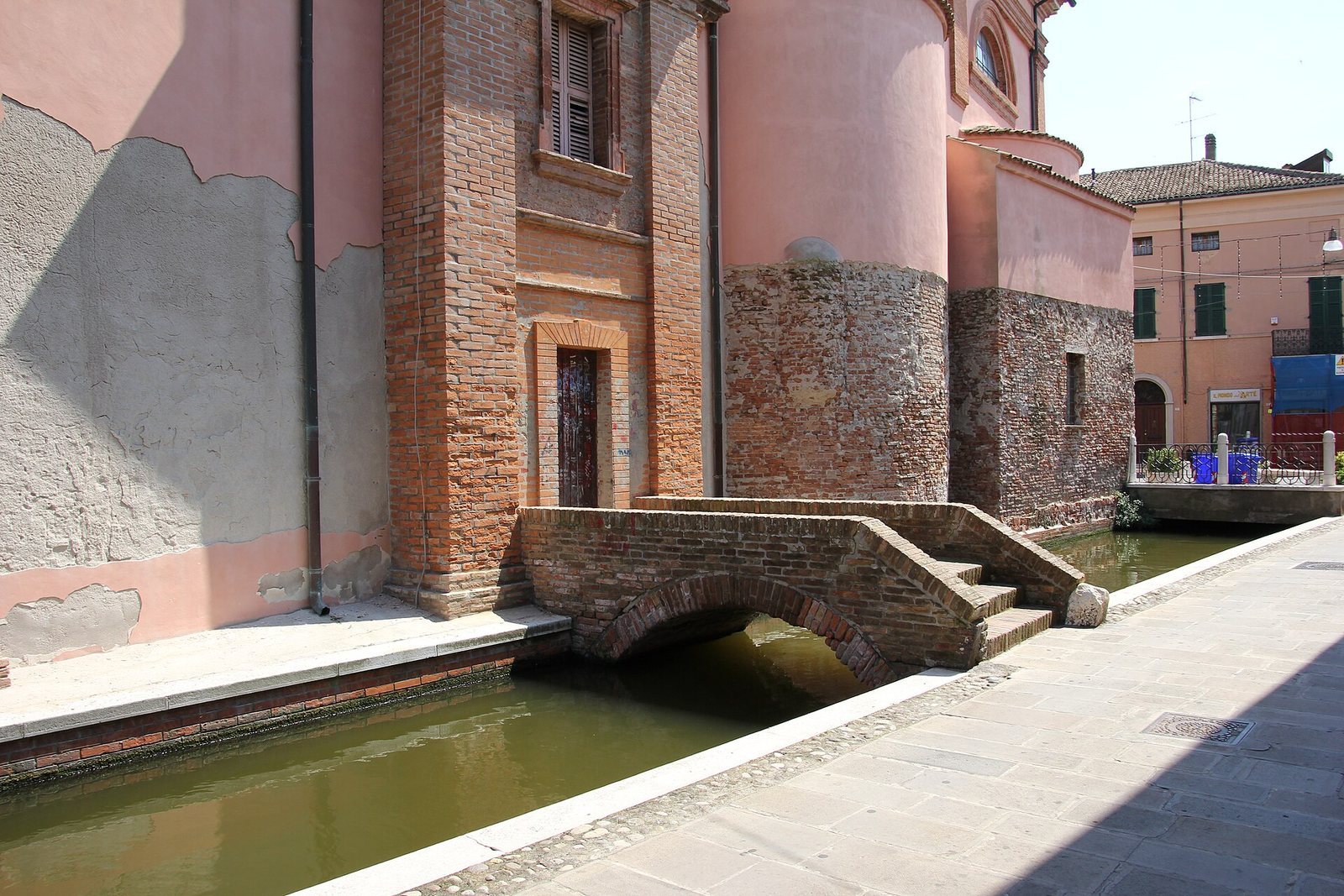
The church stands in Comacchio’s historic center on Via Sambertolo and is aligned north to south. Its red-brick front is divided into three vertical sections by pilasters, shallow supports attached to the wall. Four niches and a portal made of white Istrian stone, a pale building stone from the Istrian region, mark the façade. The left side is partly plastered, with the chapel structures visible; the right adjoins other buildings. Clay tiles cover the roof.
Interior plan
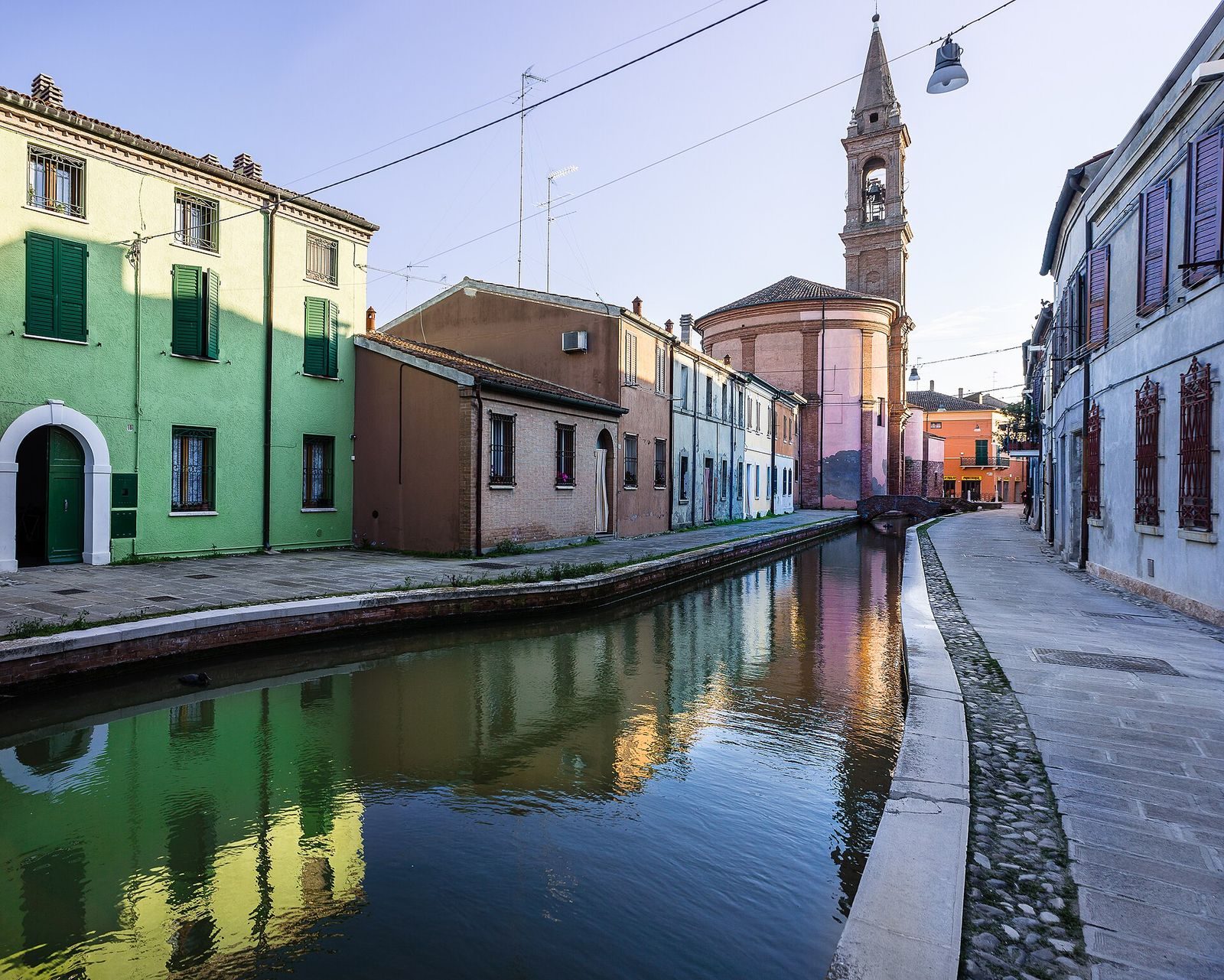
The interior has a single nave, the church’s main central space, with side chapels and a beige limestone floor edged in black marble. Three bays, or divisions along the nave, are separated by pilasters. Their capitals, the upper parts of the supports, carry an entablature, a horizontal structure running along the nave. Above it, a barrel vault forms a continuous arched ceiling. At the altar end, a chancel arch, which marks the transition to the altar area, leads to the slightly raised presbytery, the area around the altar. The presbytery ends in a semicircular apse, a recess at the end of the church. A bell tower stands beside it.
Altar and associated works
Main altar and altarpiece
The main altar was adapted to liturgical practices introduced by the Second Vatican Council, a major Catholic council held in the 1960s. Its altarpiece, a painting made for an altar, was painted by Cesare Mezzogori in 1661. It shows the Virgin of the Rosary with Saints Dominic and Justina. Mezzogori reworked a 1631 plague-votive painting by Guido Reni, a religious work associated with a vow during a plague. He retained the pose of the Virgin and Child but showed two saints receiving a rosary, rather than Reni’s seven saints pleading with them among angels. In the lower background, the Battle of Lepanto, a 1571 naval battle between an Ottoman fleet and the Holy League, appears beside an angel pointing toward it. The angel carries a banner with the Latin words Non armis sed rosis, meaning “not with arms but with roses,” expressing the idea that prayer brought victory. Francesco Samaritani, a member of the confraternity that administered the church, commissioned the painting.
Crucifix
A wooden crucifix carved by Filippo de Porris in 1641 stands at the main altar.
Side chapels
Right-hand chapel
The right-hand chapel contains Carlo Bononi’s Beheading of Saint John the Baptist, which captures the final moment of the saint’s life. The painting has been linked to Ludovico Carracci’s popular theatrical style, which Bononi had encountered.
Left-hand chapel
The left-hand chapel contains an Annunciation, attributed by later studies to Jacopo Bambini after it had previously been mistaken for a Flemish work. The scene shows the angel Gabriel announcing to Mary that she will bear Jesus. Mary prays as Gabriel flies into the room; above them, God the Father blesses her, with the Holy Spirit between them. Two donors pray in the lower part of the painting.
Other furnishings and images
Madonna of the Rosary
The church has a wooden statue of the Madonna of the Rosary and Child, acquired through a monetary donation to the confraternity. A deed from 1674 specifically requested a wooden statue of the Virgin of the Most Holy Rosary with the Child. The figure presents the Madonna seated frontally on a throne, wearing a white tunic with her hair parted; the Child sits on her knees.
Assumption fresco
A fresco, a painting made on wet plaster, by Mario Capuzzo dates to the 1950s. It depicts the Assumption, Mary’s being taken into heaven, among angels and saints. The artist’s wife restored it in 1993.
Baptismal font and confessional
The baptismal font is on the right in the central chapel, opposite the confessional.