Calydon: An Ancient City and Sanctuary of Aetolia
Site at a Glance
- Popularity
- High
- Country
- Greece
- Primary era
- Classical
- Eras represented
- Bronze Age, Iron Age, Classical
- Civilizations
- Ancient Greek, Mycenaean
- Site type
- City
On this page18 sections
History
Calydon was an ancient Greek city near modern Evinochori in Aetolia, a region of western Greece. Structures from the Mycenaean period, Greece’s Bronze Age civilization, show that the site was active in that era. Calydon later became a major Aetolian city in the Classical period and an influential member of the Aetolian League, a federation of communities in the region.
Myth and early history
Greek tradition credited the legendary king Aetolus with founding Calydon in the land of the Curetes and naming it for his son. A foundation around the 13th century BC has been proposed on the basis of this tradition, while the archaeological evidence points to Mycenaean activity. The city’s myths centered on King Oeneus and his son Meleager. In the Calydonian boar story, Artemis sent a destructive boar after Oeneus failed to offer her first fruits at the Thalysia, a harvest festival. Oeneus summoned heroes including Atalanta, Theseus, Peleus, Telamon, Castor and Pollux, Jason, and Amphiaraus, and Meleager killed the beast. Strabo gave a different account of its origins, making it the offspring of the Crommyon sow.
In Homer’s account, the Curetes, a people associated in myth with the region around Pleuron, tried to capture Calydon but were driven away by Meleager. The city was also among the Aetolian communities that sent ships to the Trojan War under King Thoas. In another episode of the Iliad, Diomedes, Oeneus’s grandson, restored Oeneus to the throne after the sons of Agrius had driven him out.
Classical and Hellenistic history
Calydon’s position near the entrance to the Gulf of Corinth may have given it strategic value, although its role in recorded historical events was relatively limited. In 391 BC the Achaeans held the city and sought help from Sparta against the Acarnanians. Calydon returned to Aetolian control after Thebes defeated Sparta at Leuctra in 371 BC. The Theban general and statesman Epaminondas is credited with restoring the city.
Roman decline and abandonment
During the Roman civil war between Julius Caesar and Pompey, Calydon supported Pompey in 48 BC, and the city’s decline began after his defeat. In 31 BC, following his victory at Actium, Octavian transferred Calydon’s inhabitants to Nicopolis, the city he had founded to commemorate that victory. Calydon was then abandoned. The sanctuary’s treasury and Artemis’s cult statue were taken to a temple at Patras. Other artworks, statues, and building materials were also removed, including a statue of Dionysus.
Rediscovery and later history
From 1720, Calydon also served as a titular see of the Catholic Church, an honorary bishopric linked to a historic place rather than an active diocese. This status was established after the end of the Venetian-ruled Kingdom of Morea in the Peloponnese. Leake identified the ruins in 1809; they were also known as the Kastro of Kurtaga.
Greek excavation at the sanctuary began in 1908. Greek and Danish teams carried out further campaigns in the 1920s and 1930s, and Danish archaeologist Ejnar Dyggve led additional work from 1928 into the late 1940s. The Danish Institute at Athens undertook further investigations in the 2000s.
Remains
Calydon occupied two hilltops and the valley between them on the slopes of Mount Arakynthos, about 11 kilometres from the sea. Although poetic descriptions called it high and rocky, the city itself was not built at great elevation. Its wider territory included a fertile plain, with the Evenus to the east and the Achelous to the west. A lake near the city was noted in antiquity for its fish.
City layout and defenses
Acropolis and urban layout
The acropolis, the city’s upper fortified area, lay in the northwest and occupied about one-tenth of the urban area. By the late 6th century BC, a sanctuary stood on its summit. The sanctuary of Artemis Laphria and Apollo Laphrios lay outside the city walls, southwest of the acropolis and between two valleys.
Walls and Sacred Way
Built in the early 3rd century BC, the city walls enclosed about 35 hectares and extended for roughly four kilometres. Several towers formed part of the defenses; sections survive, and the full course can be traced. Two towers protected the gate on the road toward Stratos. From the western gate, the Sacred Way ran about 400 metres toward the sanctuary. Treasuries stood along the route, which ended at the sanctuary’s main entrance.
Sanctuary of Artemis Laphria and Apollo Laphrios
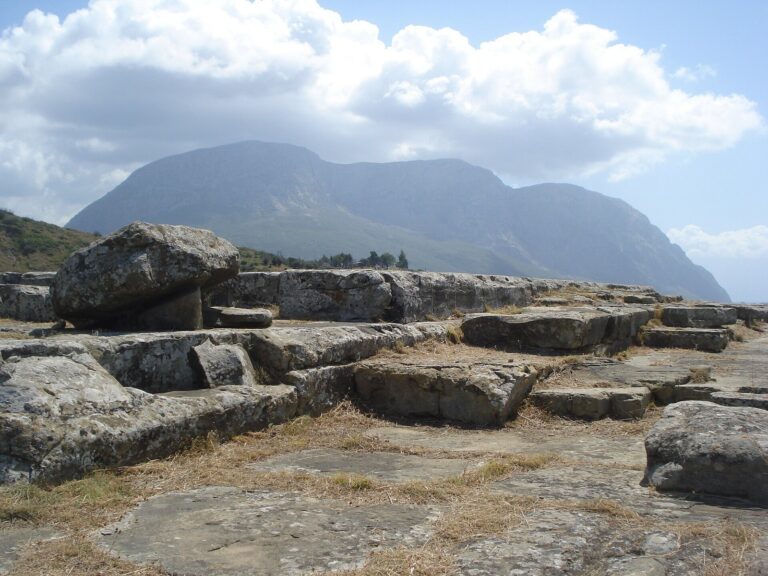
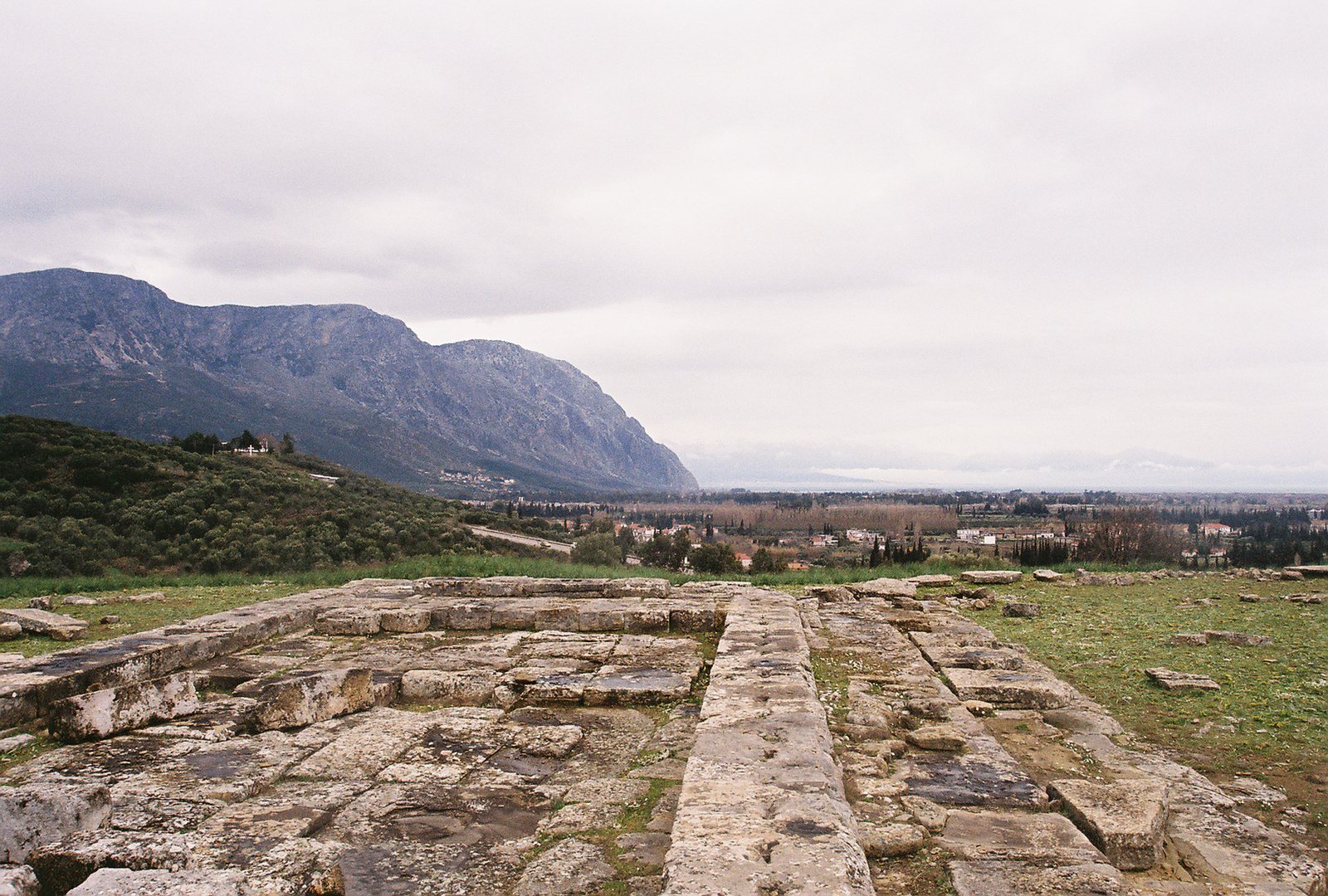
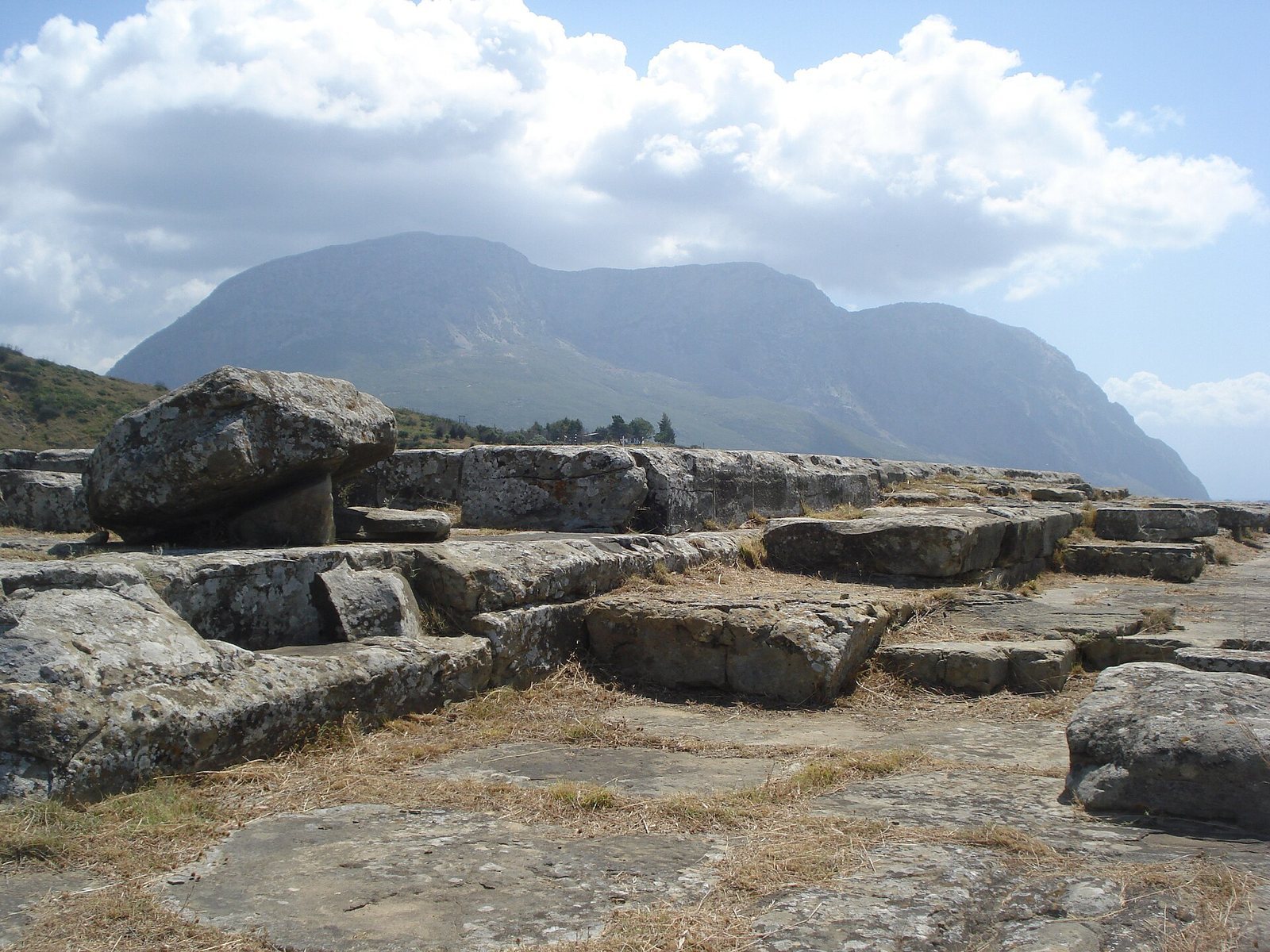
Known also as the Laphrion, the sanctuary was established by the Geometric period, an early Greek era following the Bronze Age, and no later than the 7th century BC. It became one of Aetolia’s major religious centers. A wall enclosed the sacred precinct, which acquired successive temples and other buildings.
Sixth-century temples
Two temples in the Doric style, with relatively plain column capitals, were built in the 6th century BC. Temple A was dedicated to Apollo, or possibly Dionysus, while Temple B was dedicated to Artemis. Both were renewed in the 5th century BC, and a portico was added to Temple B around 500 BC. Terracotta decorations from the temples included panels in the friezes and ornaments for roof edges and peaks, with subjects such as the labors of Heracles and sphinxes. Finds also include objects dedicated to Artemis and Dionysus.
Temple of Artemis and fourth-century renewal
The sanctuary was substantially renewed in the 4th century BC. A portico with six columns was built in its southeast part. Around 360 BC, a larger temple replaced Temple B. Built of poros stone, a soft, porous building stone, it had a single row of columns around it, with six at each end and thirteen along each side. Its inner chamber held twenty Ionic columns with scroll-shaped capitals. There stood a gold-and-ivory image of Artemis made by Menaikhmos and Soidas of Naupactus. The second-century Greek traveler Pausanias described the statue.
Northern complex and colonnaded hall
A large square complex was built in the northern part of the sanctuary in the 2nd or 1st century BC. It included a long, two-storey colonnaded hall with two aisles and large semicircular recesses at both ends. The sanctuary remained in use into the Roman period.
Theatre and lower-town structures
Theatre
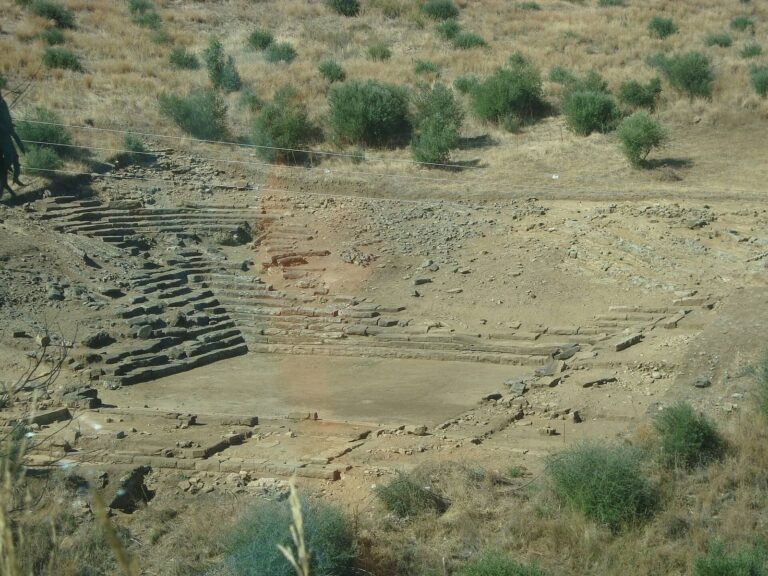
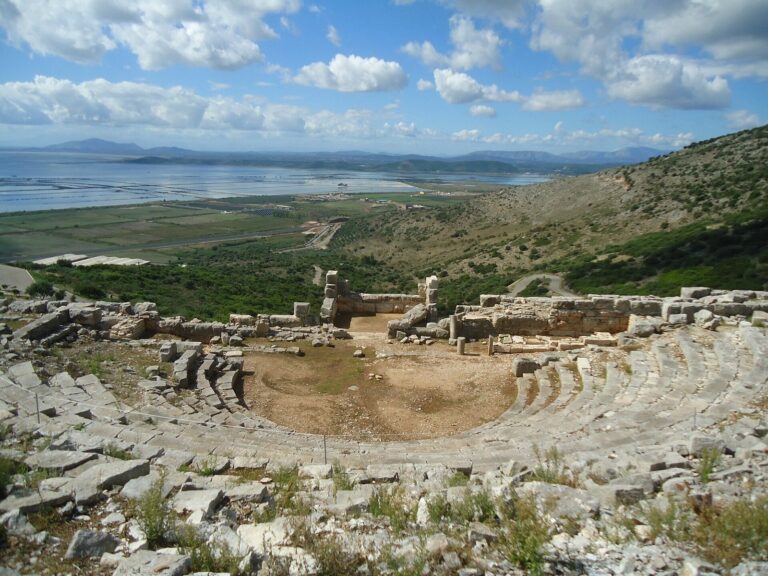
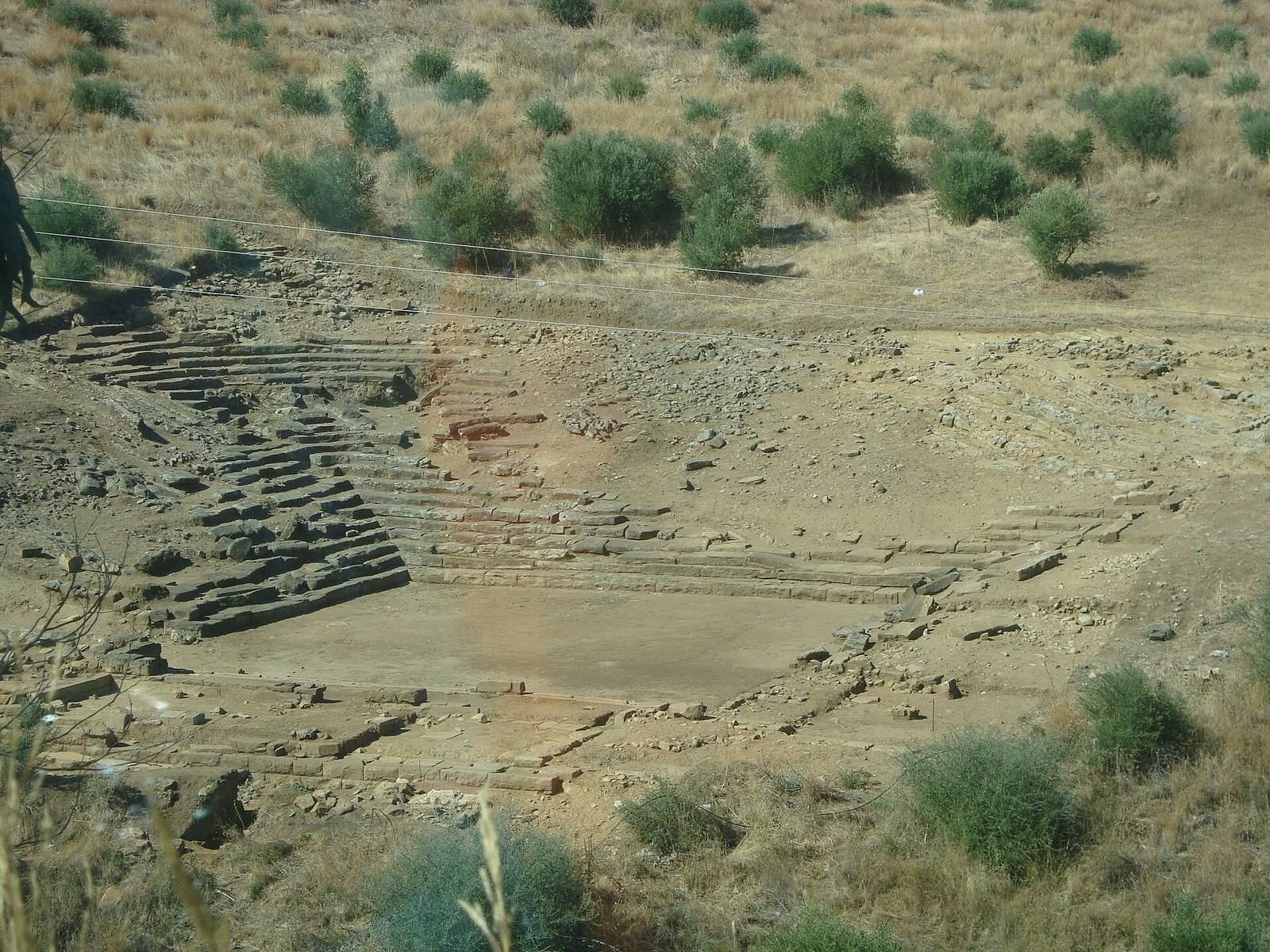
A theatre of the Hellenistic period, the era following Alexander the Great’s conquests, stood on the slope south of the sanctuary. Its plan was unusually square, and its seating could accommodate about 5,000 people.
Courtyard building and kilns
A building in the lower town had a courtyard surrounded by columns and is thought to have served as a sports facility. One of its rooms was a shrine of Cybele, an Anatolian mother goddess. Kilns were also found in the lower town.
House in the lower acropolis
Excavation in the lower part of the acropolis uncovered a house dating to the 2nd century BC.
The Leonteion
The Leonteion, a hero shrine built in the 2nd century BC and believed to mark the tomb of Calydonian hero Leon, measured about 37.5 by 34.4 metres. Its columned courtyard was about 16.8 metres square. An entrance structure stood on the north side, with rooms along the east, south, and west. The north room’s wall bore figures of gods and heroes from Calydonian mythology. Beneath the complex lay a vaulted underground tomb containing a stone sarcophagus shaped like a couch. Finds from Calydon are held mainly in the National Archaeological Museum in Athens, with others in the Archaeological Museum of Agrinio. They include terracotta architectural decorations from the temples and the stone door from the Leonteion tomb.