Santa Maria di Monserrato: A Baroque Church in Palermo
Site at a Glance
- Popularity
- Low
- Country
- Italy
- Primary era
- Early Modern
- Eras represented
- Early Modern, Modern
- Civilizations
- Italian, Kingdom of Sicily, Kingdom of the Two Sicilies, Spanish
- Site type
- Religious
- Remains
- Church
On this page11 sections
History
Santa Maria di Monserrato is a Baroque church built in 1690 in Palermo, Italy, on a site that had earlier served as a villa, an isolation hospital, a temporary residence for Sicily’s viceroys, and a hospice for poor girls. A viceroy governed a territory on behalf of its monarch. The church’s history reflects the changing religious and social uses of this property outside Palermo’s walls.
Villa, epidemic hospital, and viceregal residence
In the sixteenth century, the villa and its grounds belonged to Pietro de Luna, Duke of Bivona. In 1575, during the plague of San Carlo, the property became a lazaretto, a facility for isolating people during epidemics. The disease came from Oran, reached Sicily from the south through Sciacca, and was brought by Italian seaborne raiders who had sacked Oran.
In 1600, Luca Cifuentes restored the building and made it a temporary residence for Sicily’s viceroys. They stayed there on arriving in Palermo while awaiting their formal installation. For a brief period, the Monastery of San Giovanni dell’Origlione administered the property. It served again as an isolation hospital during Palermo’s 1624 plague, which came from Tunis through Trapani.
Hospice, church, and confraternity
In 1668, the complex became a home for poor girls run by the Congregation of the Refuge of the Poor, founded in 1632. Its patron was Fernando Afán de Ribera y Enríquez Jr., son of the former Sicilian viceroy and Duke of Alcalá. The congregation was linked to the Company of Saint Dionysius and the Congregation of the Seven Corporal Works of Mercy, Christian acts of practical care. The institution and its chapel were dedicated to Mary of the Seven Sorrows, a devotion focused on Mary’s grief at Christ’s suffering and death.
The church was built in 1690. On April 4, Archbishop Ferdinando Bazan y Manriquez and Capuchin missionaries, members of a branch of the Franciscan order, led a procession to collect alms in the Reclusorio area. The preacher Antonio da Olivadi, born Giuseppe Punteri, had advised the archbishop. The landscape was associated with Calvary, and the procession placed six crosses on the plain before the villa and another by the chapel entrance stair. The area became known as the Plain of the Seven Crosses. Asdrubale Termini dedicated the church to Mary of the Seven Sorrows.
In 1820, merchants, boatmasters, and boat owners formed the Congregation of the Holy Crucifix at the Borgo under the title of Our Lady of Montserrat, a Marian devotion associated with Catalonia. Its statutes, approved on September 10, 1830, set out its aim of fostering devotion to the dead Christ and the Sorrowful Mother, with members expected to pass this duty from parent to child. Veneration of a crucifix then kept at Santa Lucia al Borgo had prompted the congregation’s formation. Its Good Friday observances became part of Palermo’s Holy Week.
Nineteenth- and twentieth-century changes
A court assigned the property to Ernesto Wilding, Prince of Butera, in 1844. After Viale della Libertà opened and the English Garden was created in 1851, architect Giovan Battista Filippo Basile directed construction of the church facade in 1853. Giuseppe Enea and Francesco Padovani decorated the chapel in 1900.
Bombing in 1943, during the Second World War, almost completely destroyed the conservatory. The chapel was the only part of the original complex to survive; the property was later rebuilt and adapted, and it ceased to serve as a home for poor girls. Santa Lucia al Borgo was also badly damaged and subsequently demolished, and its parish title passed to Santa Maria di Monserrato. Restoration work on the church’s paintings took place in 1981, followed by work on the roofs, paintings, and facade in 2007 and 2008. The church belongs to the Archdiocese of Palermo, an ecclesiastical jurisdiction led by an archbishop.
Remains
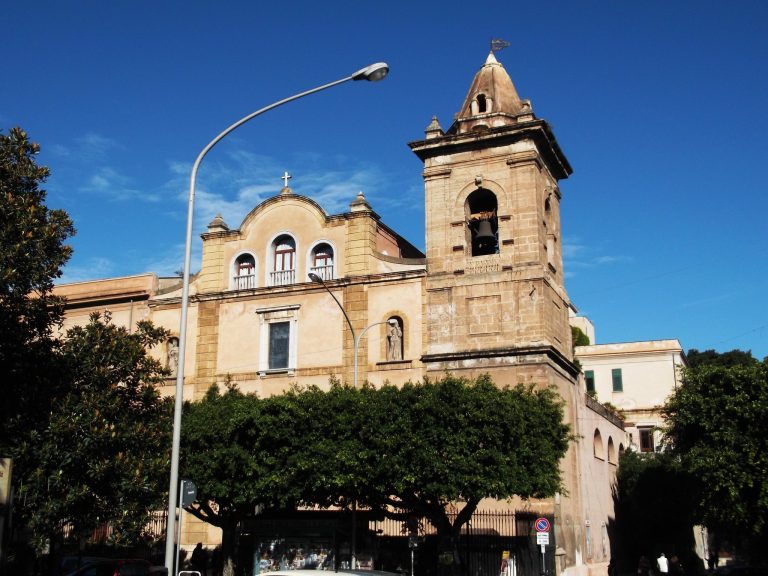
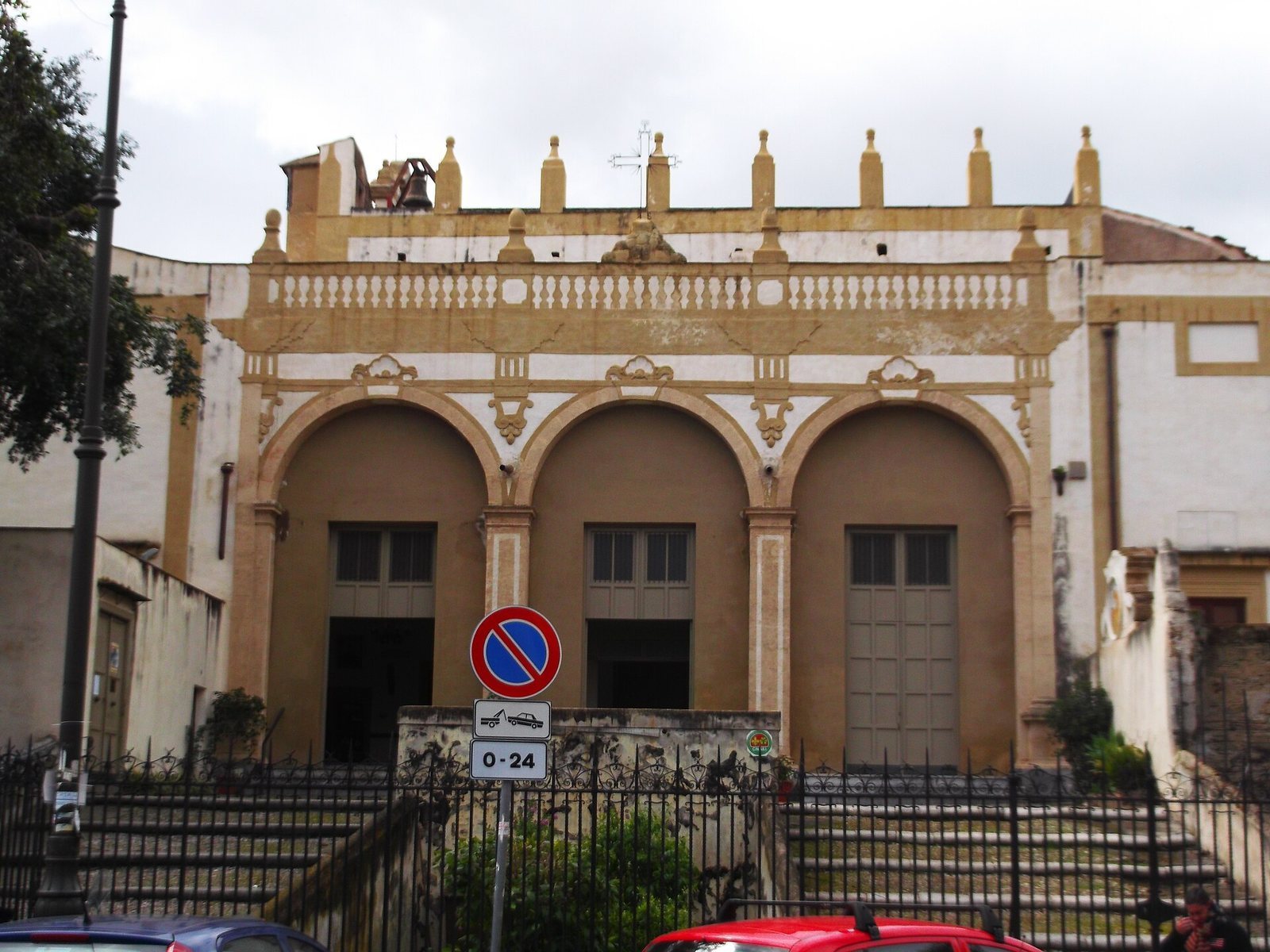
The surviving church has a Baroque interior and an exterior shaped by a Romantic interest in medieval architecture. It stands at Via delle Croci and Via Carlo Alberto dalla Chiesa, beside Viale della Libertà and the English Garden. A road cut truncates the building, and two stairways connect its ground level to the roadway.
Exterior
The facade has a three-arched open gallery built from tufa, a porous building stone. Its design evokes a medieval ruin, with Gothic lines drawing on Norman, Chiaramontan, and Catalan influences. Chiaramontan describes a Sicilian Gothic style associated with the Chiaramonte family. A small open bell chamber rises above the side elevation.
Interior
Nave and choir
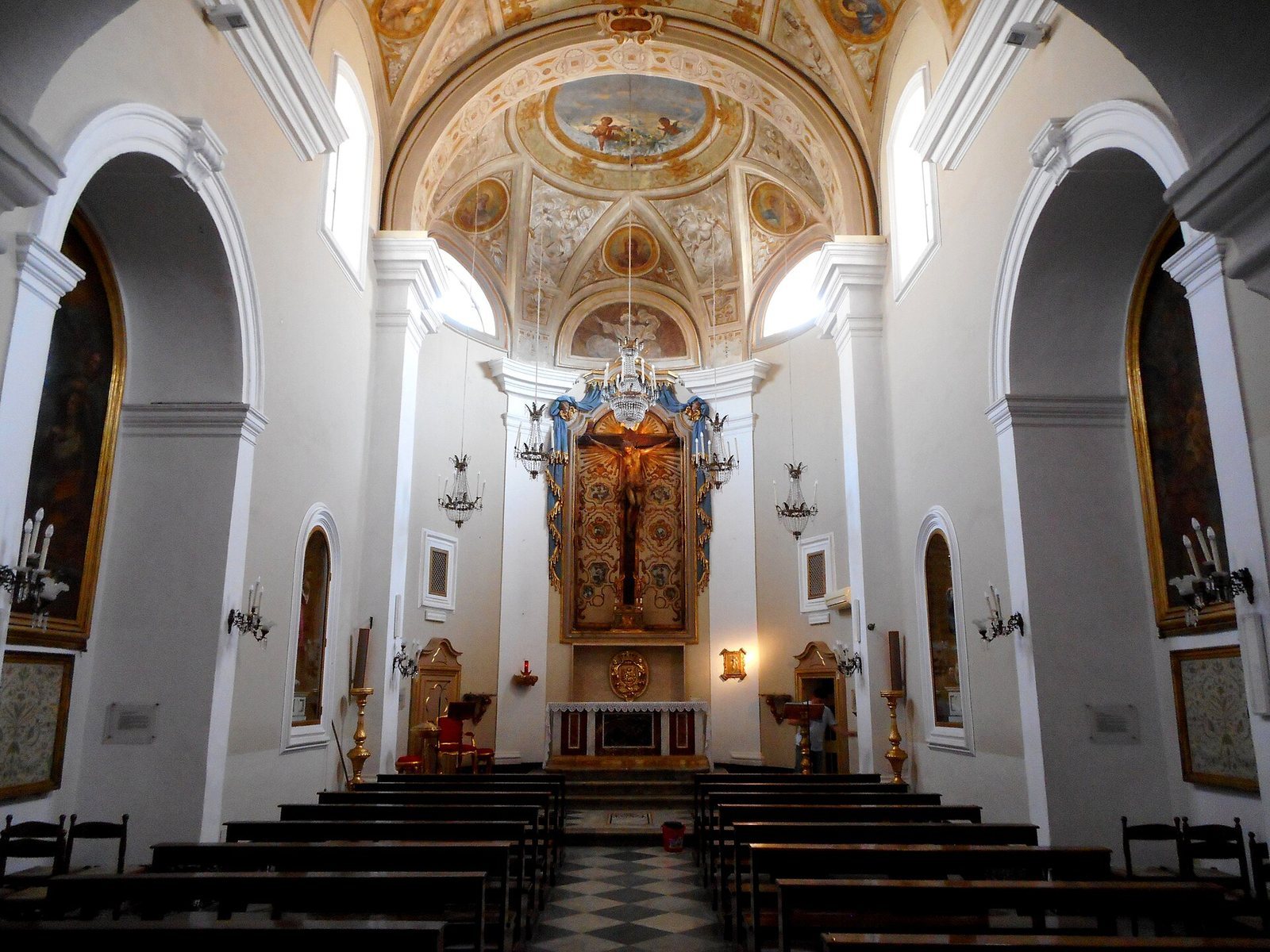
The church has a single nave, with three altars set in chapels and wall niches. Beneath the choir are intersecting vaulted ceilings and three shallow arches supporting a choir divided into three sections.
Painted ceilings and walls
The curved ceiling depicts Mary grieving at the foot of the Cross, winged angels, and two groups of childlike figures painted in a single color. Four medallions show Saint Augustine, Saint Monica, Saint Alphonsus Maria de’ Liguori, and Saint Rosalia. On the right wall, a medallion associated with Anna Vella and Lo Bianco is dated 1806; nearby is Raffaello Visalli’s depiction of the Holy Family, dated 1744.
At the rounded end of the church, the curved surface above the apse depicts the Eternal Father. Three medallions show Saint John the Baptist, Saint Peter, and Saint Paul, while the trapezoid-shaped ceiling sections are painted with childlike figures in a single color.
Chapels and altars
On the left, a vestibule contains an eighteenth-century wooden door. The Chapel of the Sorrowful Mother has a seventeenth-century wooden statue of Saint Joseph with the Child on its altar. An image of Santa Maria di Montserrat stands on the altar in the Chapel of Our Lady of Montserrat. The main altar consists of a crucifix placed on a reliquary, a container for religious relics.
Sculptures and procession objects
The church holds an old wooden statue of Saint Lucy brought from the demolished Santa Lucia al Borgo. A seventeenth-century papier-mâché crucifix by an unknown maker, once kept in a chapel at Santa Lucia al Borgo, is also housed here. A platform bearing the Sorrowful Mother and a case containing the dead Christ are carried in the confraternity’s Good Friday procession.