Old Cemetery in Oppeln: A Former Municipal Burial Ground
Site at a Glance
- Popularity
- Low
- Country
- Poland
- Primary era
- Modern
- Eras represented
- Modern
- Civilizations
- German, Kingdom of Prussia
- Site type
- Burial
- Remains
- Necropolis
On this page15 sections
History
The Old Cemetery in Oppeln, Poland, was established in 1813 as the city’s permanent municipal burial ground under Prussian rule. Prussian authorities had required cemeteries to be placed beyond city walls from 1810, but a suitable site was not immediately available. The burial ground was therefore laid out provisionally beside a rifle range in the Oder Suburb. Consecrated in December during epidemics of typhus and nervous fever, it met an urgent need for burial space and was sometimes called the Oder Cemetery.
Foundation and shared administration
The cemetery was intended for Christian burials. Protestants and Catholics administered it jointly until 1874, with separate areas assigned to the two confessions and to military burials. Later rules set its service area to include Oppeln, Pasieka, Grudzice and the Malinka housing estate, while Evangelicals from Groszowice could also be buried there. Graves were initially maintained for 50 years, with extensions permitted.
The cemetery became the burial place of several civic, military and cultural figures. These included politician and mayor Friedrich Wilhelm Leopold Augustini (1770-1841); lieutenant general Jakob Friedrich von Holtzendorff (1741-1820); and Carl Heinrich Fabian Count von Reichenbach (1778-1820), a Prussian administrative jurist who headed the Oppeln district from 1816 to 1820. Other burials included Prussian officer Bernhard Karl Ludwig Friedrich von Schöning (1787-1813), photographer Max Glauer (1867-1935), writer and local historian Elisabeth Grabowski (1864-1929), and pastor Caspar Wrzodek (1835-1907).
Expansion and overcrowding
The municipal authorities took over the cemetery’s management in 1874. The grounds were enlarged in 1860, 1872 and 1888, including a northwest extension in 1872-73. A further expansion in 1903 added 1.1 hectares to the north. Dense building development around the cemetery eventually restricted further growth.
By 1 April 1911, every burial plot was occupied, and reuse was limited to abandoned graves. A new main cemetery opened at Halbendorf in 1920, drawing an increasing share of burials while the older cemetery remained in use. From 1923 to 1930, annual burials ranged from 529 in 1924 to 603 in 1929, about 20 times the number at Oppeln’s other cemetery in Zakrzów.
Flooding, closure and British burials
The cemetery’s low position in the Oder floodplain exposed it to flooding and high groundwater. These conditions sometimes prevented burials and required the use of substitute cemeteries. After groundwater rose following a flood in 1930, burials stopped as work on a relief canal began. The cemetery closed in 1931.
The grounds received 41 British military burials and two British civilian burials. In February 1925, the remains of 11 men who had died before the official First World War end date of 31 August 1921 were moved to the Commonwealth War Graves Commission cemetery at Stahnsdorf, southwest of Berlin. The Commission identifies and cares for Commonwealth war graves and memorials. Thirty British servicemen who died in 1921 and 1922 were not exhumed. Under the official cutoff, deaths after 31 August 1921 were not treated as war deaths for the Commission’s purposes.
In 1934, a road, now Niemodlińska Street, was built through the oldest southern part of the cemetery. After Oppeln came under Polish administration in 1945, German inscriptions were removed from almost all gravestones, name plaques were broken, and many gravestones were taken away. Some German burials were transferred to mass graves at Półwieś. The cemetery returned to use from 1945 until its final closure in 1963.
Postwar changes and protection
An inventory in 1984 counted about 2,700 graves, roughly 2,500 of them from before the Second World War. The 1997 Oder flood inundated the cemetery and caused extensive damage. In 2016, excavation for a proposed dog park led to the abandonment of the plan. A regional German-minority project also documented the cemetery’s history and published its findings.
After several years of campaigning for protection and restoration, the cemetery entered the Opole Voivodeship monument register on 20 May 2020. It has not been used for burials since 1963 and has remained vulnerable to repeated vandalism.
Remains
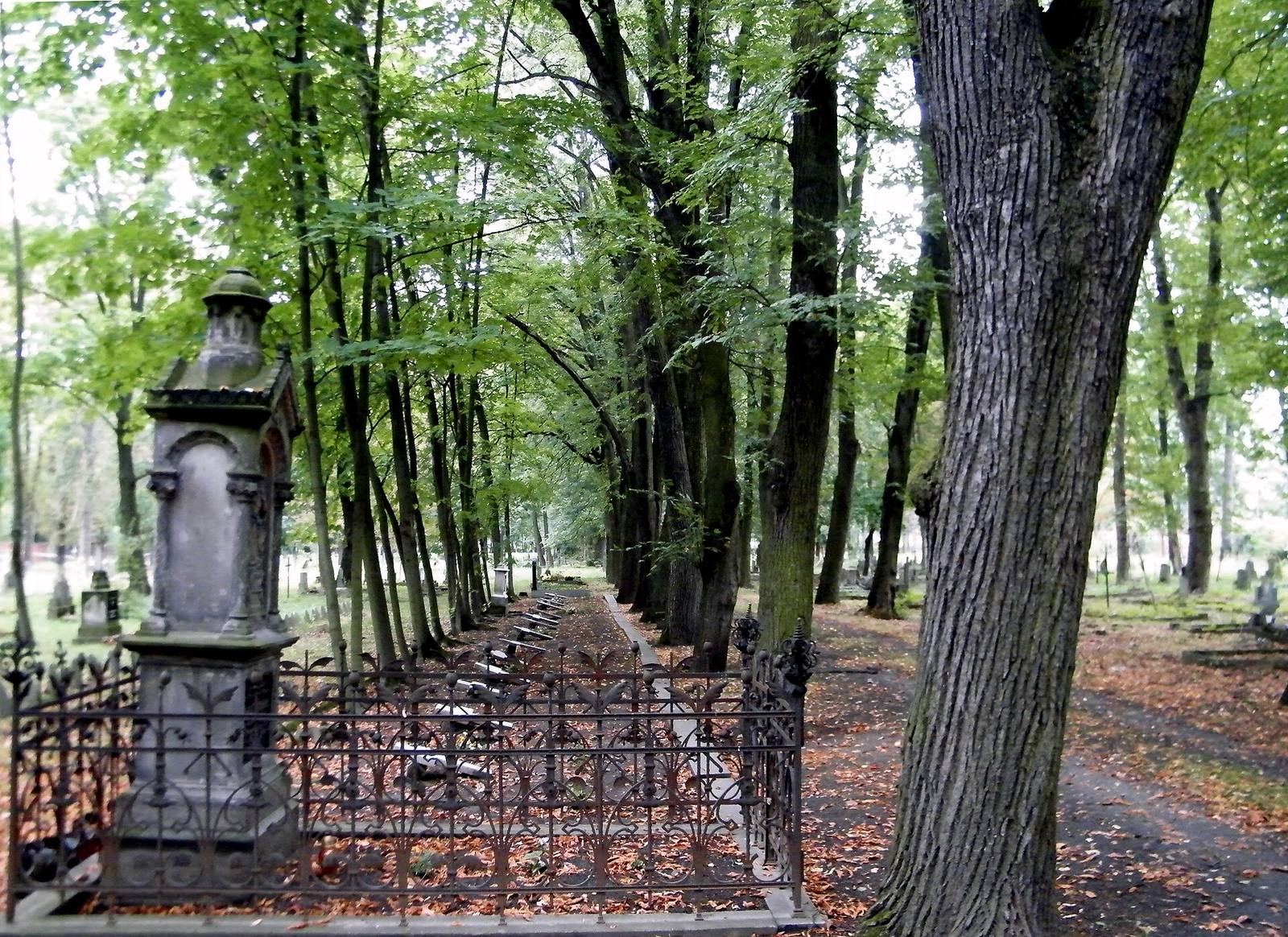
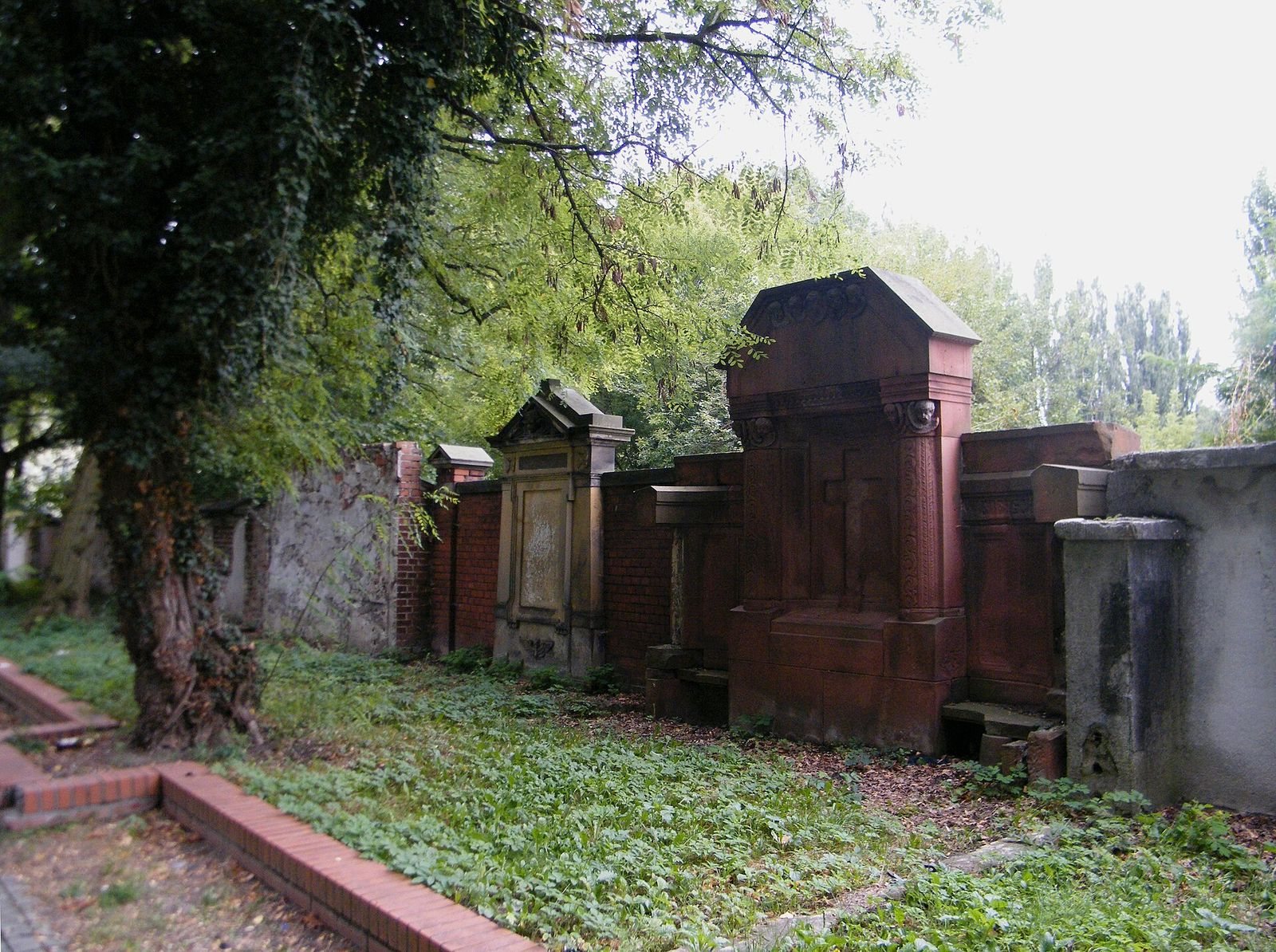
The cemetery occupies low-lying ground in the Oder floodplain, on Wrocławska Street in the Oder Suburb. Its present area is 6.5 hectares, compared with 8 hectares before the road was built through the southern section in 1934. Part of the former cemetery land is now public green space, while part was used for the road. The burial areas were divided among Catholics, Protestants and military burials. A cemetery wall was built in 1850, and a perimeter fence forms part of the site.
Cemetery buildings
Administrative building and mortuary
Building work in 1874 included an administrative building, a chapel and a mortuary. The administrative building now houses the municipal green-space service, while the old mortuary survives as a ruin.
Interdenominational cemetery chapel
The interdenominational cemetery chapel is dated to 1901-02. Built of red brick, it uses the Neo-Gothic style, a revival of medieval Gothic architecture.
Beyer family tomb chapel
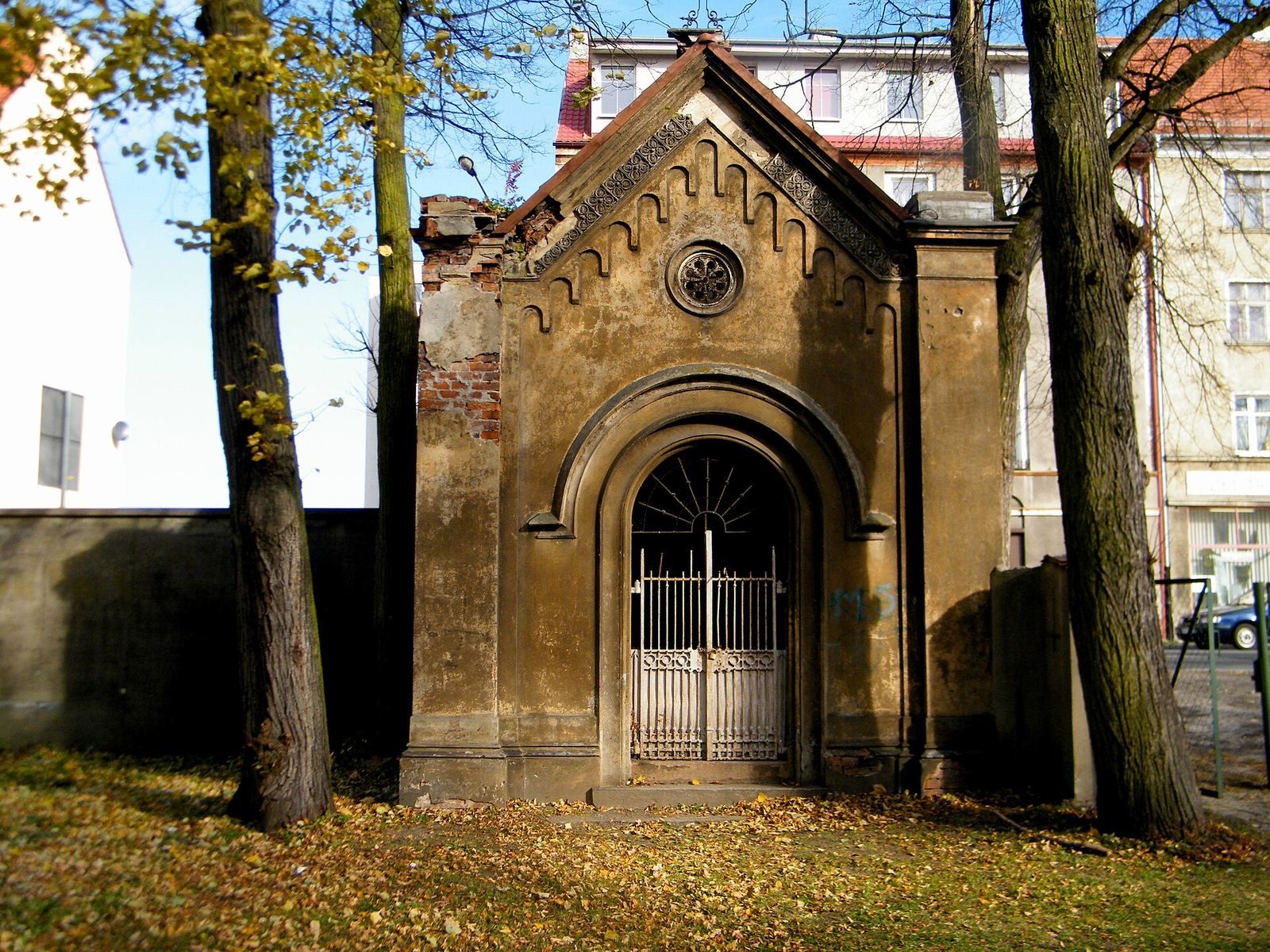
The Beyer family tomb chapel has a plastered façade and a Neo-Romanesque design, a revival drawing on medieval Romanesque architecture.
Tombs and memorials
Süssenbach family tomb
The oldest surviving tomb belongs to the Süssenbach family. It commemorates Christian Jan Süssenbach, a royal chief forester who died in 1832, and Cathrina Ernestin Süssenbach, who died in 1831. A royal chief forester managed royal forests.
War memorial
An obelisk erected in 1910 commemorates those killed in the Prussian-Austrian War of 1866, the conflict between Prussia and Austria.
British servicemen’s burial place
The burial place of the British servicemen whose remains stayed in the cemetery is thought to be near the Beyer family chapel, possibly in the southeast corner.
Excavated graves
Excavations in 2016 exposed graves and gravestones beneath the ground in the area proposed for the dog park.