Huqoq: An Ancient Jewish Village and Synagogue in Israel
Site at a Glance
- Popularity
- Medium
- Country
- Israel
- Primary era
- Classical
- Eras represented
- Classical, Early Modern, Modern
- Civilizations
- Byzantine, Ottoman, Roman
- Site type
- City
On this page17 sections
History
Huqoq is an archaeological site of an ancient village in Israel’s Lower Galilee. A large Jewish settlement flourished there in the Roman period, within a sequence of occupation that extended from the Bronze Age into the Ottoman era.
Early occupation and biblical identification
Archaeological evidence points to separate periods of occupation from the Early and Middle Bronze Ages through the Iron Age, Persian imperial rule, and the Hellenistic period, which followed Alexander the Great’s conquests and brought Greek cultural influence. Later phases belong to the Roman and Byzantine eras, followed by rule under the Abbasid and Fatimid caliphates, the Mamluks, and the Ottomans. The Byzantine period was the later eastern Roman Empire.
The Hebrew Bible mentions Huqoq in Joshua and Chronicles, but its identification with this archaeological site remains plausible rather than certain. One difficulty is that the proposed location may be too far from Aznoth-tabor to fit the description in Joshua. Chronicles associates Huqoq with a Levitical city of Asher, a town assigned to the Levites, the Israelite tribe associated with religious service. A related passage in Joshua names Helkath instead. Huqoq may have replaced Helkath in a later list, or Helkath may have been an earlier name for the settlement.
Roman and Byzantine settlement
In the Roman period, Huqoq was a prosperous Jewish village whose water supply included a constant spring. Its synagogue is one indication of the community’s Jewish character. Animal remains point to professional butchery in the ancient settlement, in contrast to butchery by farmers in the later Muslim-period community. Late Roman and Byzantine rabbinic writings also refer to the settlement. Eusebius, a Christian bishop and historian of Caesarea who lived in the third and fourth centuries, identified biblical Huqoq with a village of his own time. Rabbinic texts indicate that the Jewish village survived the Bar Kokhba revolt.
At least three rock-cut hiding complexes are associated with Huqoq. System 2 appears to have been used especially during the First Jewish Revolt, the Jewish uprising against Roman rule from 66 to 70 CE. Two construction phases have been proposed, possibly linked respectively to that revolt and the Bar Kokhba revolt of 132 to 136 CE. Some finds may reflect preparations for the later uprising, but they do not establish that it spread to Galilee. System 2 seems to have been abandoned after the revolt was suppressed.
A separate hoard of 22 bronze coins, discovered in 2025, dates to 351–352 CE, during the Gallus revolt, another Jewish uprising against Roman rule. The hoard indicates that the underground complex was used again centuries after its construction. Its carefully chosen hiding place has been interpreted as a sign that the owner hoped to recover the coins.
Medieval and Ottoman periods
The underground complex saw limited use in the Middle Ages. Sparse pottery from the Crusader period suggests occasional activity, while tools from other rooms point to some reuse under the Mamluks. A hoard of 24 Crusader bullion coins, valued largely for their precious-metal content, was concealed in the northern complex between 1140 and 1163 CE. Most were minted under Baldwin III, king of Jerusalem during the Crusader period, when Latin Christian states held territory in parts of the eastern Mediterranean. The cache may have belonged to a Frankish or local inhabitant.
A tomb at Huqoq has been identified in Jewish, Christian, Druze, and Muslim traditions as the burial place of Habakkuk, a prophet in the Hebrew Bible. Pilgrimage to the tomb is recorded from the twelfth century. The Jewish travelers Samuel ben Samson and Menahem ben Perez of Hebron referred to it in 1210 and 1215, and a travel account dated 1270–1291 gives a fuller description. The English traveler John Sanderson recorded the Jewish identification in 1601. The attribution has been questioned because it may depend only on the resemblance between the names Huqoq and Habakkuk. Jewish and Druze pilgrims continue to visit the tomb.
The Palestinian Arab village of Yaquq was built on the ancient site and existed during Ottoman rule. A Tegart fort, a fortified police post built by British authorities in Palestine during the Mandate period, was constructed nearby on 11 July 1945 by Solel Boneh, the construction arm of the Histadrut, a Jewish labor federation. Kibbutz Huqoq was also established nearby in 1945 by former Palmach members, the elite fighting force of the Haganah, and youth movements associated with the labor movement. The kibbutz took its name from the biblical Huqoq. Yaquq was depopulated during the 1948 war, and its buildings were bulldozed in 1968.
Modern archaeological work
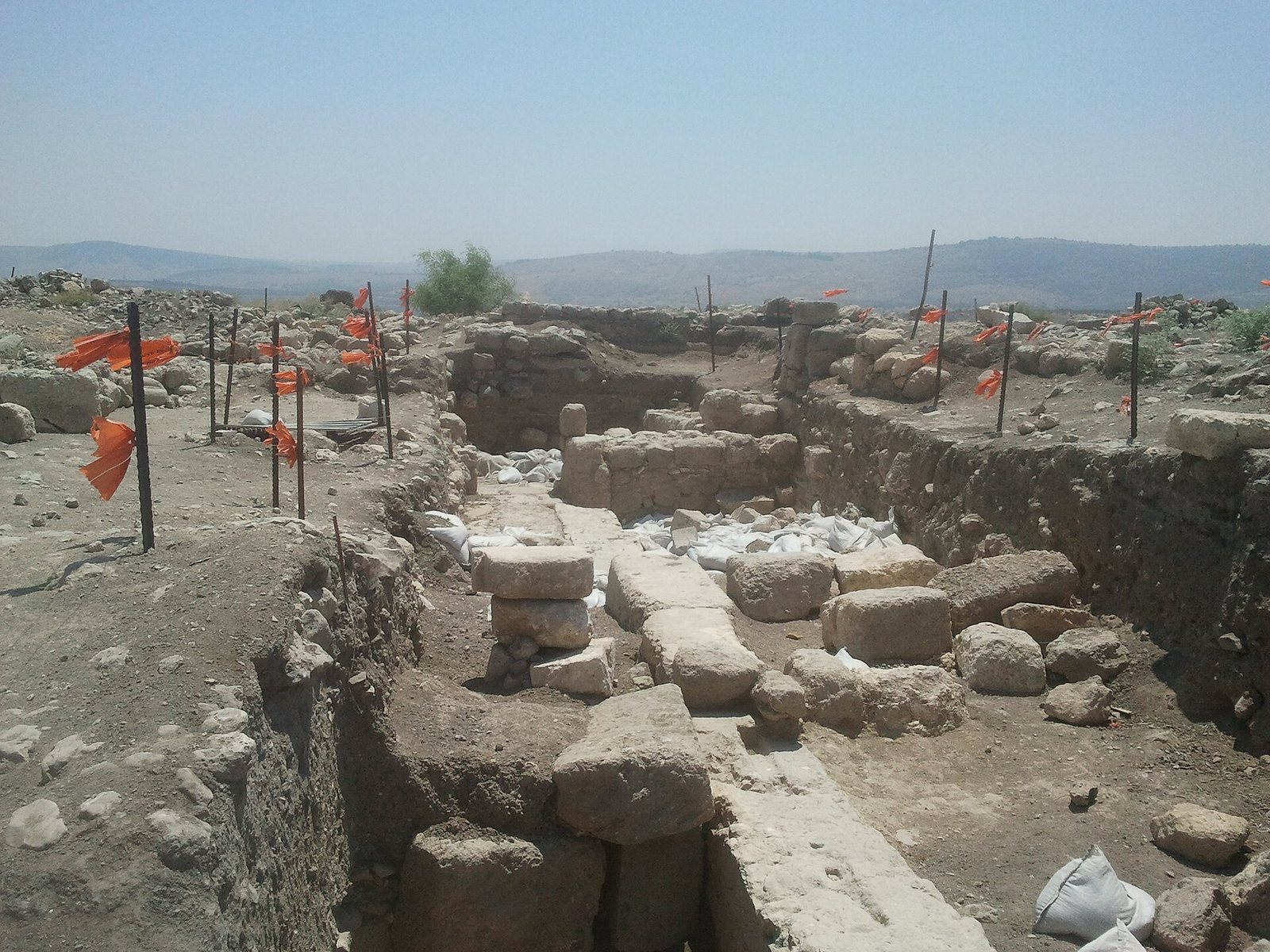
Excavations at Huqoq began in 2011 under the direction of archaeologist Jodi Magness, with David Amit and Shua Kisilevitz also associated with the project. Work continued through at least 2019. A cemetery survey took place in 2013, and excavation of the hiding complex involved local residents, students, cave-club volunteers, and soldiers from an army underground-operations unit. Mosaics uncovered during excavations from 2014 to 2017 entered a period of conservation.
Remains
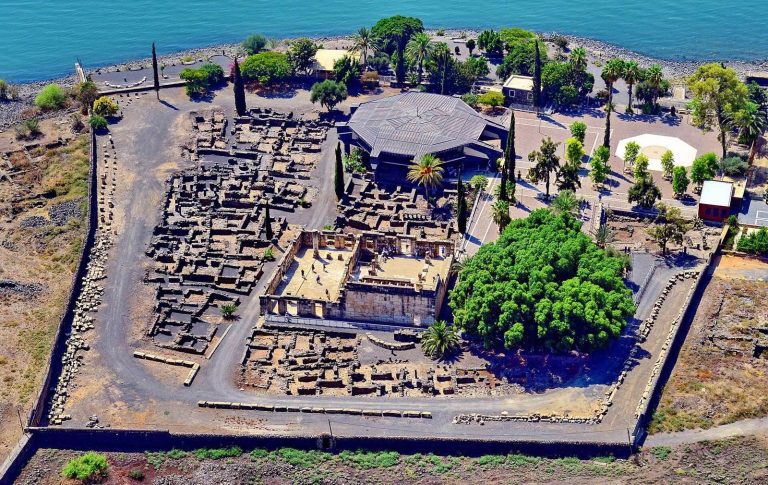
The archaeological area covers about 25–30 dunams, or roughly 25,000–30,000 square metres. It brings together village remains, a monumental synagogue, features cut into bedrock, and underground passage systems. Dressed stone was used in the synagogue, while the hiding complex and other installations were cut into rock.
Village setting and footprint
The site lies about 12.5 kilometres north of Tiberias, near the Sea of Galilee and uphill from Capernaum and Magdala. It is listed at about 20–25 metres above sea level. Remains of Yaquq cover roughly a third of the site, to the north of the archaeological area; architectural fragments were reused in later buildings there. A spring at the foot of the northeastern slope supplied water to Yaquq and also supported the ancient settlement.
Burial and agricultural remains
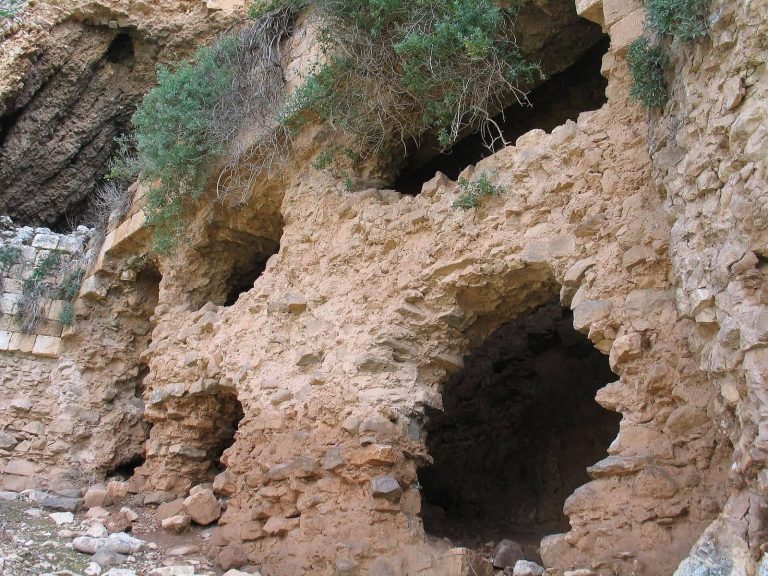
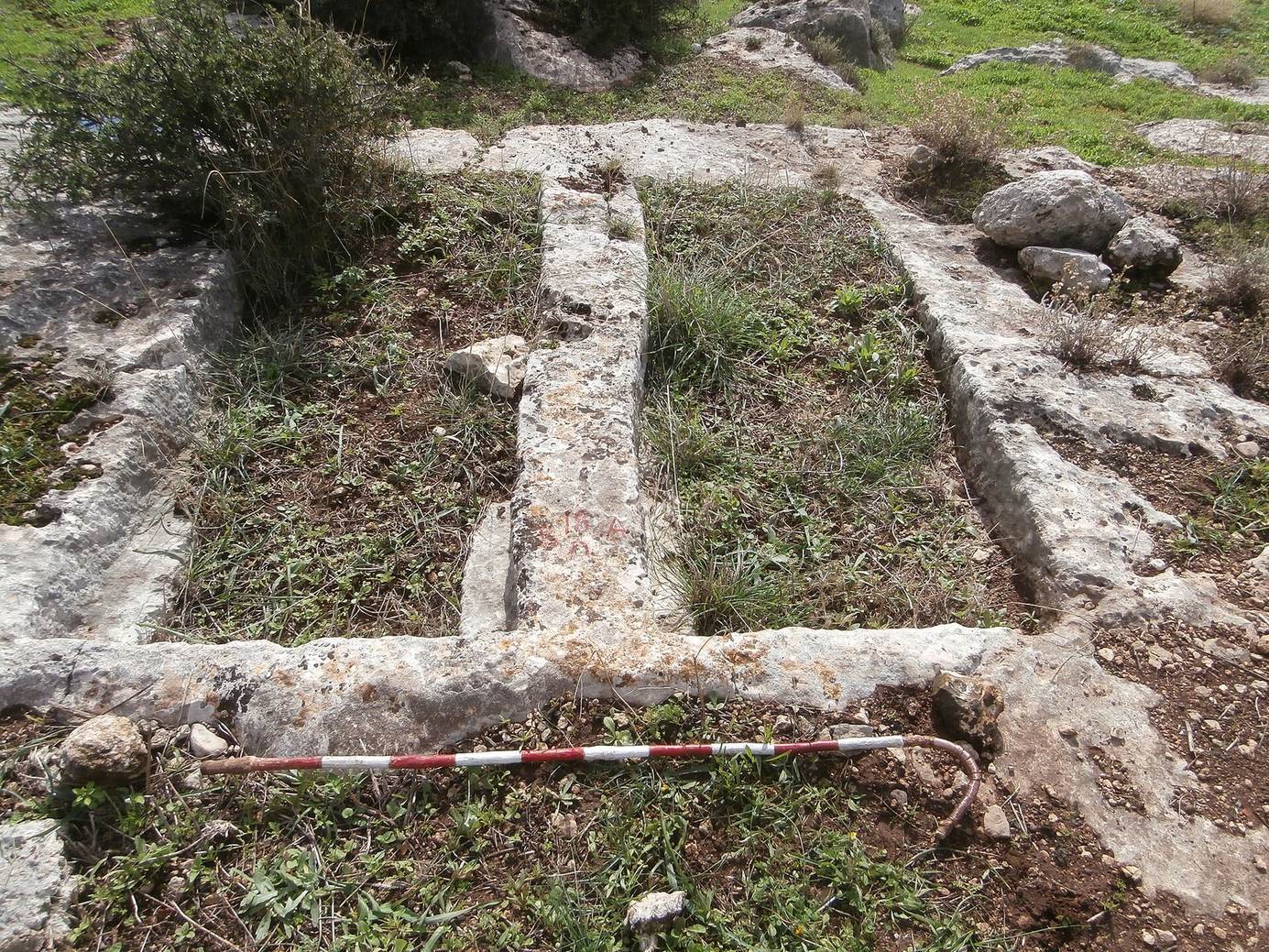
A cemetery surrounded the ancient village. Its remains include cist graves, which were formed from stone slabs, rock-cut tombs, and a mausoleum. Quarries, agricultural terraces and installations, a winepress, and an olive press also formed part of the surrounding landscape. Two large ritual baths, pools used for purification, were cut into bedrock at the eastern and southern edges of the village. In the village’s industrial area, rock-cut installations exposed in 2017 include settling pits and collection pits used to process agricultural produce.
Synagogue and mosaics
Structure and painted surfaces
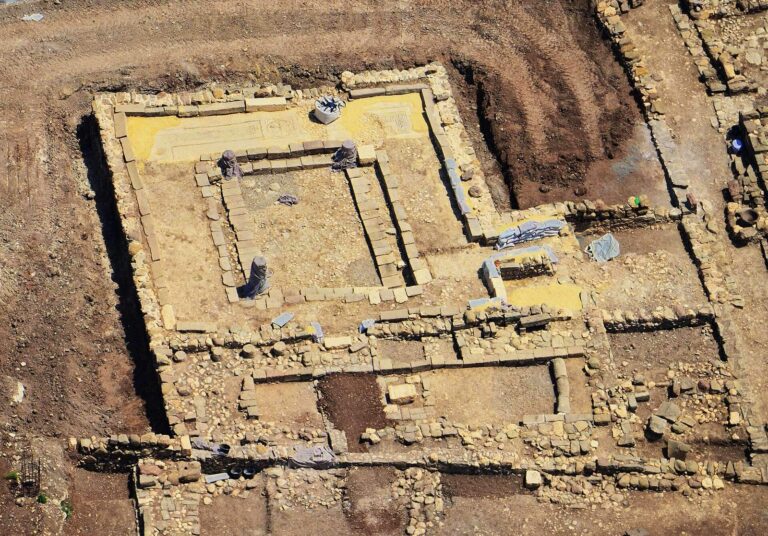
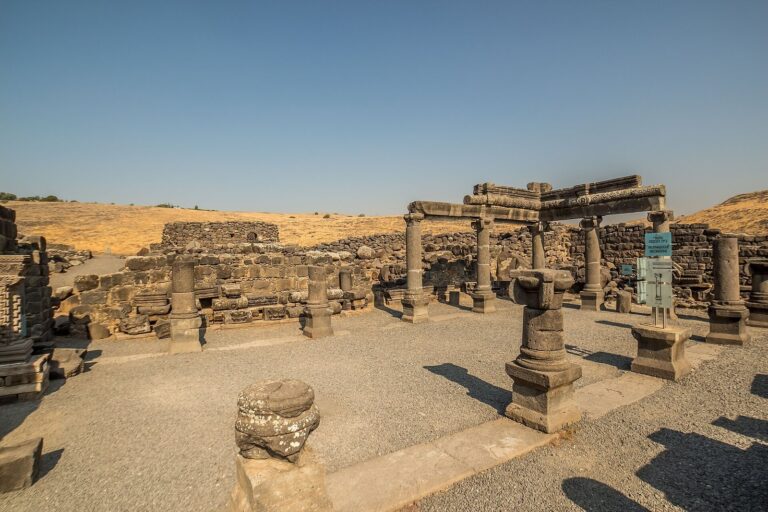
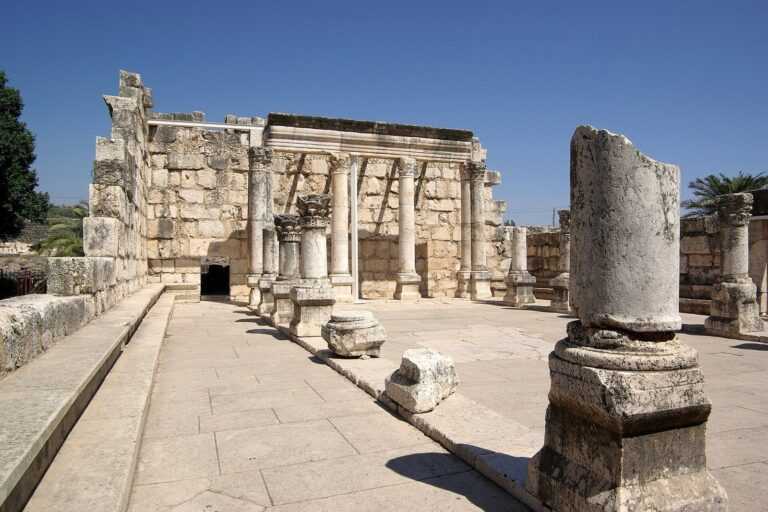
Excavations exposed a monumental synagogue dating to the fifth century CE. Its remains include large walls built from dressed stone, limestone carvings, and a fine floor mosaic made of small tiles. Plaster fragments preserve traces of pink, red, orange, and white paint that once decorated the walls and columns.
Samson and biblical scenes
One mosaic panel depicts Samson twice. In one scene he carries the gates of Gaza; in another, he ties burning torches to the tails of foxes, which set fire to Philistine grain fields. The Philistines were an ancient people of the southern Levant. A second panel, found south of the first in 2013, also shows Samson carrying the gates. Its lower portion is cut off; the figure wears a red belt and has a red band behind his back. One or more nearby horse riders may represent Philistines.
Other panels show Noah’s Ark, the twelve spies, the parting of the Red Sea, Jonah being swallowed by a fish, and the Tower of Babel. These subjects are rare in synagogues of the period. Only two other examples of synagogue mosaics showing Samson are known, including one at a site a few miles away.
Inscription and eastern passage
A partly damaged, six-line Hebrew inscription in a mosaic includes a blessing. Readable portions refer to the effort of observing commandments and to peace, while the text promises a reward for good deeds. Two small circular panels with women’s heads flank the inscription.
A mosaic in the synagogue’s eastern passage is arranged in three horizontal bands. The upper band shows three men in tunics and an elephant with a shield beside it. In the middle, men appear beneath arches, including an elderly seated figure holding an object resembling a scroll. The lower band shows a bull pierced by a spear, with blood flowing from its body. The meaning of the scenes remains uncertain. One proposed interpretation connects them with the Maccabean story, a Jewish revolt against Seleucid rule. Another identifies groups in armor and white robes with an alliance between the Seleucid dynasty and John Hyrcanus, a high priest and ruler in Judea.
Hellenistic imagery
The mosaics also include Hellenistic subjects, such as cupids, winged figures associated with love in Greco-Roman art, and theater masks. Another scene brings together prominent-looking men, soldiers, and war elephants; one figure may represent Alexander the Great, the Macedonian king whose fourth-century BCE conquests founded a vast empire. Magness has proposed that Huqoq may be the only known synagogue decorated with non-biblical scenes.
Underground hiding complexes
System 2 layout
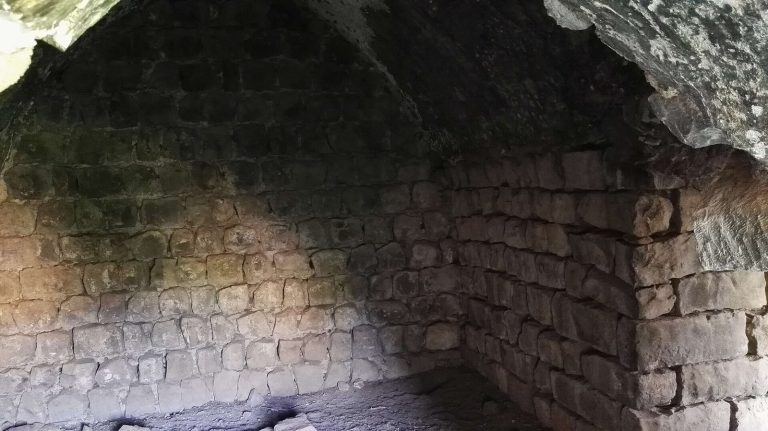
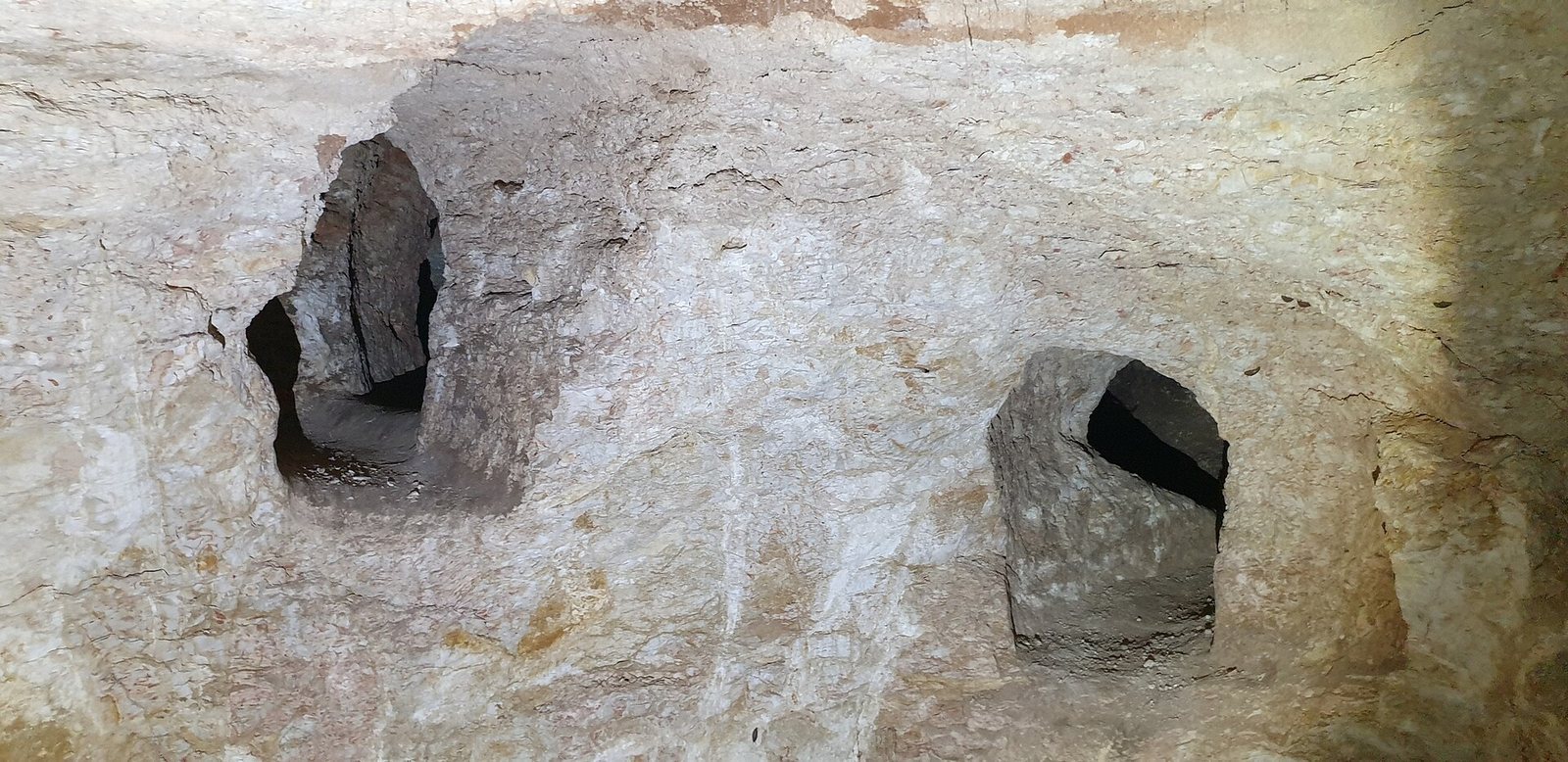
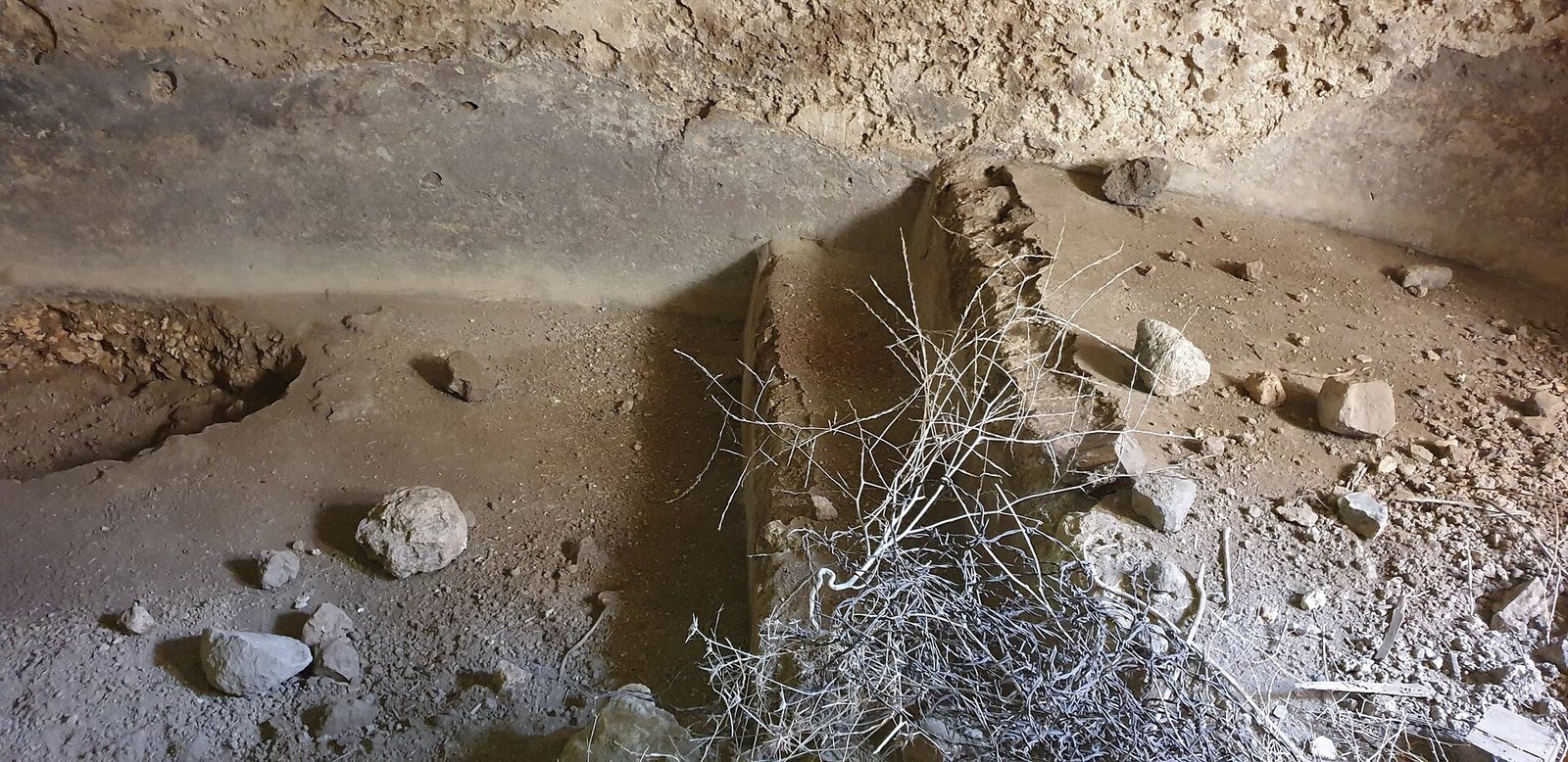
At least three underground hiding complexes are associated with Huqoq. Two lie directly beneath the synagogue area; System 2 is on the northern slope of the synagogue hill. It is described as the most extensive identified in Galilee. Cut into soft chalk beneath a hard, mineral-rich soil layer, the complex contains seven or eight chambers and spaces linked by arched openings and narrow, low passages. Some tunnels turn at right angles, a design intended to slow pursuers. Other passages remain blocked.
The complex incorporated earlier features. Its original entrance ran through a rock-cut ritual bath, and two cisterns were incorporated into the layout. The cisterns were sealed, a wall between the bath and the complex was breached, and stairways were cut to connect different levels. Other spaces served for storage and concealment.
Finds and concealed objects
Finds from the underground complex include pottery, much of it belonging to the Kefar Hananya tradition, a major Jewish pottery-making tradition in Galilee, as well as a gem ring, axeheads, and coins. Two black X-shaped marks, possibly crosses, were painted on the ceiling near the entrance to a chamber. The separate cache of bronze coins occupied a purpose-cut pit at the end of a narrow, winding passage.
Tomb associated with Habakkuk
A description from the 1930s records a basalt tombstone about two metres wide and 1.5 metres long, covered with white plaster. The old stone was replaced in 1981, and a small building was erected over the replacement. Beside it is a spring-fed pool intended for use as a ritual bath.