Saint Luke Church in Świerczyna: A Parish Church and Marian Sanctuary
Site at a Glance
- Popularity
- Very Low
- Country
- Poland
- Primary era
- Early Modern
- Eras represented
- Early Modern, Modern
- Civilizations
- Kingdom of Prussia, Polish–Lithuanian Commonwealth
- Site type
- Religious
- Remains
- Church
On this page12 sections
History
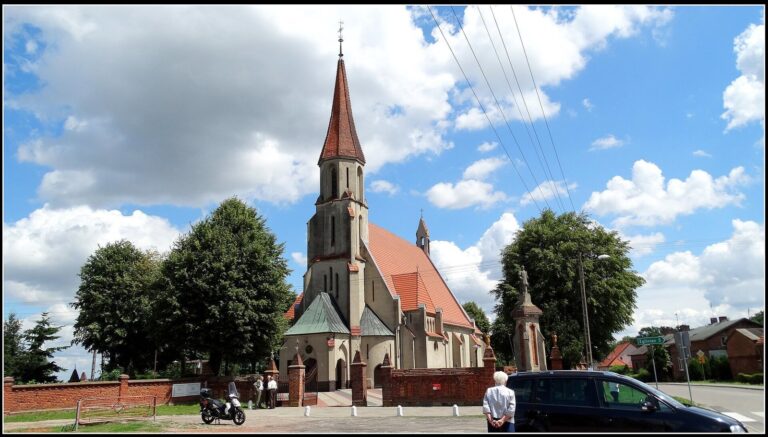
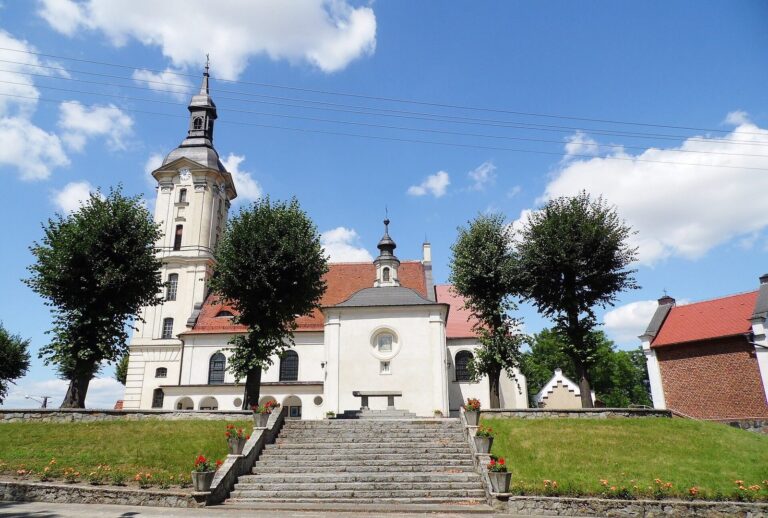
Saint Luke Church in Świerczyna is a Roman Catholic parish church in Poland, built in the second half of the seventeenth century. Its architecture now combines Baroque forms, known for dramatic shapes and ornament, with Neo-Gothic design, a revival of Gothic architecture. The church serves the parish of the same name within the Krzywiń deanery, an administrative district of the Archdiocese of Poznań.
Foundation and early development
Wojciech Skarbek-Malczewski, castellan of Ląd, and Jan Daleszyński financed the church’s construction. A castellan was a territorial official responsible for a castle and its surrounding district. Devotion to the Virgin Mary in Świerczyna dates to the early eighteenth century, when silver votive offerings were made.
In 1731, Stanisław Malczewski arranged repairs and an enlargement of the presbytery, the clergy’s area around the altar. In 1853, Jan Modlibowski promoted the addition of a masonry Chapel of the Transfiguration.
Twentieth-century changes and Marian sanctuary
A masonry side nave was added in 1929–30, changing the church from a single-nave building to one with two naves. Interior painting in multiple colors was completed in 1965–66, and the church was restored in 1989.
In 1970, the Archdiocese of Poznań established the church as an archdiocesan Marian sanctuary. Its listed commemorations are 15 August and 18 October. The main annual celebration honoring Mary takes place on 15 August, the Assumption, a Catholic feast commemorating the belief that Mary was taken into heaven. A novena, a devotional series of prayers, is held each Wednesday in honor of Our Lady of Świerczyna.
Remains
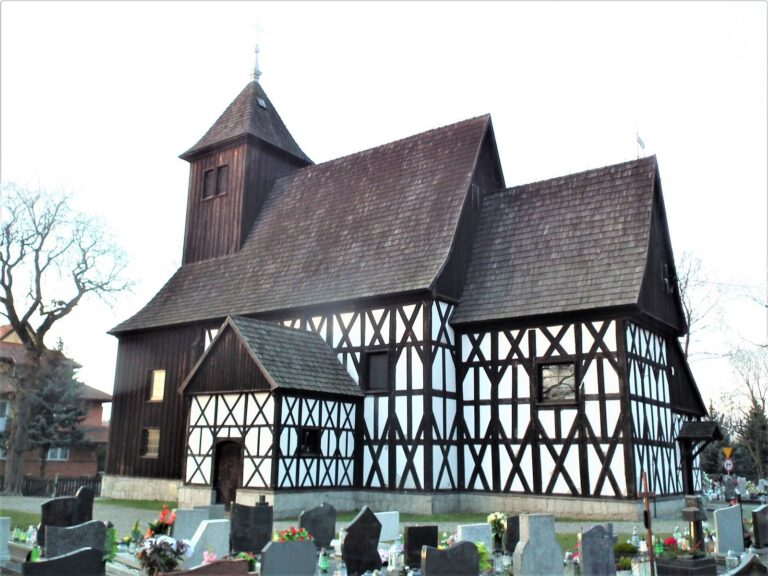
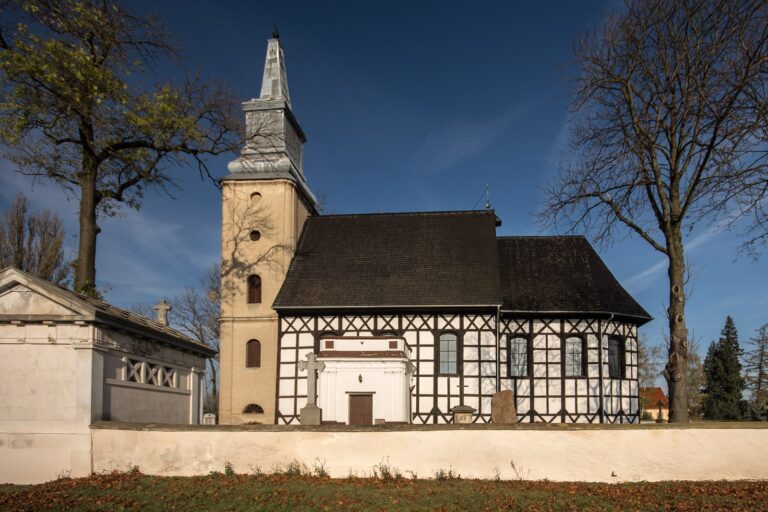
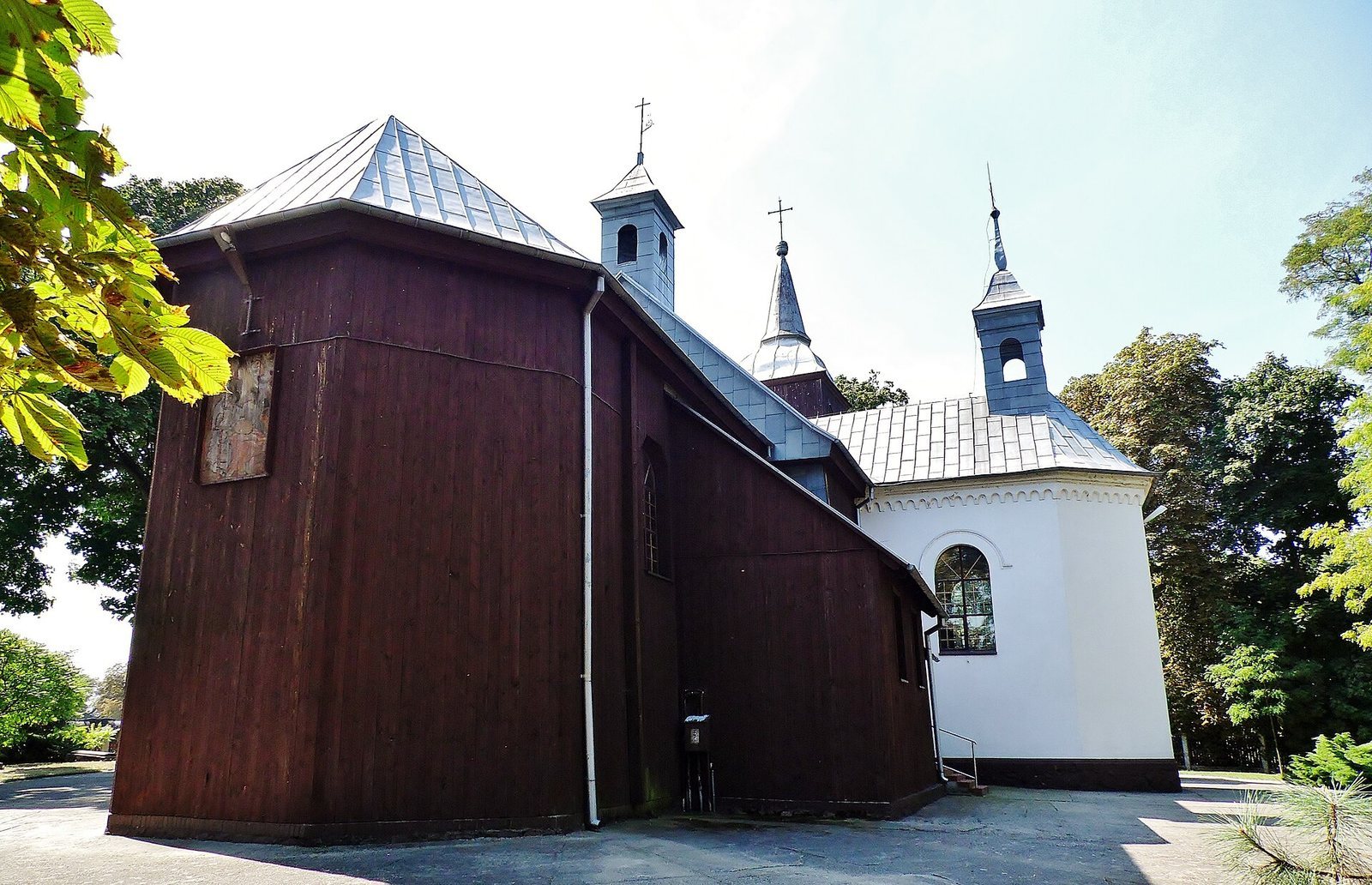
The church retains an east–west plan and a mix of timber and masonry construction. Originally a single-nave timber building made from interlocking horizontal logs, it now has two naves. The smaller presbytery ends on three sides, with a sacristy and the masonry chapel beside it.
Exterior form and construction
Main church and tower
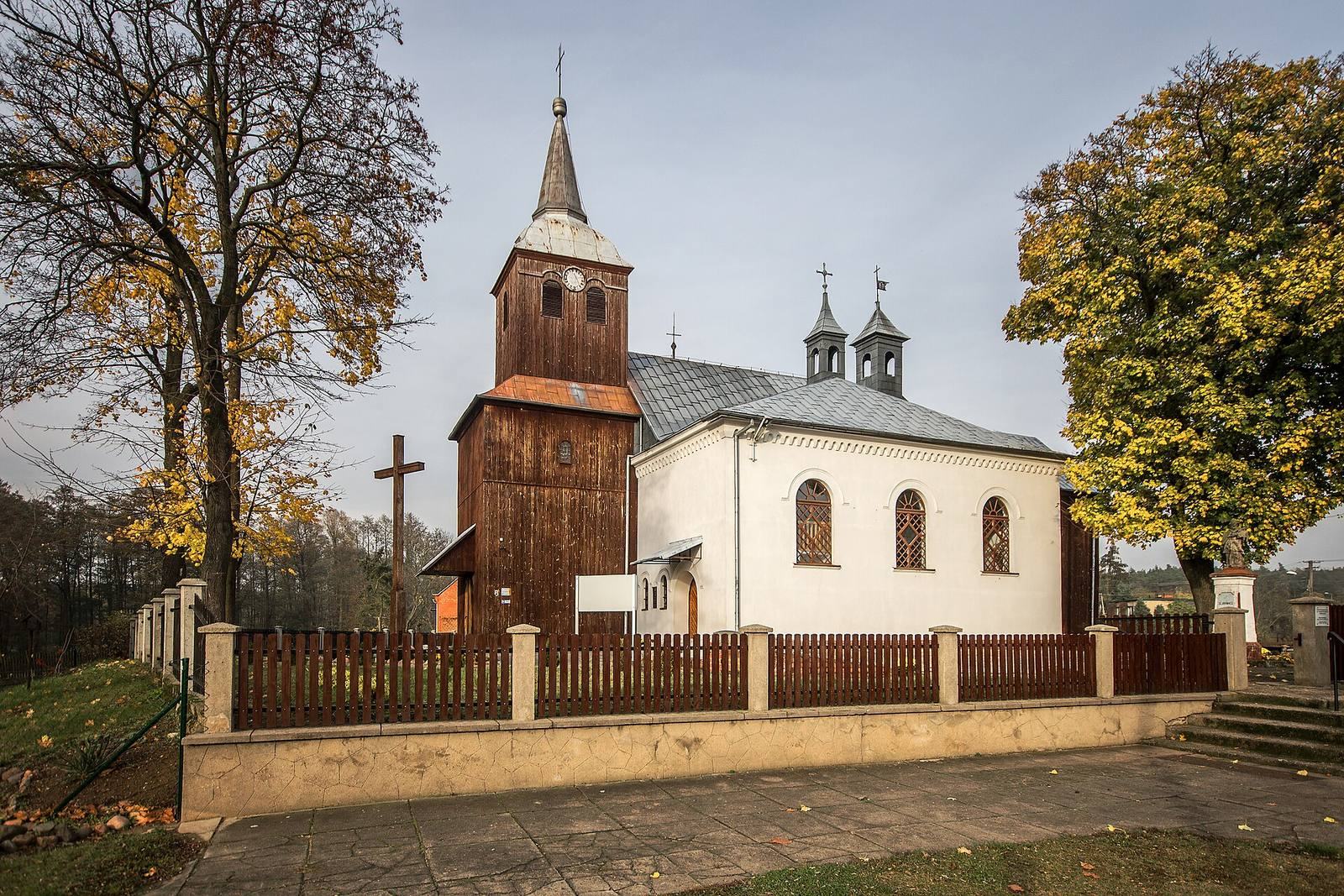
A two-storey timber-frame tower stands at the front of the church. Its upper storey is narrower than the lower one, and the ground floor contains a porch. A clock sits beneath a metal, helmet-shaped roof topped by a spire. The church has a two-ridge metal roof. Its square roof bell turret, a small tower that houses a bell, has a tent-shaped roof, a small raised lantern and a weather vane. The vane bears the date 1731 and the initials WSM, those of the church’s funder Wojciech Skarbek-Malczewski.
Chapel and side nave
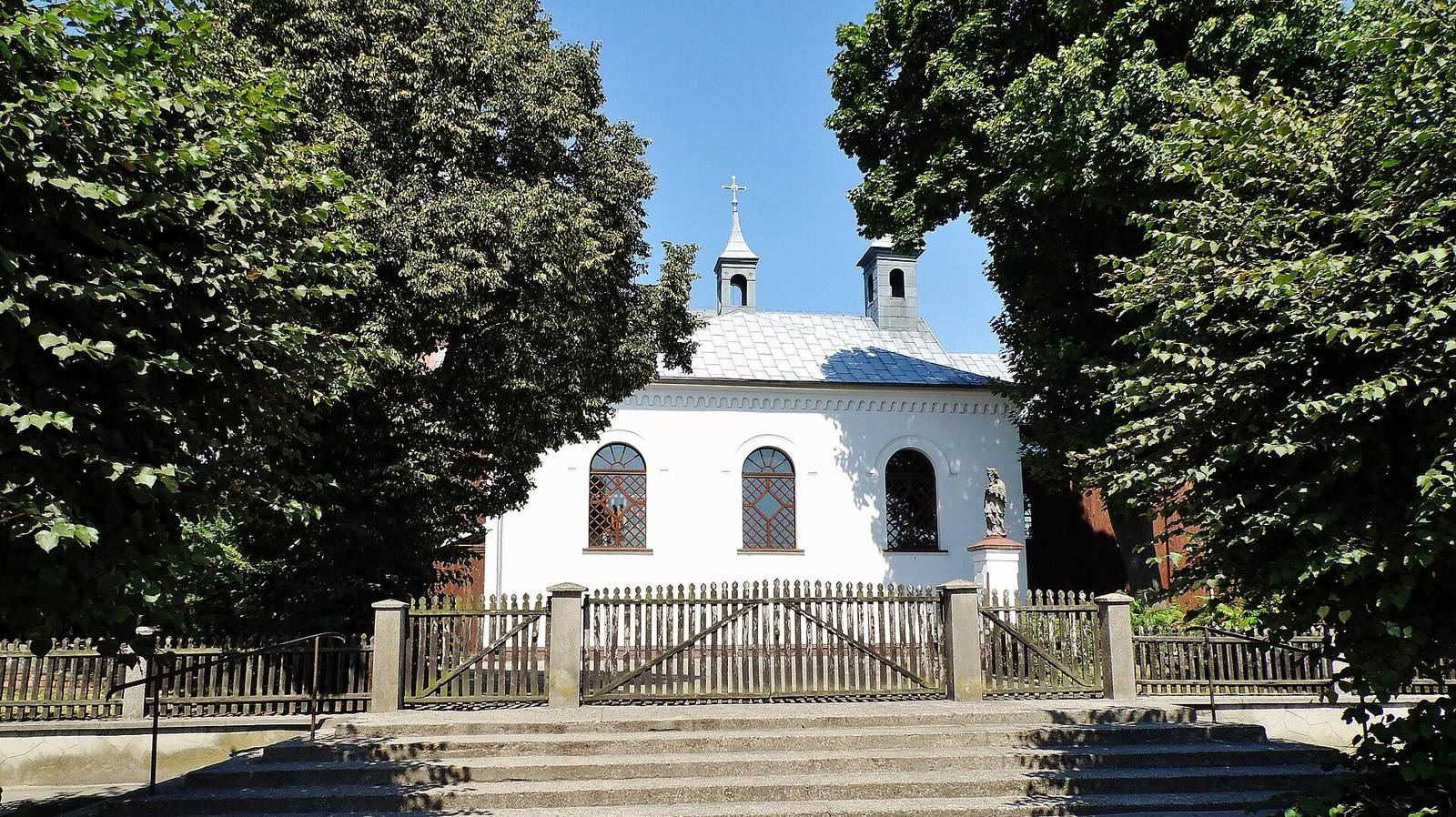
The masonry Chapel of the Transfiguration has a five-sided plan and a small bell turret at its top. It is Neo-Gothic, while its altar is Neoclassical, a style drawing on ancient Greek and Roman forms. The masonry side nave is a later addition to the original timber church.
Interior and furnishings
Ceilings and choir gallery
The main interior has a flat ceiling, while the chapel’s ceiling is formed by intersecting vaults. The gallery for the choir rests on two columns. It carries a Baroque organ case dating to the first half of the eighteenth century. The organ has ten stops, controls that select groups of pipes, and one keyboard with a foot-operated pedalboard. Paintings of nine saints decorate the gallery’s straight front rail.
Altars and other furnishings
The late-Baroque furnishings include a main altar and two side altars. The pulpit bears sculptures of the four Evangelists, figures associated with the canonical Gospels, and Saint Stanislaus, an eleventh-century bishop of Kraków venerated as a martyr and patron saint of Poland. The church also has two late-Baroque crucifixes and a baptismal font dated 1737, supported by an angel figure. Sculptures of apostles in the church were made by Andrzej Majchrzak.
Madonna and Child
The main altar holds a wooden Madonna and Child from the second quarter of the fifteenth century. The late-Gothic sculpture belongs to the Beautiful Style, a refined form of late-medieval Gothic art, and is covered with paint and gilding. Mary wears a crown and richly folded robes, holds the naked Christ Child on her left forearm and carries a scepter in her right hand. The crowned child holds an orb in his left hand.
Rood beam
A beam spans the opening between the nave and presbytery. This rood beam, traditionally used to support devotional figures, carries a Passion Group depicting Christ’s suffering and death. The work dates to around the middle of the nineteenth century.