Church of the Holy Mandylion at Kuntsevo Cemetery: An Active Russian Orthodox Church
Site at a Glance
- Popularity
- Medium
- Country
- Russia
- Primary era
- Early Modern
- Eras represented
- Early Modern, Modern
- Civilizations
- Russian
- Site type
- Religious
- Remains
- Church
On this page10 sections
History
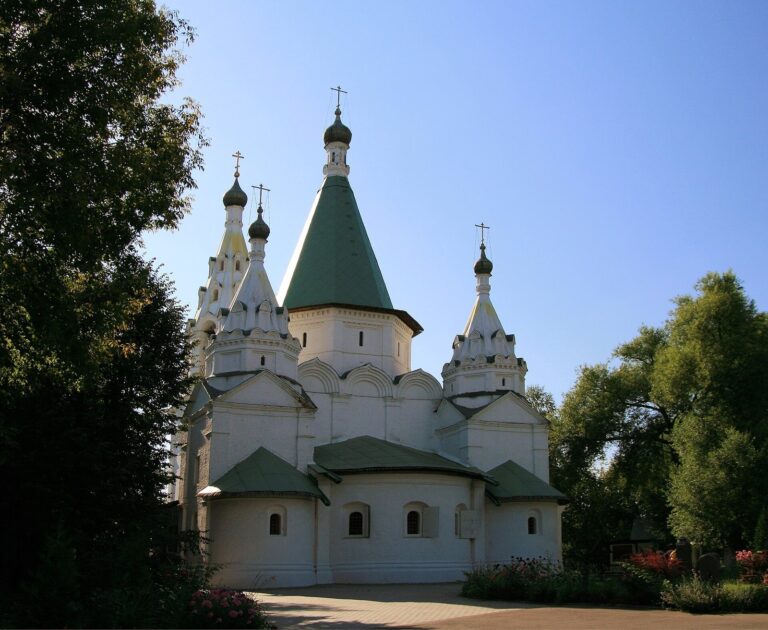
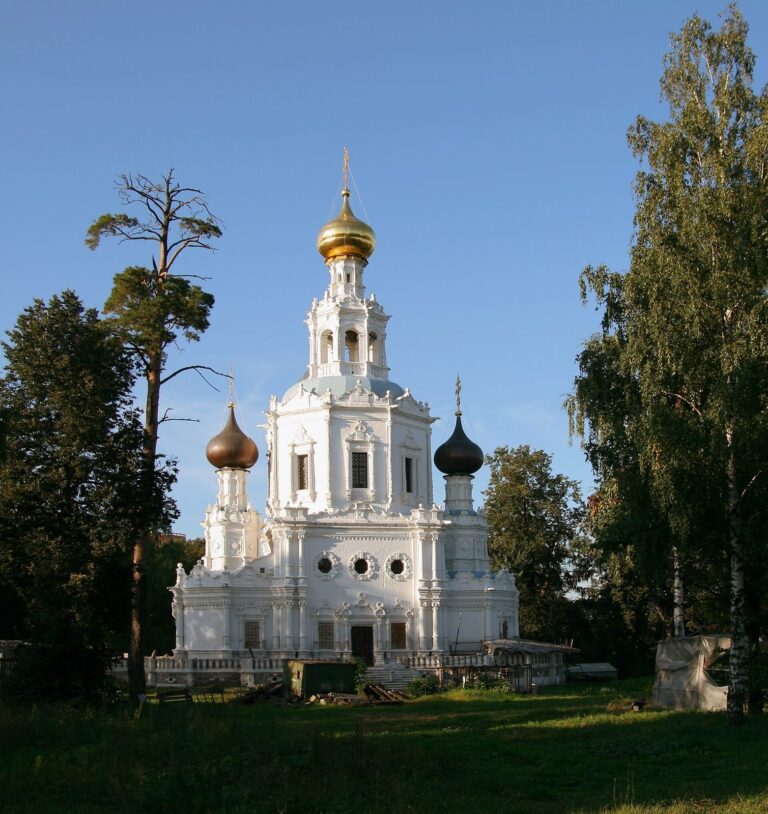
The Church of the Holy Mandylion at Kuntsevo Cemetery is an Orthodox church on the bank of the Setun River in Russia. Built on the estate of diplomat and boyar Artamon Matveev, a member of Russia’s highest nobility, it was constructed between 1673 and 1676, with 1676 given as its foundation date. The church belongs to the Moscow Patriarchate of the Russian Orthodox Church and is within the Moscow Diocese, the church jurisdiction for Moscow, and the St George Deanery, a grouping of local parishes.
Construction and expansion
The church was rebuilt in 1809, when a bell tower and a refectory, a hall associated with communal meals or gatherings, were added. Landowner G. A. Kiryanov paid for an altar dedicated to Gregory of Decapolis, a Byzantine monk and saint. A stone enclosure followed in 1833. In 1844, landowner A. G. Dobrovolskaya funded a northern chapel in the refectory dedicated to Nicholas the Wonderworker, also known as Nicholas of Myra. The chapel was consecrated, or formally dedicated for worship, in 1850.
In 1905, the old, deteriorated bell tower was demolished and replaced. The work was funded by the family of merchant and publisher Sergei Sabashnikov and designed by architect Vyacheslav Frantsovich Zhigardlovich.
Closure and damage
Vasily Guryev served as the church’s priest from 1932 to 1937. He was executed at the Butovo firing range on 13 October 1937, and was canonized in 2005 as a hieromartyr, a member of the clergy venerated as a martyr saint. The church closed in 1941. Its upper sections were dismantled so that the building could not guide German aircraft.
After its closure, industrial enterprises used the building. A fire destroyed its furnishings, including the seventeenth-century iconostasis, a screen of icons separating the sanctuary from the main worship space, and other icons.
Restoration and renewed worship
A restoration plan was prepared in 1968, but work halted soon after it began. Restoration resumed in the 1970s. The dilapidated church was returned to worshippers in 1989, and services began again in May. On 16 July 1996, Patriarch Alexy II, head of the Russian Orthodox Church from 1990 to 2008, consecrated the main altar. Bishop Ignaty Punin, a senior cleric who oversees a diocese, performed the church’s great consecration, the formal rite dedicating the building for worship, in 2013. The church remains active.
Remains
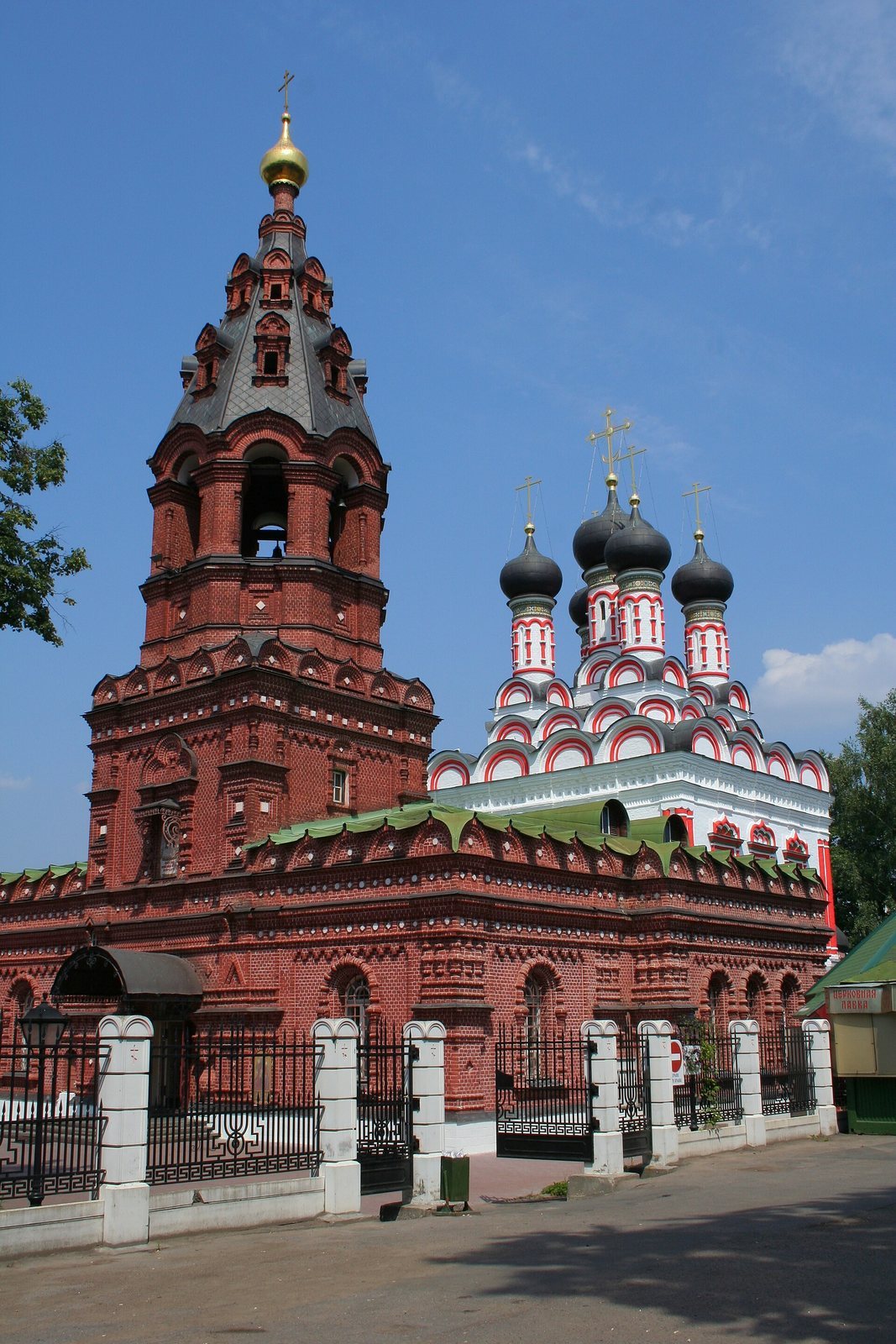
The complex stands beside the Setun River and includes the church, a bell tower, a refectory, a stone enclosure, and chapels. Its northern chapel is inside the refectory, while the enclosure bounds the church grounds.
Architectural complex and interior
Bell tower and enclosure
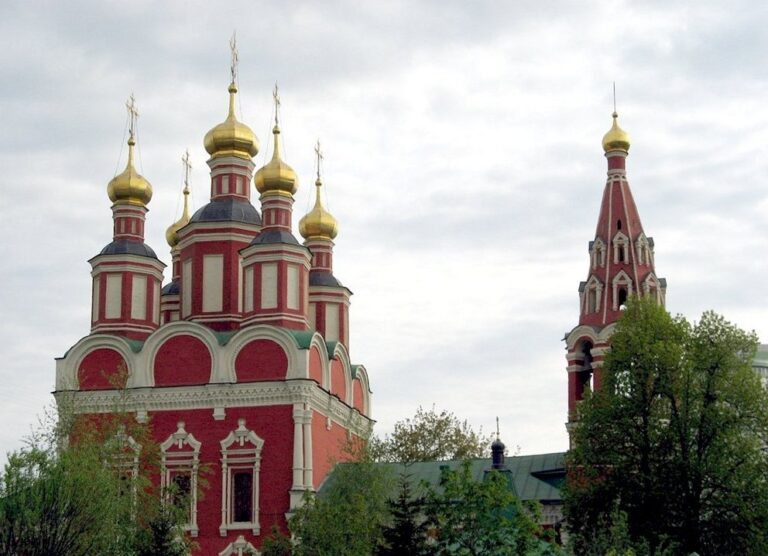
The replacement bell tower, built in 1905, has three tiers and a steep, tent-shaped roof. Its neo-Russian style is a revival style drawing on Russian architectural forms. The stone enclosure was built in 1833.
Refectory and chapels
The refectory is a hall associated with communal meals or gatherings, and the northern chapel occupies part of it. Chapels associated with Gregory of Decapolis and Nicholas the Wonderworker form part of the church complex.
Interior and sacred objects
A carved, gilded iconostasis with five tiers was made after the main altar’s consecration in 1996. During the 2000s, the workshop collective Joy painted the church walls. An icon depicting the Image of the Savior Not Made by Hands, an Orthodox image of Christ traditionally believed to have formed without human artistic creation, survives with Nicholas the Wonderworker and Gregory of Decapolis shown alongside it. The icon dates to the second half of the nineteenth century.
Associated sacred objects include a fragment of the True Cross and a fragment of Saint Nicholas’s relics, bodily remains or other objects associated with a saint.
Clergy cemetery
A diocesan cemetery for Moscow clergy lies behind the altar. Priest Daniil Sysoev, who was killed in 2009, was buried there that year.