Zamchysche: The Medieval Hillfort of Luboml
Site at a Glance
- Popularity
- Very Low
- Country
- Ukraine
- Primary era
- Medieval
- Eras represented
- Medieval, Early Modern, Modern
- Civilizations
- Polish–Lithuanian Commonwealth
- Site type
- Military
- Remains
- Citadel
On this page11 sections
History
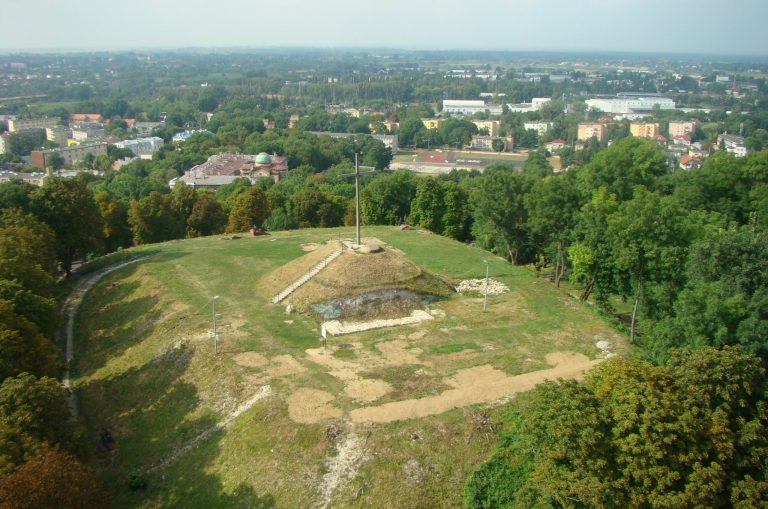
Zamchysche is a hillfort, a fortified settlement site, in central Luboml, Ukraine, where a fourteenth-century earthen mound was raised over an earlier citadel. The citadel was the fortified central stronghold of thirteenth-century Luboml. The hillfort has been interpreted as the remains of Old Rus’ Luboml, part of the medieval East Slavic political and cultural world.
Medieval citadel and castle
Luboml appears in chronicles in 1287. In 1392, King Władysław Jagiełło signed a charter at the castle granting Magdeburg rights to Chełm. This form of town law gave defined legal privileges and a degree of self-government. Jagiełło, who was king of Poland and grand duke of Lithuania, visited Luboml repeatedly, granted the town privileges, and may also have granted it Magdeburg rights.
The wooden castle was associated with Jagiełło’s reign. Polish local historians writing in the first half of the twentieth century attributed its construction to his sister Alexandra. Jagiełło’s activity in Luboml also included a wooden Church of the Holy Trinity in 1409 and a masonry church in 1412. Ivan Vyhovsky, a Ukrainian Cossack political and military leader, served as Luboml’s starosta, a royal official administering a district or estate, from 1658 to 1664.
Late eighteenth-century redevelopment
Count Franciszek Ksawery Branicki acquired the Luboml starosty in 1768 and built a palace behind the castle in the 1780s. He probably initiated a broader redevelopment of the town. The castle, which stood west of the palace, and the old churches of St George and St Michael were dismantled in the last quarter of the eighteenth century. A new St George church was built on the former church’s site, while trading rows took the place of St Michael’s, north of the Market Square. The castle was last mentioned in 1773.
Twentieth-century use and investigation
In the early twentieth century, Jewish residents kept livestock in the castle’s underground chambers. Polish authorities erected a memorial on the hill in the mid-1920s for the Battle of Grunwald, a major 1410 battle between Polish-Lithuanian forces and the Teutonic Order. Local tradition linked a contingent from Luboml Castle to the battle. Steps made from railway sleepers were added on the western slope in the 1930s; after Soviet rule began in 1939, the memorial was dismantled.
During the German occupation of 1941–1944, the occupying authorities imprisoned detainees in the underground chambers, and the first victims were shot on the castle hill. After the war, the chambers served first as a store for a border detachment and later as a commercial depot. A memorial to fighters for Soviet power was initiated in 1967, followed by a granite obelisk in 1968. In the 1970s, a Memorial of Glory was established on the hill’s upper platform, where Red Army soldiers were reburied. The hill was also adapted for recreation in the early 1960s.
V. Antonovych mentioned the site in 1901. Yu. Kukharenko surveyed it in 1958, P. Rappoport in 1963, and S. Panyshko carried out exploratory work in 1993 and 2001. Building work caused substantial damage to the hillfort. A 1969 decision by the Volyn Regional Executive Committee placed the hill under state protection as archaeological monument No. 183. The site is designated an archaeological monument of national significance.
Remains
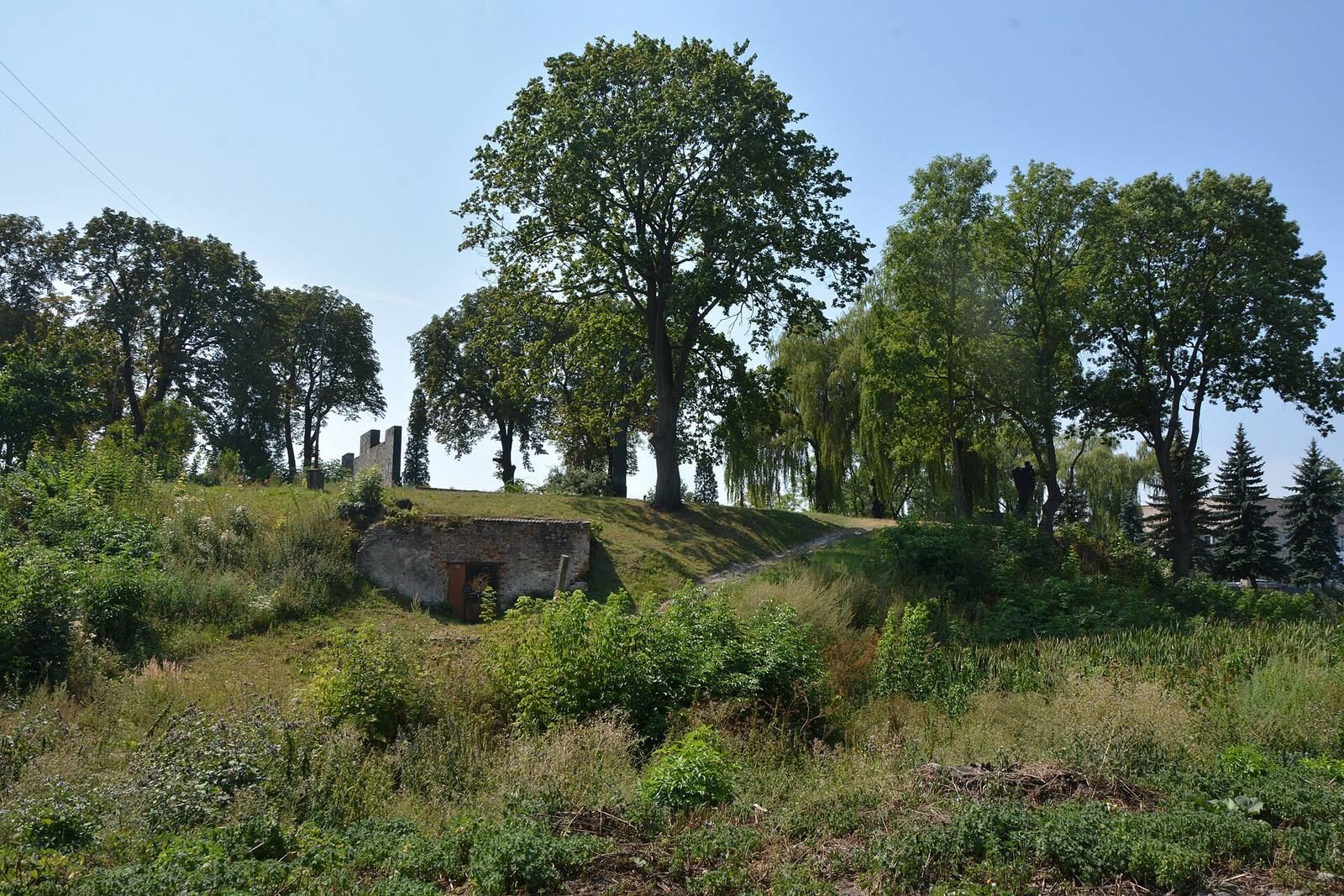
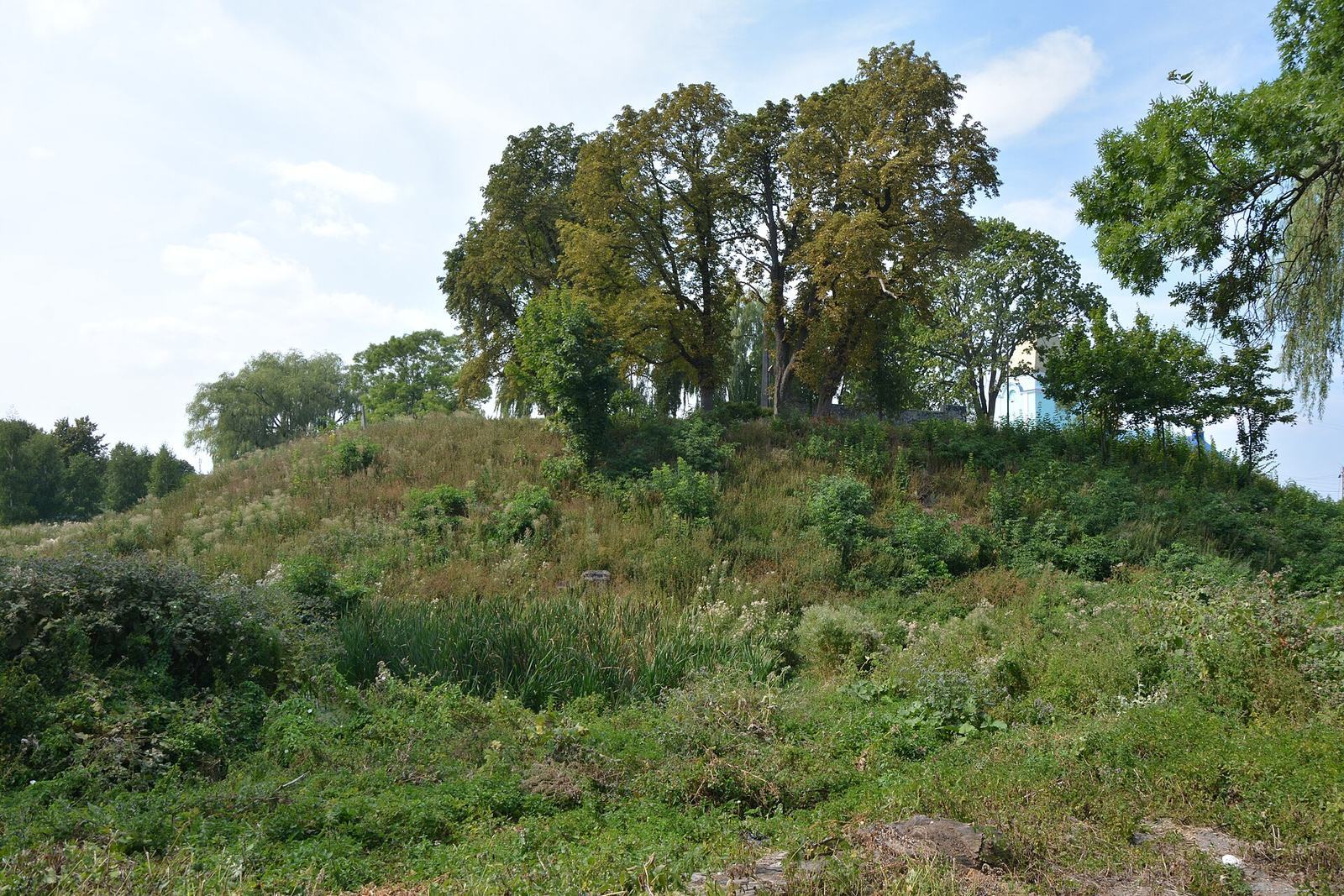
The hillfort has a conical form, with a circular summit platform 60 metres across and 6 metres above the present ground. A surrounding ditch is about 20 metres wide, and remains of circular earthen ramparts lie beside the Market Square.
Buried structures
Underground chambers
A masonry structure of six rooms was built within the mound during the seventeenth or eighteenth century. Vaulted underground spaces beneath the ramparts are also associated with the remains of Branicki’s palace. Local legend describes an underground passage running south from beneath the hill.
Starosta’s house foundations
Foundations identified in 1963 belong to a masonry building dated to the mid-seventeenth century and interpreted as the starosta’s house.
Memorials and summit features
Memorial complex
The summit carries a memorial complex. Its former Grunwald memorial was a masonry obelisk; the later Soviet memorial included a granite obelisk, while the Memorial of Glory occupies the upper platform.
Recreation installations
A wooden bridge was built on the western side in the early 1960s. A dance platform and buffet were also established on the summit.