Santa Maria delle Grazie: A Church and Convent near Senigallia
Site at a Glance
- Popularity
- Medium
- Country
- Italy
- Primary era
- Medieval
- Eras represented
- Medieval, Early Modern
- Civilizations
- Duchy of Urbino, Papal States
- Site type
- Religious
- Remains
- Monastery
On this page12 sections
History
Foundation and family patronage
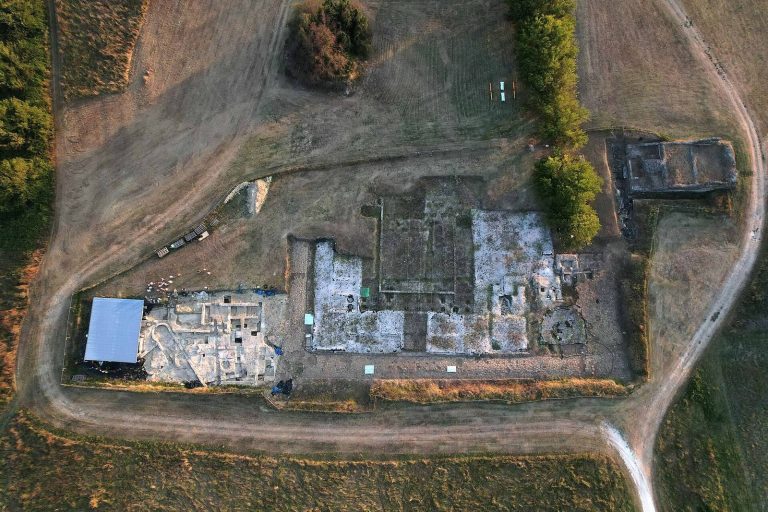
Santa Maria delle Grazie is a church and convent complex on a hill about three kilometres southeast of Senigallia, Italy. Giovanni Della Rovere, an Italian nobleman and lord of Senigallia, commissioned it in 1491, with a design by Renaissance architect Baccio Pontelli. A small chapel dedicated to the Virgin Mary had stood on the site; its names, Madonna del pinocchio and Santa Maria del Pignotto, probably referred to the surrounding pine trees. Woodland once covered the area and was gradually cleared for fields, gardens, and buildings.
Giovanni had vowed to establish the church and convent in honour of the Virgin Mary and Saint Francis. The birth of his son Francesco Maria in 1490 fulfilled that vow, and the first Friars Minor of the Observance, a Franciscan branch committed to a stricter observance of the order’s rule, settled at the convent in 1492. Francesco Maria I Della Rovere later commissioned architect Girolamo Genga to enlarge and revise the complex. Work was underway before Francesco Maria I died in 1538, but political and economic difficulties prompted reductions to the original plans.
The church may also have been intended as a burial place for the Della Rovere family, following the example of the Montefeltro family’s church of San Bernardino in Urbino. Giovanni’s brother-in-law Antonello Sanseverino, his daughter Girolama, and his mother Teodora Manerola were buried at the complex. Giovanni was first interred in the sacristy. On 18 March 1627, Francesco Maria II Della Rovere arranged for his remains to be moved to a tomb in the church.
Completion and parish life
The convent’s woodland was enclosed by a wall in 1666. The complex was completed in 1684 with the involvement of Vittoria Della Rovere, the last direct descendant of Giovanni to carry the family name. The sacristy was furnished in 1690, and fourteen small shrines devoted to the Stations of the Cross were erected around the forecourt in 1722.
On 8 March 1851, Pope Pius IX established the Parish of Santa Maria delle Grazie by formal papal letter. He cited the need for a nearby place of worship, religious instruction for children, and pastoral care through teaching and the sacraments. The municipality of Senigallia took ownership of the complex and adjoining land in 1866, undertaking to maintain the parish. In 1871, the surrounding woodland was cleared for the municipal cemetery, and a Jewish cemetery was established to its southwest. Part of the earlier enclosure wall now bounds the municipal cemetery.
Modern use and restoration
After the Second World War, rooms beside the main cloister served as housing for displaced people and later as an elementary school. In August 1978, they became the Sergio Anselmi Museum of the History of Sharecropping. The museum explores sharecropping, an arrangement in which a tenant farmer shares the crop with the landowner, and its collection includes thousands of objects connected with domestic life and agricultural work in the region through the 1960s.
In September 2008, the Friars Minor left after 515 years of continuous presence. Diocesan priests took responsibility for the parish, which uses part of the former convent beside the church and the smaller cloister. The complex belongs to the Diocese of Senigallia and is recognized as an Italian national monument. Deterioration of the roof and damage to the interior wall lining led to the church’s closure in September 2016. Structural work in 2022 and 2023, followed by renewal of the building systems in 2024, formed part of its restoration.
Remains
The church
Plan and interior
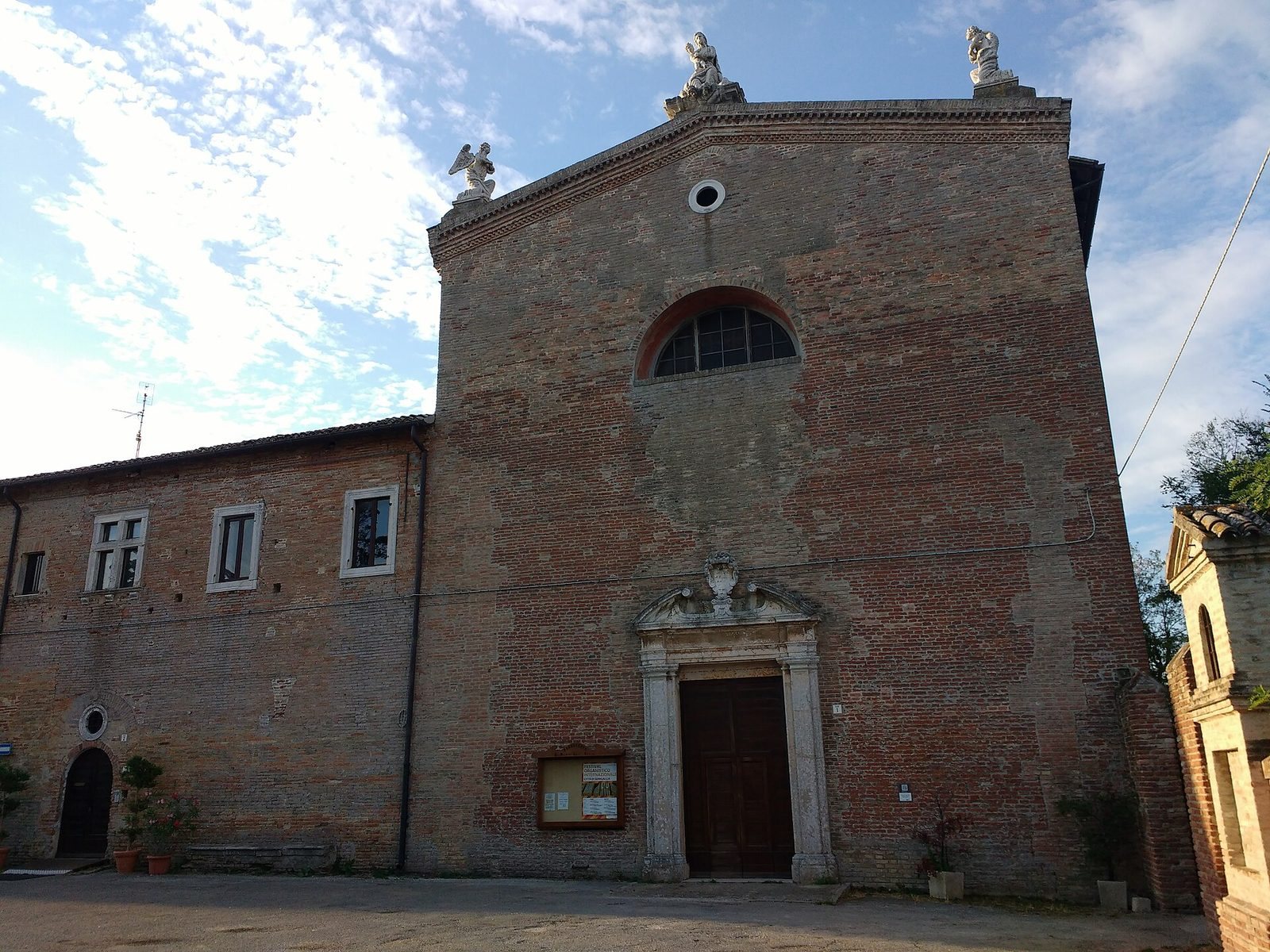
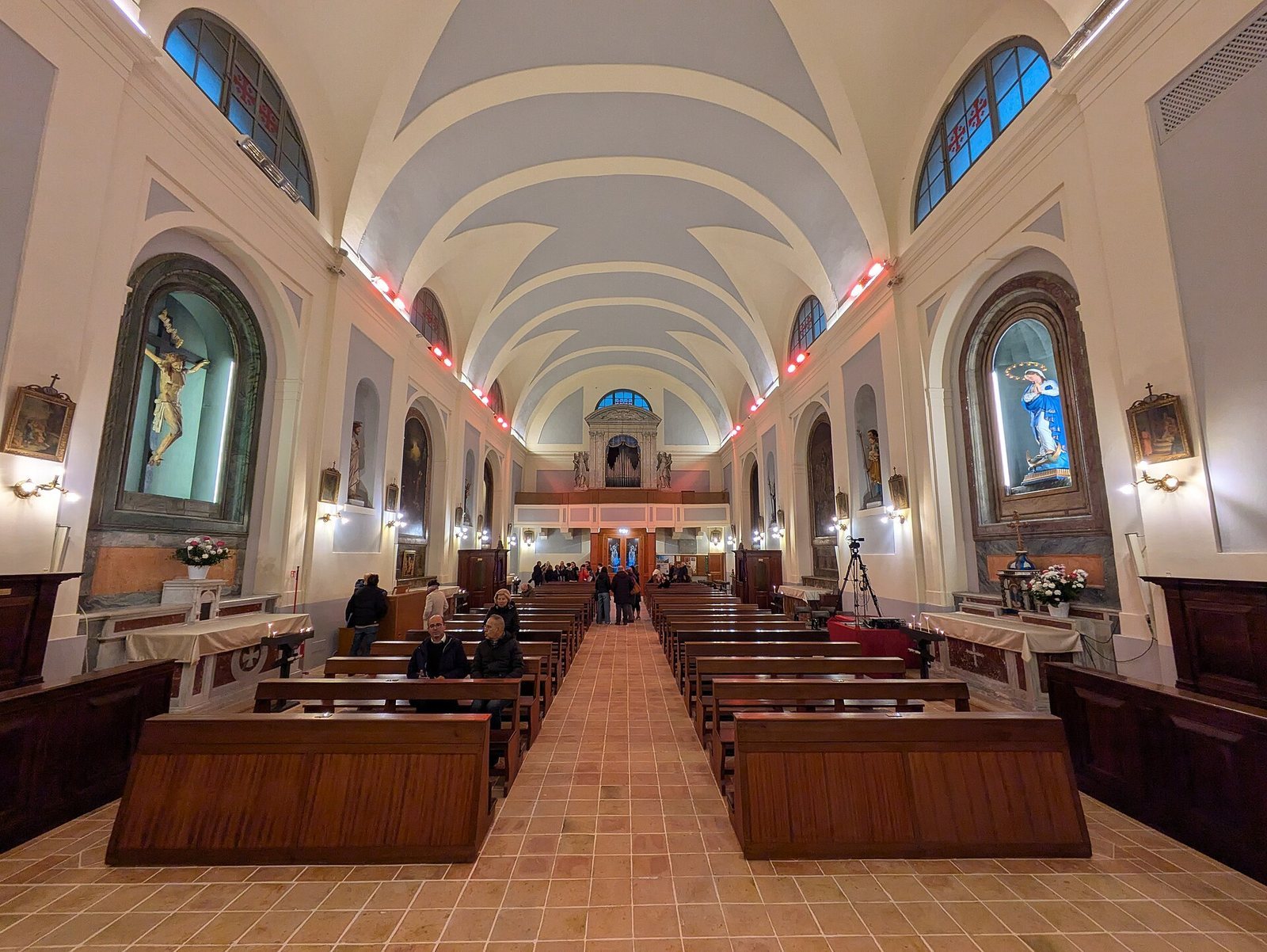
The church is arranged on an east-west axis in Pontelli’s original plan. Its first planned form was much smaller than the present building, corresponding to the choir and altar area. Genga’s enlargement added space for the congregation and moved the entrance to the north. This change of orientation probably responded to yielding ground after the sacristy and bell tower had been built, and left the western cloister only partly enclosed. In 1626, builders added a lining over the church’s perimeter supporting walls, with niches and pilasters, shallow wall strips shaped like columns. They also built an arched ceiling beneath the roof trusses, giving the interior a substantially different appearance from its earlier form.
Portal and paintings
The entrance portal, made in 1684, bears the emblems of the Della Rovere and Medici families. In the church’s altar end is Pietro Vannucci’s altarpiece Madonna Enthroned with Child and Saints. Piero della Francesca’s Madonna of Senigallia, once kept in the church, was transferred to Urbino in 1917 after bombing in Senigallia during the First World War. It is now held by the Galleria Nazionale delle Marche in Urbino.
The convent and cloisters
Plan and construction
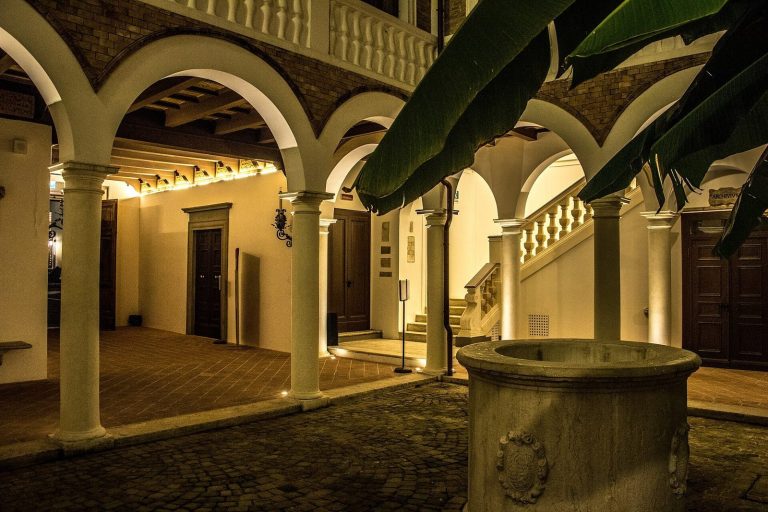
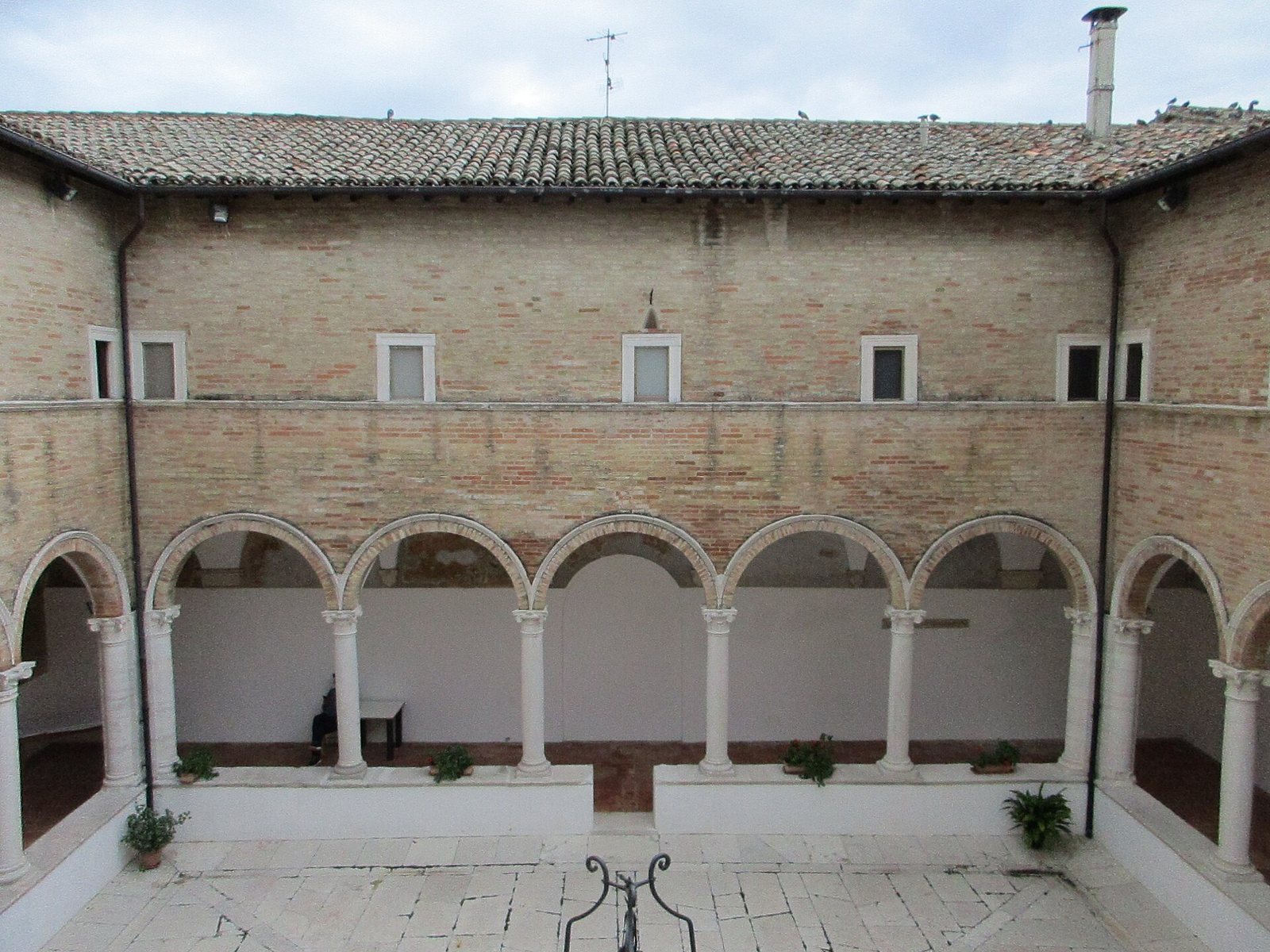
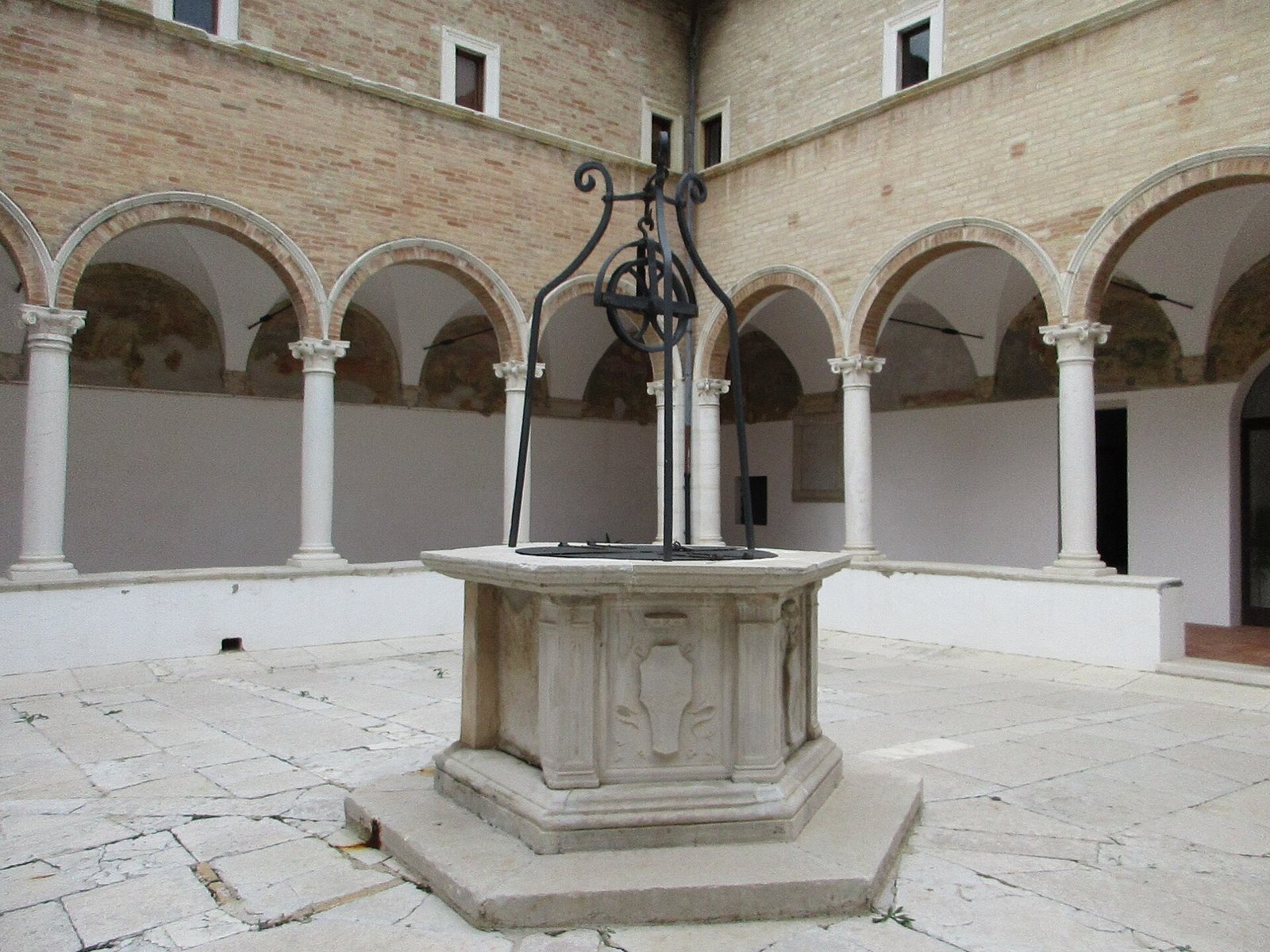
The sacristy and convent were the first parts built. Pontelli’s plan placed the convent around two separate square cloisters, covered passages surrounding courtyards. Its layout follows a geometric grid, although the cell windows do not line up evenly with the cloister arcades, reflecting practical needs. Marble finishes on columns, capitals, and cornices contrast with the reddish local brickwork. The design combines geometric refinement associated with the Renaissance with a more practical, austere character.
Frescoes and wellhead
Pietro Francesco Renulfo painted frescoes in the cloisters in 1598, showing episodes from the life and miracles of Saint Francis. The two courtyards have 28 and 19 painted lunettes, curved wall spaces used for paintings, respectively. The larger cloister also has 28 arches and a central wellhead bearing Della Rovere heraldry, including the arms of Pope Sixtus IV, a member of the family.
Museum rooms and collections
The Sergio Anselmi Museum occupies convent rooms beside the main cloister. Its collection includes objects related to household life and farming in the region, as well as photographs of the Senigallia countryside taken by Mario Giacomelli in the 1960s and 1970s and later donated to the museum.