Church of the Annunciation of the Blessed Virgin Mary in Jasionna: A Seventeenth-Century Wooden Parish Church
Site at a Glance
- Popularity
- Very Low
- Country
- Poland
- Primary era
- Modern
- Eras represented
- Early Modern, Modern
- Civilizations
- Polish–Lithuanian Commonwealth
- Site type
- Religious
- Remains
- Church
On this page10 sections
History
The Church of the Annunciation of the Blessed Virgin Mary in Jasionna, Poland, is a Roman Catholic parish church built in the mid-seventeenth century on the site of a fifteenth-century predecessor. It serves a local Catholic community and belongs to the Parish of the Annunciation of the Blessed Virgin Mary in Jasionna, within the Jedlińsk Deanery, a grouping of parishes, and the Diocese of Radom, a wider church jurisdiction.
Nineteenth-century alterations
Repairs between 1865 and 1876 added a porch on the nave’s central axis and altered the music gallery. Painted decoration was added in 1882, followed by a vestibule adjoining the sacristy in 1883.
Twentieth-century rebuilding
The interior was repainted in 1902, 1930, and 1978. In 1985, the building was dismantled apart from its chancel, the altar end of the church, and rebuilt to a greater length. Larch elements were replaced during the work.
Remains
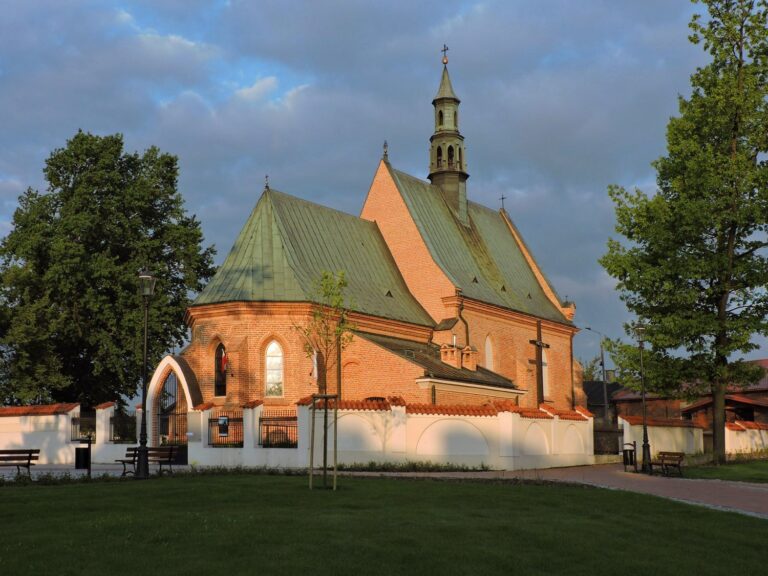
The church has three aisles and timber walls built using log construction, in which horizontal timbers interlock. Its plan does not follow an east-west alignment.
Plan and exterior
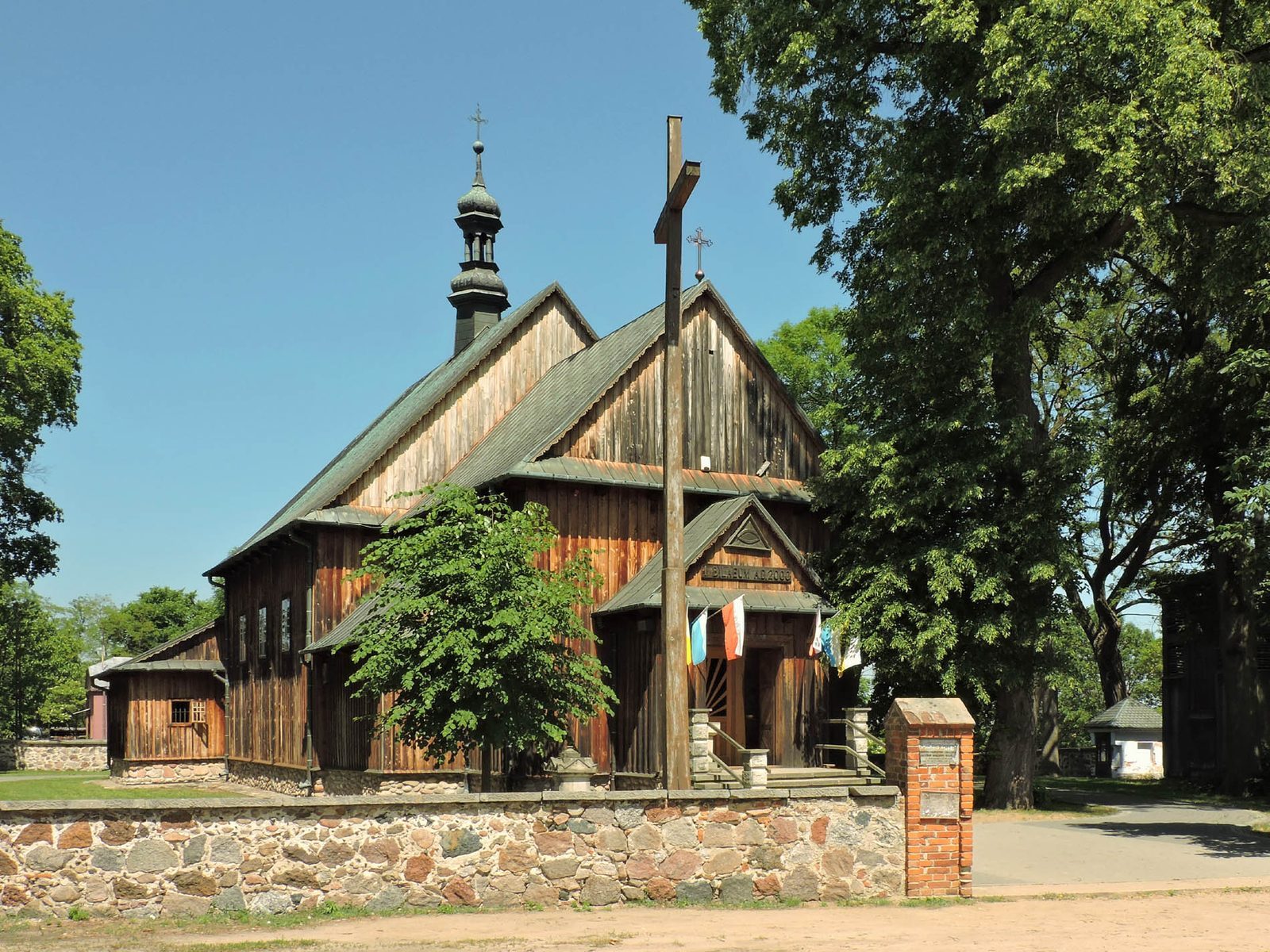
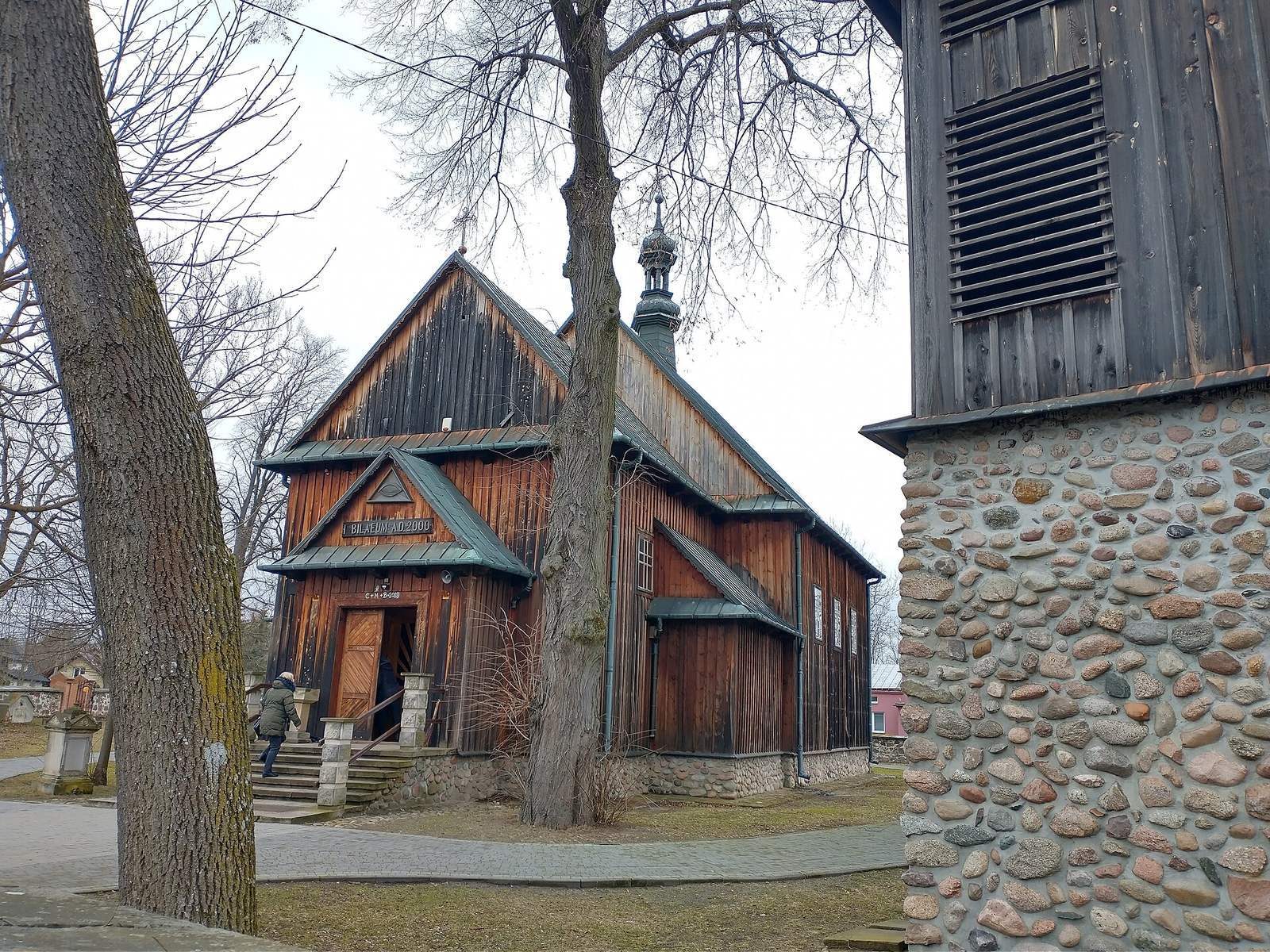
The chancel, the altar end of the church, is smaller than the nave, the main body, and finishes in a straight wall. A sacristy, a room for clergy and church objects, adjoins it. A porch stands at the front of the nave, flanked by two side annexes. The roof has two ridges and a copper-sheet covering. An eight-sided bell turret rises above it, topped by a sheet-metal dome and a small lantern, or raised roof structure. Gutters and downpipes carry rainwater away, and the building also has surface drainage and lightning protection.
Interior arrangement
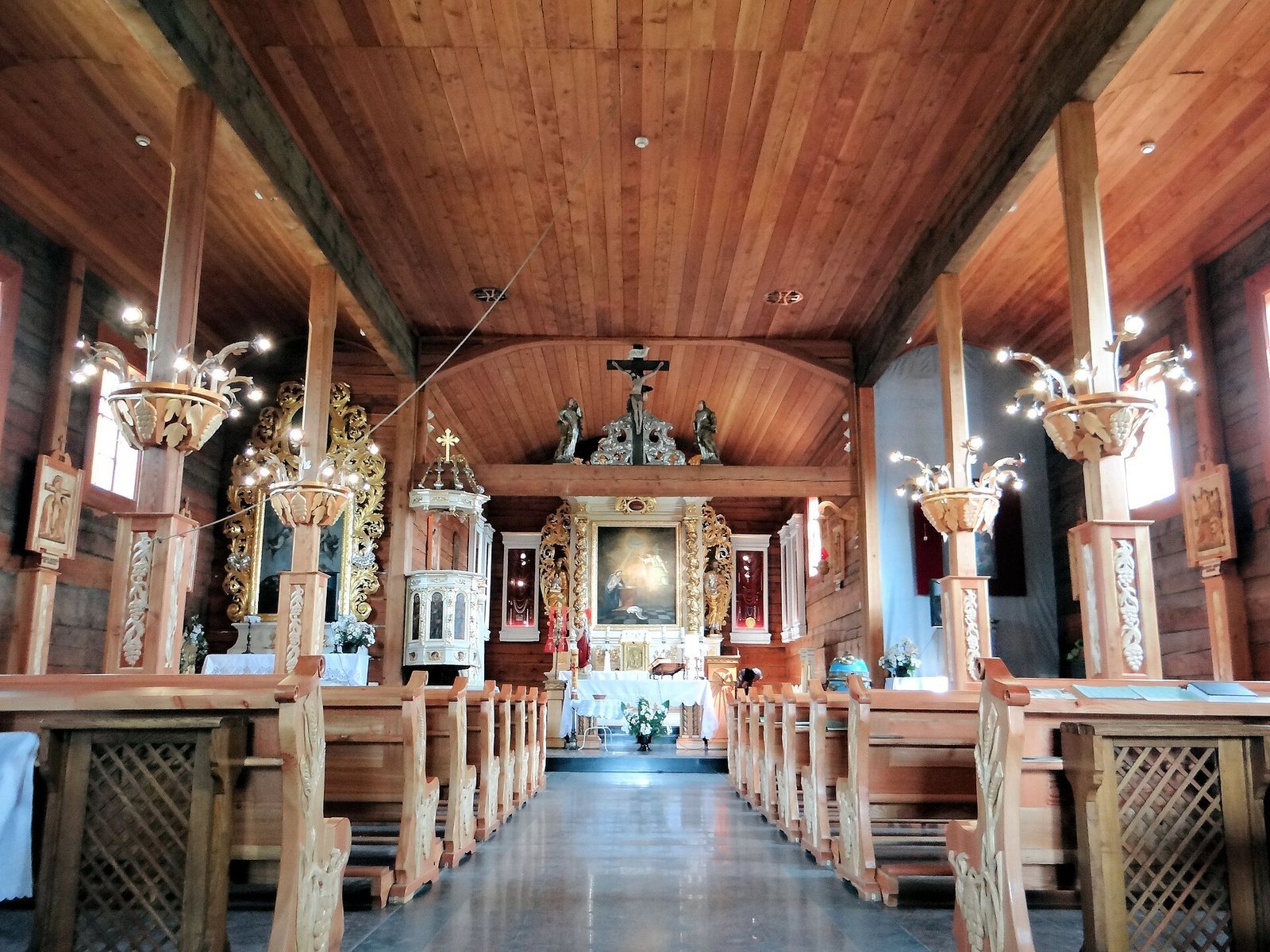
Two rows of paired pillars divide the interior into three sections. The chancel has a barrel vault, a curved ceiling shaped like a tunnel, while the main nave has a flat ceiling and the side aisles have shallower, half-barrel vaults. An elevated music gallery for musicians or an organ rests on four pillars and projects forward at its centre. The floor is covered with ceramic tiles.
Furnishings and parish objects
Altars and liturgical fittings
The main altar, a side altar, and the pulpit date to the middle of the eighteenth century and are Baroque, a European artistic style. A late-Baroque baptismal font dates to the second half of that century. The sanctuary lamp is also Baroque and indicates the reserved Eucharist.
Devotional objects and vestment
A folk-style processional image, a devotional image carried in religious processions, dates to around the middle of the nineteenth century. It depicts Christ and Saints Roch and Rosalia, whom Catholic tradition associates with protection from plague. Two crucifixes represent Rococo, a European style that developed after Baroque, and folk art. A chasuble, a vestment worn by a priest, has an embroidered vertical band and dates to the seventeenth or eighteenth century.
Organ and parish books
The organ was made in 1870 by Leopold Blomberg, an organ maker. Parish books dating to around the turn of the seventeenth and eighteenth centuries are bound with parchment reused from incunabula, books printed before 1501.