Greek Theatre of Thasos: A Hellenistic Theatre and Roman Arena
Site at a Glance
- Popularity
- Low
- Country
- Greece
- Primary era
- Classical
- Eras represented
- Classical, Modern
- Civilizations
- Ancient Greek, Greek, Roman
- Site type
- Entertainment
- Remains
- Theatre
On this page10 sections
History
The Greek Theatre of Thasos is an ancient Greek theatre at Limenas, Greece, whose earliest confirmed building phase dates to the beginning of the Hellenistic period, from the late fourth to the first quarter of the third century BC. The Hellenistic period followed Alexander the Great’s death in 323 BC, as Greek-speaking kingdoms spread across the eastern Mediterranean. The theatre’s existence is associated with Hippocrates, who lived on Thasos in the late fifth century BC. Hegemon, a comic actor and writer who introduced parody, or comic imitation of a recognizable style or work, also lived there during this period.
Hellenistic beginnings
The auditorium may have begun construction in the late fourth century BC, although its surviving remains belong to the Roman period. Excavated walls, considered alongside Roman pottery, suggest that the area was occupied before the theatre was built.
Roman arena and later use
From the first century AD onward, the theatre was altered repeatedly and hosted gladiatorial contests, animal hunts, and fights between people and animals. In the late second or early third century AD, during the Severan dynasty, a Roman imperial dynasty that ruled from the late second into the early third century, the building was converted into an arena.
Before AD 140, Euphrillos’s son and his wife paid for a safety barrier along the orchestra. In the Early Christian period, the first centuries when Christianity emerged and became established in the Roman world, the theatre area was used as a cemetery.
Excavation and conservation
Excavation began in 1921 under French archaeologist G. Daux and lasted no more than two years. After 1960, the Archaeological Society at Athens, a Greek archaeological research and preservation institution, undertook further work focused mainly on stabilizing and conserving the theatre. Investigations covered the auditorium, stage building, side passages, and orchestra. Stabilization also supported the theatre’s reuse for performances in the Philippi-Thasos Festival, which began in 1961. A restoration campaign ran from 1997 to 2001. A study prepared in 2010 proposed conservation, restoration, and partial reconstruction of the stage building and side passages, as well as replacing damaged wooden seating with marble; completion depended on finishing work on those structures.
Remains
Hillside setting and auditorium
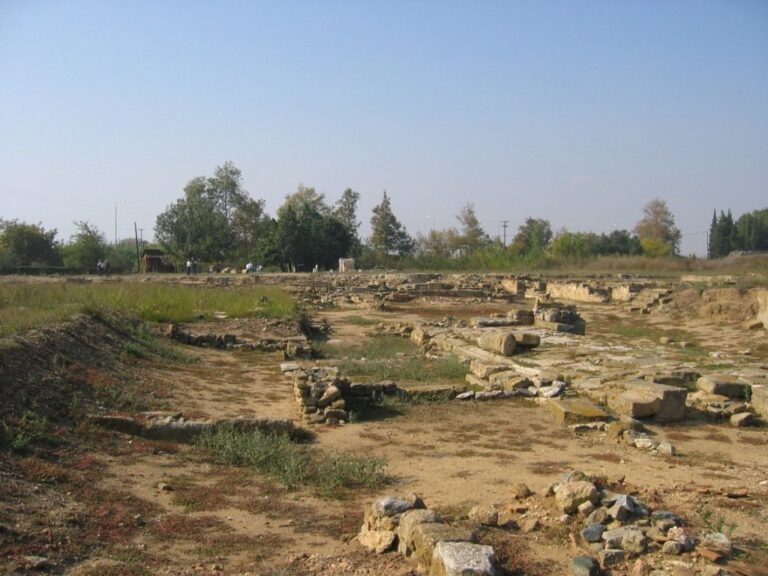
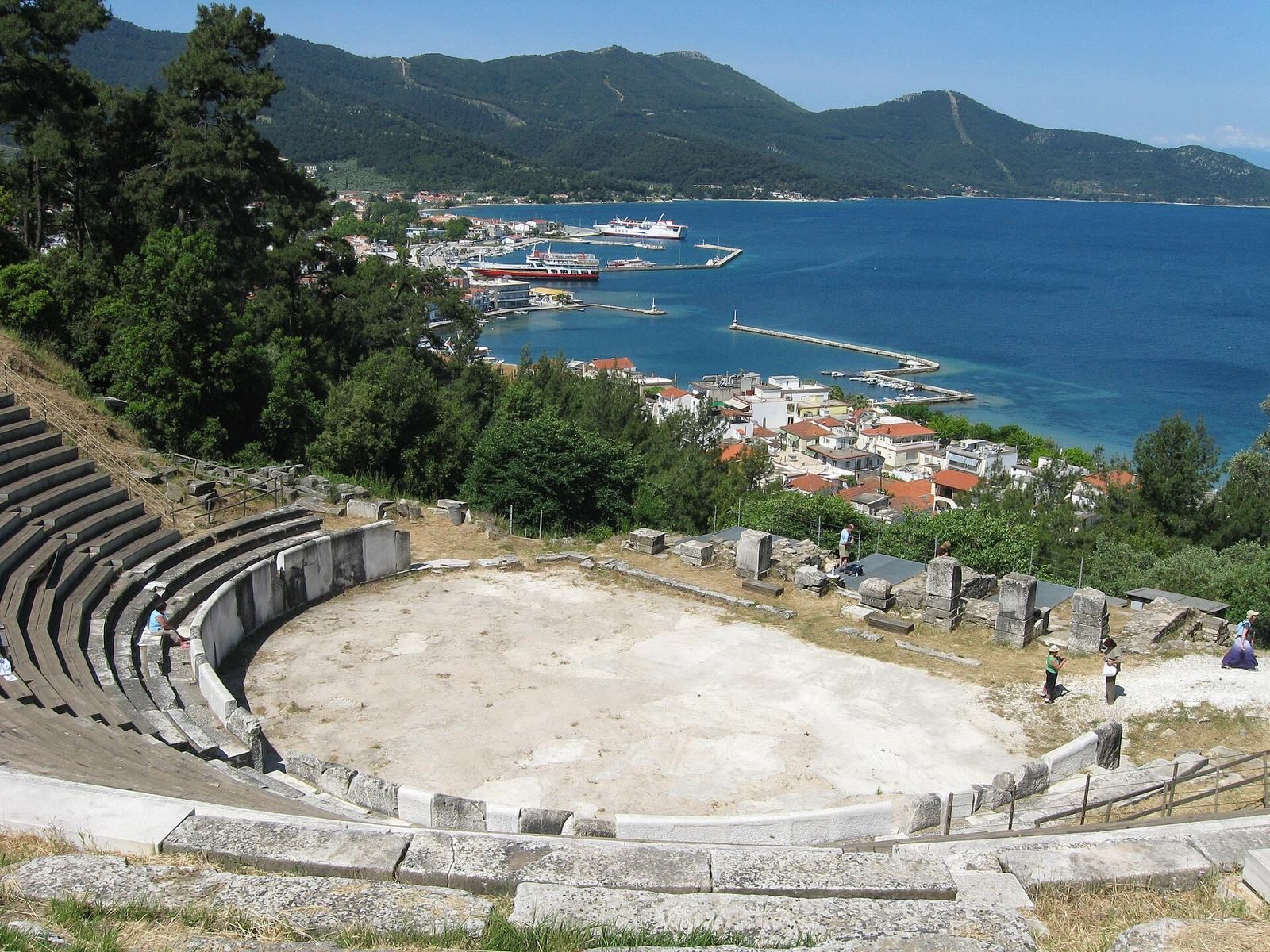
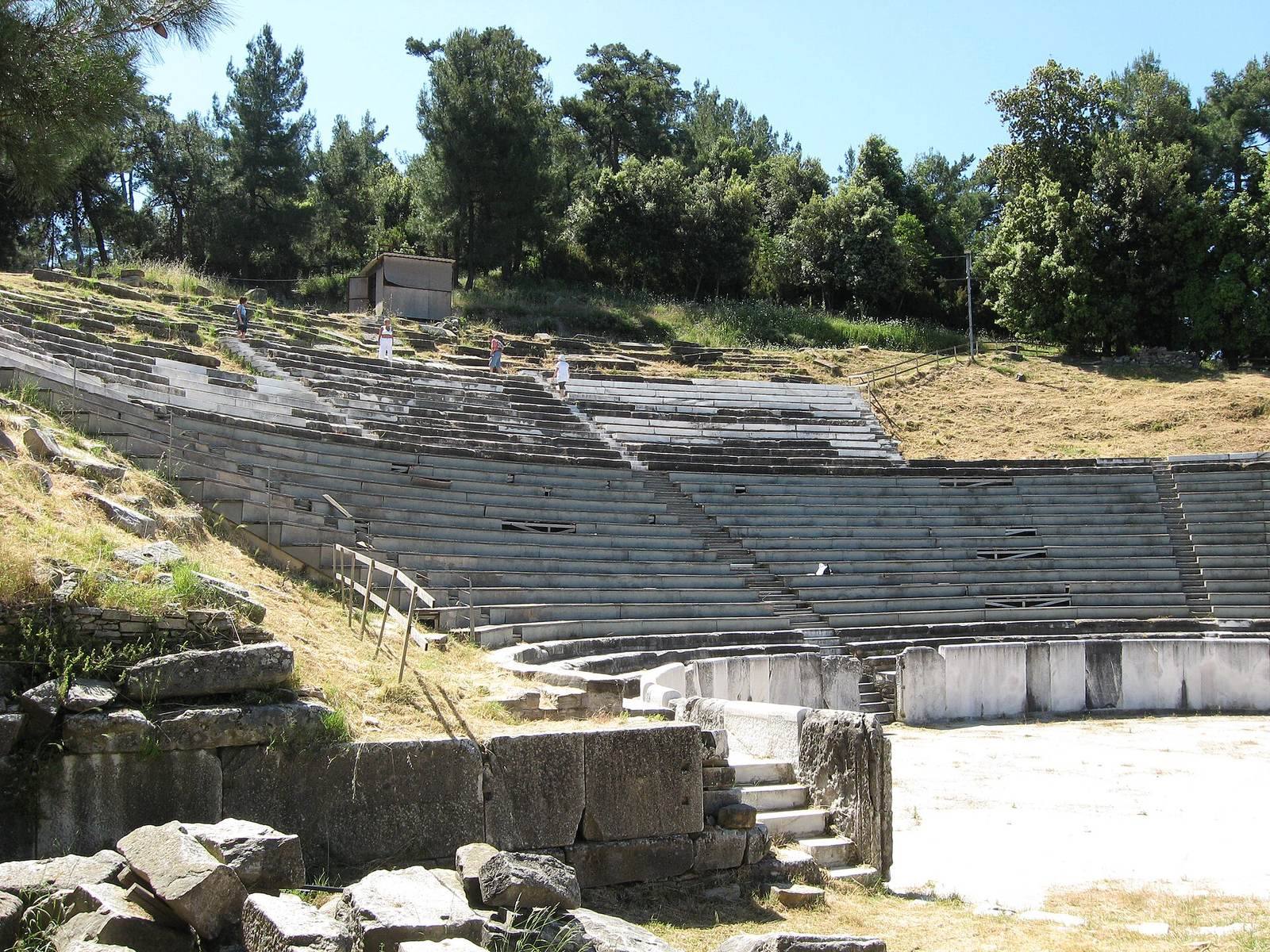
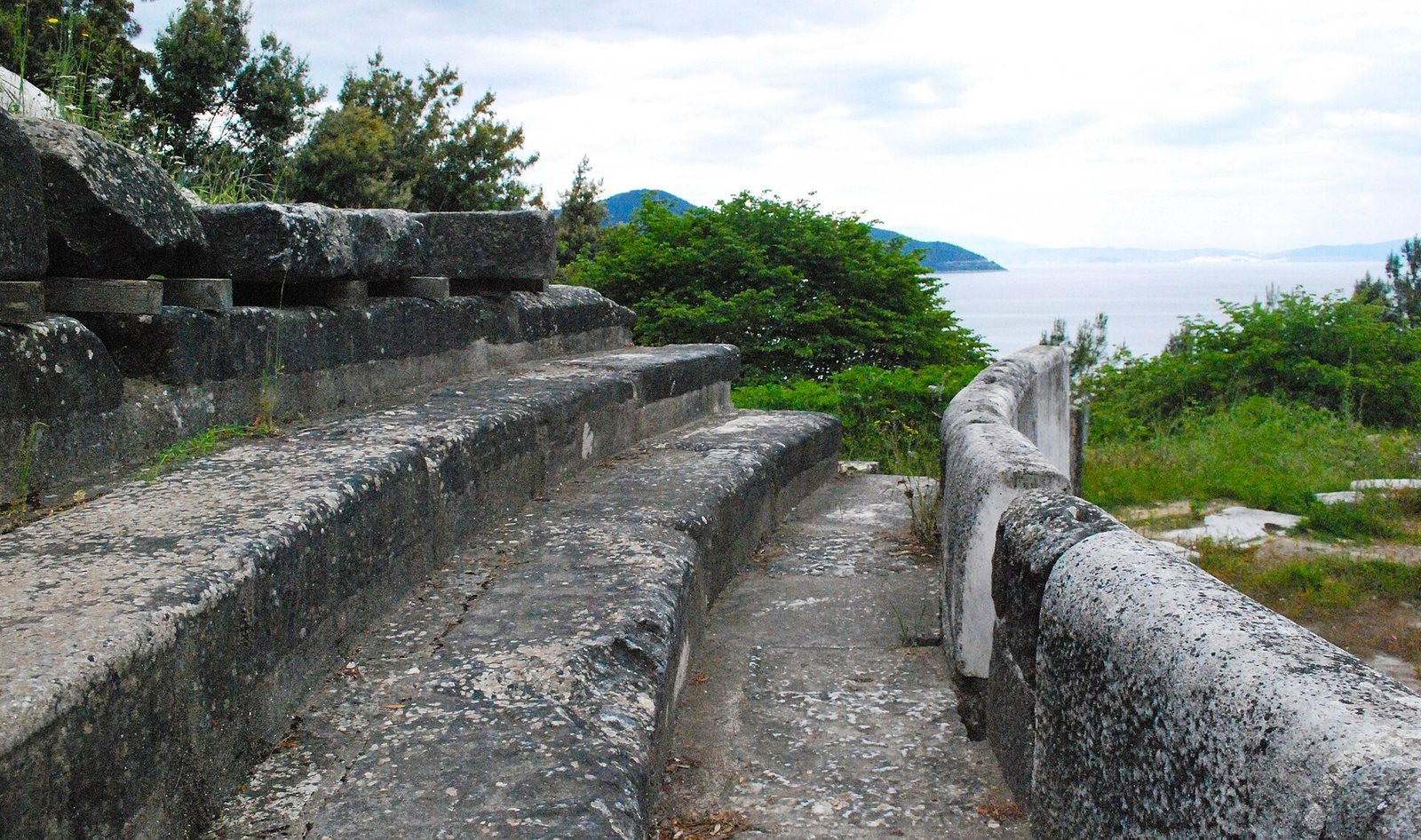
The theatre occupies a natural hollow in the hillside at the northeastern edge of the ancient city of Limenas, with part of the structure resting against the city wall. Its irregular semicircular auditorium faces northwest toward the city and sea and is divided into four seating sections. A large marble retaining wall beneath the floor of the stage-front area may have belonged to a theatre of the Classical period, the Greek era of the fifth and fourth centuries BC, though this attribution remains uncertain. During restoration, tree roots around the seating complicated the work, and the trees were later cut down. A metal structure was installed where seats had not survived, and its slope guided restoration.
Stage and performance area
Stage building
The stage building had Hellenistic and Roman phases. Its third-century-BC form was two storeys high, with a marble façade. Along the front stood twelve fluted columns between two projecting supports. Slots in the columns held painted wooden panels that served as the stage background, while the colonnade supported a raised wooden acting platform. Several surviving architectural elements indicate a lighter colonnade on the upper storey. A wall from the Hellenistic phase, found in the building’s central section, was incorporated into a later Roman-period wall.
Orchestra and side passages
The orchestra, the theatre’s central performance area, was bordered by a drainage channel that ran beneath the threshold of the northeastern side passage. The side passages provided access beside the stage building. When the theatre was converted into an arena, large doors were installed to close these openings.
Spectator barrier
A railing ran along the edge of the orchestra as a safety barrier for spectators. Euphrillos’s son and his wife financed its construction before AD 140.