Sanctuary of Santa Maria dei Miracoli: A Pilgrimage Church in Andria
Site at a Glance
- Popularity
- Medium
- Country
- Italy
- Primary era
- Early Modern
- Eras represented
- Medieval, Early Modern, Modern
- Civilizations
- Byzantine, Italian, Kingdom of Naples, Kingdom of the Two Sicilies, Spanish
- Site type
- Religious
- Remains
- Sanctuary
On this page11 sections
History
The discovery and first church
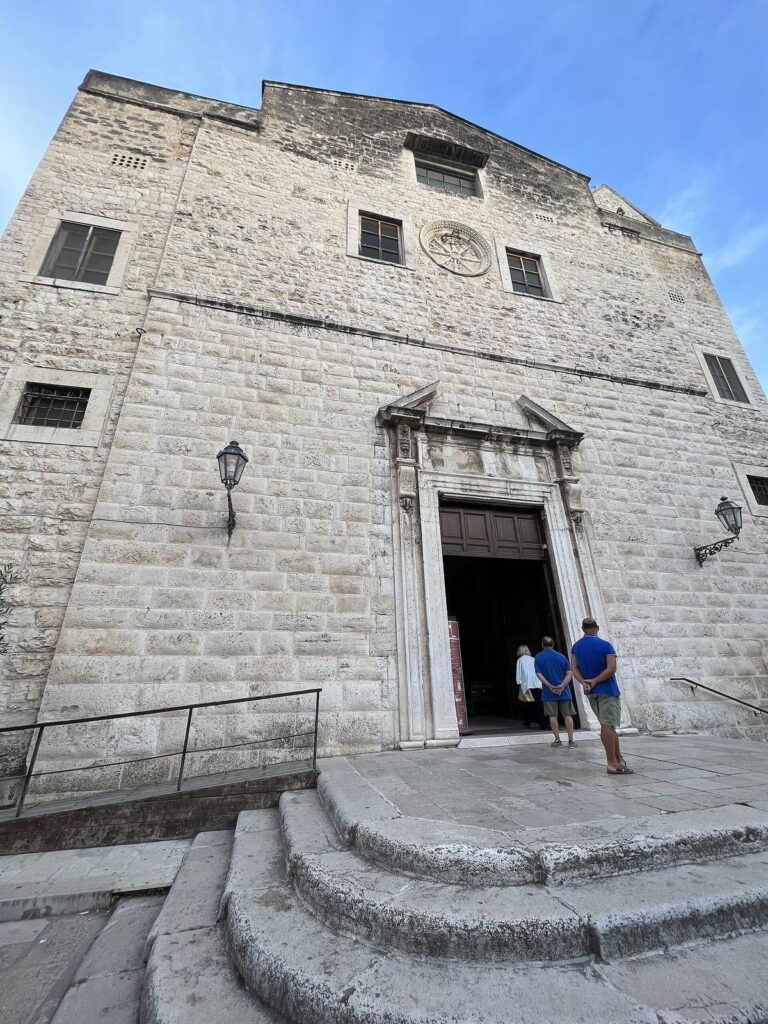
The Sanctuary of Santa Maria dei Miracoli is a Roman Catholic pilgrimage church in Andria, Italy. Its history as a Marian sanctuary centers on a Byzantine image of the Virgin and Child found there in 1576, and it remains an active parish church.
Catholic tradition places the rediscovery of Santa Margherita in Lama, a Basilian monastic settlement where monks lived in separate cells around a shared place of worship, on Saturday, March 10, 1576. The search followed a local boy’s reported dream of an appearance by the Virgin. Those who found the image set a lamp before it and agreed to keep the lamp burning in turns. When one of them forgot to add oil, they found it still alight and full. They regarded this as a miracle and told Luca Fieschi, bishop of Andria.
At a Mass on June 6, 1576, the image received the title Santa Maria dei Miracoli d’Andria. That date is also given for the sanctuary’s consecration. The image was placed in the care of Cassinese Benedictine monks, a branch of the Benedictine tradition associated with Monte Cassino, who built the first church, known as the Church of the Crucifixion.
Expansion for pilgrims
In the first half of the seventeenth century, growing numbers of pilgrims led to the construction of a second, upper church and a large convent. The convent later took on other uses. It now houses the Umberto I provincial agricultural technical institute and offices of the Province of Barletta-Andria-Trani.
Damage and renewed worship
In 1799, French troops of the Neapolitan Republic and forces led by Ettore Carafa, Duke of Andria, caused damage in the city. The church was later abandoned, following the damage and the suppression of religious orders by Gioacchino Murat, a French commander who ruled Naples during the Napoleonic era.
Bishop Giuseppe Cosenza sought to revive devotion to the Madonna dei Miracoli. In 1837, with the consent of Ferdinand II, the Bourbon king of Naples and Sicily, he entrusted the sanctuary to Augustinian monks from Naples. The monks began restoring the church.
Nineteenth-century devotion
In 1855, Andria escaped a cholera epidemic affecting Apulia and a parasitic plant disease that destroyed vineyards. People regarded both events as a second miracle, and two gold crowns were placed on the heads of the Madonna and Child. On May 3, 1857, a gold rose offered by the king was placed on the Virgin’s breast in a ceremony.
Also in 1857, Bishop Longobardi believed the Virgin had saved Andria from an earthquake. The city declared the Madonna dei Miracoli a co-patron alongside Saint Richard of Andria, its patron saint.
Changes in care and status
After the Kingdom of Italy confiscated convents and church property in 1866, the Augustinians left, and a priest-chaplain took charge of the church. The order returned in 1886, when the sanctuary was in serious condition, and built a new convent. That building is now the Villa Santa Monica reception center. In 1907, on the fiftieth anniversary of the image’s coronation, the church received the title of minor basilica, an honorific status granted to Catholic churches.
Remains
The sanctuary is arranged across three levels, from a rock church at the base through a small church in the middle to the upper church. Together, these spaces form a complex that developed over several centuries.
The lower rock church
Santa Margherita is a ninth-century rock church and the oldest part of the complex. Its Basilian monastic settlement includes a hall divided into three aisles, decorated with scenes or motifs from Genesis. The Byzantine icon of the Virgin and Child remains in the cave church. The Virgin wears a crown of twelve stars representing the apostles; the sun, representing Christ, is shown to her right, and the moon, representing the Virgin, to her left. The image is revered as miraculous.
The middle small church
The sixteenth-century middle level, known as the Tempietto, is an almost square space divided into three aisles. It lies between the cave church below and the presbytery of the upper church. Its Chapel of the Crucifixion contains frescoes.
The upper church
The upper level dates to the seventeenth and eighteenth centuries. Local historical writing has attributed its design to the Italian architect and sculptor Cosimo Fanzago. That attribution was questioned beginning in 1945 and remains contested in more recent studies.
Organ and silver statue
The pipe organ, built by Michele Sessa in 1854, stands on a gilded wooden gallery dated 1644. It has 22 stops, each controlling a set of pipes, one keyboard, and a foot-operated pedal keyboard.
Worshippers donated a silver statue to the church after the Augustinians left in 1866. It was stolen in 1983 and subsequently remade.