Saint Catherine Church in Rybnik-Wielopole: A Wooden Parish Church
Site at a Glance
- Popularity
- Low
- Country
- Poland
- Primary era
- Early Modern
- Eras represented
- Early Modern, Modern
- Civilizations
- Holy Roman Empire, Kingdom of Bohemia, Kingdom of Prussia
- Site type
- Religious
- Remains
- Church
On this page10 sections
History
Saint Catherine church in Rybnik-Wielopole is a wooden Roman Catholic parish church in Wielopole, Poland, built at Gierałtowice in 1534. It is the oldest wooden-architecture monument in the Rybnik region. Its present dedication is to Saint Catherine of Alexandria, a Christian martyr, and Our Lady of the Rosary, a title for Mary linked to rosary devotion. The church belongs to the local parish within the Golejów deanery of the Archdiocese of Katowice.
Construction at Gierałtowice
Stanisław Dąbrówka funded the church’s construction. It was renovated in 1676. A wooden tower was added in 1844 by Mateusz Pindur, a carpenter from Chudów.
Transfer to Wielopole
A small chapel dedicated to Our Lady of the Rosary was built in Wielopole in the late eighteenth century. As the district grew, it could no longer serve the community’s needs. The church was moved from Gierałtowice to Wielopole in 1975–1976 and rededicated by Bishop Herbert Bednorz of Katowice. It has stood at its present location since 1976.
Repairs in 1960–1962 revealed the church’s painted decoration. Further repairs took place in 2010.
Remains
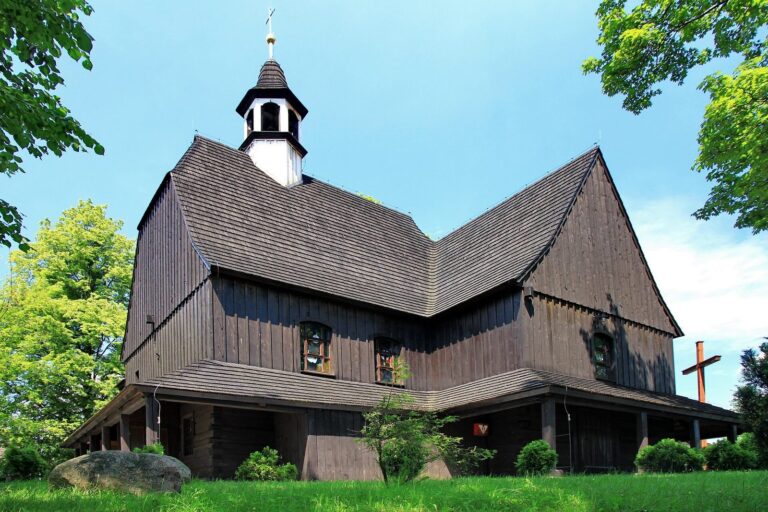
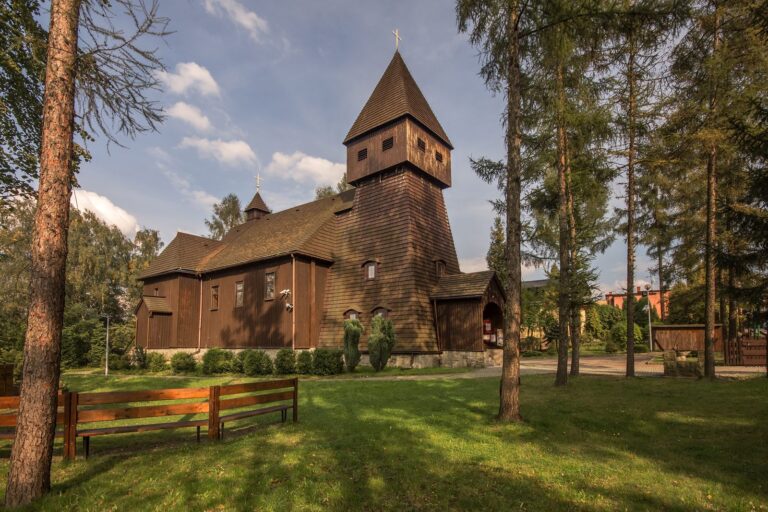
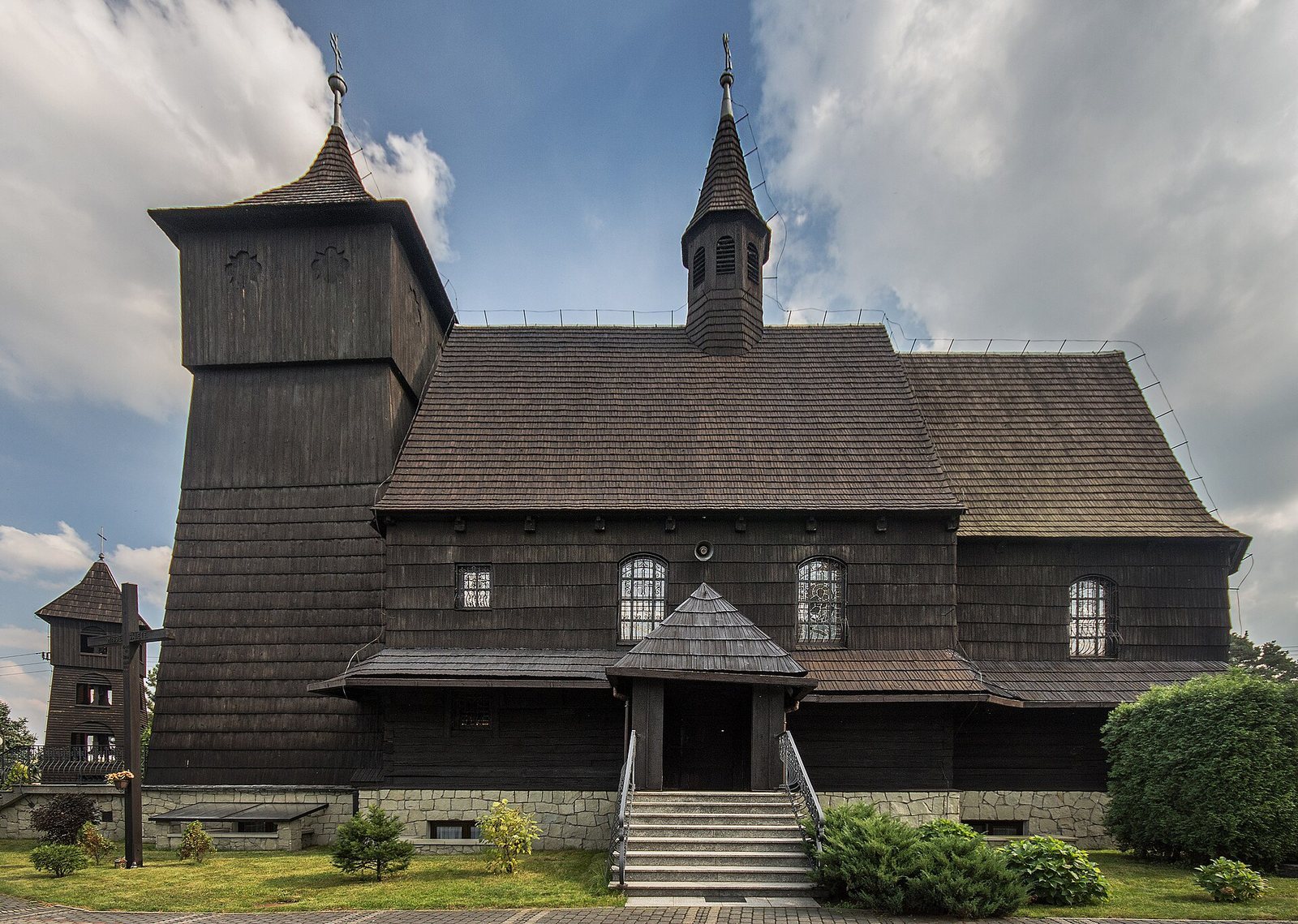
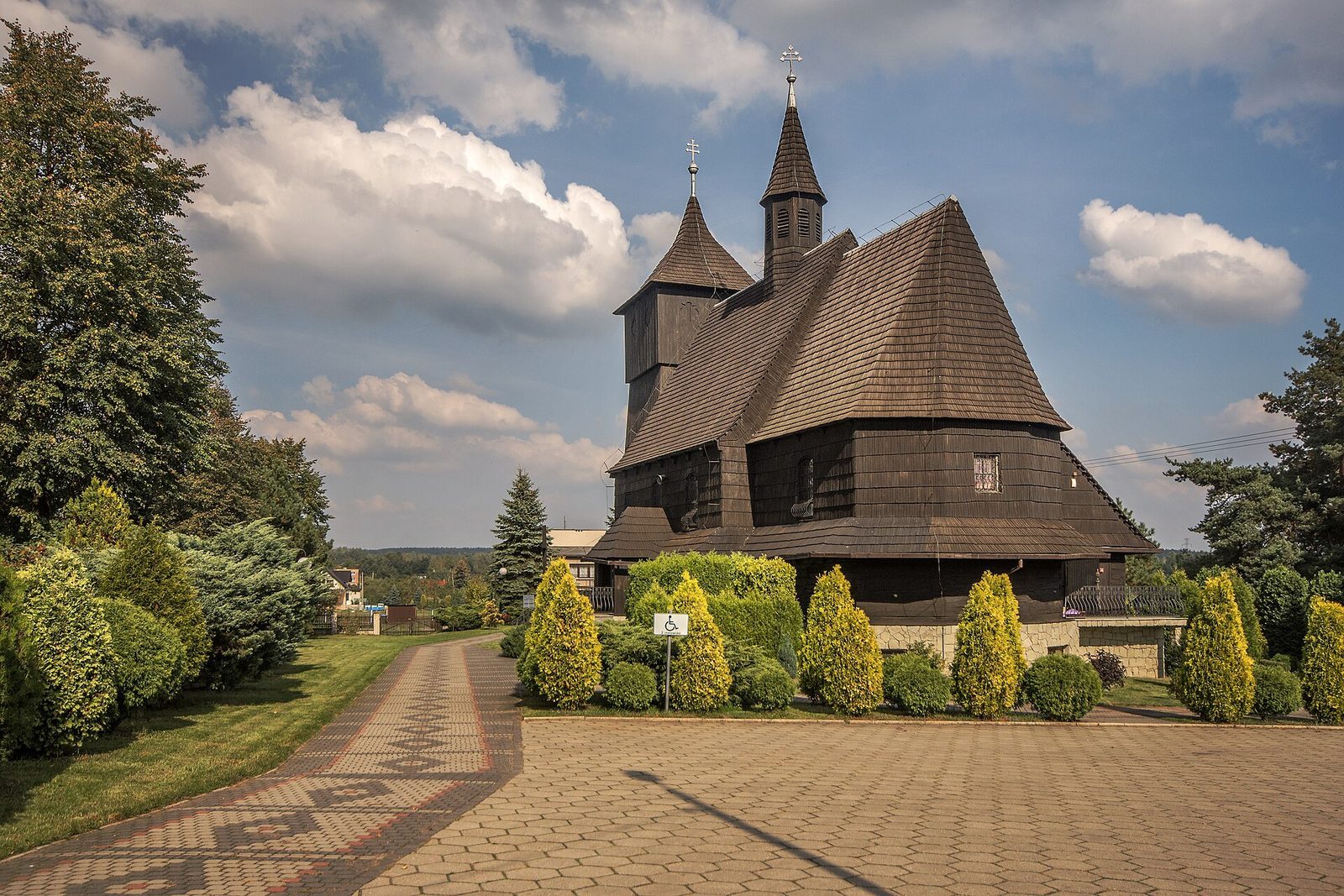
The church is a timber, single-nave building on a rectangular plan, raised on a stone base. It is non-oriented, meaning it does not follow the customary east–west alignment. Its narrower chancel, the area around the altar, has a three-sided end and a sacristy, a room for vestments and liturgical objects, on one side.
Exterior and tower
Shingled, roofed galleries extend around the church. Its shingled roof has two ridges, with a hipped section above the chancel and an octagonal bell turret on the nave ridge. One side entrance is reached through a porch, while another passes beneath the tower. The tower stands on a high masonry base and has a timber frame of upright posts, walls that narrow toward the top, an overhanging bell chamber, and a tent-shaped roof.
Interior and furnishings
Ceiling decoration
The boarded ceilings over the nave and chancel retain late Gothic painted decoration from 1534. The designs were made using reusable templates and include a Piast eagle, an emblem associated with Poland’s medieval Piast dynasty, set within a Gothic shield, as well as an image of Saint Catherine.
Altars and paintings
The late Baroque main altar dates to 1827 and was made by sculptor Izydor Mrowiec of Krzanowice. Late Baroque side altars from the seventeenth century hold paintings of Mary Magdalene, a follower of Jesus, and Joachim and Anne, traditionally regarded as Mary’s parents. A painting of Saint Catherine, made in 1828 by Franciszek Frömel of Fulnek in Moravia, is also preserved in the church.
Other furnishings
Historic furnishings include a seventeenth-century Baroque pulpit, a wooden baptismal font supported by an angel figure, and a patron’s pew dated 1691. Most of the interior fittings are modern. At the rear, a gallery supported by four columns holds an electronic organ.
Belfry and grounds
A separate belfry built near the church in 2005 holds three bells. The highest-pitched and smallest weighs about 260 kilograms and is dedicated to Saint Catherine; the middle bell, about 350 kilograms, to Our Lady of the Rosary; and the lowest-pitched and largest, about 600 kilograms, to Divine Mercy, a Christian devotion to God’s mercy. Green spaces around the church include young larches, black pines, and blue spruces. Tombstones at the church commemorate parish priests Jerzy Rzerzucha and Stanisław Płaza.