Holy Trinity Church in Ulanów: A Wooden Roman Catholic Filial Church
Site at a Glance
- Popularity
- Very Low
- Country
- Poland
- Primary era
- Early Modern
- Eras represented
- Early Modern
- Civilizations
- Polish–Lithuanian Commonwealth
- Site type
- Religious
- Remains
- Church
On this page8 sections
History
Construction and local support
Holy Trinity Church in Ulanów, Poland, is a wooden Roman Catholic filial church built in 1690. A filial church is a secondary church served by a parish rather than the parish church itself. Holy Trinity is served by the parish of St John the Baptist and St Barbara, and belongs to the Ulanów deanery, a group of parishes within the Diocese of Sandomierz. The church is dedicated to the Holy Trinity.
Its construction was paid for by Jędrzej Zamojski, a Polish-Lithuanian Commonwealth official and senior provincial governor, together with local contributions. Many residents who supported the work were raftsmen, giving the church its local name, the “Raftmen’s Church.”
Alterations, damage, and rebuilding
A porch was added in 1742. The church underwent restoration in 1856–1860 and again in 1979–1981. On 29 March 2002, a fire caused extensive damage to its interior. The building was reconstructed by the end of that year, and work to restore the interior was completed in 2005.
Remains
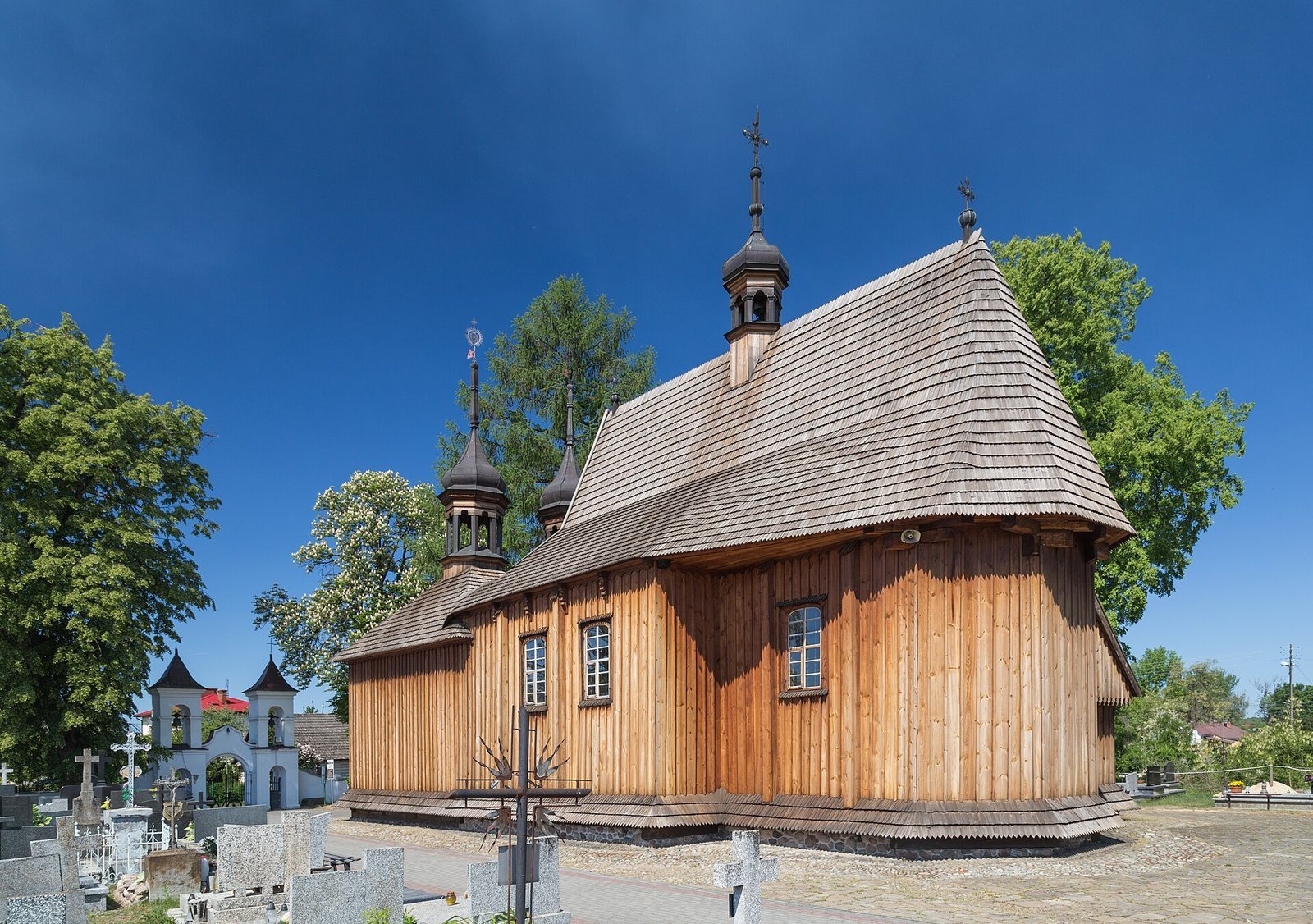
The church is a single-nave wooden building constructed from larch logs. Its chancel is narrower than the nave and ends in three sides, with a sacristy beside it.
Exterior
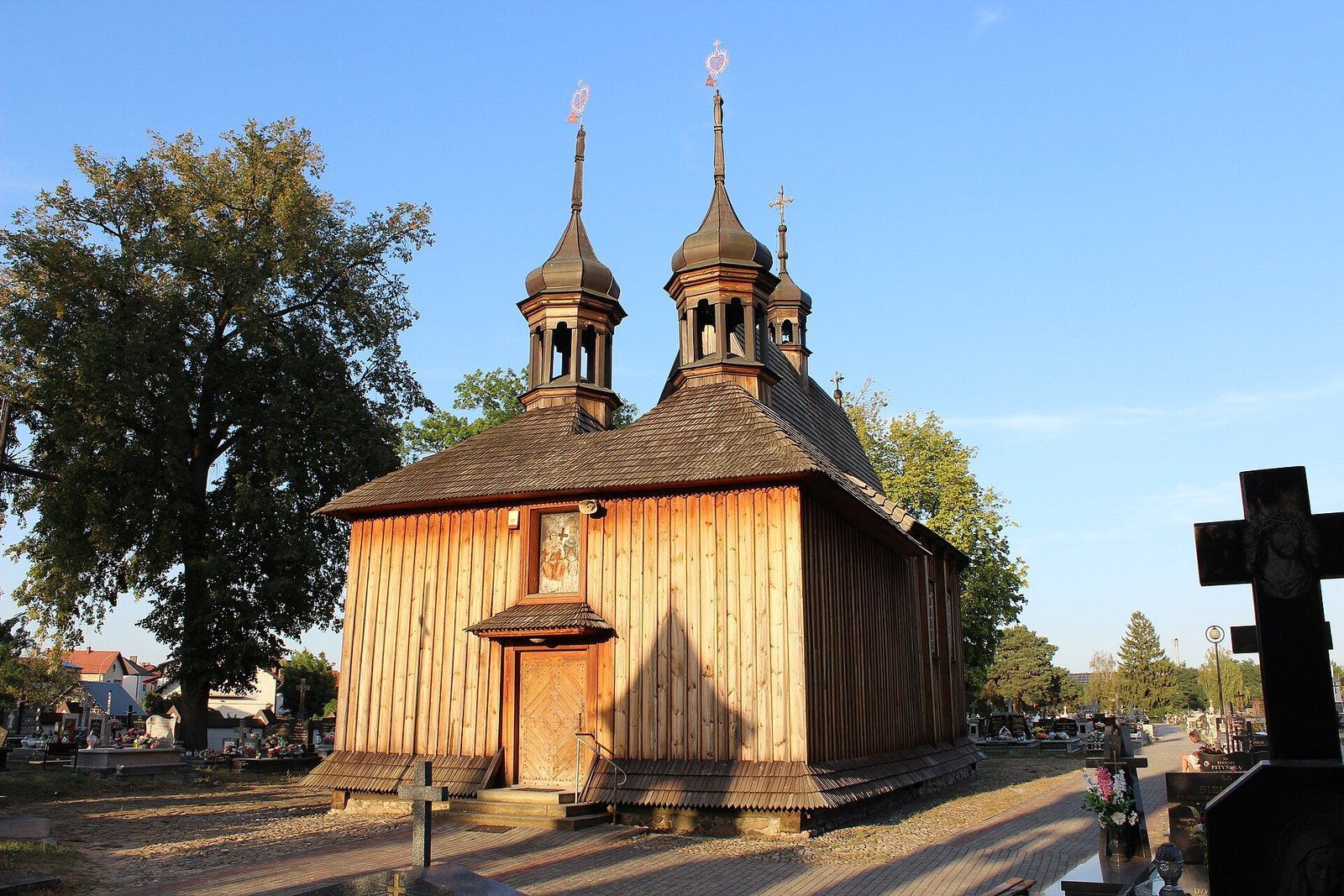
A large porch projects from the front of the nave. Two original small turrets rise above it, each capped by a metal onion-shaped roof and a lantern. The building has a single-ridge shingle roof with an octagonal bell turret. That turret is crowned by an onion-shaped roof with a spire and lantern, while a shingle apron covers and protects the lower walls.
Interior
Ceiling and music gallery
The ceiling is shaped to resemble a barrel vault and is supported by two posts in the nave. The raised music gallery, a platform for singers or musicians, rests on two columns and has a straight parapet.
Furnishings and painted decoration
Before the 2002 fire, the furnishings included a late-eighteenth-century organ and a main altar and pulpit from the second half of the eighteenth century. These were late Baroque pieces, part of a later phase of a European art style of the 1600s and 1700s. Two side altars in the Baroque style dated to the late seventeenth century. An eighteenth-century crossbeam over the chancel opening carried a crucifix. The church also had eighteenth-century paintings that used visual effects to suggest depth. Their scenes included episodes from the Old and New Testaments, the death of Saint Joseph, and the raising of Lazarus. Repainting in 1866 had altered the paintings, which were destroyed in the fire. Fragments of earlier painted decoration, dating to the late seventeenth century, were found during the 1979–1981 restoration.