Agia Irini: A Bronze Age Settlement on Kea, Greece
Site at a Glance
- Popularity
- Medium
- Country
- Greece
- Primary era
- Bronze Age
- Eras represented
- Bronze Age
- Civilizations
- Unclassified
- Site type
- City
On this page14 sections
History
Agia Irini is a prehistoric settlement on a peninsula in Agios Nikolaos Bay on Kea, Greece. Its earliest substantial remains date to around 2500 BCE, in Early Cycladic II, a phase of Bronze Age culture in the Cyclades. These remains are associated with the Keros-Syros culture, an archaeological grouping used for this period of island material culture.
Early Cycladic settlement
A settlement here has been proposed for the late Neolithic, around 3000 BCE, but the evidence consists of scattered finds. Occupation at Agia Irini ended shortly after 2200 BCE and resumed around 2000 BCE. The latest finds from the earlier phase are associated with the Kastri culture, another archaeological grouping of Early Cycladic material.
Rebuilding and regional connections
Around 1900 BCE, during the Middle Cycladic period, residents rebuilt the settlement with a new layout rather than following its earlier foundations. They fortified it during this phase. Around 1700 BCE, the settlement was rebuilt again, as Minoan influence became more pronounced. Minoan culture was centered on Crete; Mycenaean culture developed on mainland Greece.
Agia Irini flourished as a political and economic center from about 1600 to 1450 BCE. Its inhabitants likely farmed to supply local needs while also trading. Pottery indicates contacts with Crete, the nearby Cyclades, Attica and the Peloponnese. From the eighteenth century BCE onward, the settlement may have connected Minoan and mainland Mycenaean cultures.
Destruction and later use
Earthquakes damaged buildings during the sixteenth century BCE. A more severe earthquake in the fifteenth century BCE destroyed the settlement. Walls were torn apart, buildings collapsed, and masonry buried cellars and their contents.
The settlement was not reoccupied as a whole. Around the transition between the fourteenth and thirteenth centuries BCE, a few residents repaired and used some rooms, including the sanctuary. Pottery from this phase indicates that Kea had become closely integrated into Mycenaean mainland culture. Use of the site in Classical and Roman times was limited, although the sanctuary continued in use.
The sanctuary was repaired after another earthquake around 1200 BCE and remained in use into the Hellenistic period, which began in the late fourth century BCE. Evidence extends to about 300 BCE. An Archaic-period inscription, from an early phase of Greek history before the Classical period, dedicates an offering to Dionysus, a Greek god associated with wine, festivity and ritual. It suggests continuity between earlier Minoan-Mycenaean and later Greek religious practice.
The settlement’s ancient name is unknown. Its modern name comes from a Byzantine-period chapel dedicated to Saint Irene.
Rediscovery and excavation
Archaeologist Gabriel Welter discovered the site during the Second World War. Systematic excavations began in 1960 under John Langdon Caskey, with American archaeologists associated with the University of Cincinnati and the American School of Classical Studies at Athens. Caskey organized the finds into eight archaeological layers, from the Neolithic to the Mycenaean period. Publications began appearing in 1977 and remained incomplete in 2011. Finds from Agia Irini are held in the archaeological museum at Ioulida, Kea’s principal town.
Remains
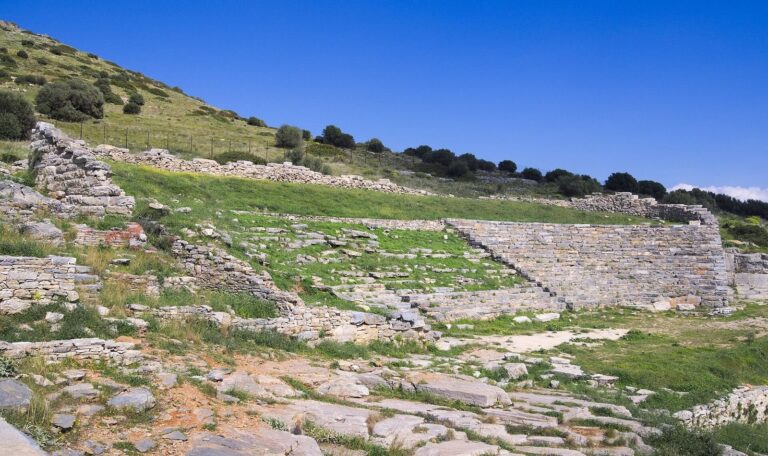
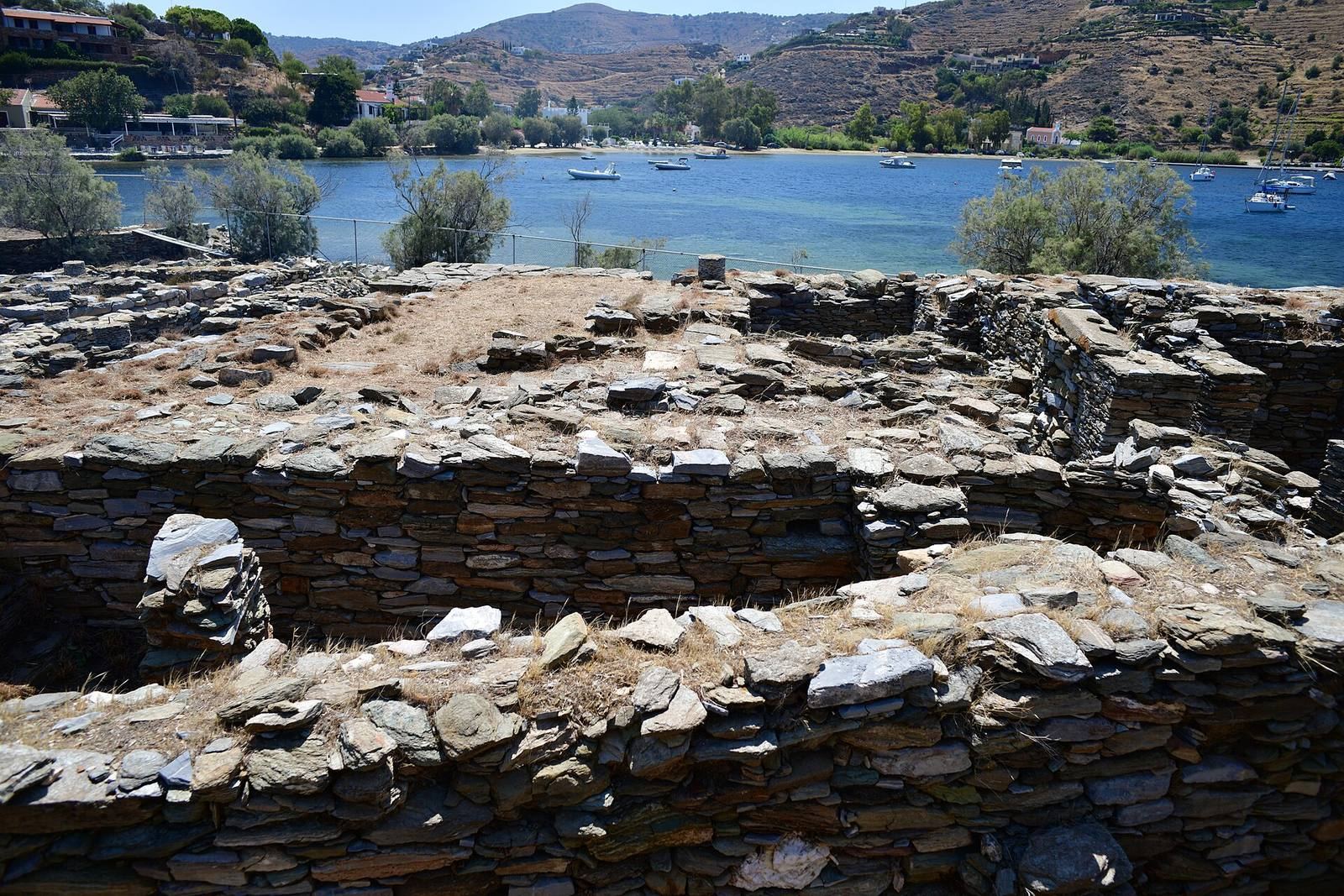
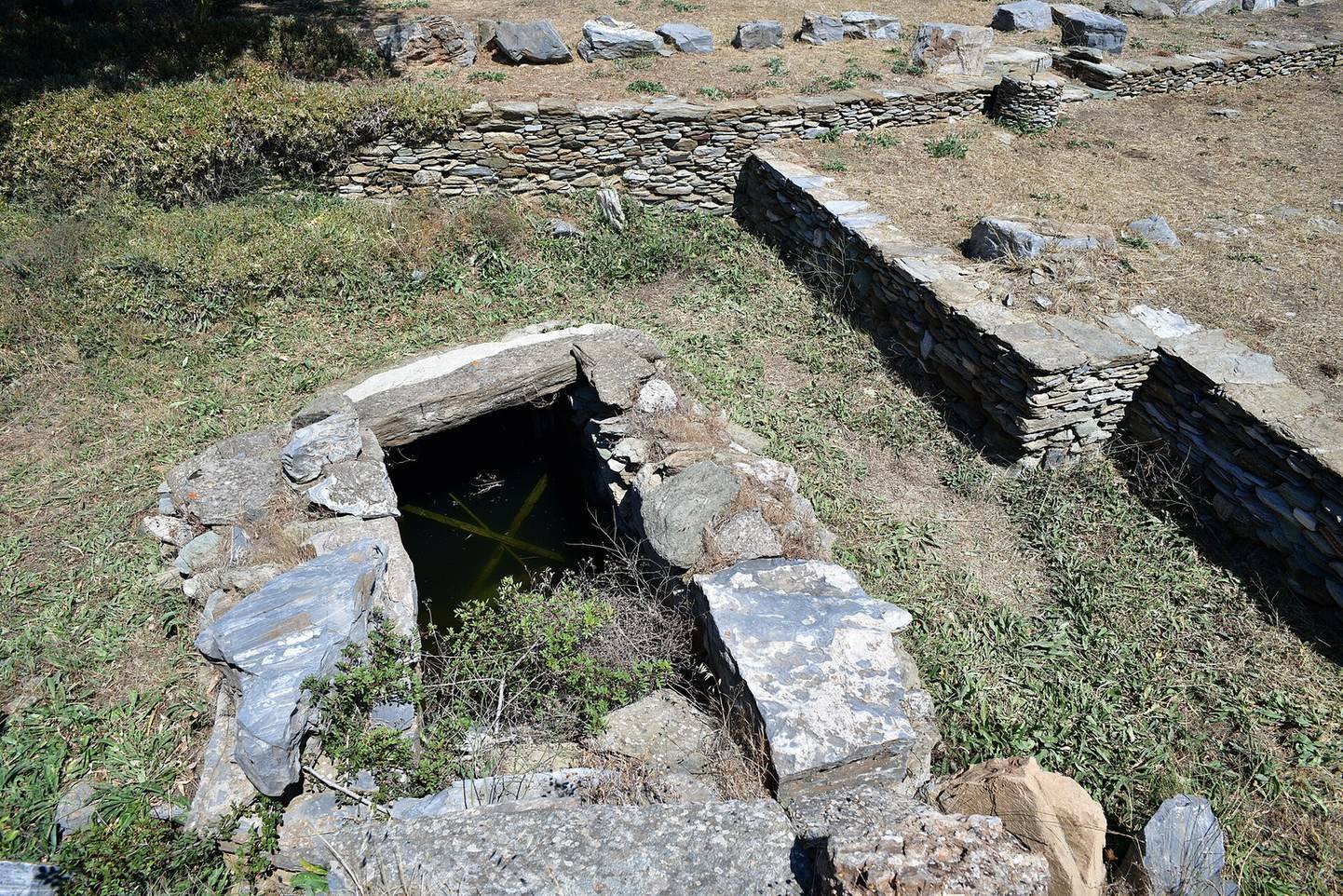
The settlement occupied a peninsula now about 150 by 80 metres, with defensible terrain, a freshwater spring and a sheltered harbour. Its remains include a densely built residential area with streets, fortifications and a sanctuary set somewhat apart. The architecture ranges from carefully finished early foundations to later houses and dressed-limestone defenses.
Settlement and defenses
Fortifications
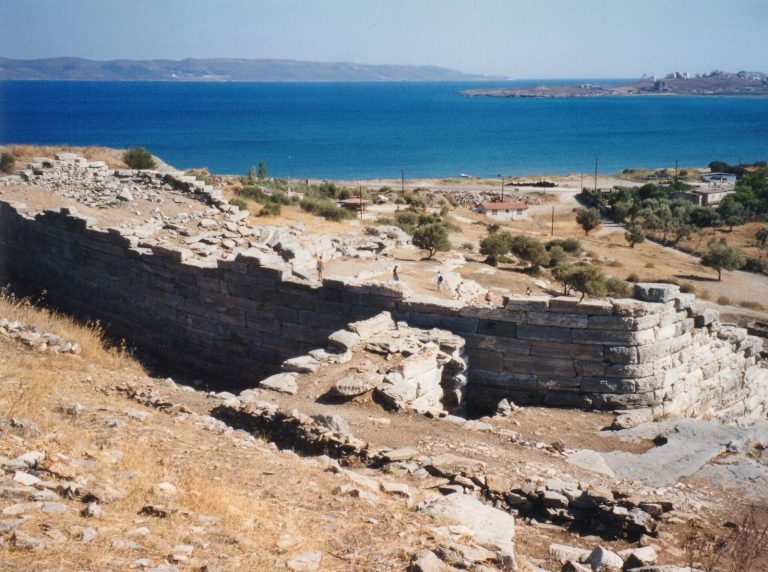
A fortification wall and a horseshoe-shaped watchtower protecting a city gate belong to the Middle Cycladic phase. Around 1700 BCE, the wall was rebuilt using dressed limestone. Rectangular towers took the place of the earlier tower, whose outer face was curved.
Houses
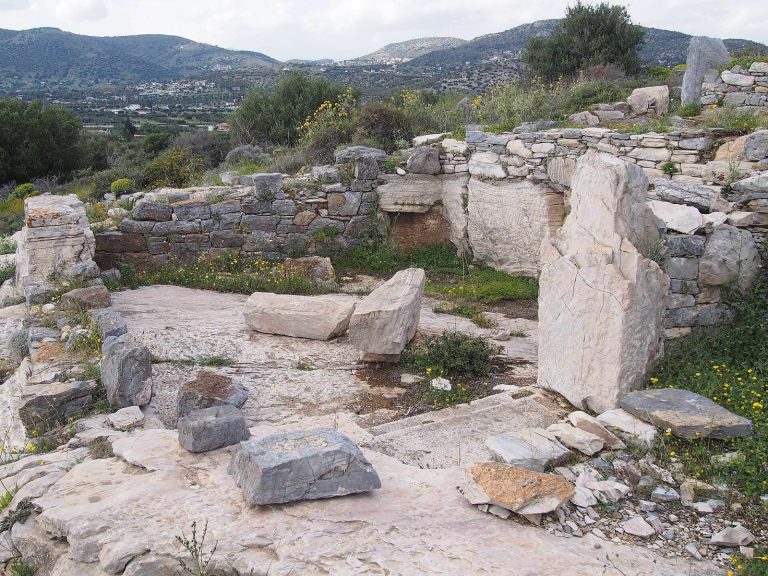
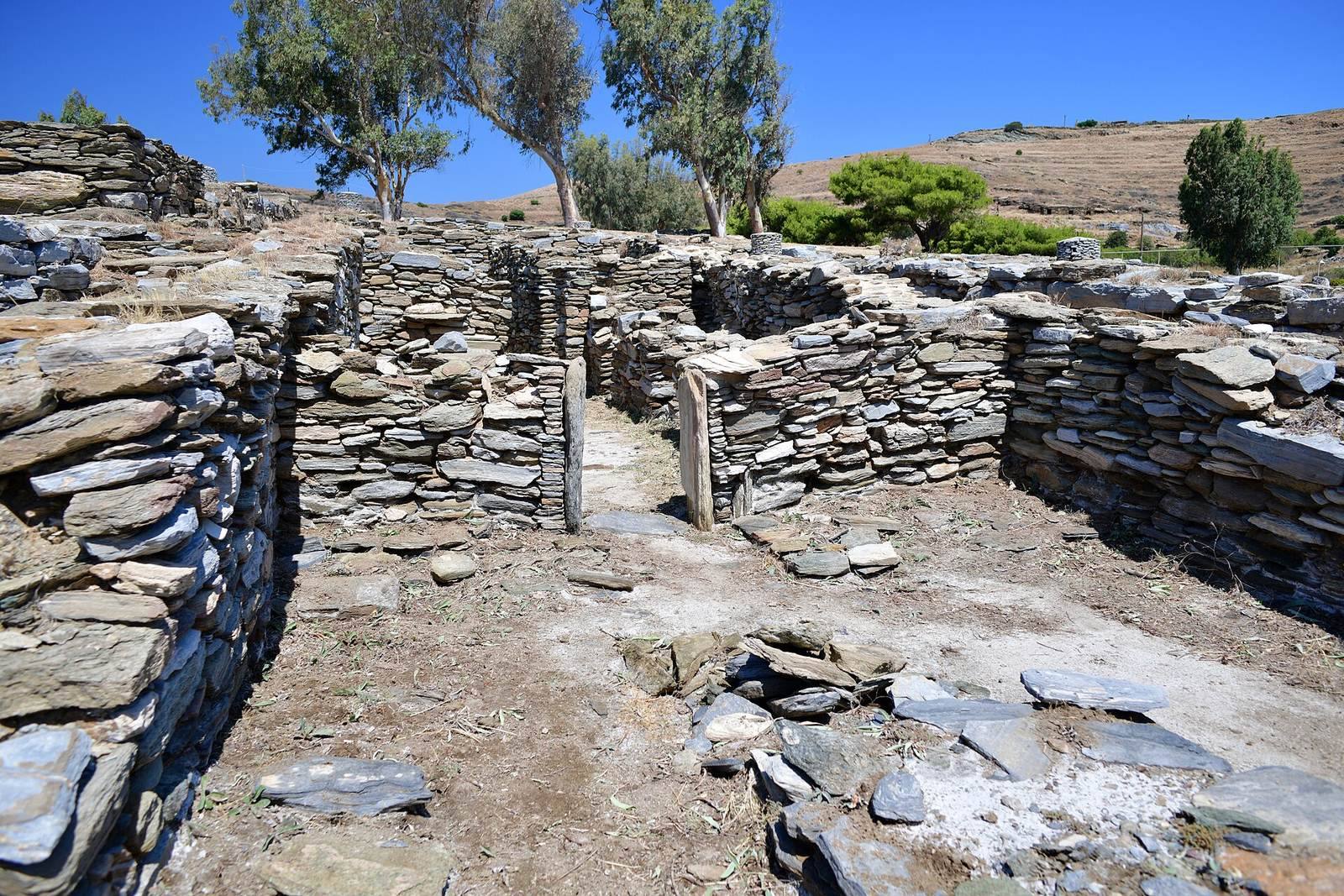
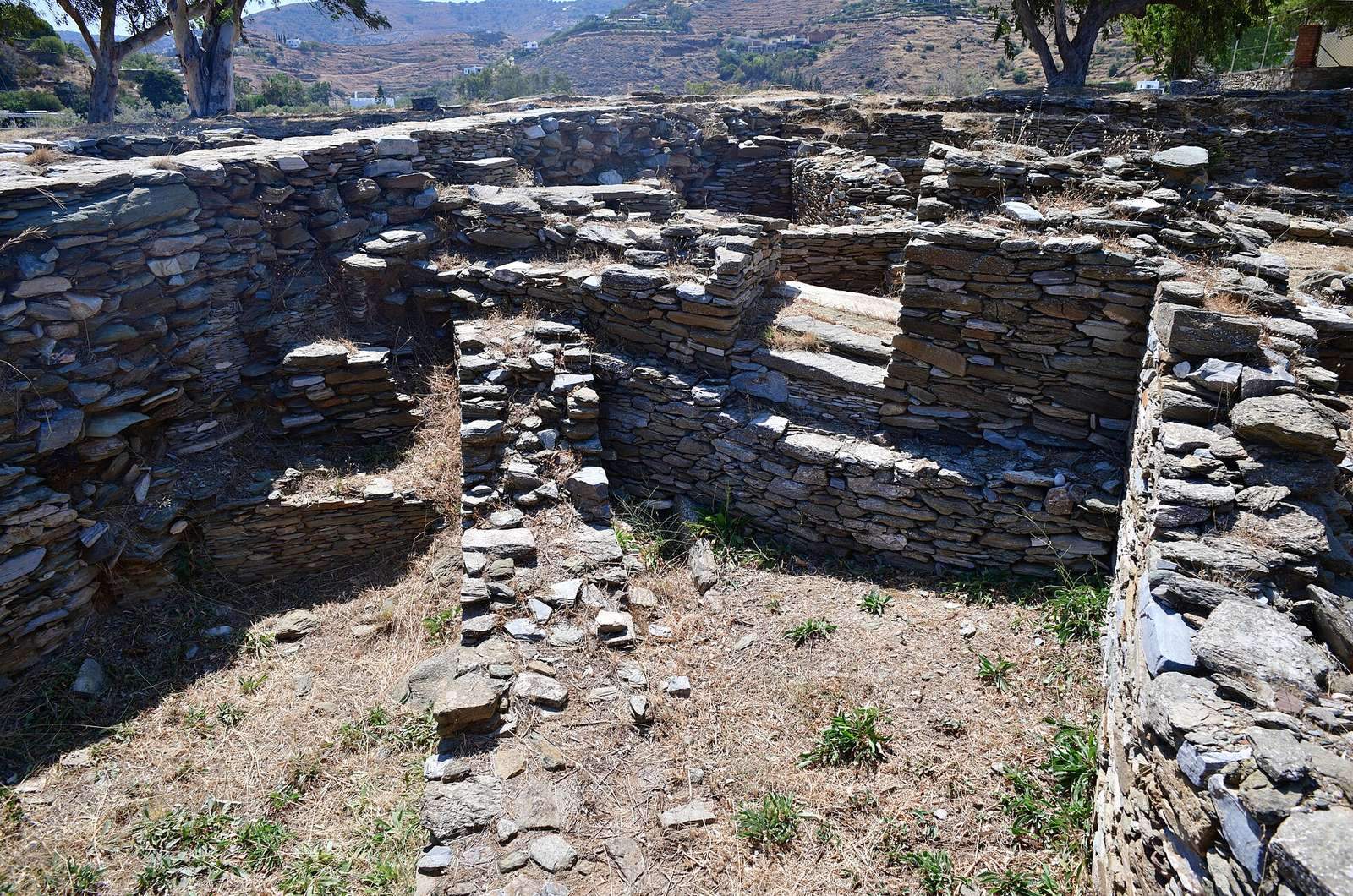
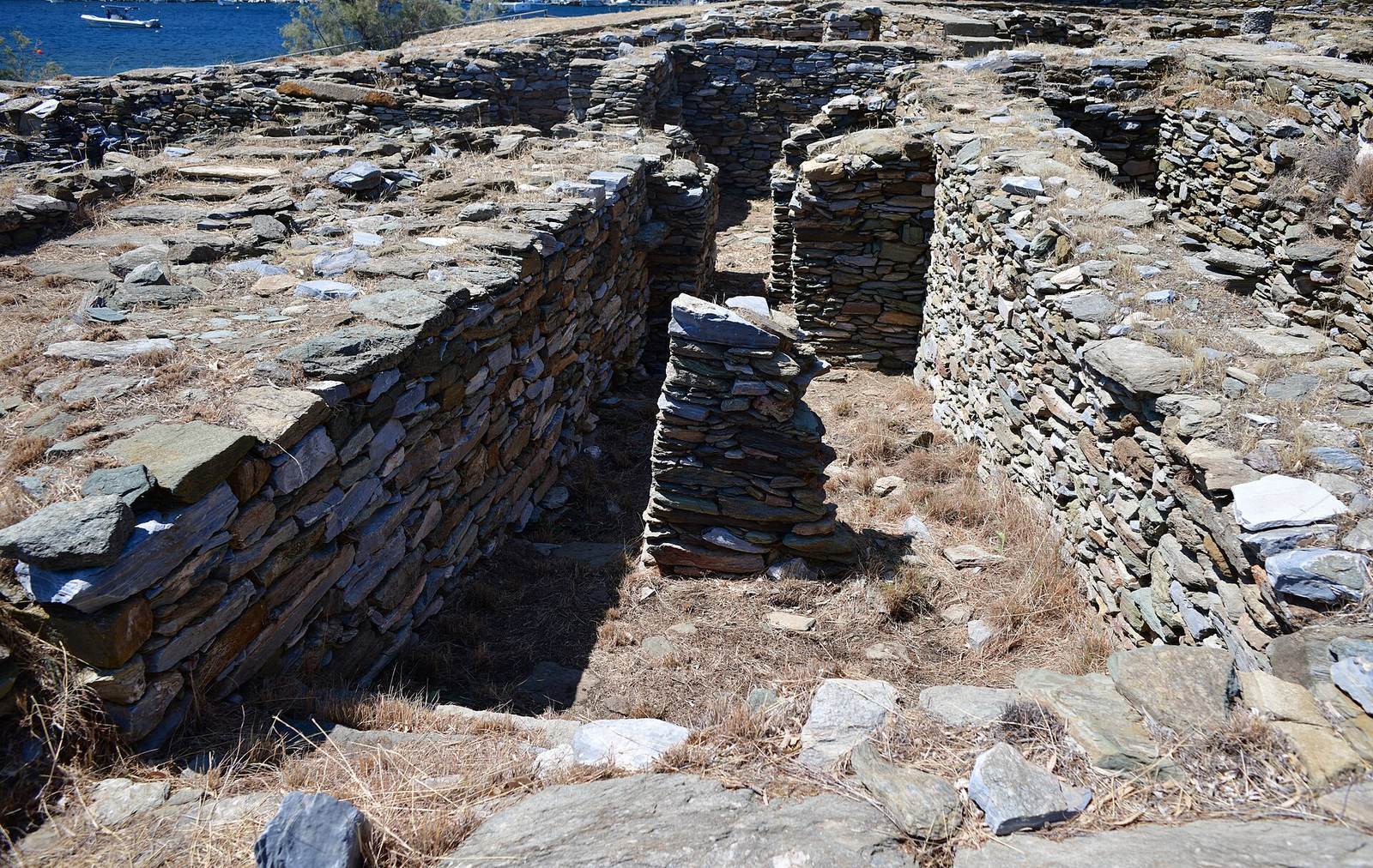
The earliest surviving foundations date to Early Cycladic II. Their walls have smooth, vertical faces, and ceilings could span about 4.5 metres without supporting pillars. Middle Cycladic houses had simple plans, and some walls were coated with lime plaster. In the later settlement, houses crowded closely together and contained many small rooms; some had upper storeys. Buildings grew over time, and some larger complexes formed by joining earlier houses.
House A
House A, the largest and best-studied building, covered about eight percent of the known settlement area. It measured approximately 22 by 38 metres and had an irregular pentagonal plan. Standing as a separate block surrounded by streets, it contained 39 identifiable rooms on its basement and ground floor, as well as at least part of an upper storey. Its exterior courtyard had benches and an open-air cooking place. Light shafts brought sunlight into interior rooms. The building also included two kitchens, food-storage rooms and a bathroom whose drain connected to a sewer beneath the adjoining street.
Sanctuary
Temple building
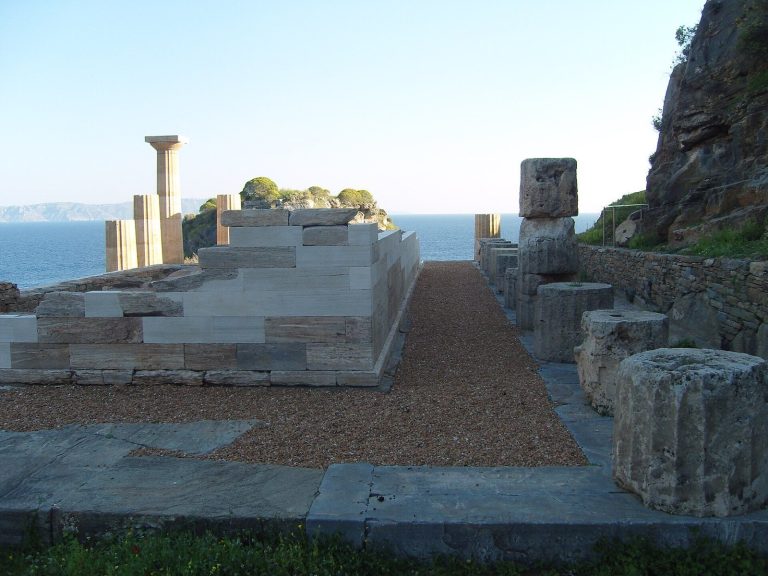
The sanctuary began with a rectangular structure about 5 by 5 metres. By the fifteenth century BCE, the temple had become an elongated building about 6 metres wide and more than 24 metres long. Its main room stood near the sole entrance, while the smaller rooms behind it could be reached only through that room.
Cult figures and offerings
Dozens of female terracotta figures, made of fired clay, were found in the temple walls. They range from about 60 centimetres tall to life-size and wear long skirts in Minoan style. Many have bodices that leave the breasts exposed; others are bare above the waist. Several appear to dance, with arms raised or hands at their hips. They may represent goddesses or dancing priestesses. Drinking and pouring vessels were also found, along with objects interpreted as offerings, including a small symbolic smelting vessel.
Pottery and other finds
Middle Cycladic pottery includes styles from Crete, Attica and neighboring Cycladic islands. Mainland Minyan pottery, a distinctive Greek ceramic style, was initially predominant. Minoan-style pottery became more common after about 1700 BCE, and some forms were copied locally. Individual signs in Linear A, a Bronze Age Cretan writing system that remains undeciphered, were also found. In the later settlement, pottery linked to Crete and the southern Cyclades made up nearly half the finds, alongside prominent styles from the Peloponnese and nearby mainland. House A yielded about 10,000 ceramic vessels, including roughly 8,000 shallow bowls stacked together; the group may have been a merchant’s stock. Minoan-style masons’ marks were found in the building, and other evidence points to a Cretan type of weighted loom, which used weights to keep its vertical threads taut.