San Francesco di Paola: A Renaissance Parish Church in Venice
Site at a Glance
- Popularity
- Low
- Country
- Italy
- Primary era
- Early Modern
- Eras represented
- Early Modern
- Civilizations
- Venetian
- Site type
- Religious
- Remains
- Church
On this page11 sections
History
Early church and hospice
San Francesco di Paola is a Roman Catholic church in the Castello district of Venice, Italy. Rebuilt in Renaissance style for the Minims, the Catholic order founded by St Francis of Paola, it was consecrated in 1619 and became the parish church of the same name. It belongs to the Latin Church, the largest autonomous church within Catholicism, and the Patriarchate of Venice, an ecclesiastical jurisdiction headed by a patriarch.
A sacred building stood on the site by 840, dedicated to St Demetrius of Thessaloniki. It was renovated in 1070 and rededicated to St Bartholomew the Apostle. In 1291, Bartolomeo Querini, bishop of Castello, left for the establishment of a hospice for elderly people. An oratory dedicated to St Bartholomew followed beside it in 1296. A church to the same saint was built in the 14th century, probably rebuilt from its foundations in Gothic form, with hospice buildings separating it from the oratory. In 1342, Pope John XXII placed the church under the jurisdiction of the patriarch of Grado, a senior church leader.
The Minims and rebuilding
The complex passed to the Minims in the 1580s, after the order arrived in Venice. In 1588, concern about the poor condition of the church and hospice led the order to decide on demolishing the church, oratory, and hospice and constructing a new complex. Doge Pasquale Cicogni, the Venetian Republic’s chief magistrate, attended the laying of the cornerstone, blessed by Giovanni Trevisan, patriarch of Venice. The Querini family supported the building work. The new church was consecrated on 8 August 1619 and dedicated to St Francis of Paola, founder of the order.
Suppression and parish life
Measures introduced under Napoleonic rule in 1805 led to the monastery’s suppression in 1806. Its buildings became barracks, and the property passed to the state in June of that year. The religious community moved to San Francesco in Verona, while the church continued to hold services under a vicar. The monastery buildings were demolished in 1885 to make way for a school. The church remained a dependent church of San Piero di Castello until 1952, when it became an independent parish. The Salesians, a Catholic congregation with a longstanding focus on education and youth ministry, care for the active parish church.
Remains
Setting and exterior
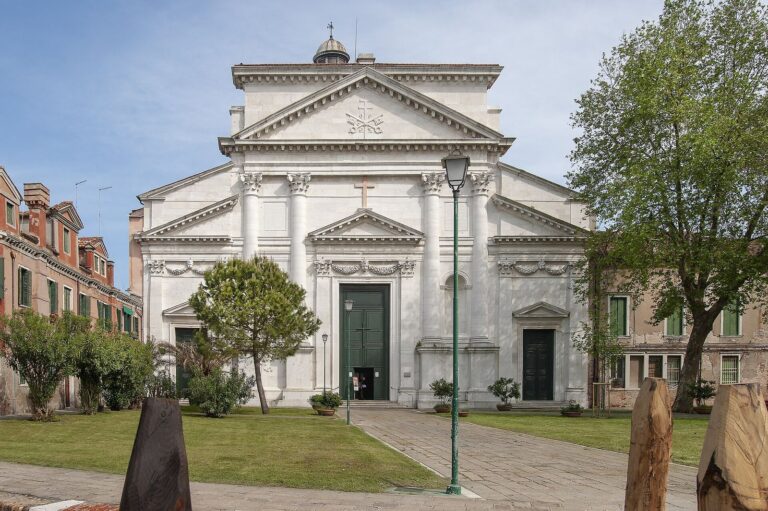
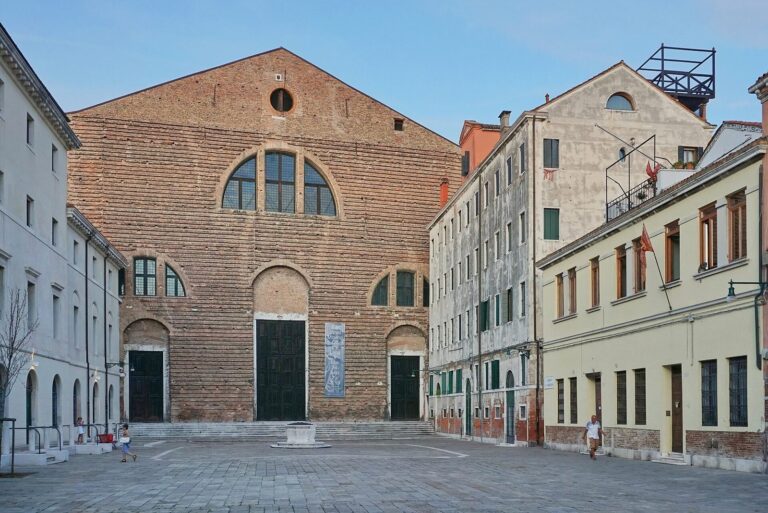
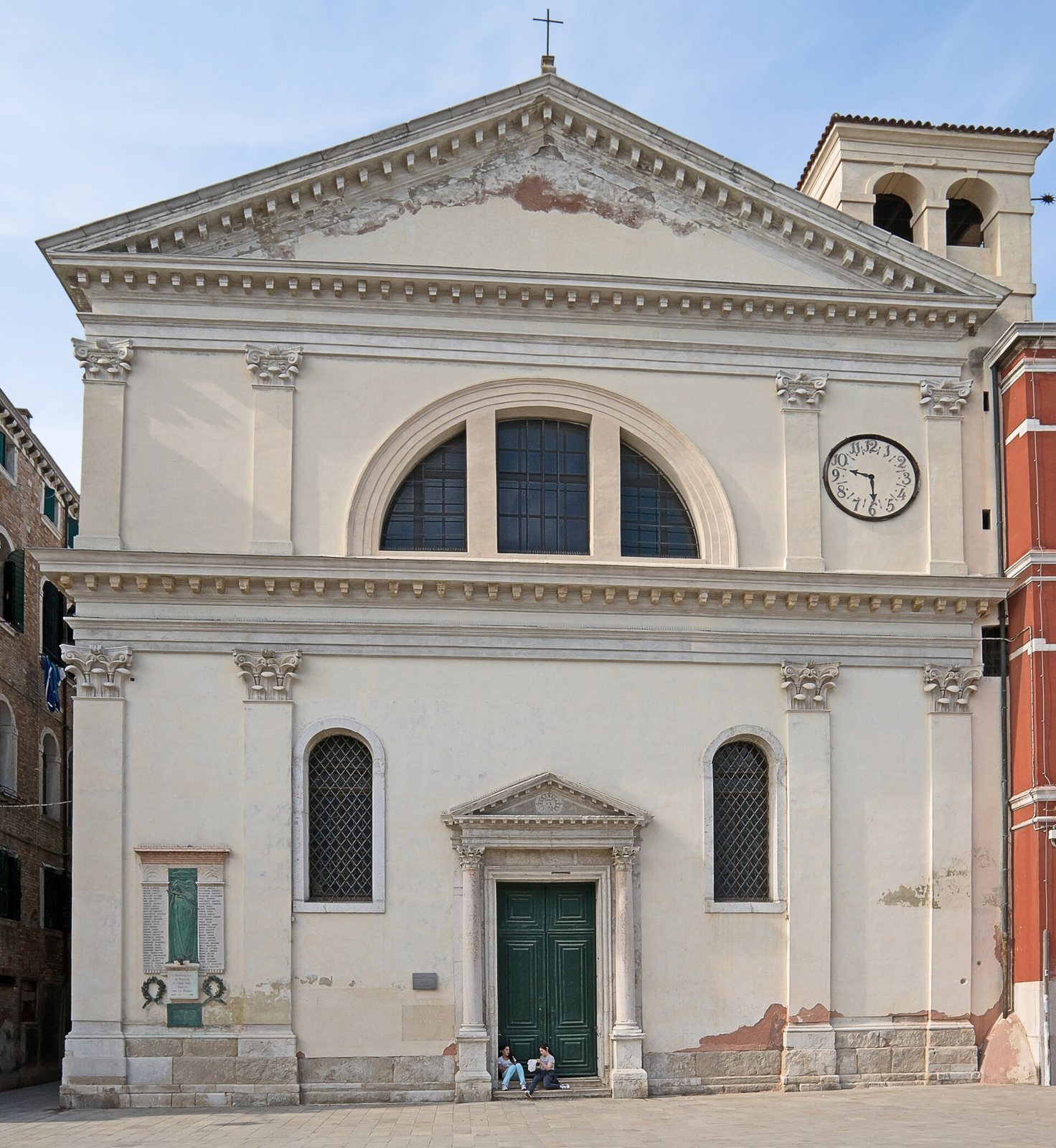
The church stands along Via Garibaldi. The street was created in the 19th century by filling in the Rio di Castello, a waterway linking the San Marco basin with the Castello canal. Until 1810, the church faced the Rio di San Domenico, also called Rio di Castello, from a narrow embankment, with a bridge of the same name opposite. The building measures 39 metres long and 18 metres wide. Its two-storey classical facade has a central doorway flanked by two windows, shallow columns attached to the wall, and a triangular upper section. Above the entrance, a sculpted flaming sun bears the Minim motto “Charitas,” meaning “charity.” A painted clock on the facade’s right side shows 9:30, possibly recalling the time of St Francis of Paola’s death.
Nave and ceiling paintings
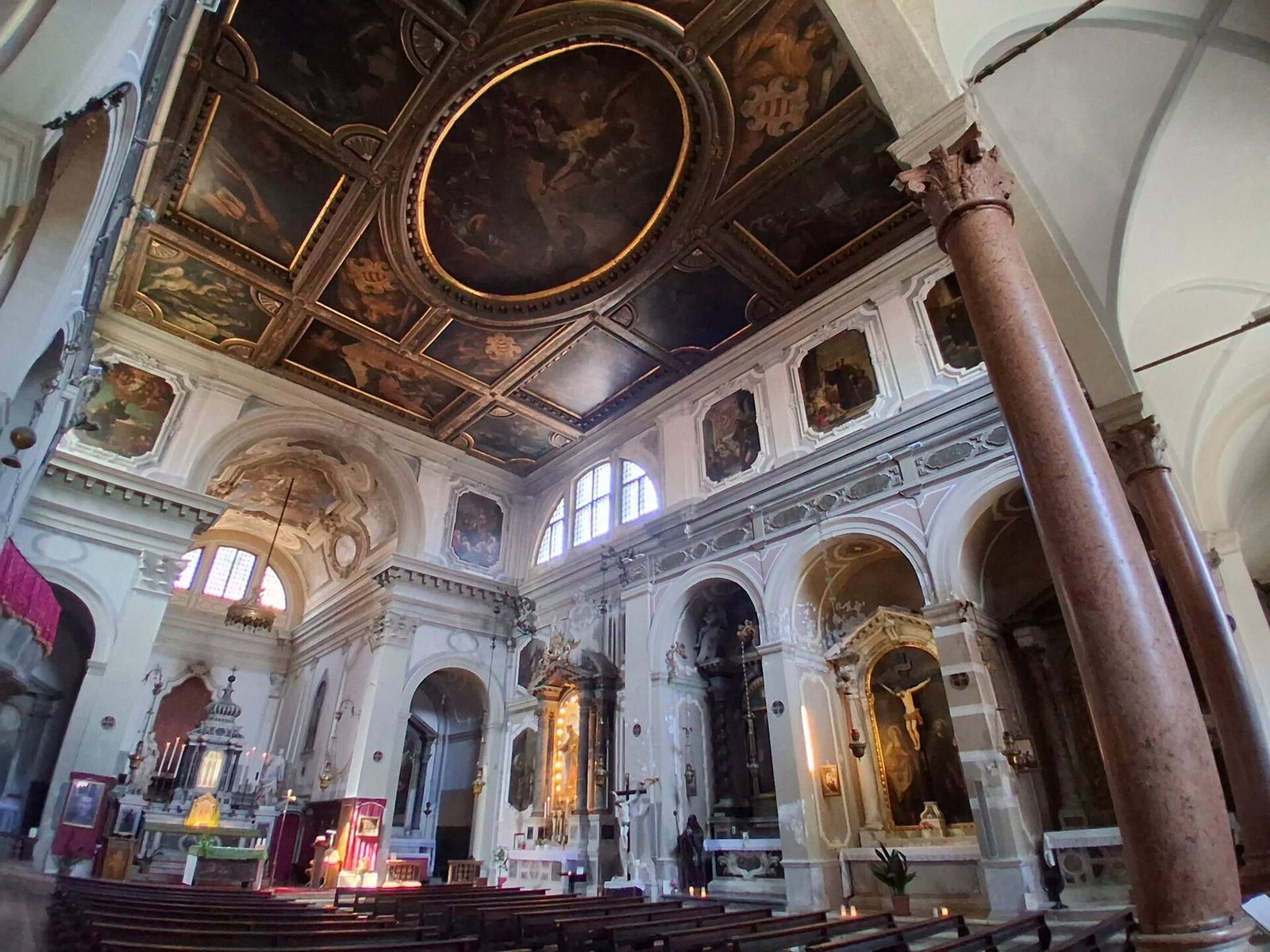
The interior has a single nave, remodelled in the 18th century while retaining most of its earlier character. A choir gallery used by the religious community for communal worship extends along the side walls in two arms, and shallow chapels line both sides of the nave. The church has 11 altars, including one that accommodates the baptistery. Paintings dated 1585 by Giovanni Contarini, commissioned by Cesare Carafa, decorate the surviving nave ceiling. The central panel depicts the Resurrection, surrounded by New Testament scenes, including the Nativity and Annunciation, and episodes from St Francis of Paola’s life. The cycle also includes the four Evangelists, the four Doctors of the Church, saints recognized for important contributions to Christian theology, four coats of arms, and two scenes connected with the Carafa family.
Presbytery and main altar
The 18th-century vault above the presbytery, the area around the main altar, carries a fresco by Michele Schiavone showing St Francis of Paola in glory, with the Evangelists in its four corners. Paintings of episodes from the saint’s life appear above both arms of the choir gallery. The main altar has a tabernacle of green Genoese marble, consecrated on Christmas Eve 1749, flanked by marble statues of St Mark and St Bartholomew.
Chapels and side altars
A chapel altar on the right holds Palma the Younger’s Annunciation, dated 1585; the altar on the left has Jesus in Glory with Saints Anthony of Padua and Anthony the Abbot. A crosswise altar carries a multicolored statue of Our Lady of the Rosary. Among the 16th-century marble side altars, one has a St Francis of Paola painting attributed to Alvise del Friso, a copy of a work in San Trovaso; another bears Palma the Younger’s The Virgin, St John the Evangelist, and Donors, and another has Our Lady of Sorrows. At the fourth chapel, a statue of St Anthony of Padua stands in a niche decorated with gold mosaic. Other chapel works depict St Vincent Ferrer; Saints Anne, Oswald, and Cajetan; and Saints Catherine, Clare, Gertrude, and Marina, the last group attributed to Palma the Younger. A 14th-century wooden sculpture of Mother of Consolation, a devotional title for the Virgin Mary, stands on the altar associated with that group.
Nave paintings
Francesco Zanchi’s paintings on the nave walls portray four episodes from the saint’s life. On the left are St Francis of Paola Resurrecting a Lamb and Fish Returning Coins Lost by a Benefactor; on the right are St Francis of Paola Breaking a Gold Coin in Two and The Happy Death of King Louis XI. Other canvases include Francesco Solimena’s The Saint Resurrects a Child (1748), Giandomenico Tiepolo’s Exorcism of a Possessed Man (1748), Jacopo Palma the Younger’s The Virgin, St John the Evangelist, and Donors, and Vincenzo Canal’s St Francis Resurrects His Disciple Tommaso di Ture, Crushed by a Tree (1746).
Baptistery and organ
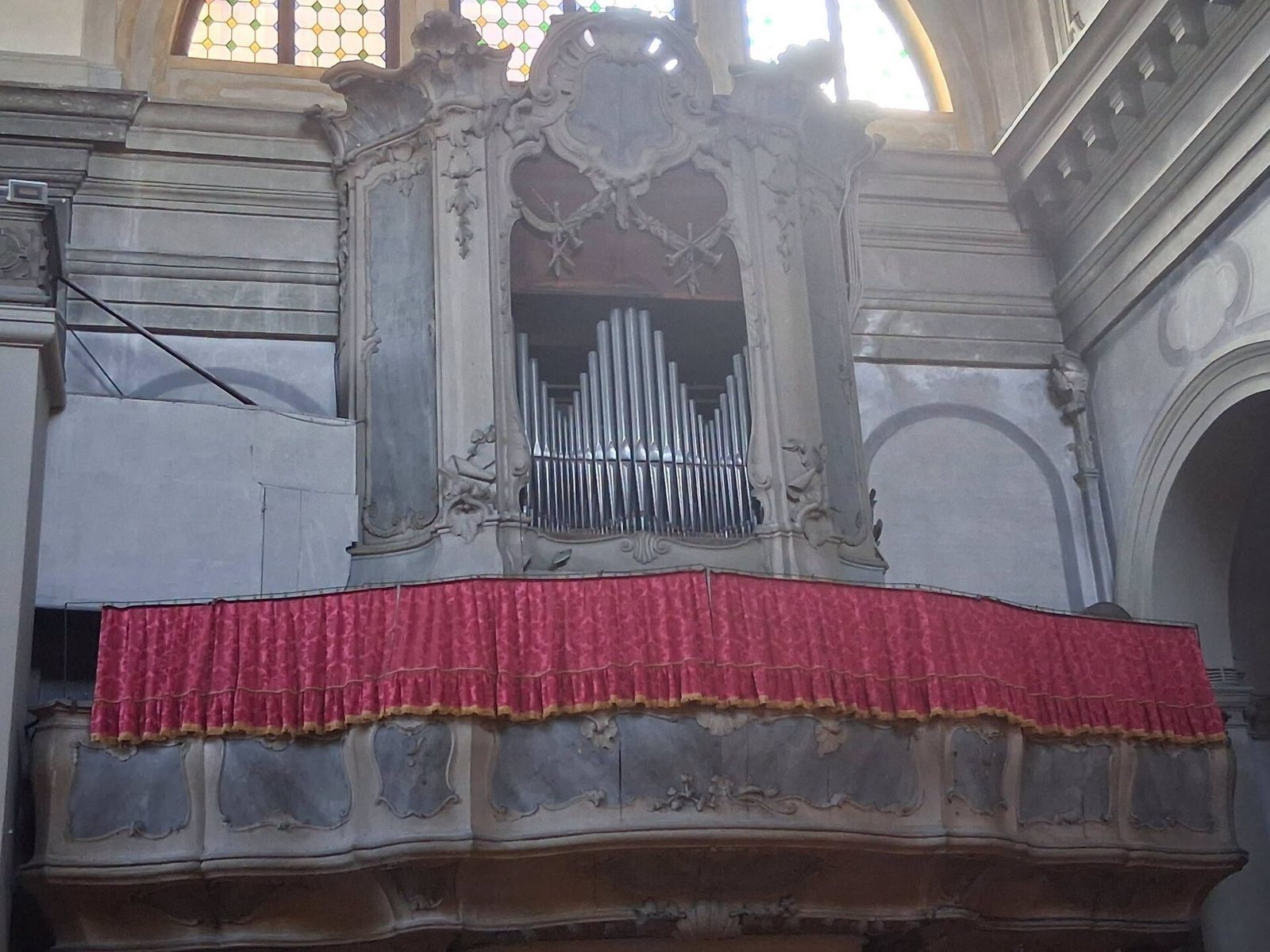
The baptistery contains a 16th-century font made of red Verona marble. Its altarpiece, Jacopo Marieschi’s Martyrdom of St Bartholomew (1764), was moved there from the main altar in 1953. Gaetano Callido built the church organ in 1799.