Durrow Abbey: An Early Medieval Monastic Centre in Ireland
Site at a Glance
- Popularity
- Medium
- Country
- Ireland
- Primary era
- Medieval
- Eras represented
- Medieval, Early Modern, Modern
- Civilizations
- British, Norman
- Site type
- Religious
- Remains
- Monastery
On this page13 sections
History
Foundation and early prominence
Durrow Abbey is an early medieval monastery in Ireland, probably founded in the sixth century by Columba, an Irish Christian monk and missionary. Traditions differ over whether he established it before leaving for Britain or during a later return to Ireland. Columba entrusted the building work to Laisrén, a monk and relative who led the community and later became Iona’s third abbot.
Durrow grew into a centre of education and a source of further monastic foundations. The eighth-century English monk and historian Bede praised it as a distinguished Irish monastery. In later centuries, Durrow and Armagh, a historic ecclesiastical centre, were together called the Universities of the West. Its position near Ireland’s geographic centre and the Slighe Mhór, or Great Way, drew pilgrims whose visits helped bring wealth to the monastery.
In 630, a synod, an assembly of church officials, met at or near Durrow to address a dispute about the date of Easter. The surrounding district was then known as Mag Lena.
Political ties and medieval change
Durrow had close ties to Clann Cholmáin, a branch of Ireland’s ruling Uí Néill family. Domnall Midi, one of its kings, was apparently buried at the monastery in 763. The following year, during a family succession struggle, men from Durrow fought members of the community at Clonmacnoise, another major early medieval monastery. Durrow lost 200 men. In 776, its men joined Donnchad Midi, a ruler of the same family, on a raid into Munster.
The Book of Durrow, an illuminated parchment manuscript of the four Gospels in Latin, was at the monastery by 916 at the latest, although it may have been made elsewhere. Its date is disputed, with scholars generally placing it in the seventh or eighth century. After the Reformation, the sixteenth-century movement that reshaped Western Christianity, it was found in the possession of a local farmer. It is now held at Trinity College Dublin.
In July 1054, monks at Durrow observed the sudden appearance of a bright star. An entry in the Annals of the Four Masters describes the event, regarded as the only known European observation of the supernova of 1054. Viking attacks repeatedly ravaged the monastery, and Durrow was among the religious centres and libraries burned in 1095. Its destruction was completed during the Norman invasion, the Anglo-Norman expansion into Ireland that began in the late twelfth century.
During the twelfth century, the church reformer Malachy initiated an Augustinian monastery at Durrow. This religious community followed the rule associated with the Order of St Augustine, and it was destroyed in 1175. Hugh de Lacy, an Anglo-Norman lord of Meath, was killed at Durrow in 1186 by an Irish workman.
Closure and later history
The abbey closed in 1541, ending monastic life at the site. Its church continued in use as a parish church until the end of the nineteenth century, after which the abandoned complex fell into ruin. In 1839, Hector John Graham-Toler, 2nd Earl of Norbury, was shot and killed in his plantation at Durrow.
In 1994, the Church of Ireland transferred St Columba’s Church on the grounds to the State after a dispute over ownership. The Irish government purchased Durrow Abbey, its associated sixth-century monastic site, and part of its historic estate in 2003 to protect them from proposed commercial development. Durrow is protected as a National Monument and was added to Ireland’s Tentative List, a roster of sites that may be proposed for UNESCO World Heritage status, in 2010.
Remains
Durrow survives as a largely undisturbed early medieval monastic complex, with ecclesiastical and secular features both above ground and below it. Its remains include a large ecclesiastical enclosure and a range of archaeological features across the site.
Early medieval enclosure and monuments
Enclosure, grave slabs and holy well
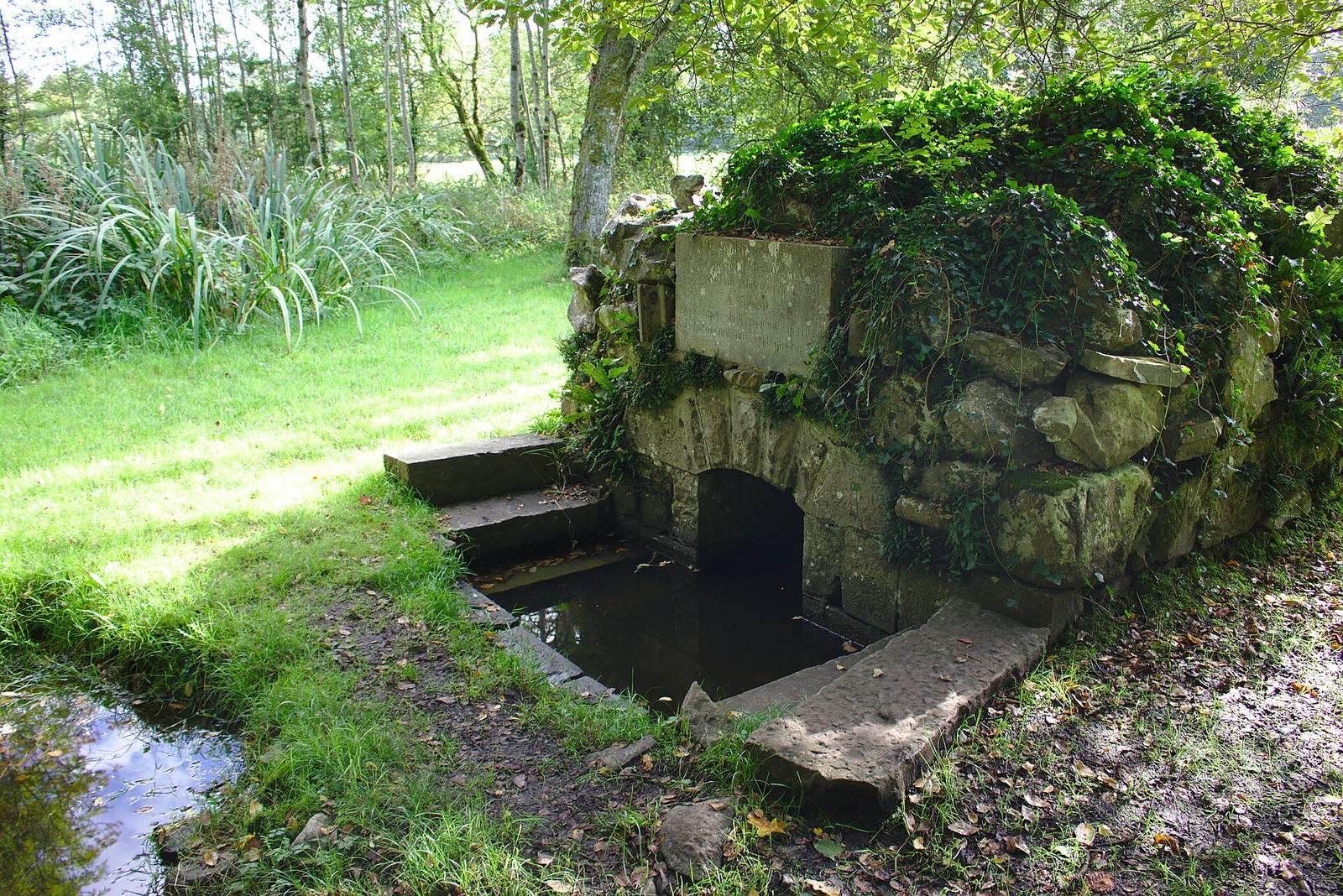
The large ecclesiastical enclosure forms a principal feature of the complex. Five early Christian grave slabs survive at the site, along with a holy well.
High cross
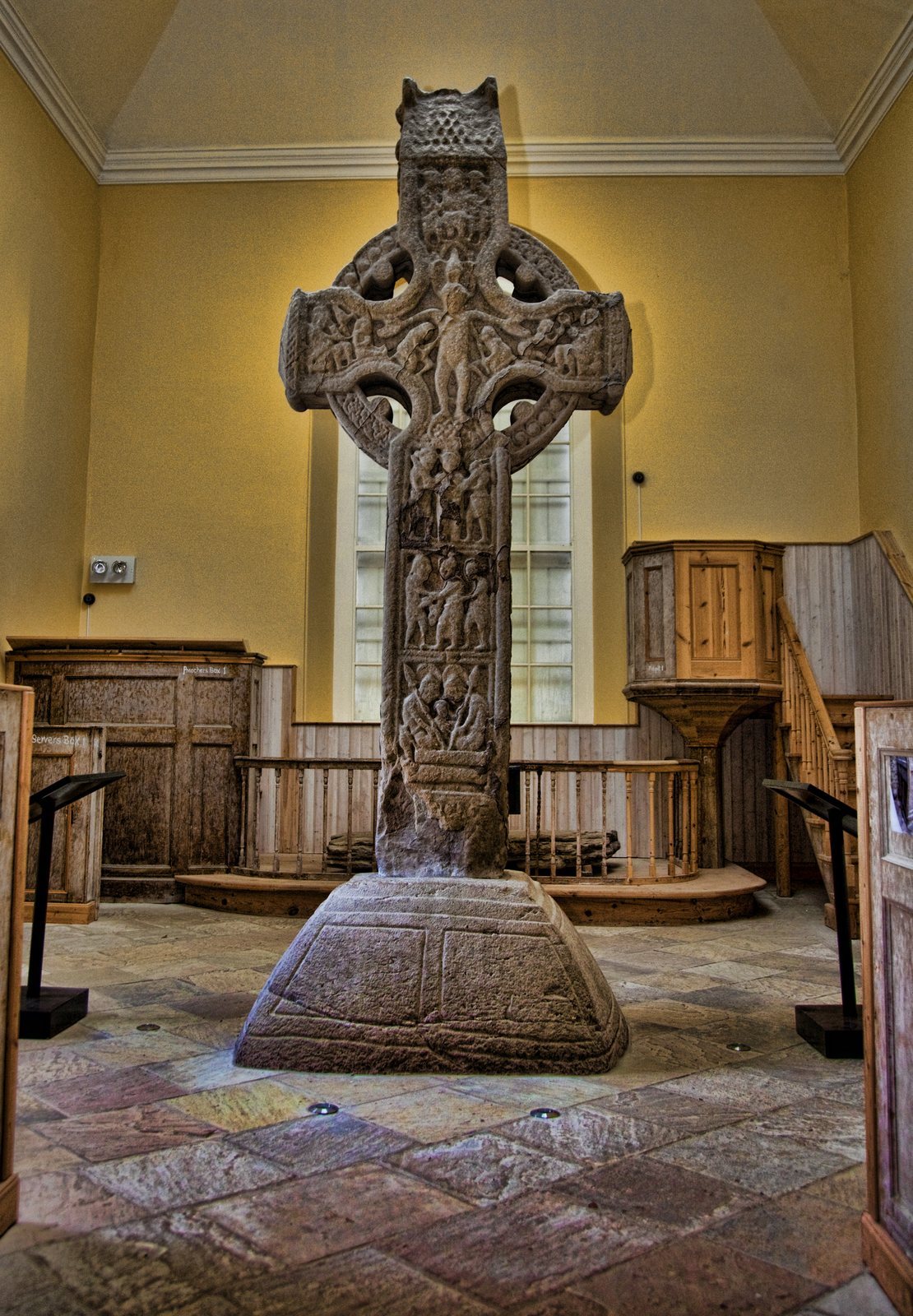
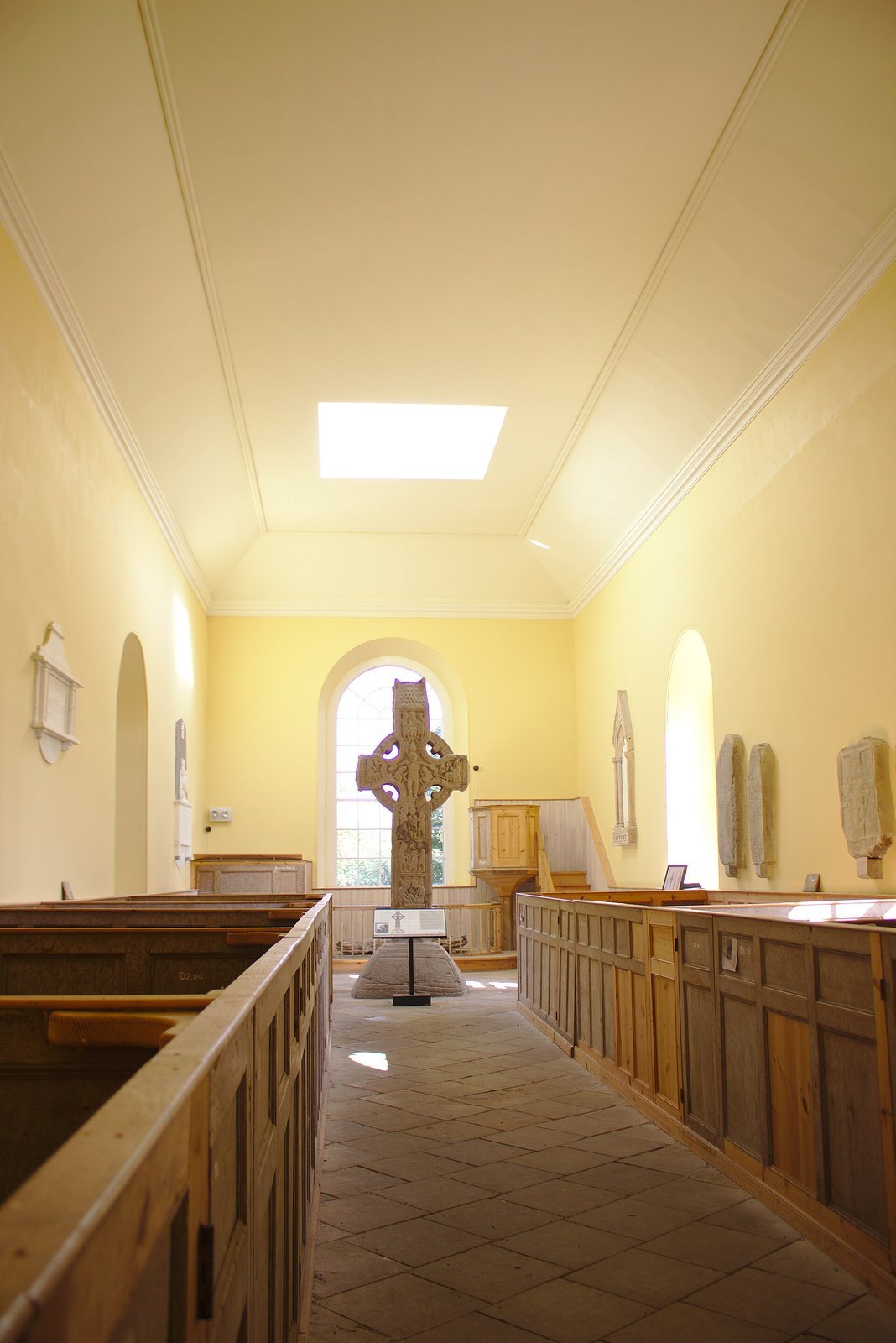
A high cross dating to the middle of the ninth century was probably close to three metres tall. Its carved scenes from the Old and New Testaments include expressive human figures. A shaft fragment and a cross base also survive at Durrow, while the complete cross-head is held in the National Museum of Ireland.
Later buildings and earthwork
Motte
A motte, a raised earthwork used as a defensive stronghold, was built at the abbey in 1180 using stones taken from the site.
Church
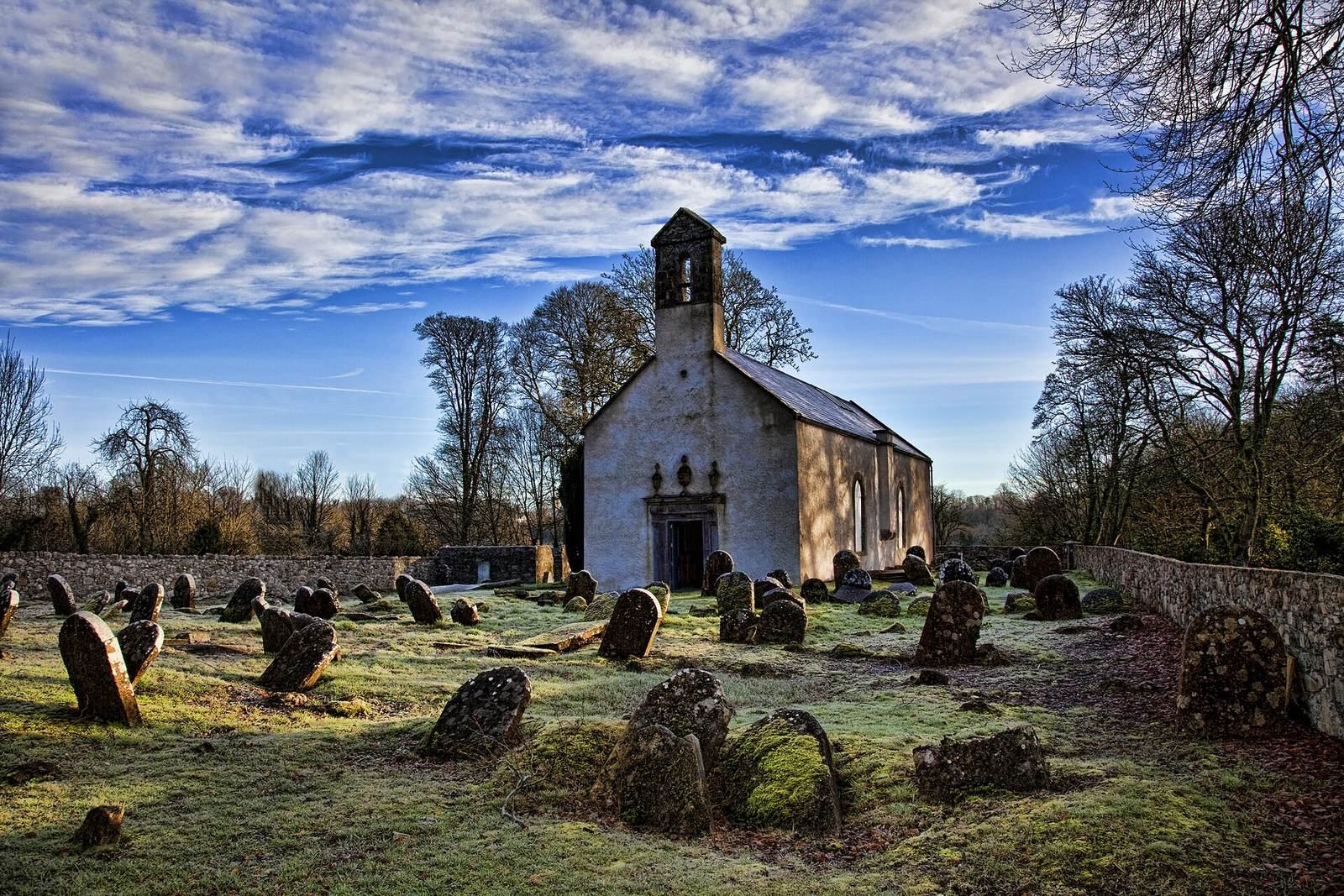
The church now standing dates to the late eighteenth or early nineteenth century and occupies the footprint of at least one earlier church. The medieval church is thought to have stood on the site of a twelfth-century abbey church.
Durrow Abbey House
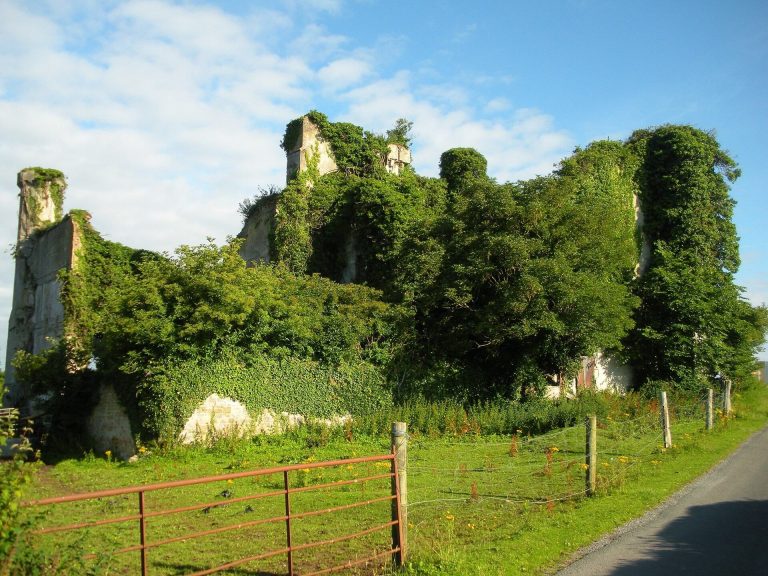
Durrow Abbey House was rebuilt in the 1920s after a fire destroyed its roof and interior.
Landscape and route
The name Durrow derives from a phrase meaning “plain of the oaks.” Some of Ireland’s few remaining pre-medieval oaks are associated with the site. A line of oaks beside the fields marks the route of the Slighe Mhór along the Esker Riada, a raised glacial ridge system that formed a route across Ireland.