San Domenico, Arezzo: A Gothic Dominican Church
Site at a Glance
- Popularity
- High
- Country
- Italy
- Primary era
- Medieval
- Eras represented
- Medieval, Early Modern, Modern
- Civilizations
- Grand Duchy of Tuscany, Italian, Republic of Florence
- Site type
- Religious
- Remains
- Church
On this page15 sections
History
Foundation and medieval role
San Domenico is a Gothic Dominican church in Arezzo, Italy, begun in 1275 and completed in the 14th century. The Dominican friars, members of the Order of Preachers, had been in Arezzo since 1236. Their church was dedicated to St Dominic, and the Ubertini and Tarlati families helped finance its construction.
Although unfinished, the church hosted a meeting of cardinals to elect a pope in January 1276. The Roman Church regarded it as its first conclave. San Domenico became an important religious building in Arezzo and a notable Tuscan church of a mendicant order. Such orders relied on public preaching and support rather than the landed wealth associated with older monasteries. The church’s extensive fresco decoration served this emphasis on preaching, while local artists working there were influenced by Giotto.
Alteration, abandonment, and restoration
During the 16th and 17th centuries, the interior was changed to suit Baroque taste. New altars were added, and medieval frescoes were covered with whitewash. Following a reform of religious orders in the Grand Duchy of Tuscany, the state that governed much of Tuscany before Italian unification, the church was abandoned in 1782 and remained so until the early 20th century. The Renaissance painter Niccolò Soggi was buried in the church.
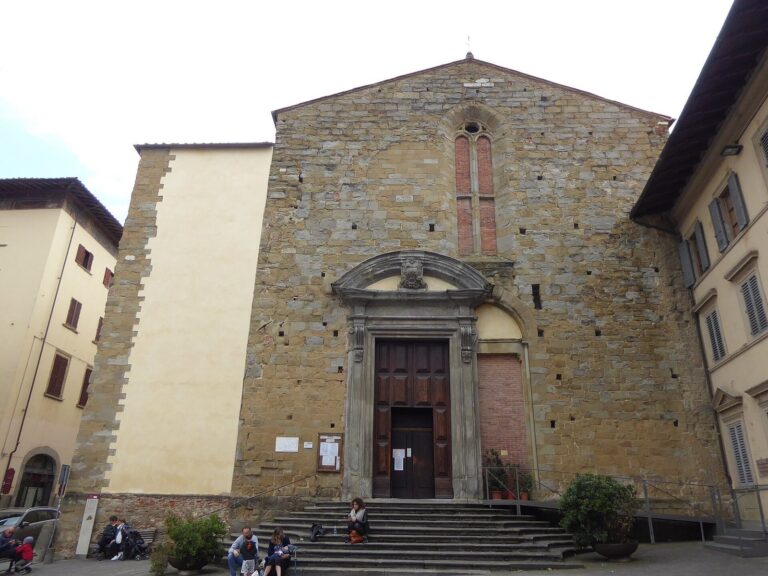
Early 20th-century restoration removed the later altars and uncovered and repaired surviving 13th- and 14th-century frescoes. The work concluded in 1924, bringing back much of the church’s earlier appearance. A porch designed by Giuseppe Castellucci was added in 1936 to shelter the fresco above the entrance. In April 1960, Pope John XXIII granted San Domenico the honorific status of minor basilica. It remains a Roman Catholic church in the Diocese of Arezzo-Cortona-Sansepolcro.
Remains
Plan and exterior
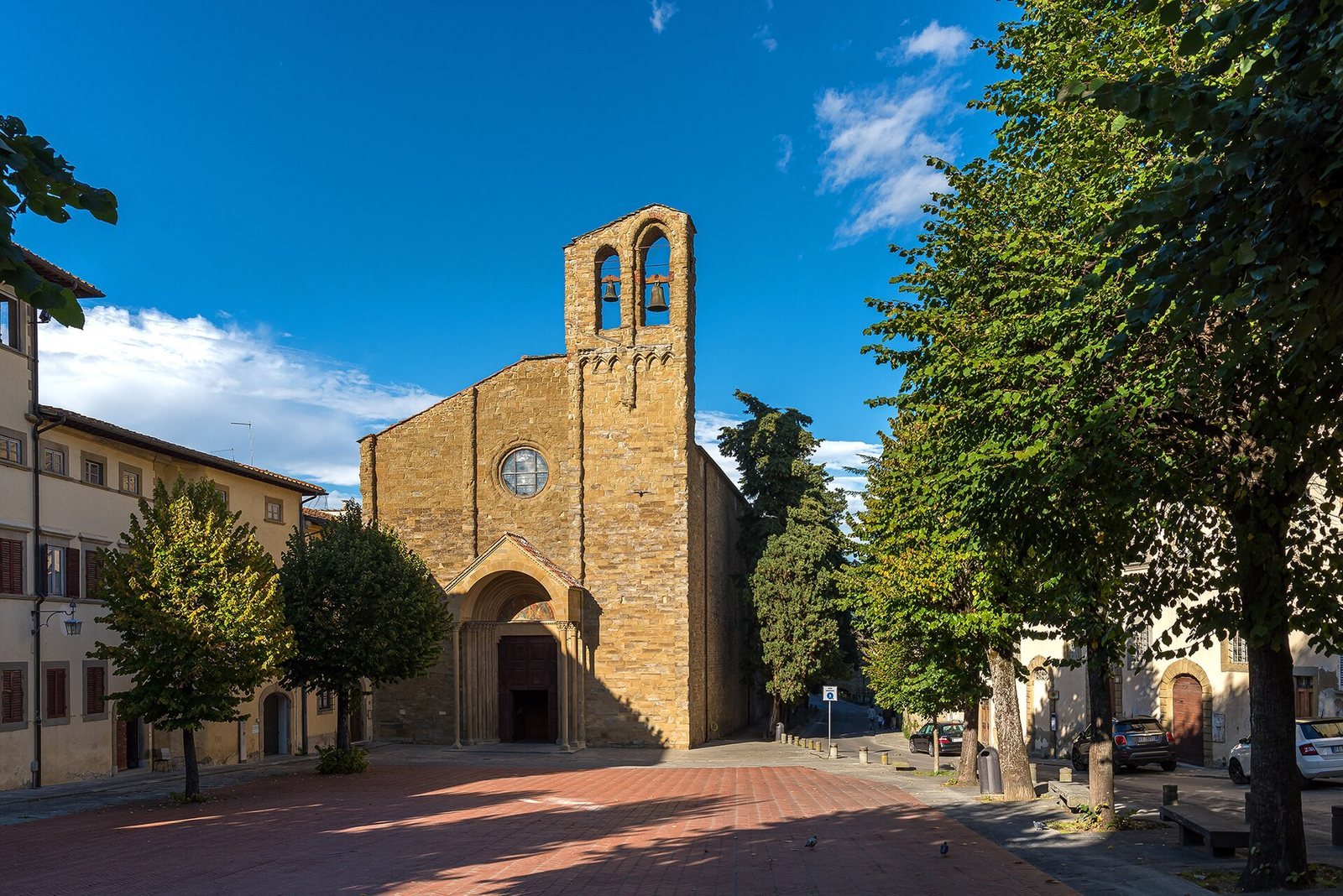
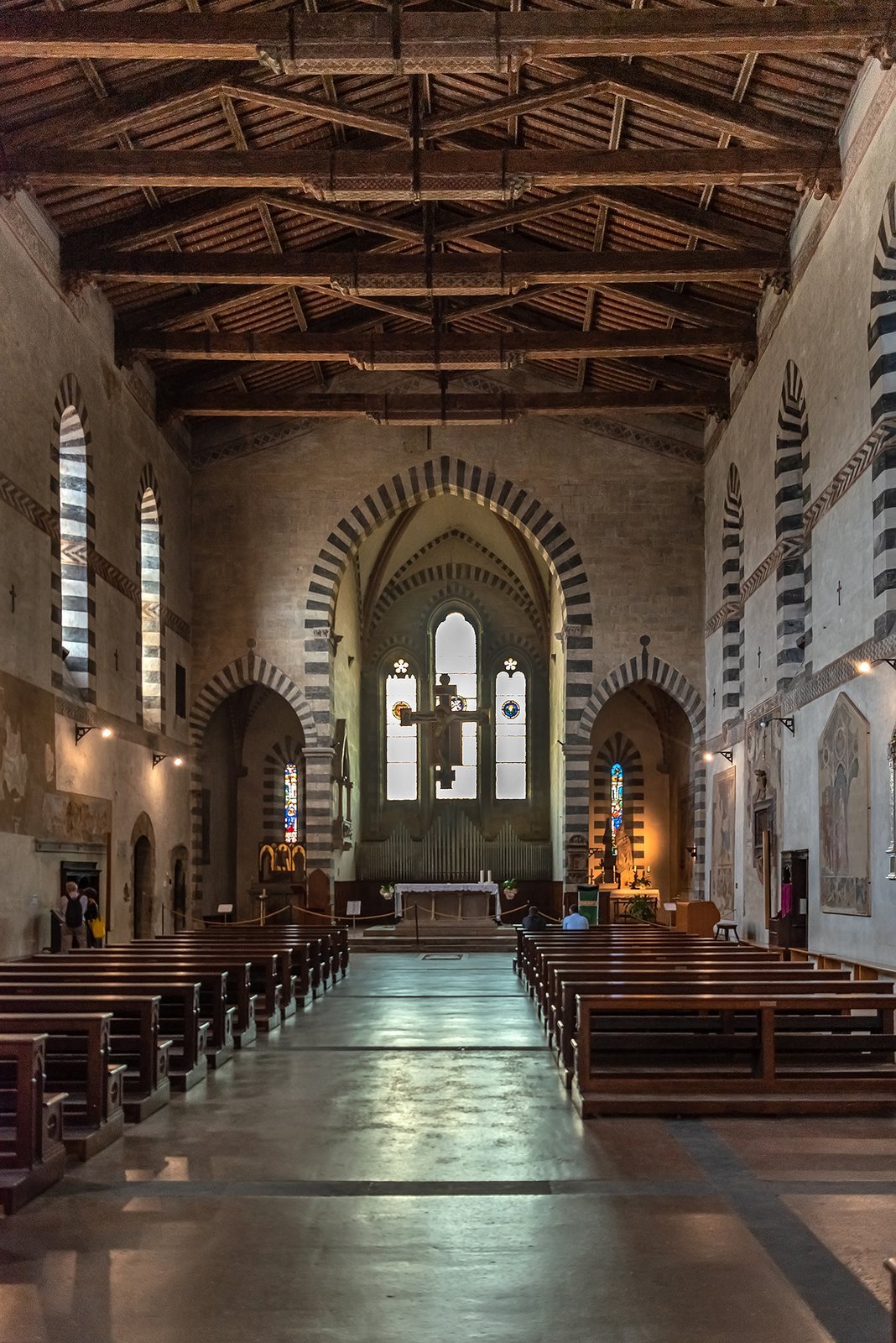
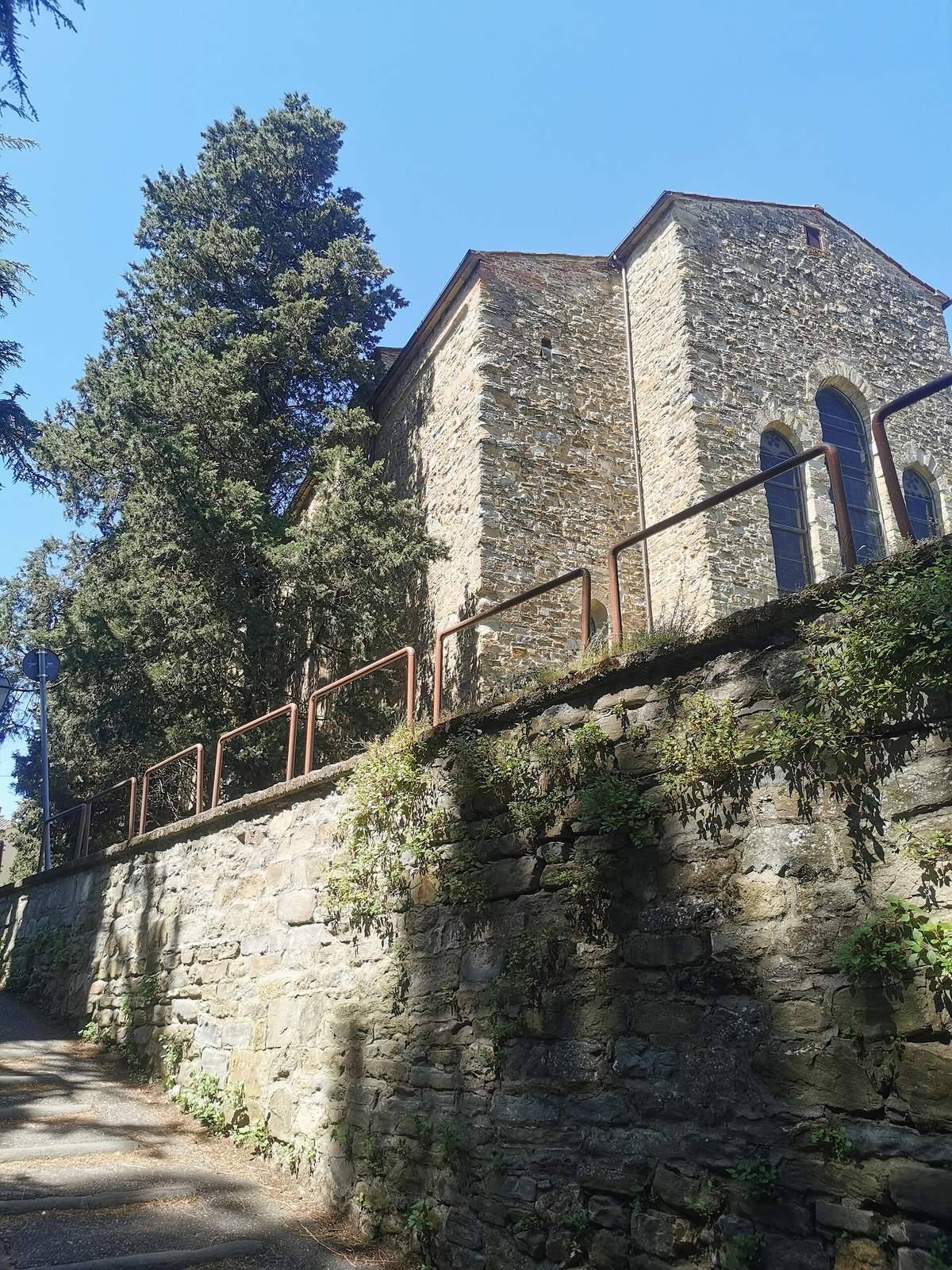
The church stands at the northern edge of Arezzo’s historic center, on the north side of the former fortification walls. Its simplified Cistercian-inspired plan has a single nave, without a crosswise arm, and a choir flanked by smaller chapels. The choir has a cross-ribbed vault, a ceiling supported by intersecting ribs; the nave is unvaulted, with its timber roof structure exposed. The central choir chapel may reflect the design of the somewhat earlier Santa Maria Novella in Florence, a proposed connection based on the similarity between the two.
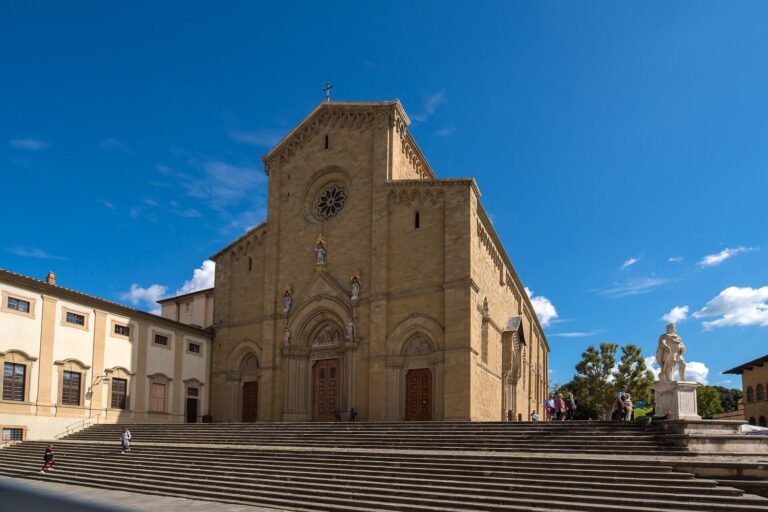
The unfinished, austere façade is asymmetrical and built of hard sandstone. Pilasters divide it into three bays: the central bay has a round window, the left bay angles slightly, and the right forms the wall supporting the bells. The Romanesque doorway is sheltered by the later porch. Above it, an open upper level has two bell openings and contains two 14th-century bells. Six single-opening windows line each side of the nave; they are set progressively closer together toward the apse, the recessed end of the church, increasing the impression of depth. Modern stained-glass windows are also present.
Nave and wall paintings
Entrance wall
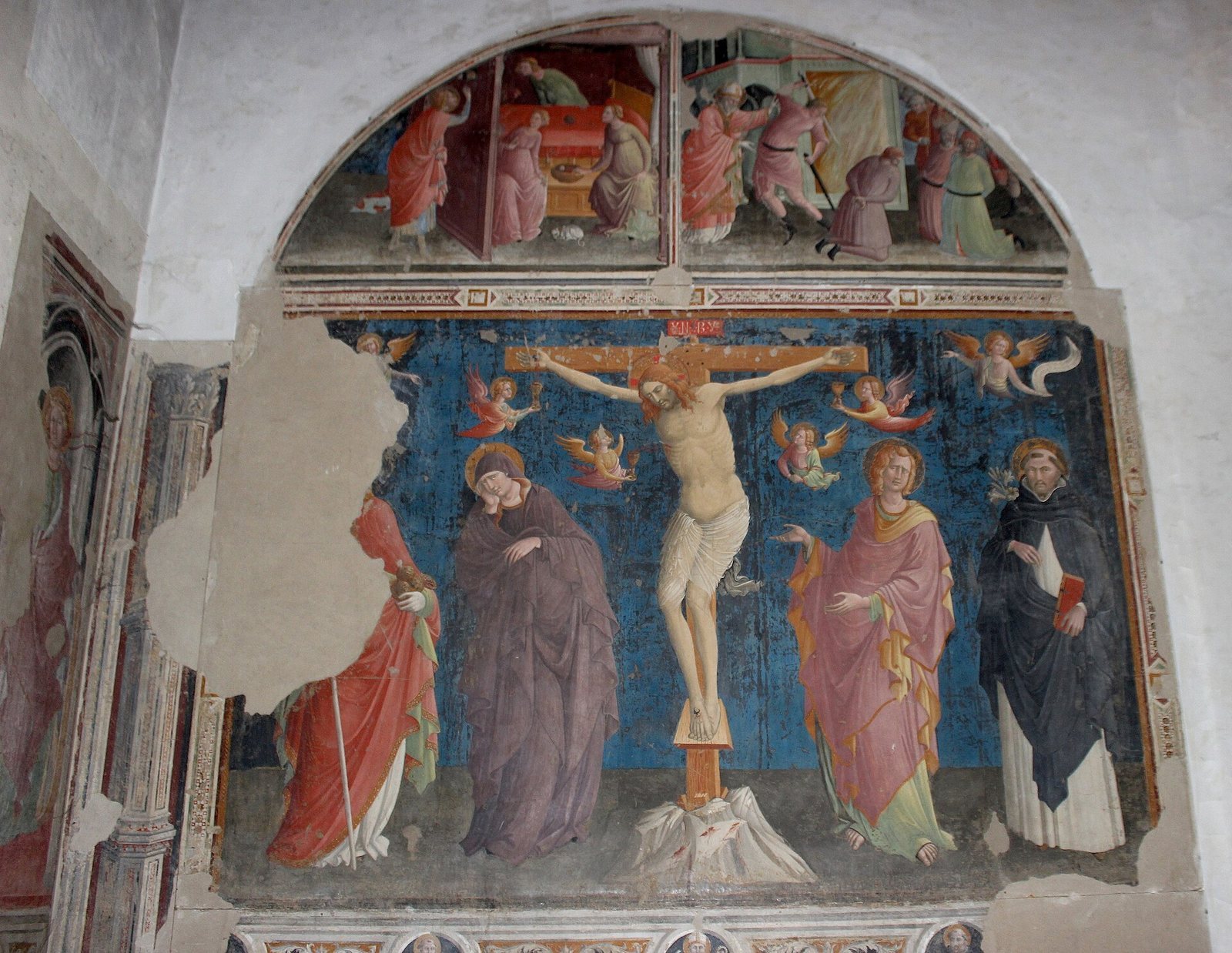
Above the entrance, an arched fresco panel shows the Madonna and Child between St Dominic and St Donatus. Attributed to Angelo di Lorentino and dated to around 1480, it is now badly deteriorated. On the inner left side of the entrance wall, Spinello Aretino’s fresco of Saints Philip and James the Less combines scenes from their lives with images of St Catherine. Its upper arched panel depicts Catherine’s mystical marriage and martyrdom. Opposite, Parri di Spinello’s Crucifixion, dated to around 1435–1440, includes the Virgin and saints such as Dominic and Nicholas; its upper panel contains scenes from St Nicholas’s life.
Right nave wall
Parri di Spinello painted St Catherine of Alexandria on the right nave wall. Nearby are badly damaged scenes of the Adoration of the Magi from the 14th century and St Francis with St Anthony from the 15th century.
Dragondelli Chapel
The Gothic Dragondelli Chapel contains a small shrine-like frame with a double pointed arch and a black-stone altar carved by Giovanni di Francesco of Florence in 1368. This chapel and altar are the church’s only surviving example of a characteristic type found in Arezzo. A fresco of Jesus among the Doctors is attributed to Gregorio and Donato d’Arezzo.
Works near the Dragondelli Chapel
A niche on the same wall holds a glazed terracotta St Peter of Verona, made by Giovanni and Girolamo della Robbia around 1515–1520. Nearby, Spinello Aretino’s 1409 painting imitates a three-part altarpiece: St Catherine stands between St Lawrence and another saint. Three circular panels above show the Redeemer in the center and St Dominic in each of the others; the lower panel depicts the martyrs’ deaths.
Choir and apse chapels
Crucifix and high altar
Cimabue’s large painted Crucifix hangs in front of the main chapel. It is generally dated to the 1260s, although proposed dates range from about 1260 to 1271. Painted in tempera on wood, it measures 336 by 267 cm and is regarded as Cimabue’s earliest surviving work and the only surviving work from his early period. Pietro Toesca attributed it to Cimabue in 1927. The body of Christ curves gently, with the head drooping in the Gothic image of a suffering Christ. The face and loincloth retain Byzantine influence, while the body has a stronger sense of volume. Mary and St John appear at the ends of the cross arms, and a circular panel above them, made by another artist, depicts Christ. A similar Cimabue crucifix at Santa Croce in Florence was lost in the 1966 flood. The Gothic high altar has a stone top supported by small marble columns.
Tomb of Ranieri degli Ubertini
On the presbytery’s left wall, the funerary monument of Ranieri degli Ubertini is attributed to Gano di Fazio, though its date is uncertain. Ranieri, who died around 1300–1310, had been bishop of Volterra from 1273. The monument is Arezzo’s earliest preserved wall-mounted tomb and is considered Gano’s earliest known work. Its coffin sits beneath a canopy formed by a trefoil-pointed arch bearing the bishop’s family arms and supported by two columns. Inside, a fresco shows the enthroned Virgin and Child among angels; its lower part is lost. The recumbent figure is carved on the coffin’s front rather than placed on top, and two Dominican friars mourn the deceased. The tomb has lost the projecting Gothic ornaments on its upper section and statues that probably crowned the arch supports. Restoration returned it to its original position in the presbytery.
Right apse chapel
The right apse chapel contains Spinello Aretino’s fresco of the Annunciation, dated to around 1386, and a stone Madonna and Child from around 1330. The anonymous sculpture belongs to the artistic circle of Arezzo. It once formed part of a group of works for the city’s ten gates, including the San Biagio gate, from 1339 onward. It was brought inside to protect it from weathering.
Left apse chapel
A triptych, a three-part painting, in the left apse chapel depicts the Archangel Michael between St Dominic and St Paul. The chapel’s left wall has fragmentary frescoes, mostly from the 14th and 15th centuries. These include damaged scenes of the Crucifixion, the Annunciation, and the Madonna and Child, the last attributed to Giovanni d’Agnolo Balduccio. An unknown artist painted a 14th-century scene of St Catherine’s mystical marriage. A 17th-century frieze of cherubs is attributed to a painter influenced by the Cortona school, possibly Salvi Castellucci. The same wall holds an 18th-century funerary monument to Anton Filippo de’ Giudici by an unidentified sculptor. Paintings present in the church in the 19th century included works by Ulisse Ciocchi and an Annunciation by Valerio Bonci.