Palazzo Aldobrandini: An Aldobrandini Family Palace in Italy
Site at a Glance
- Popularity
- Very Low
- Country
- Italy
- Primary era
- Early Modern
- Eras represented
- Medieval, Early Modern, Modern
- Civilizations
- Grand Duchy of Tuscany, Republic of Florence
- Site type
- Domestic
- Remains
- Elite Residence
On this page11 sections
History
Palazzo Aldobrandini is a family palace in Italy whose present overall form emerged from the consolidation of earlier properties between the late seventeenth and early eighteenth centuries.
Aldobrandini ownership and consolidation
Several houses on the site belonged to the Aldobrandini del Nero family from the fourteenth century. The branch descended from Ippolito Aldobrandini, who served as Pope Clement VIII from 1592 to 1605, ended in 1690. After neighboring buildings had been acquired, a collateral Florentine branch of the family brought the properties together and shaped the palace into its present overall form.
The consolidated estate stood at the corner of Piazza Madonna degli Aldobrandini, then known as Campo Corbolini. It also extended along Via de’ Conti, formerly Via della Forca, and Via del Giglio.
Later ownership and restoration
In 1861, the palace passed by inheritance to a Venetian noble family and was later sold. It subsequently belonged to Ernesto Modigliani. During his ownership, the garden was modestly maintained and fell into neglect. After the Ambrogio Binda paper company acquired the palace, it erected business sheds on the garden site, and the garden disappeared.
Architect Giorgio Borsier directed restoration work in 1975. The restoration received an award from the Giulio Marchi Foundation in 1977.
Remains
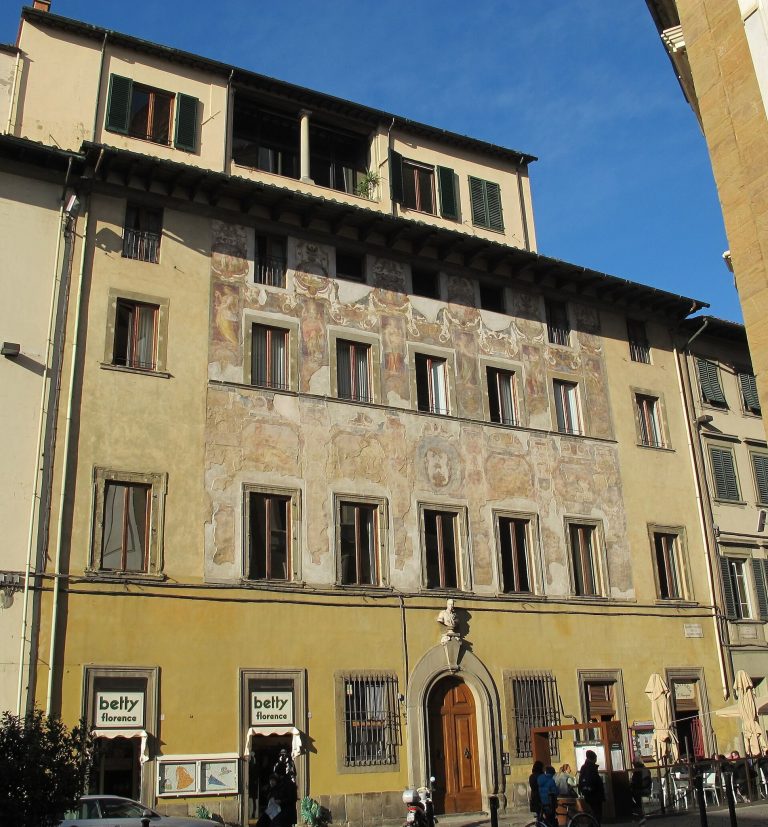
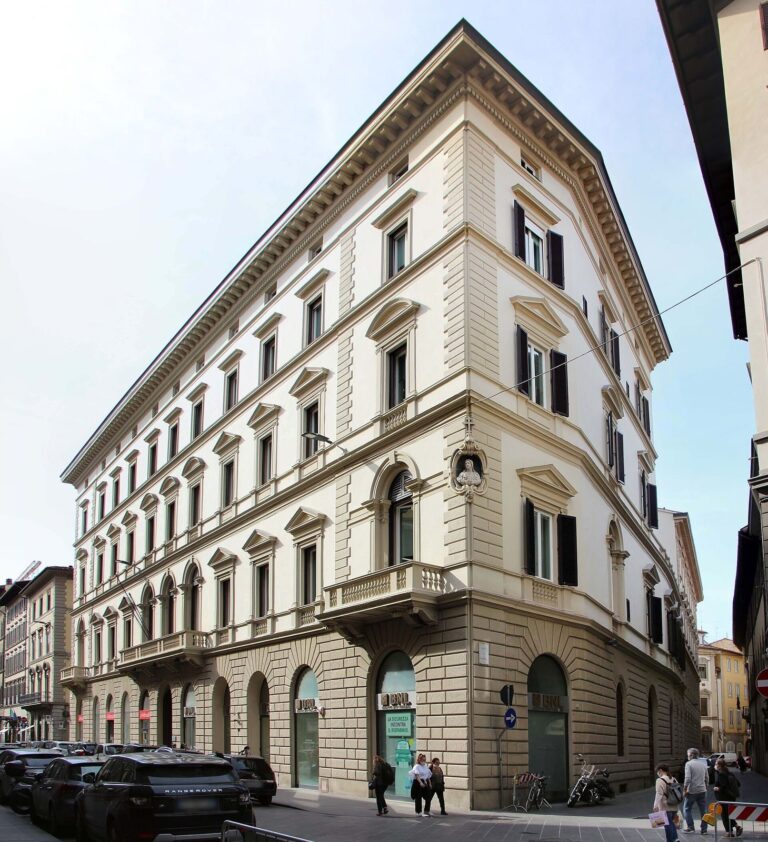
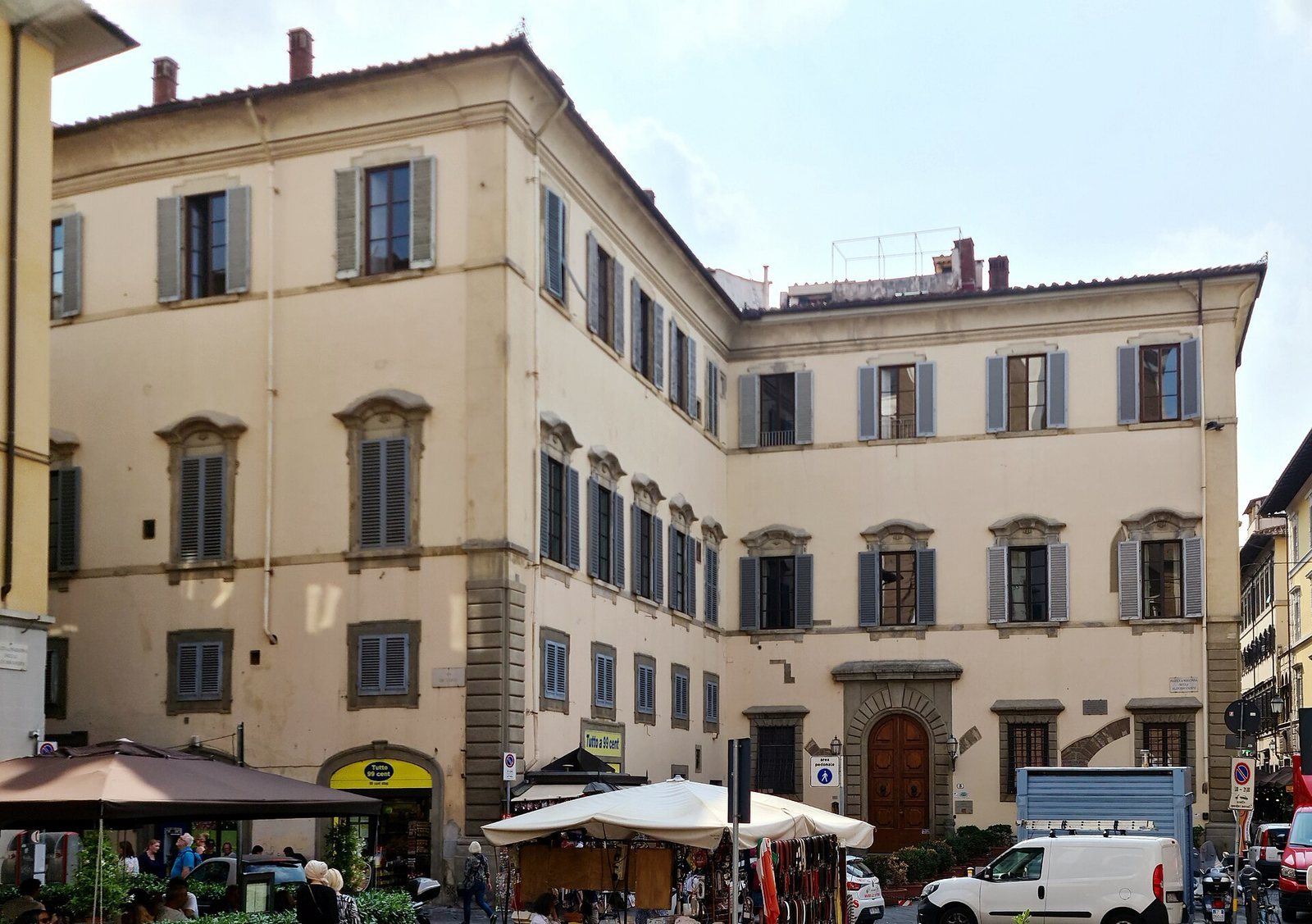
The palace has three floors and two principal fronts that meet at a right angle on Piazza Madonna degli Aldobrandini. The building also extends along Via de’ Conti and Via del Giglio. Its surviving features include decorated entrances, older exposed masonry, and painted rooms.
Exterior
Principal fronts and openings
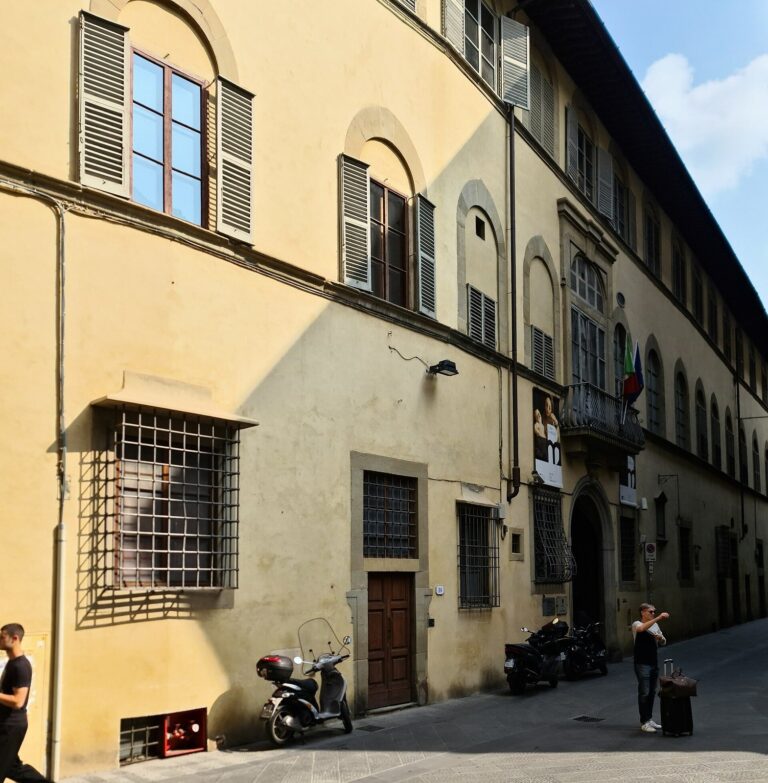
One principal front is divided into five bays (vertical sections of a facade), and the other into four. At ground level, a round-arched entrance is framed by a band of cut stone and topped by a horizontal ledge. Rectangular windows on this floor have wrought-iron grilles, carved stone supports, and upper ledges echoing the entrance. On the Via de’ Conti side, intermediate-level windows and oval-arched openings may once have served for carriage access.
The rectangular first-floor windows have carved stone supports and upper ledges with varied profiles. Those on the second floor also rest on carved supports, which have ear-shaped projections. A horizontal band links the windows, while a broad, inward-curving moulded band supports the roof eaves.
Earlier masonry
Exposed stonework on the plastered entrance front belongs to earlier buildings associated with the Aldobrandini del Nero family. It is especially clear toward Via del Giglio, where the stones trace the shape of an arched opening.
Entrance and painted interiors
Entrance hall
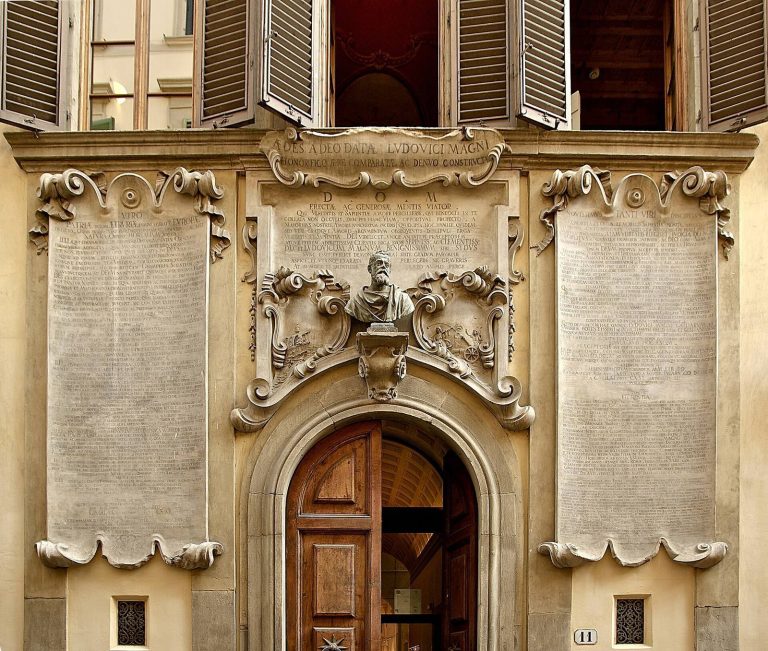
The entrance leads into a hall with a barrel vault, a ceiling curved like a half-cylinder, which was decorated in the nineteenth century. A wrought-iron gate from that century stands in the hall. Before the staircase is a carved door bearing the Aldobrandini arms. A coat of arms of the Aldobrandini of Madonna once stood above the exterior entrance and was removed in the nineteenth century.
First-floor paintings
Rooms on the first floor contain murals commissioned for the 1759 marriage of Giovan Francesco Aldobrandini and Maria Cristina Bourbon del Monte Santa Maria. Vincenzo Meucci painted Allegory of the Virtues Defeating the Vices, while figure painter Tommaso Gherardini created the Gallery of Imaginary Ruins, depicting invented ruined architecture. Giuseppe Del Moro, a painter of architectural perspectives that create an illusion of three-dimensional space, also worked on the interiors. The floor also has paintings dating to the early nineteenth century.
Ground-floor room
A room at ground level, on the corner of Via del Giglio, has eighteenth-century paintings of imagined ruins. It now houses a restaurant.