Palazzo Martelli: A Florentine Family Palace and Civic Museum


Site at a Glance
- Rating
- 4.5
- Popularity
- Low
- Country
- Italy
- Primary era
- Early Modern
- External website
- Open
- Eras represented
- Early Modern, Modern
- Civilizations
- Grand Duchy of Tuscany, Republic of Florence
- Site type
- Domestic
- Remains
- Elite Residence
On this page12 sections
History
Palazzo Martelli is a residential palace in Florence, Italy, developed by the Martelli family from older houses into an elaborately decorated urban residence. Its history extends from the family properties of the 1520s through successive unifications and renovations, and since 2009 it has housed the Museo di Casa Martelli, a civic museum presenting surviving parts of the collection and the frescoed rooms.
Family Houses and Structural Unification
The site contained several Martelli family houses by the 1520s. A major step toward creating a single palace followed the marriage in 1627 of Senator Marco Martelli and his cousin Maria. Their union brought together properties and inheritances belonging to different branches of the family, after which Marco acquired additional neighboring buildings.
Between 1668 and 1669, Marco began the first major structural unification of the houses along the former Via della Forca, now Via Zannetti. The process continued for roughly eighty years and was completed under the architect Bernardino Ciurini. The resulting complex retained the accumulated character of properties joined over time rather than representing a single moment of construction.
The Eighteenth-Century Renovation
In 1738, Giuseppe Maria Martelli, Archbishop of Florence from 1721, and the Florentine bailiff Niccolò Martelli promoted another substantial renovation. The work focused on the piano nobile, the principal reception floor of an Italian palace, which was traditionally more richly decorated than service areas. Bernardino Ciurini, Vincenzo Meucci, Ferdinando Melani, Giovan Martino Portogalli, and Bernardino Minozzi took part in the project.
During the later eighteenth century, Niccolò’s son Marco reorganized the family picture collection. The previous arrangement, based on Baroque variety, gave way to an Enlightenment-inspired classification by subject. Landscapes, battle scenes, historical paintings, and self-portraits were grouped into more systematic categories.
Marco also commissioned frescoes with mythological themes and scenes celebrating the family from artists led by Tommaso Gherardini. Luigi Sabatelli decorated the staircase vault. The staircase prominently displayed two family treasures attributed to Donatello, a David and the Martelli coat of arms, connecting the palace’s domestic setting with the artistic traditions of Florence.
Collection, Decline, and Public Museum
Much of the collection was dispersed during the nineteenth century as the aristocratic fortunes of the Martelli family declined. In 1986, the last heir, Francesca Martelli, left the palace and the family’s remaining property by will to the Florentine Curia. During the period of ecclesiastical administration from 1986 to 1998, many household goods disappeared, including most of the tableware, very few garments, and all household linen. The extent of losses among valuable objects cannot be established because no inventory existed at the time.
The Florentine Curia sold the complex to the Italian state in 1998 after issues concerning the contested inheritance of Stefano Bardini had been resolved. The Superintendency for the Florentine Museum Complex then carried out an extended program of restoration, cataloguing, and adaptation to public regulations. These works prepared the palace for its new role as a museum while preserving its rooms and the surviving collection.
The museum was inaugurated on 22 October 2009 after several postponements. The palace is state-owned and managed through the Musei del Bargello. Its presentation retains a historically crowded arrangement associated with the family residence, bringing together paintings, small bronzes, decorative objects, and interiors. The surviving works include paintings by Piero di Cosimo, Francesco Francia, Francesco Morandini, Salvator Rosa, Luca Giordano, Domenico Beccafumi, Giusto Sustermans, Michael Sweerts, Pieter Bruegel the Younger, Orazio Borgianni, and Francesco Curradi, as well as small bronzes by artists including Massimiliano Soldani Benzi. In 2014 and 2015, the palace hosted an exhibition on the mystical and devotional life of the Martelli women.
Remains
Facade, Courtyards, and Staircase
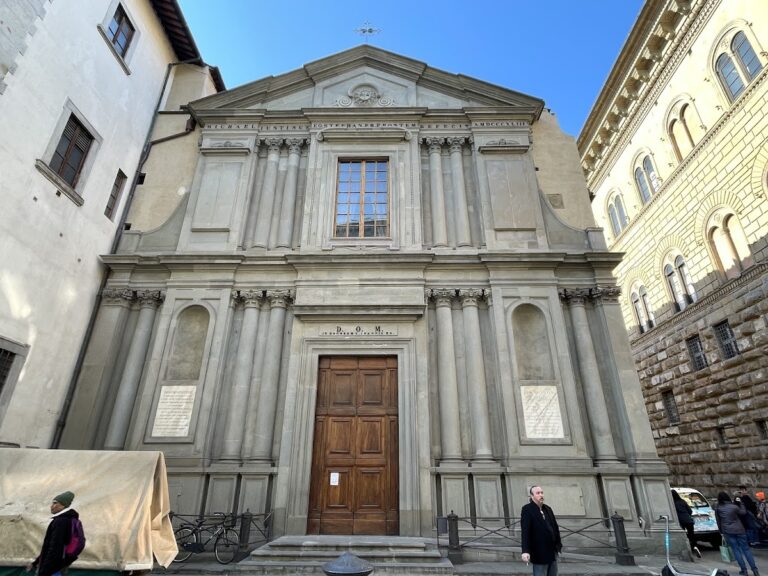
The palace has a relatively simple exterior, with partly blocked arched openings, smooth rusticated frames, and a terrace on the principal floor. Its terrace doorway is framed by right-angled molding and fitted with an innovative wrought-iron balustrade. Illusionistic paintings known as trompe-l’oeil, a technique that makes flat surfaces appear three-dimensional, create the impression of architectural space in the lunette and the final compartment of the door-window. A facade tabernacle contains Mino da Fiesole’s Madonna and Child with the Infant Saint John.
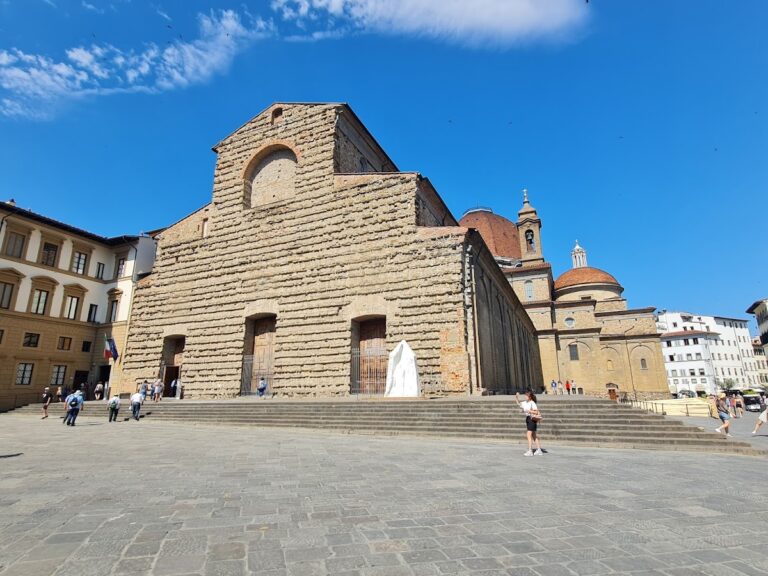
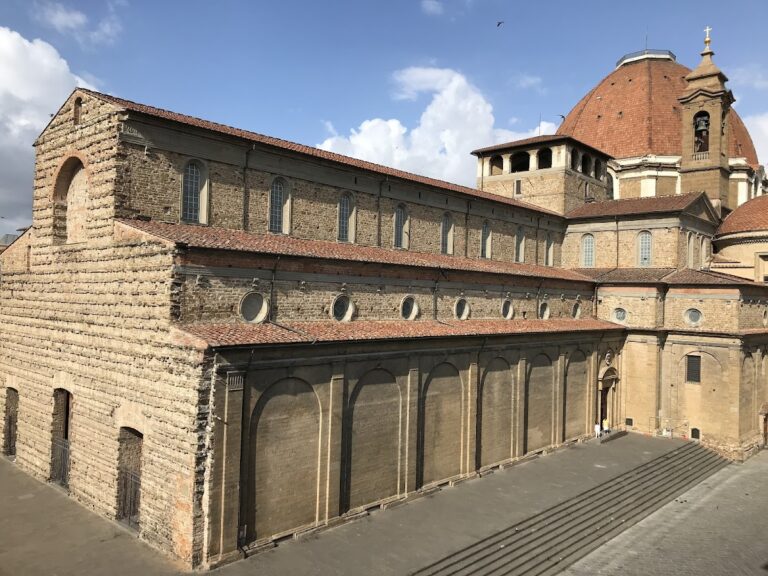
The entrance passage leads to a small courtyard with arcades closed by glazing. Trompe-l’oeil paintings give the courtyard an illusion of expanded space. From here, the ceremonial staircase rises toward the principal-floor rooms and also provides access to the frescoed Giardino d’Inverno, or Winter Garden. A nearby small courtyard has a doorway opening onto a private passage toward the Basilica of San Lorenzo.
A separate doorway leads to the large courtyard and the service area. This part of the palace includes the so-called bathroom, a completely frescoed room decorated in 1822 with bucolic scenes attributed to Niccolò Contestabile. Fountains, basins, and windows opening onto the inner courtyard helped cool the room during summer.
The ceremonial staircase is built from pietra serena, a blue-gray sandstone widely used in Florentine stairs, columns, and frames, and has a wrought-iron handrail. At its summit is the Martelli coat of arms, showing a golden griffin on a red field. The marble David once displayed on the staircase is now in the National Gallery of Art in Washington, where it is considered a copy of Donatello’s marble David in Florence’s Bargello Museum. The coat of arms attributed to Donatello is also held by the Bargello Museum.
Gallery Rooms
First Gallery Room
The first floor contains four small- and medium-sized gallery rooms in which paintings cover the walls in an arrangement compared with that of the Galleria Palatina. The first room has a ceiling decorated by Antonio Marini. Its paintings include works by Francesco Francia, the painter known as Il Poppi, Salvator Rosa, and Luca Giordano, together with Giovan Battista Benigni’s large portrait of the Martelli family shown within the gallery.
Second Gallery Room
The second gallery room has a ceiling by Niccolò Connestabile depicting the marriage of Cosimo I de’ Medici and Camilla Martelli. Its paintings include works by Domenico Beccafumi and Giusto Sustermans. Beccafumi’s Festival of the Lupercalia and Vesta cult appears alongside Luca Giordano’s Oath of Brutus against the Tarquins after the Death of Lucretia.
Third Gallery Room
Antonio Marini’s ceiling painting in the third gallery room represents Roberto Martelli in Donatello’s workshop. The room contains landscapes, two paintings by Pieter Bruegel the Younger, a Venetian view by Hendrik Frans van Lint, and self-portraits by Luigi Sabatelli and Pietro Benvenuti.
Small bronze statuettes collected for the abbot Domenico Martelli include Apollo playing the lyre, Bacchus by Sansovino, a dancing faun with cymbals, Meleager sacrificing to Diana, and Laocoön and His Sons. Massimiliano Soldani Benzi made these bronzes. Seven small boxwood sculptures made by Johannes Sporer between 1743 and 1751, also collected for Domenico, represent ancient sculptures including the Farnese Hercules, the Red Faun, Faun or Bacchus, Laocoön and His Sons, the Belvedere Antinous, and dying or wounded Gauls.
Fourth Gallery Room
The fourth gallery room is a modern reconstruction that brought together objects kept in storage whose original positions were unknown. It contains paintings by Orazio Borgianni and Francesco Curradi, surviving porcelain, small-format sculptures, fans, and other objects. Its ceiling fresco represents Mount Parnassus, the mountain associated in Greek mythology with Apollo, the Muses, and poetry, and gives the room its name, the Chamber of the Poets.
Tommaso Gherardini painted the ceiling in 1758. Among the contents are Borgianni’s 1612–1613 half-length portraits of Democritus and Heraclitus, ancient Greek philosophers traditionally associated with atomist thought and the idea of perpetual change. An early nineteenth-century Ginori crater vase, shaped like a Medici vase, depicts the Martelli villas of Soffiano and Gricigliano.
Chapel, Salons, and Ballroom
The chapel is decorated with a fresco of the Rape of Proserpina. The yellow salon retains eighteenth- and nineteenth-century floral-patterned silks and Piero di Cosimo’s Adoration of the Child. The red salon contains mainly nineteenth-century portraits and furnishings.
Created at the beginning of the nineteenth century, the red salon was rediscovered during restoration after smaller rooms had concealed its original floor, walls, and vault. At the center of its ceiling, a painting represents an allegory of love connected with the family’s romantic concerns.
The Pucci small salon has Pompeian-style grotesque decoration and lies near the ballroom. The ballroom is twice the height of the other rooms and retains a restrained nineteenth-century decorative scheme made to celebrate the marriages of Marco Martelli and Teresa Pucci, and of Niccolò Martelli and Caterina de’ Ricci. Views bearing the Martelli–Pucci and Martelli–Ricci arms decorate the room. Luca Ristorini designed it, while Piero and Antonio Miseri carried out its painting.
Other surviving or displayed works include Cosmè Tura’s Saint John at Patmos, Michael Sweerts’s Allegory of Vanity, Francesco Morandini’s portrait of Antonio de’ Ricci, Salvator Rosa’s Conspiracy of Catiline, and Francesco Francia’s Madonna between Saints Petronius and Anthony of Padua. The second floor still requires restoration and structural adaptation and is not open to visitors.