Sant’Agostino in Trapani: A Former Templar Chapel and Civic Church
Site at a Glance
- Popularity
- Medium
- Country
- Italy
- Primary era
- Medieval
- Eras represented
- Medieval, Early Modern
- Civilizations
- Crusader, Kingdom of Sicily, Knights Templar, Norman, Spanish
- Site type
- Religious
- Remains
- Church
On this page7 sections
History
Sant’Agostino is a Roman Catholic church in Trapani, Italy, built in 1101 as a chapel of the Knights Templar and later enlarged in the Gothic style. It is now dedicated to Augustine of Hippo, an early Christian bishop and theologian.
Templar and Augustinian phases
The original chapel was dedicated to John the Baptist, a Christian preacher regarded as the forerunner of Jesus. During the early Crusades, medieval Christian military campaigns, the Hospitallers, another religious-military order, administered the complex.
After Pope Clement V dissolved the Templar Order in 1312, Frederick III of Sicily transferred the church to the Augustinians, a Catholic religious order whose members follow the Rule of Saint Augustine. Their Gothic work was completed in 1313, and the church served as a mother church.
Religious and civic roles
In the sixteenth century, the church was remodeled in the Sicilian style and became the city Senate’s church. It continued to serve for worship as well as civic ceremonies. In 1535, Charles V swore there to recognize the city’s privileges. After his conquest of Tunis, he landed at Trapani on August 20 with 20,000 freed Christian captives and remained until August 25.
Later changes and uses
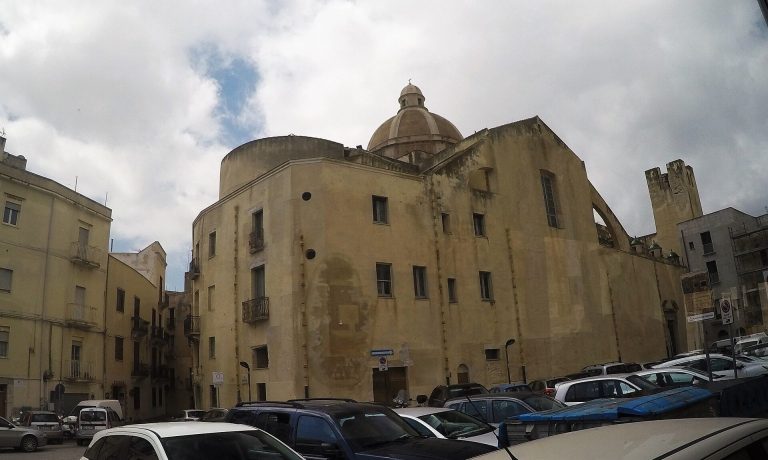
The church closed for worship and underwent extensive alterations in the nineteenth century. Bombing in 1943 destroyed the apse and part of the nave, which were later rebuilt.
The former convent housed the secret Congregation of the Most Holy Crucifix, also known as the Thirty-Three, a religious association that later moved to the Church of San Benedetto. The Lancasterian School also operated there, using advanced pupils to help teach other students. Since 2008, Sant’Agostino has been the principal exhibition venue of the diocesan museum, which operates alongside the old parish of San Nicola.
Remains
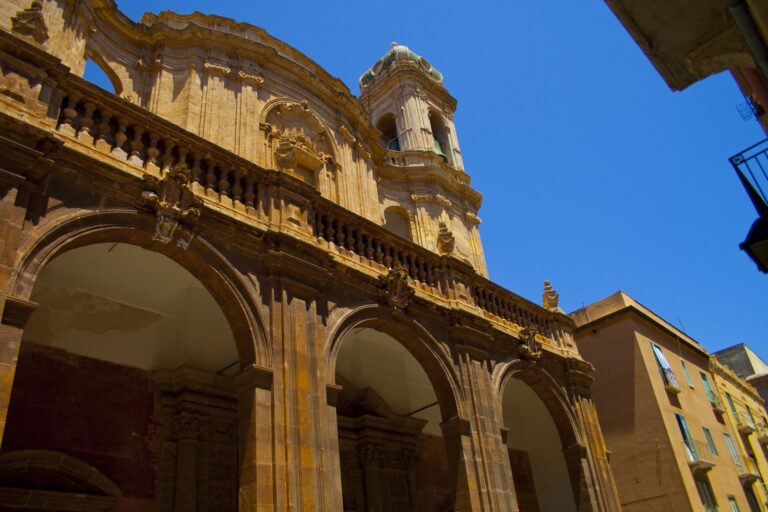
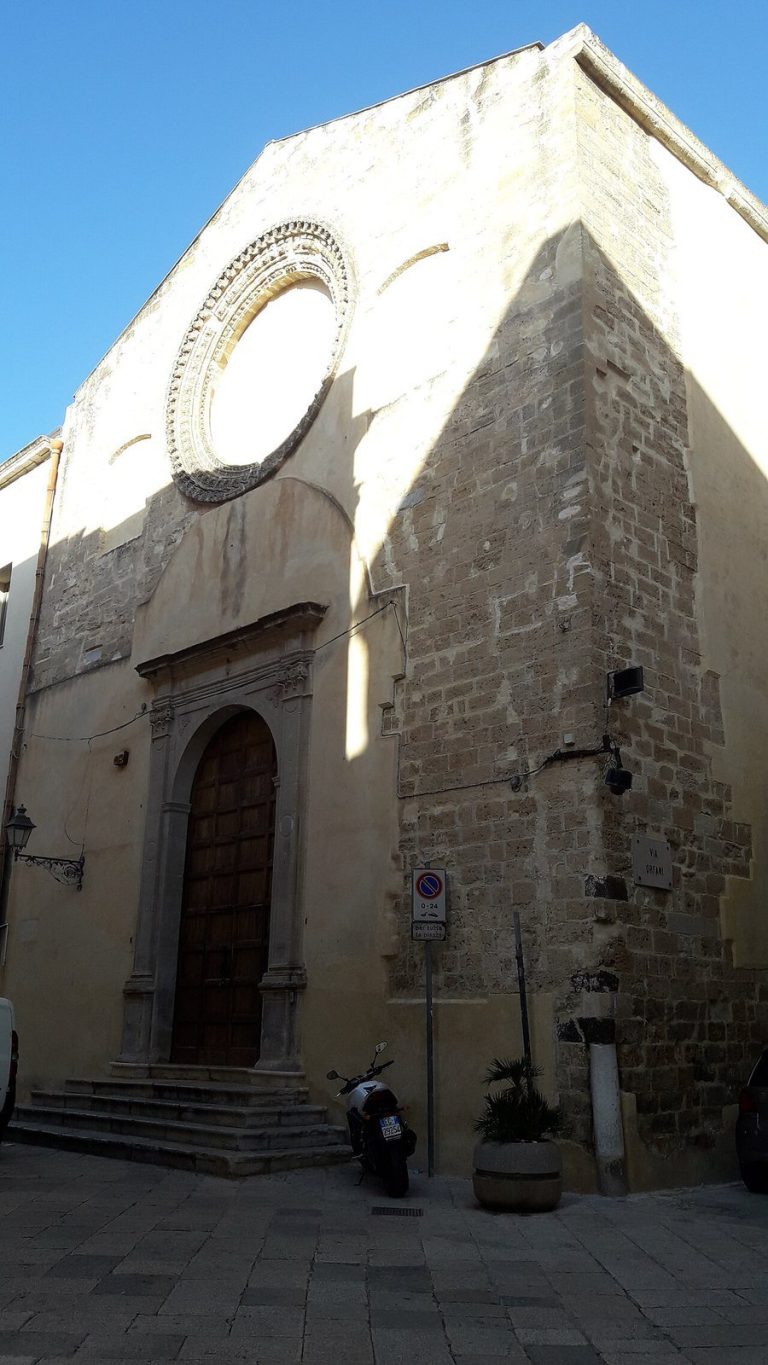
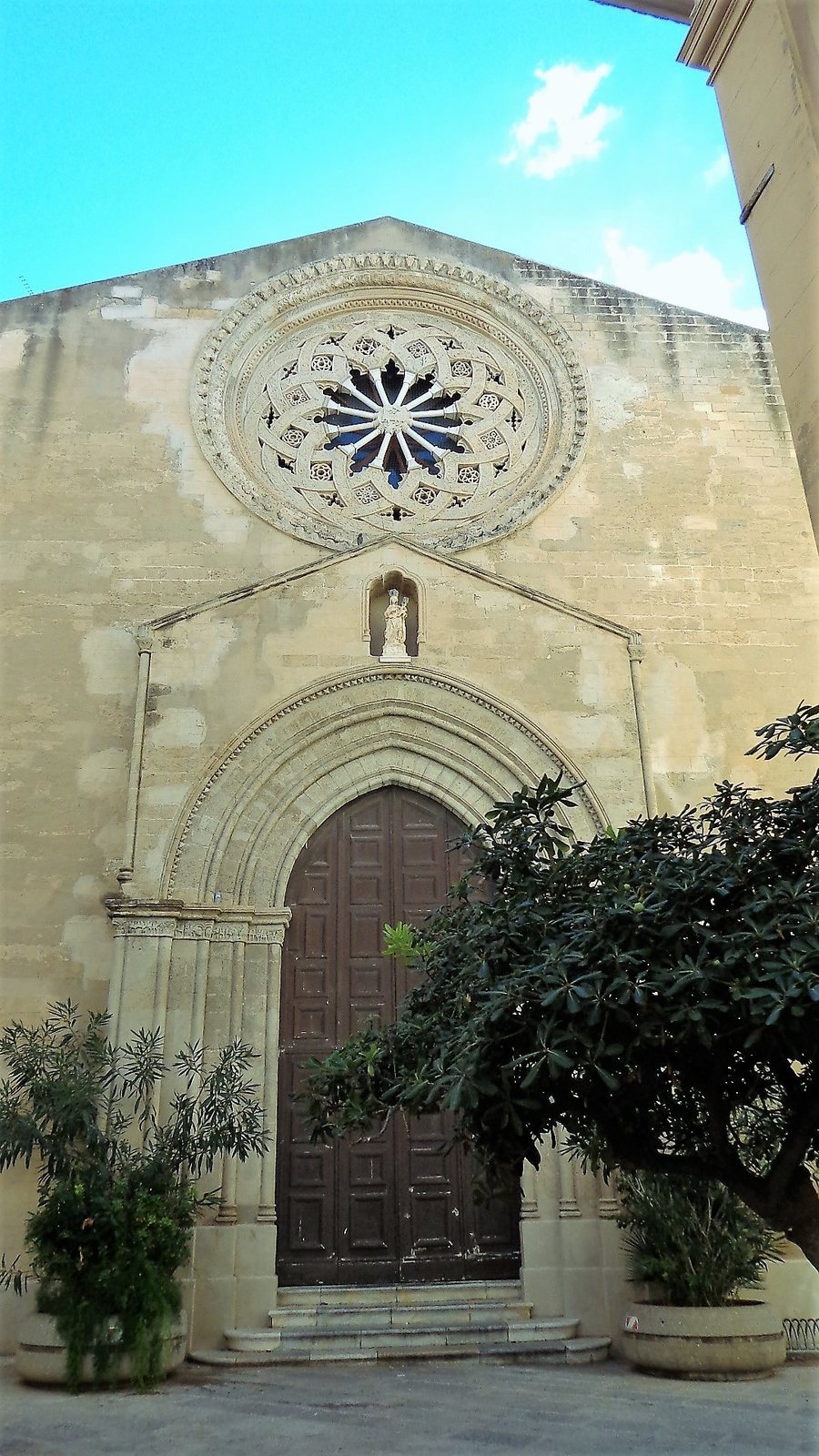
Standing at Piazzetta Saturno in Trapani’s historic center, the church has a single nave, an asymmetrical plan, and a polygonal apse. Its gabled main façade is the principal surviving part of its earlier arrangement.
Façade and adjoining space
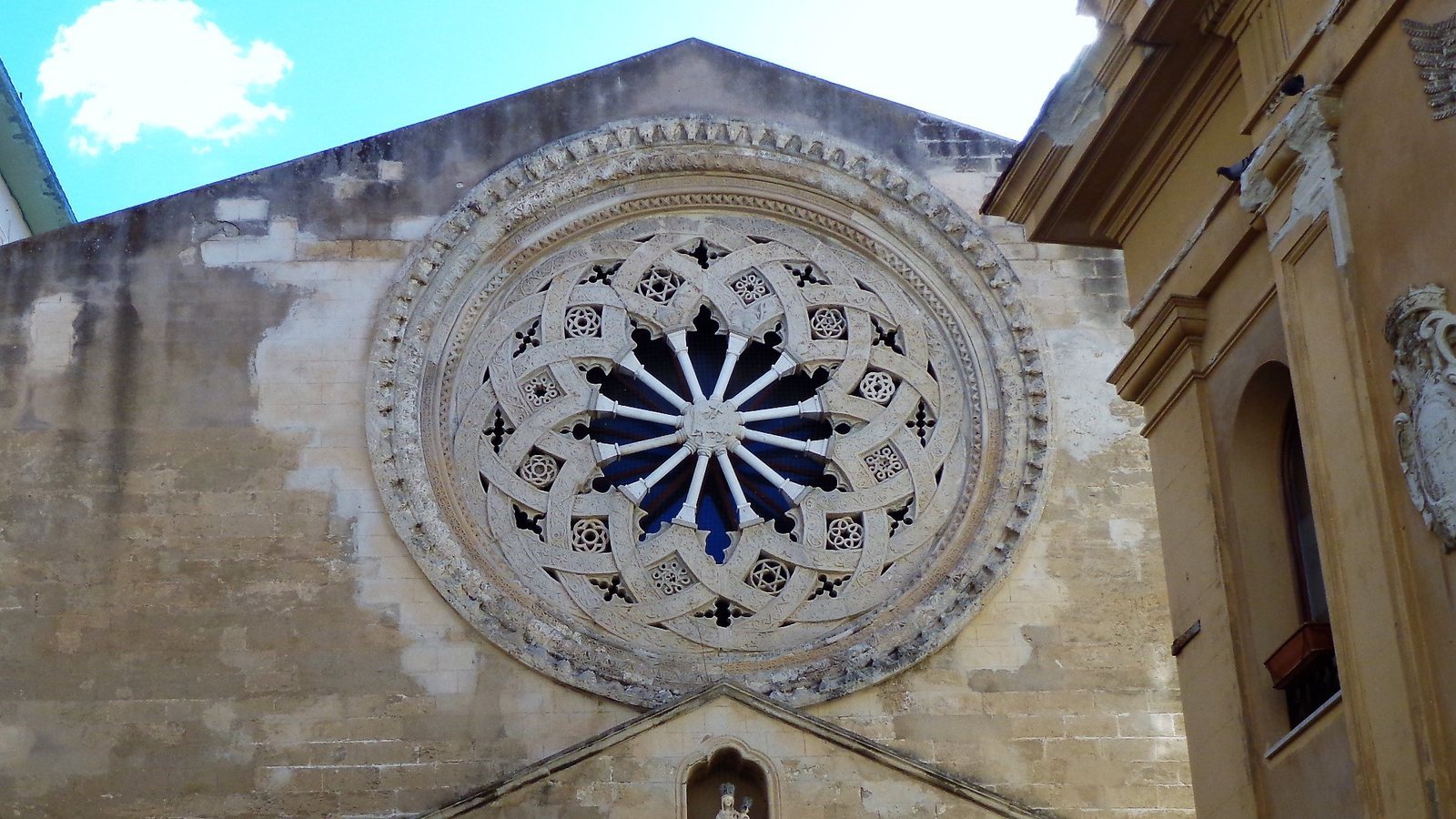
The façade’s large fourteenth-century rose window, a circular window with radiating stonework, was made by local craftspeople from stone quarried at Pietretagliate. Its Chiaramonte design, a Sicilian architectural style, uses interlaced arches and slender columns; twelve columns divide the window into equal sections. Pierced screens associated with Arab design, Stars of David, and Christian plant motifs evoking the earthly paradise sit within an almond-shaped form made by two intersecting circles. At the center, the Lamb of God forms the theological focus. A recess in the Gothic portal holds a Madonna and Child in the Gaginesque style, associated with the Gagini family of sculptors. Beside the church, the Chiaramonte family built the Fountain of Saturn in 1342 in honor of the city’s lords.
Interior
Before the postwar restructuring, the church had entrances facing north and south; the southern doorway opened into the cloister of the former convent of the Hermits of Saint Augustine. A wooden roof structure covers the nave, beneath a barrel vault, a continuous arched ceiling, painted with allegorical and grotesque figures inspired by medieval miniature art. Similar figures appear on the wooden ceiling of Palazzo Chiaramonte. Parts of Sant’Agostino’s ceiling are now held at Museo Pepoli, in a former Carmelite convent. The interior also contains Antonio Giuffrè’s painting The Three Angels Visiting Abraham. An undated, Oriental-style painting of the Pietà was once in the refectory and later passed into the possession of the knight Ferro.