Castello di Terra: Medieval Coastal Fortress of Trapani


Site at a Glance
- Rating
- 4.4
- Popularity
- Very Low
- Country
- Italy
- Primary era
- Medieval
- External website
- Open
- Eras represented
- Medieval, Early Modern, Modern
- Civilizations
- Crown of Aragon, Holy Roman Empire, Kingdom of the Two Sicilies, Norman, Spanish
- Site type
- Military
- Remains
- Castle
On this page8 sections
History
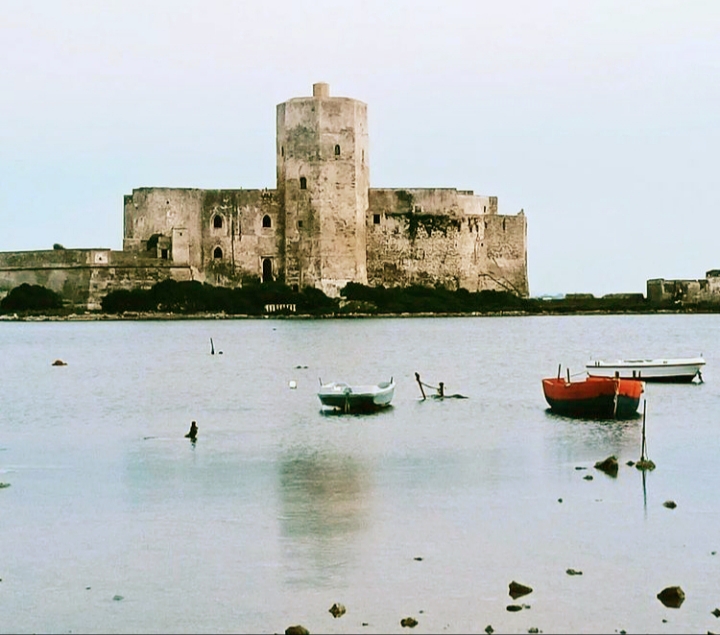
Castello di Terra is a former medieval coastal fortress in Trapani, Italy, erected during the twelfth century to defend the town, its harbour, and the approach from land. It stood at the mouth of the canal connecting the Tyrrhenian Sea with the harbour, opposite the Castello a Mare, the corresponding sea fortress. The castle occupied an important defensive position in Trapani’s historic centre, although much of its original complex was later altered or demolished.
Ancient Foundations and Medieval Origins
The medieval fortress was built on the remains of an earlier Carthaginian fortification traditionally associated with Hamilcar, a Carthaginian military and political leader. The earlier stronghold is mentioned by Diodorus Siculus, a first-century BC Greek historian whose writings include accounts of the ancient Mediterranean world. The precise origins of the medieval castle remain uncertain. Giuseppe Maria di Ferro assigned its construction to 1318 and attributed it to Frederick II, the medieval ruler identified as Holy Roman Emperor, while James II of Aragon, also known as James the Just, is associated with an enlargement of the castle in the late thirteenth century.
Spanish Rule and Artillery Defence
During the sixteenth century, when Sicily formed part of the Crown of Aragon under Spanish rule, Castello di Terra was incorporated into Trapani’s bastionised artillery-defence system. The Crown of Aragon was the dynastic polity that governed Aragon and associated Mediterranean territories, including Sicily during parts of the medieval and early-modern periods. The castle was connected with the Mura di Tramontana, Trapani’s northern coastal defensive walls, and with nearby works such as the Bastione dell’Impossibile. These changes integrated the older fortress into a wider system designed for artillery warfare.
Revolution and Military Reuse
Castello di Terra was involved in the Sicilian Revolution of 1848, an uprising against the Bourbon monarchy of the Kingdom of the Two Sicilies. Giuseppe Coppola and Enrico Fardella, local revolutionary leaders, led insurgents who stormed the fortress that year. From the eighteenth century onward, developments in warfare and urban defence reduced its military importance. During the nineteenth century, the Bourbons enlarged the complex and converted it into a barracks. By at least this period, it also served executive and administrative purposes, extending its use beyond military defence.
Urban Redevelopment and Archaeological Work
Part of the castle, including its southern section, was demolished during urban redevelopment in the 1970s to make room for administrative offices. The former landward area is now occupied by the Questura di Trapani, the provincial headquarters of Italy’s State Police, completed in 1990. This later civic use reflects the transformation of the former fortress from a defensive installation into an administrative area.
The Soprintendenza di Trapani, the local heritage-protection authority, undertook partial restoration and archaeological excavation in 1992, followed by further archaeological excavations in 1994. These interventions helped bring the history of the fortress to wider public attention. Today, Castello di Terra is represented mainly by its surviving seaward walls, while the landward portion reflects successive military, administrative, and civic changes.
Remains
The surviving fabric presents only part of the former fortress, whose quadrilateral plan included semicircular towers within the curtain walls and rectangular towers at the corners. Less than half of the original complex remains visible. The preserved structures are concentrated along the seaward side, where local-stone defensive walls face the historic harbour. The entire northwestern facade survives and closes the Mura di Tramontana, retaining the castle’s connection with Trapani’s northern coastal defences.
Seaward Defensive Walls
The seaward walls form the principal surviving remains of Castello di Terra. Built of local stone, they preserve sections of the defensive enclosure along the harbour-facing side and include the complete northwestern facade. Their present condition is partial and largely ruinous, but their position defines the part of the fortress that remains visible and conveys its relationship with the coastal defensive line.
Canal and Former Landward Area
An east-side canal once separated the castle from the rest of Trapani. By linking the sea with the harbour, it helped make the fortress’s peninsula function as a more defensible island. The former landward side has since been completely redeveloped. The Questura di Trapani now occupies this area on a civic piazza, in a building designed by the Roman architect Riccardo Leone.
The same piazza contains the Monument to the Fallen of All Wars, first erected in 1921. The commemorative monument and the later police headquarters stand within the redeveloped landward area, alongside the surviving fortifications that preserve the castle’s earlier defensive role.
Nearby sites