Saint Barbara’s Church in Chrabrowo: A Former Medieval Parish Church
Site at a Glance
- Popularity
- Medium
- Country
- Russia
- Primary era
- Medieval
- Eras represented
- Medieval, Early Modern, Modern
- Civilizations
- Kingdom of Prussia, Teutonic Order
- Site type
- Religious
- Remains
- Church
On this page9 sections
History
Saint Barbara’s Church is a former parish church in Chrabrowo, formerly Powunden, in Russia. Built in the early 14th century, it served the local community as a parish church; a parish at Powunden existed from 1334.
Parish and Lutheran affiliation
The church was Catholic and dedicated to Saint Barbara before becoming Lutheran early in the Reformation, the 16th-century movement that gave rise to Protestant churches. It was a parish church by 1325. After the Reformation, its parish belonged first to the Fischhausen inspection, a local church-administration unit, and later to the Königsberg-Land II church district, a regional church administration. That district was part of the East Prussian ecclesiastical province of the Evangelical Church of the Old Prussian Union, which united Lutheran and Reformed Protestant traditions. The affiliation with Königsberg-Land II continued until 1945.
The bell and its later journey
The larger of the church’s two bells was cast in 1727 by Georgius Bernhardus Kinder at a foundry in Königsberg. During the Second World War, it was taken for melting into munitions but survived in Hamburg’s bell cemetery, a collection point for bells removed during wartime and held for possible melting. In 1952, the Evangelical congregation in Hüffelsheim, Rhineland-Palatinate, acquired it to replace a bell destroyed by bombing. The acquisition led the congregation to sponsor the former Powunden parish from 1985. In 1990, Hüffelsheim and the municipality of Chrabrowo formed a partnership.
War, abandonment, and renewed ties
The church survived the Second World War almost unscathed. After 1945, flight and expulsion, together with a state ban, ended religious life at the church. During the Soviet period, the building served first as a club, including a sailors’ club, and later burned out. From the 1970s, masonry was taken for houses for military personnel. An accident led the military administration to forbid further dismantling, leaving the substantial ruin. The church was transferred to the Russian Orthodox Church in 2010, and local volunteers have since undertaken restoration work on it.
Evangelical congregations reappeared in Kaliningrad Oblast during the 1990s. The nearest to Chrabrowo was at Marschalskoje, a branch of Kaliningrad’s Resurrection Church. That church was the main church of the Kaliningrad provostry, a regional administrative unit of the Evangelical Lutheran Church of European Russia.
Remains
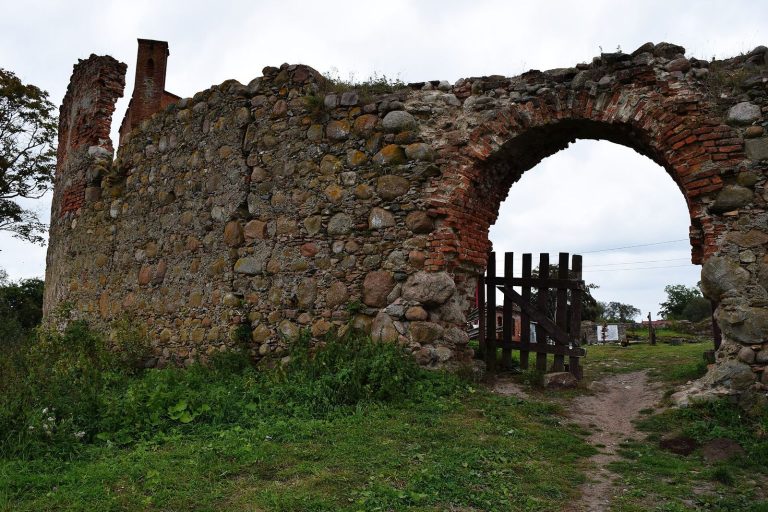
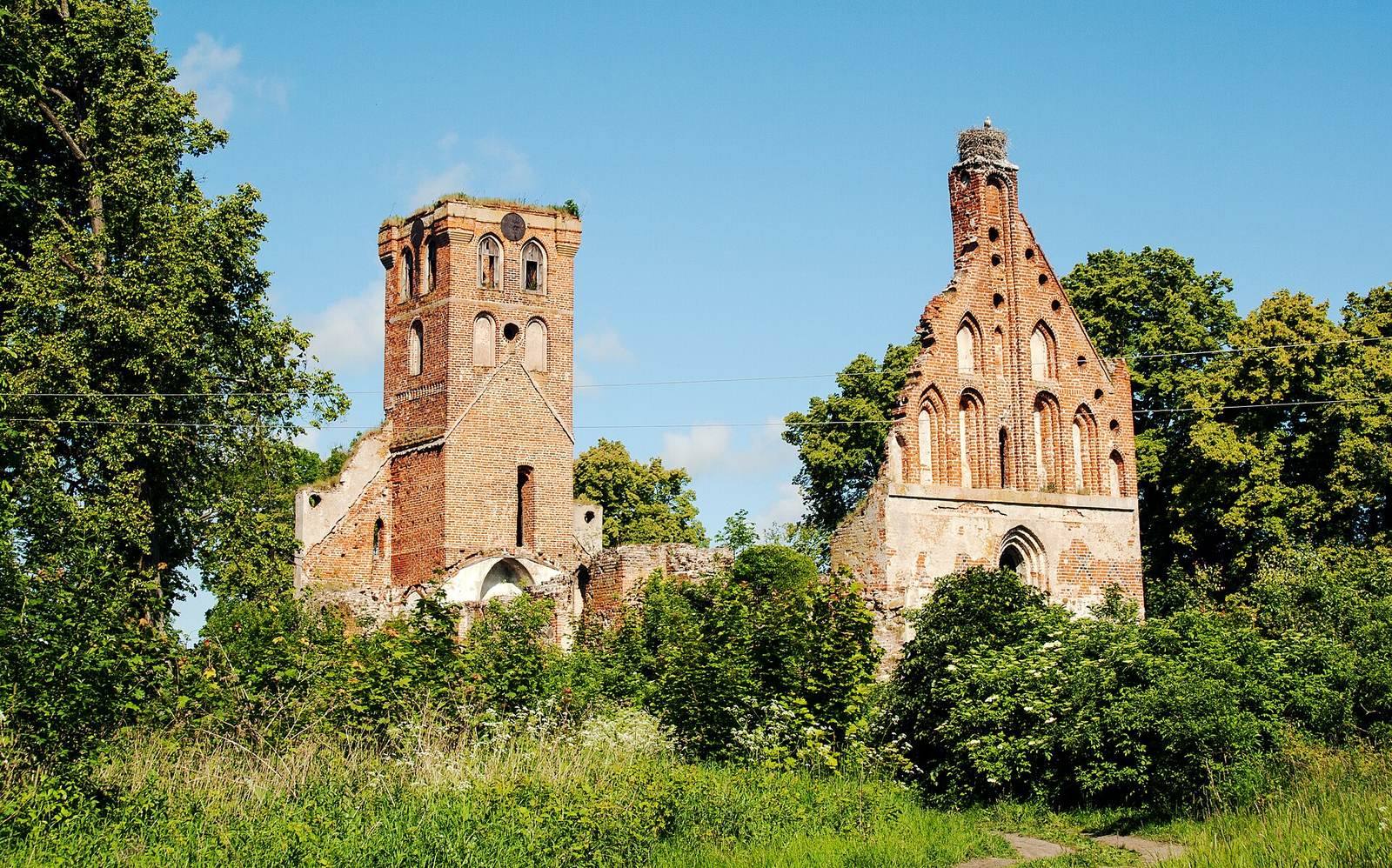
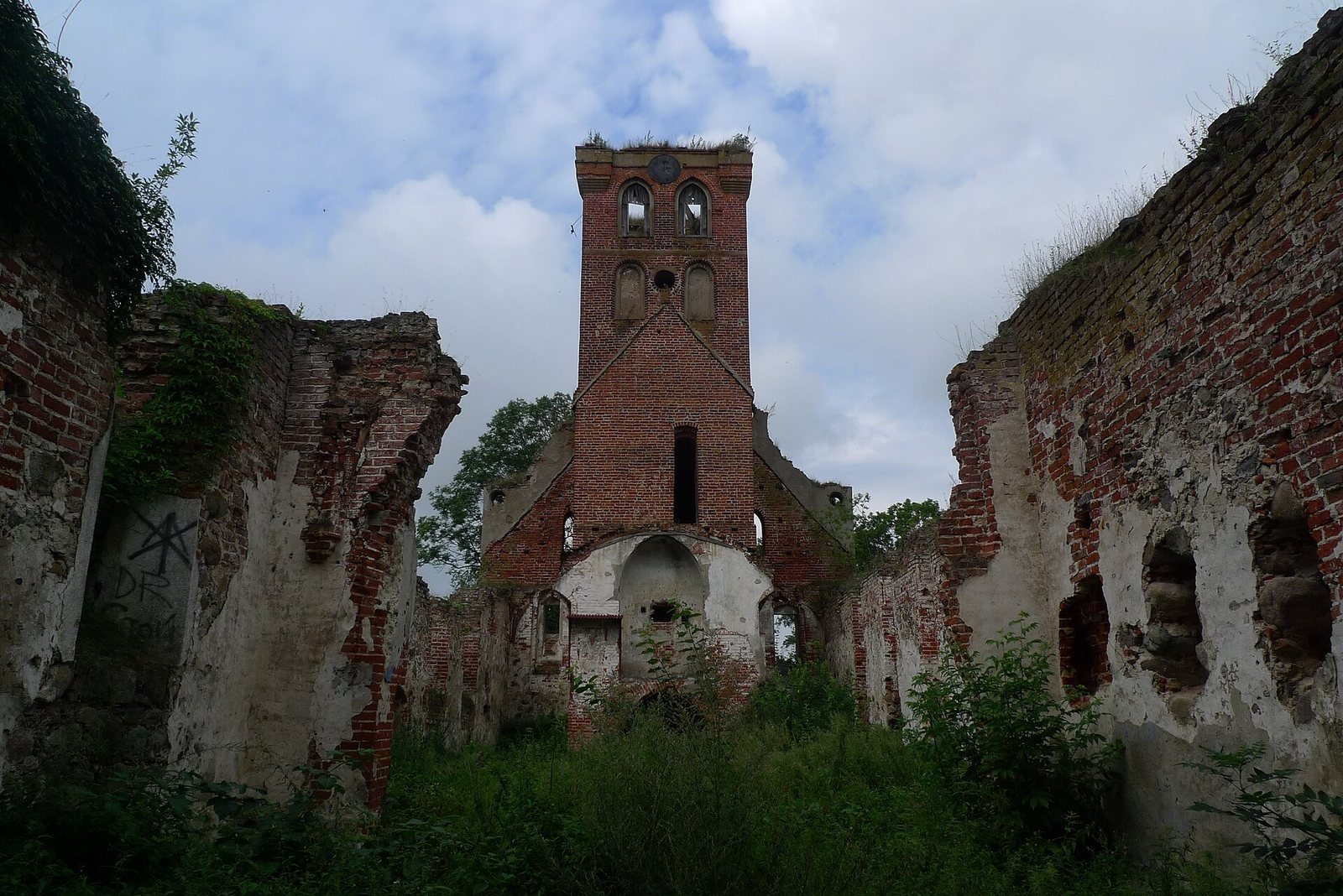
Set back west of the road near Chrabrowo’s southern entrance, the church was built of fieldstone and brick and covered with plaster. Its surviving fabric includes the high eastern gable, part of the tower, and the supports for the collapsed nave vault.
Nave and later additions
The nave’s vaulted ceiling was built between 1325 and 1350. A chancel, the area around the altar, with a closed end was added in the late 14th century, followed by a sacristy, a room for vestments and ritual objects, on the southwest side in the 15th century. Only the projecting supports, or corbels, for the nave vault remain; the roof and vault have collapsed. Major repairs took place in 1691, and the church was enlarged in 1843.
East gable and tower
The tall, seven-part east gable survives, with deep round-arch and pointed-arch recesses arranged in two tiers. The tower was heightened in 1862, but its upper portion is gone; it now reaches only to the roofline.
Wall paintings
Wall-painting remains uncovered in 1924 were dated to around 1370–80. In 2006, detached plaster revealed a fresco, a wall painting made on wet plaster, depicting the Apostle Paul, an early Christian apostle and missionary. An inscription identifies the figure, and the painting was dated to the mid-14th century. Its condition had worsened considerably by early 2010, partly because the church had no roof.
Pulpit and organ
A pulpit made in 1704 follows North German Gothic, a regional form of Gothic architecture. An organ was installed in the late 19th century.