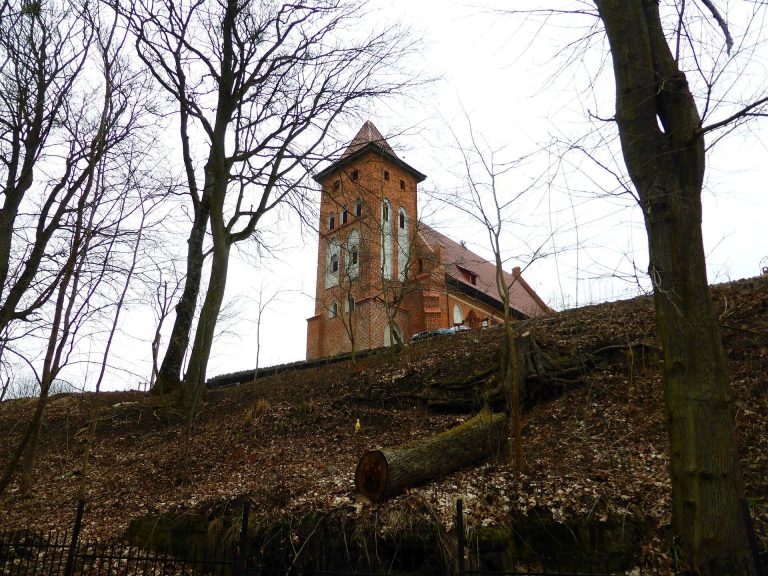
Schaaken Castle: A Teutonic Order Fortress in Russia


Site at a Glance
- Rating
- 4.6
- Popularity
- Medium
- Country
- Russia
- Primary era
- Medieval
- External website
- Open
- Eras represented
- Medieval
- Civilizations
- Crusader, Teutonic Order
- Site type
- Military
- Remains
- Castle
On this page8 sections
History
Schaaken Castle is a medieval Teutonic Order fortress in Russia, located at Nekrasovo in Kaliningrad Oblast. It was established around 1270 on the site of an earlier Prussian fortress and formed part of the fortified network created by the Teutonic Order, a medieval Catholic military-religious order that governed territories in the eastern Baltic region.
Prussian and Teutonic foundations
The area was associated with the Prussian volost of Schaaken, also known as Saken, which appears in a Teutonic Order chronicle in 1258. An Order fortress began to be built in wood in 1261, while a wooden episcopal fortress was completed at Schaaken by 1270. The earlier Prussian stronghold was known as Zoke and later as Shokin.
The fortress occupied marshy ground near the Schaaken River, now called the Bolshaya Moryanka. Its defensive position was strengthened by damming the river. The castle stood about four kilometres from the Curonian Lagoon, rather than directly on the coast. The name Schaaken comes from a Prussian word meaning “grass,” reflecting the area’s grass, reeds, and rushes.
Expansion and later historical associations
Buildings were subsequently erected against the defensive walls, expanding the complex beyond its original wooden fortification. The site later became associated with Russian imperial travel. Part of the Russian Great Embassy, a diplomatic mission sent by Peter I to Western Europe in 1697 and 1698 to seek knowledge, alliances, and technical expertise, stopped at a harbor near Schaaken. Peter I, later known as Peter the Great, stopped at Schaaken on 11 November 1711, 9 July 1712, and 23 September 1717. These dates are given in the old style.
War, reuse, and deterioration
Schaaken suffered little damage during the Second World War. From late 1945 until 1947, the castle housed a shelter for German orphans. It was then used as a collective-farm stable until the beginning of the 1960s, after which it provided housing. Auxiliary rooms continued to serve household and utility purposes.
By the 1980s, only one family lived in the castle’s still-habitable rooms. Delayed repairs and neglect by local authorities contributed to the deterioration of the surviving buildings into ruins. During the 2000s, private individuals leased the castle and restoration work began, including the rebuilding of part of the fortress wall. A museum exhibition and guided tours were established, along with a children’s area containing exotic animals. The castle was transferred to the Russian Orthodox Church in 2011. A fire occurred on the grounds in 2012, and partial reconstruction began in 2024. Schaaken Castle is a regional cultural-heritage site of the Russian Federation.
Remains
The surviving complex combines the remains of a defensive structure built on marshy ground with later buildings placed against its walls. Its position near the Schaaken River was supported by river damming, while the surviving fabric reflects prolonged deterioration, later civilian reuse, and partial restoration.
Fortifications
The original fortress was a wooden defensive structure. Later construction included defensive walls that defined the castle complex and supported additional buildings. Part of the fortress wall was rebuilt during restoration in the 2000s, while other surviving sections and buildings remain partly ruined.
Chapel and domestic buildings
Structures erected against the defensive walls included a chapel, residential quarters, and other utility buildings. These additions expanded the site beyond its original fortified core. Some rooms remained habitable into the 1980s, but the buildings later deteriorated through prolonged lack of maintenance.
Museum display
A museum display at the castle included medieval prison torture instruments, along with medieval weapons and other objects. The exhibition formed part of the later cultural use of the complex after restoration work began in the 2000s.