Saint George Church, Staraya Russa: A Russian Orthodox Church Built in 1410
Site at a Glance
- Popularity
- Very Low
- Country
- Russia
- Primary era
- Early Modern
- Eras represented
- Medieval, Early Modern, Modern
- Civilizations
- Novgorod Republic, Russian
- Site type
- Religious
- Remains
- Church
On this page14 sections
History
Saint George Church is a Russian Orthodox church in Staraya Russa, Russia, built in 1410 by Varlaam, an archimandrite, a senior rank of Orthodox monastic clergy. Its construction took place under Vasily Dmitrievich, also known as Vasily I, ruler of Moscow and Vladimir, and received the blessing of John III, Archbishop of Novgorod. The church was dedicated to Saint George, a Christian martyr venerated in Eastern Orthodoxy, and included a chapel for the Annunciation, the Christian feast commemorating the announcement to Mary that she would bear Jesus. Tradition holds that a small church dedicated to the Annunciation had stood on the site earlier. Saint George Church is among Staraya Russa’s oldest surviving churches.
Foundation and rebuilding
A description from 1625 indicates that the church survived the Swedish and Lithuanian sack of Staraya Russa during 1611–1617. The same description notes two bells in its belfry, one medium-sized and another with an iron clapper. The church had no services from 1710 to 1740. In 1740 it was taken down and rebuilt on its original foundations, with approval from Archbishop Ambrose Yushkevich. The chapel, also out of use, was restored in 1782 under Archbishop Gabriel.
Dostoevsky’s parish and later changes
In 1842 the main church’s carved and gilded iconostasis, a screen of icons separating the sanctuary from the main worship space, was effectively remade, and its Greek-style icons were restored. A new iconostasis was installed in the Annunciation chapel in 1852. Fyodor Dostoevsky’s family attended the church while living in Staraya Russa in the 1870s, and the novelist was close to its rector, Father Ioann Rumyantsev. A western porch was added between 1873 and 1880 to provide more room. In 1883 Dostoevsky’s widow, Anna Grigoryevna Dostoevskaya, and Rumyantsev established a church school for girls from poor families, named for the writer.
Parishioners paid for a stone bell tower in 1884 to replace a deteriorated belfry. Stove heating was installed in 1905. The Annunciation chapel was enlarged in 1906 into the area of its porch, while its altar retained its earlier form; an opening through the north wall also connected it with the main church. In 1910, for the church’s 500th anniversary, mosaic floors and monumental wall paintings were added. The paintings followed designs by Viktor Vasnetsov at St. Vladimir Cathedral in Kyiv, and tradition attributes the work to craftsmen from Palekh, a Russian settlement known for icon painting.
Closure, wartime losses, and return to worship
A regional decision to close the church for an expansion of the Pedagogical Technical School was made in 1931, but the building remained open until 1939. It reopened during the German occupation in the Second World War on the order of the occupation authorities. In spring 1943 German troops removed its principal possessions, including an eighteenth-century copy of the revered Staraya Russa icon of the Virgin, and took them to Dno; some valuables were later sent to Riga Cathedral. The original icon, traditionally said to have been brought to Staraya Russa by monks from a Greek city in the late tenth century, had been lost in 1941. Many other icons, including old works in the Greek style, were also lost.
After Staraya Russa was liberated in February 1944, parishioners asked to reopen the church, but the city executive committee refused. A workers’ hostel used the building in the winter of 1945. The Annunciation chapel was reconsecrated on 23 June 1945, followed by the main Saint George altar on 24 December 1946. The chapel’s iconostasis, installed in 1852, was lost during the 1940s.
Restoration and continuing use
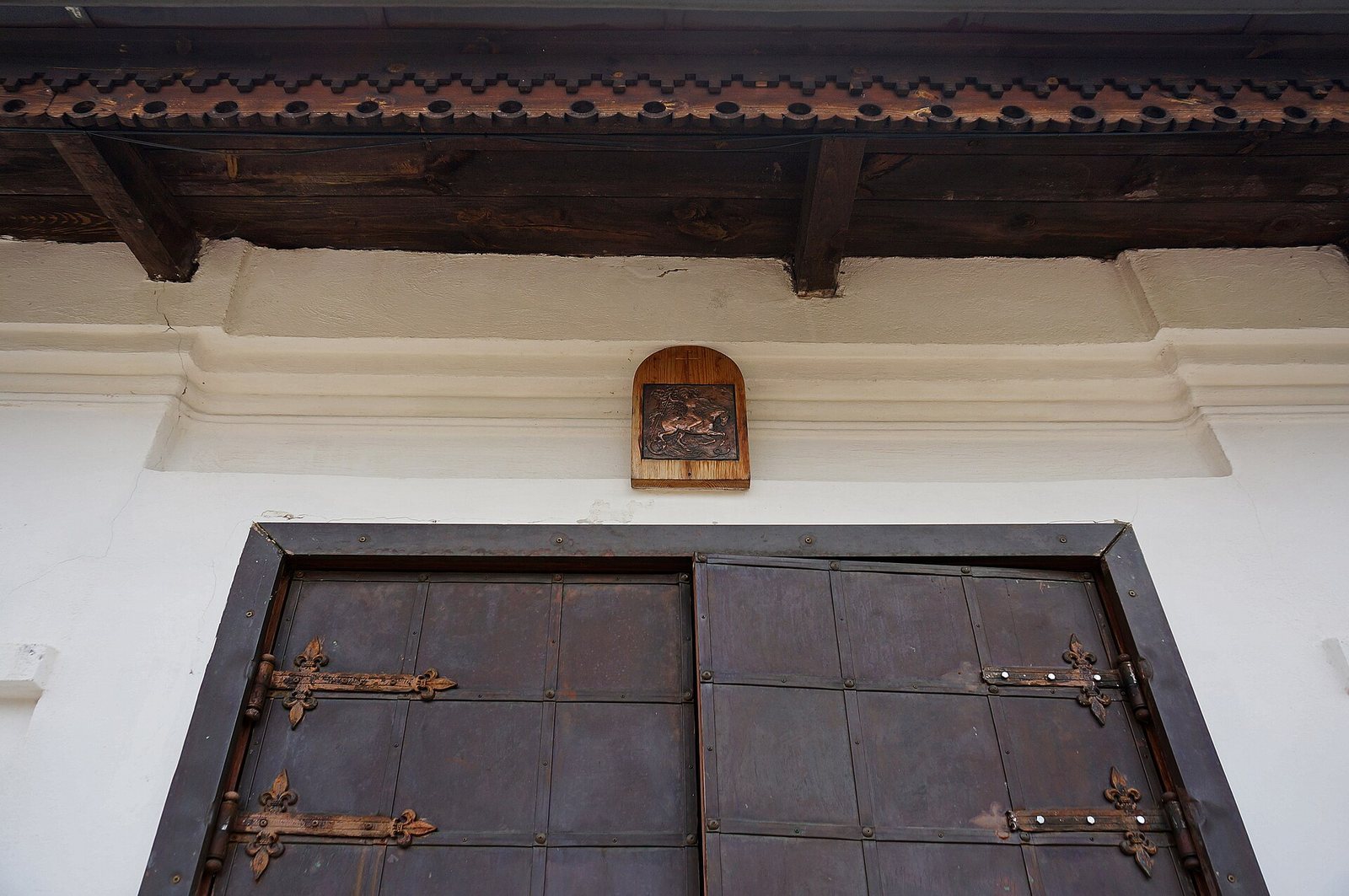
The bell tower was dismantled brick by brick in 1957, and its materials were used in postwar reconstruction. Restoration in 1965–1967, led by architect Tamara Gladenko, reopened several blocked windows and restored the passage between the main church and the Annunciation chapel. In 1996 restorers uncovered fragments of earlier wall paintings beneath later paint. The damaged images of the Evangelists Luke and Mark were reconstructed with Vasnetsov’s Kyiv paintings as models. New gilded crosses were consecrated for the restored cupolas in 2007, and ceramic tiles showing episodes from Saint George’s life were installed on the facades in 2009. Facade work and renewal of the chapel’s wall paintings followed in 2010, the church’s 600th anniversary; the bell tower has also since been restored.
The church belongs to the Russian Orthodox Church’s Diocese of Novgorod and Staraya Russa and its deanery, an administrative grouping of parishes within a diocese. It remains active and served as the city’s only functioning Orthodox church from the postwar period until the early twenty-first century. It is designated a cultural heritage site of federal significance.
Remains
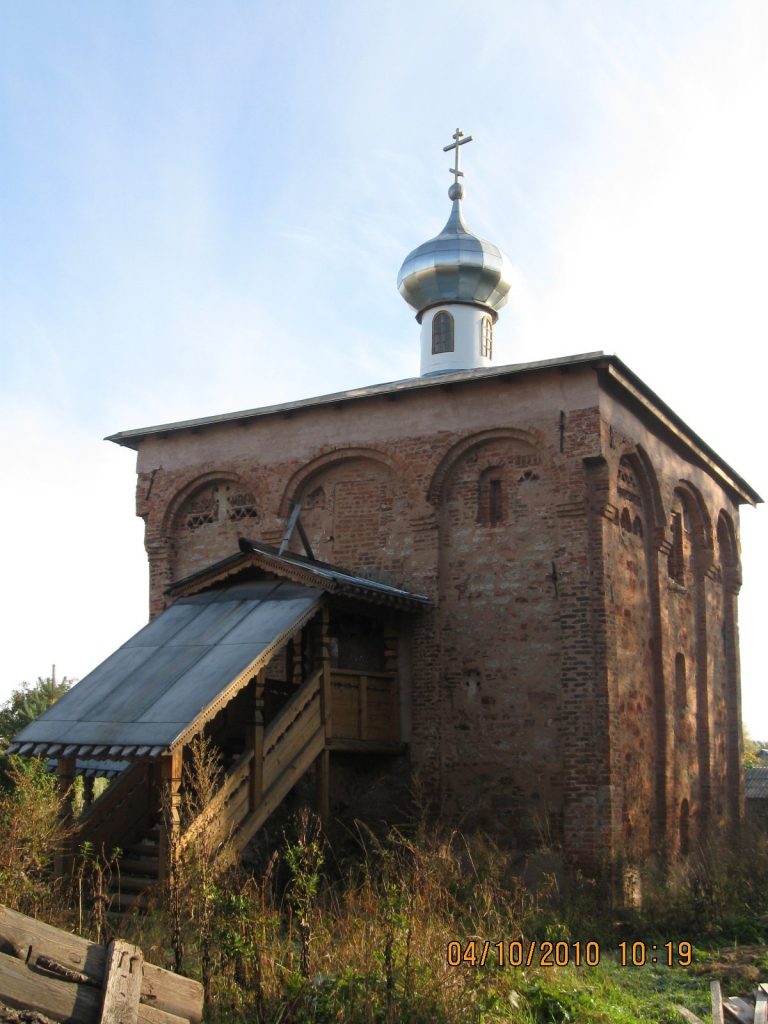
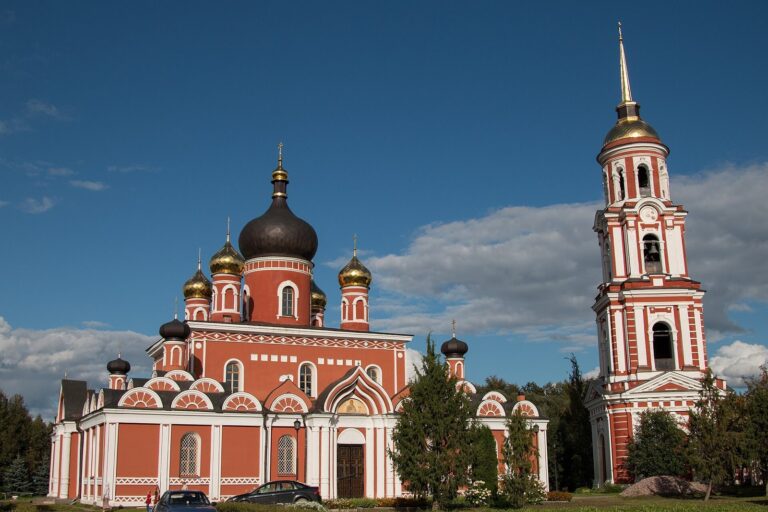
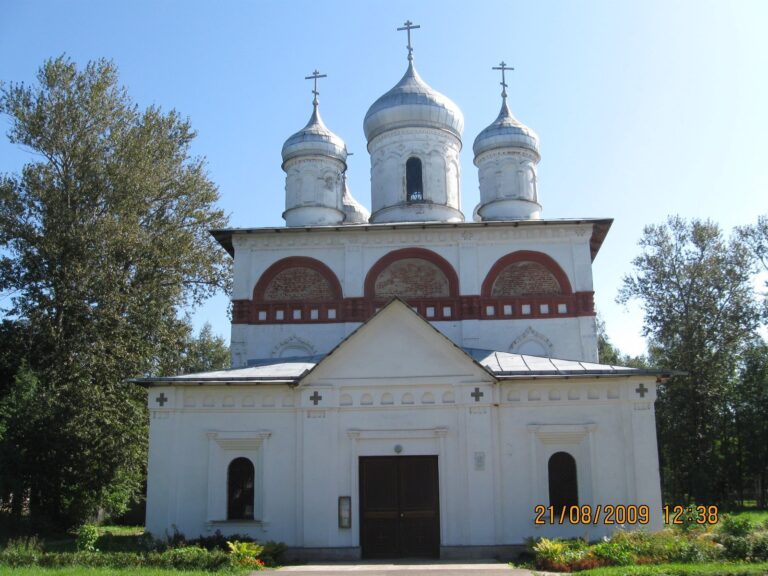
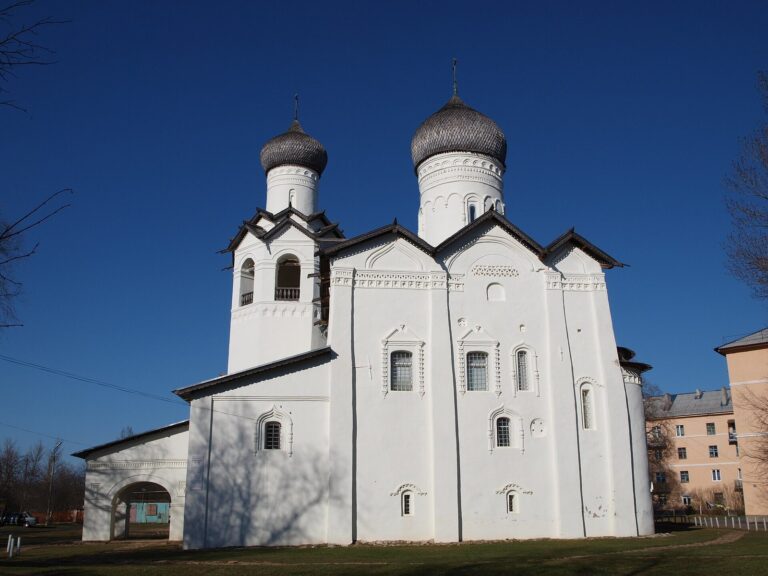
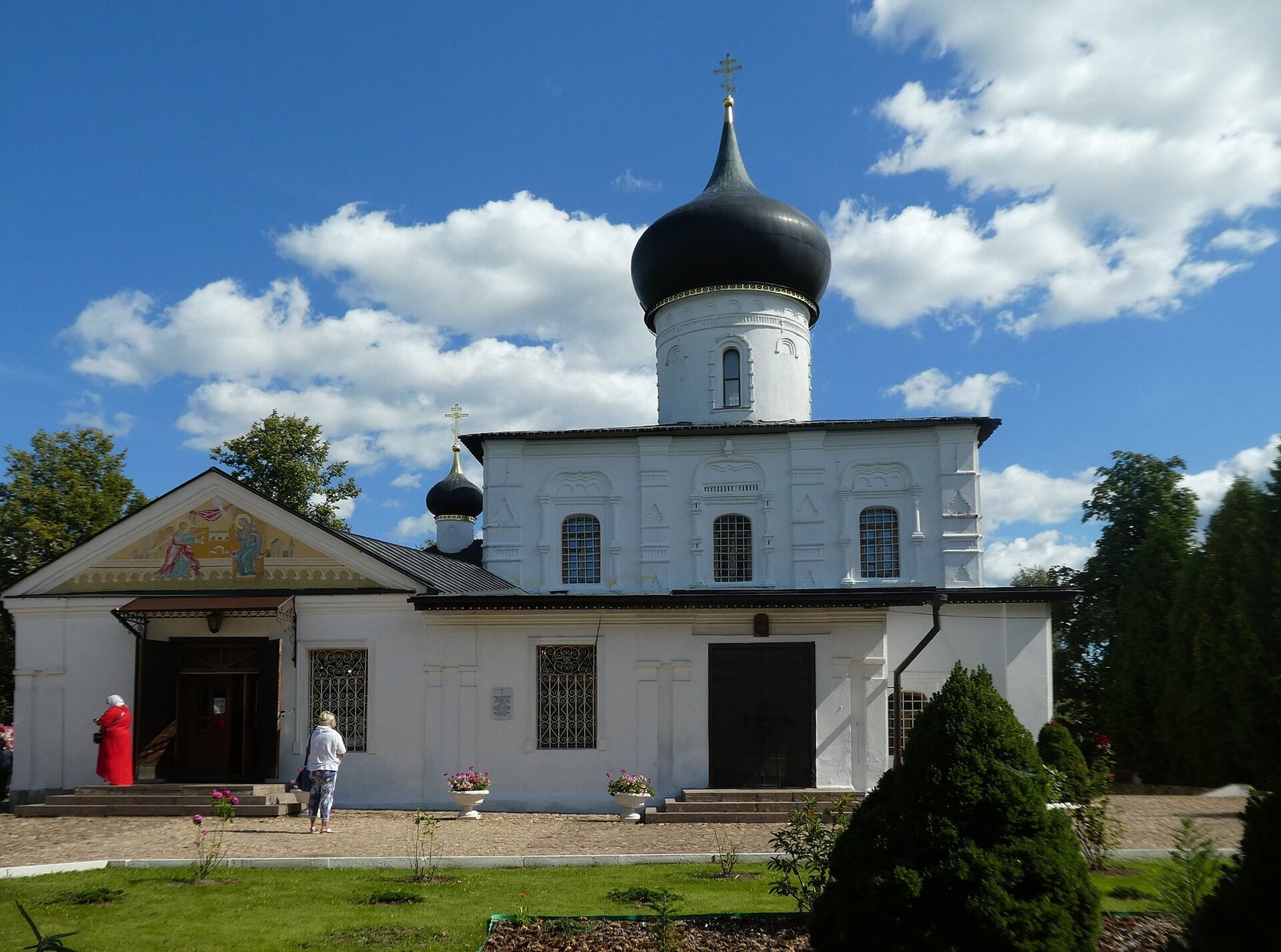
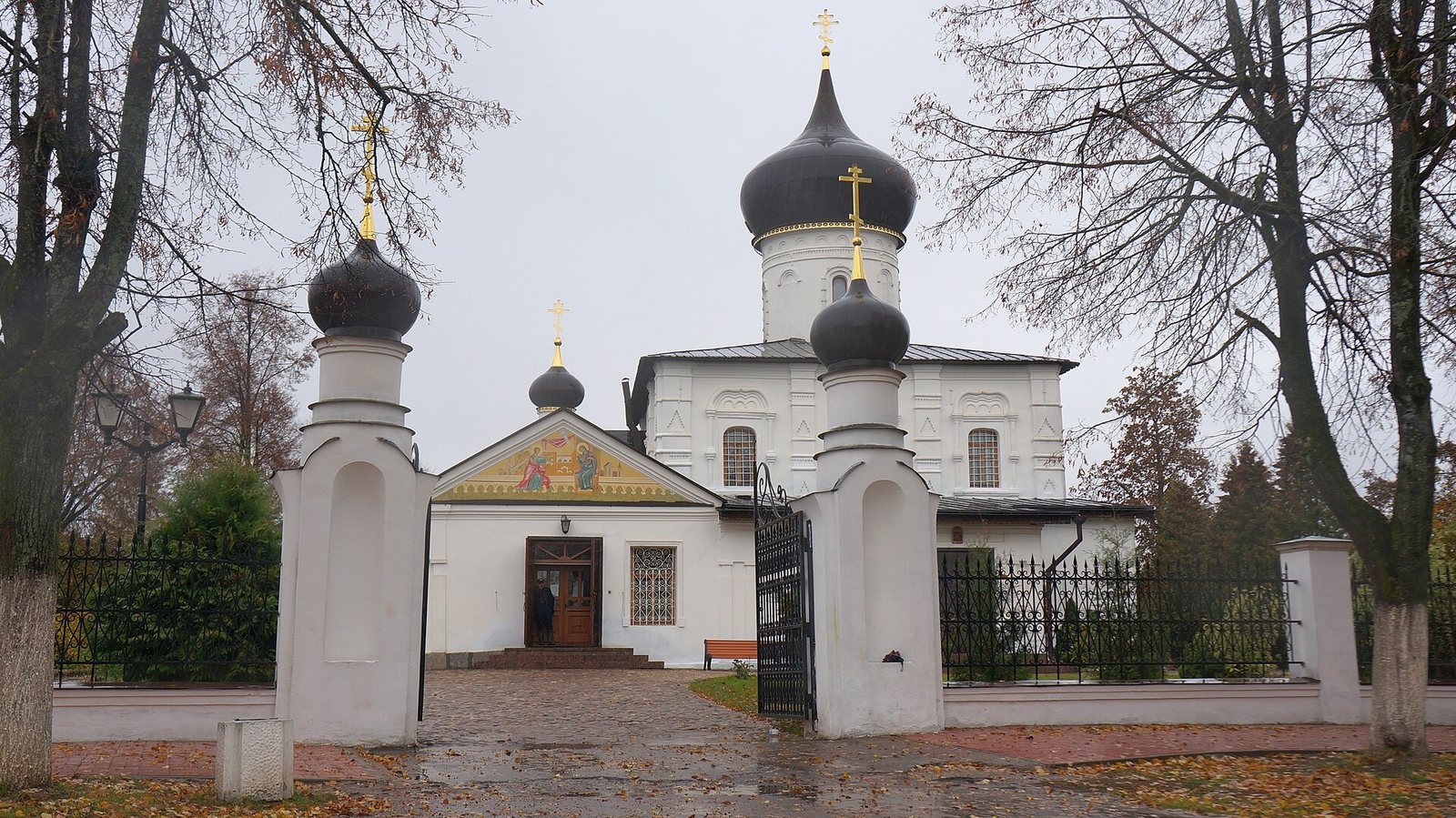
The church combines a roughly square main building with a semicircular apse, a projecting rounded space at the altar end, and an elongated chapel attached on the north. Its cross-domed plan places a dome above the central crossing, with vaulted ceilings arranged around a cross-shaped interior. The surviving form blends the Novgorod architectural tradition with later features.
Plan and exterior
Main church
Measurements recorded in 1885 give the main building a length of about 20.5 metres, a width of 18.2 metres, and a height of 10.7 metres, rising to about 26 metres including the dome. Its walls combine elongated fired brick, rubble stone, and stone slabs, held together with iron ties. The exterior has a large, richly decorated drum, the structure supporting the dome, beneath an onion-shaped dome and a roof sloping on all sides. Pilasters, shallow wall projections resembling columns, are set among decorative bands and patterned brickwork. Large windows have elaborate surrounds. The walls were painted cream, with red decorative details. The building’s appearance represents an eighteenth-century interpretation of pre-Petrine architecture, meaning Russian forms from before Peter the Great, rather than an unchanged fifteenth-century design.
Annunciation chapel
The north chapel is about 18.6 metres long and 6.4 metres wide. A large arch separates its altar from the rest of the chapel. Pilasters divide the exterior into three sections, with brick patterns, cornices, and columns framing the windows. A small drum supports its onion-shaped dome, and its roof slopes on all sides. The chapel’s enlarged form incorporates the space once occupied by its porch.
Porch and bell tower
The western porch added in the nineteenth century extends the church on that side. The stone bell tower built in 1884 stood about 38 metres high, and its largest bell weighed about 2.2 tonnes. The tower, dismantled in 1957, has since been restored.
Interior and sacred objects
Supports and iconostasis
Four square interior supports carry the ceiling vaults and the base of the dome. The five-tier main iconostasis, carved and gilded, was positioned against the two eastern supports. After the war it was at the Assumption Church in Korostyn.
Floors and wall paintings
Mosaic floors form part of the church’s interior finishes. Fragments of the wall paintings include an image of the Lord of Hosts, a traditional title for God, in the dome. Images of the Evangelists John and Matthew, traditionally associated with the authorship of the Gospels, survive in the pendentives, curved triangular surfaces that support a dome above a square space. The damaged images of Luke and Mark have been reconstructed. Ceramic facade tiles depict episodes from the life of Saint George.
Devotional objects
The church houses a reliquary, a container for relics, holding relics of seventeen saints, including Nikita, Bishop of Novgorod. It also contains a sculpture of Nil Stolobensky, a Russian Orthodox monk and saint.