Church of the Resurrection of Christ: An Orthodox Cathedral in Staraya Russa
Site at a Glance
- Popularity
- Medium
- Country
- Russia
- Primary era
- Early Modern
- Eras represented
- Early Modern, Modern
- Civilizations
- Russian
- Site type
- Religious
- Remains
- Cathedral
On this page11 sections
History
The Church of the Resurrection of Christ is an Orthodox cathedral in Staraya Russa, Russia. Built in stone from 1692 to 1696, it stands on an ancient sacred site and was later rebuilt in the Russian Empire style, a monumental neoclassical style prominent in Russia in the early nineteenth century.
Early churches and the wooden fort
A stone church dedicated to John the Baptist, with a chapel for the Prophet Zechariah, stood at the site by the sixteenth century and probably dated from the fifteenth. Swedish occupation from 1611 to 1617 ended with the church’s destruction. A wooden fort followed, with oak walls, earth ramparts, and five stone towers at its corners. Its buildings included a governor’s residence, offices, supply stores, shops, and a tavern.
After the occupation, a wooden church dedicated to the Intercession of the Mother of God was erected inside the fort, near its Intercession Tower. It became Staraya Russa’s cathedral church. A fire destroyed it in 1678. It may have been rebuilt, but it was dismantled in 1692 as work began on a stone cathedral.
The stone cathedral
Lay churchwarden Mikhail Fyodorovich Somrov, a parish officer responsible for church affairs, and parishioners paid for the new building. Its Intercession chapel was consecrated in 1697 with the blessing of Metropolitan Euthymius, a senior Orthodox bishop. On October 2, 1705, Archimandrite Serapion, a senior monastic cleric, consecrated the main church with the blessing of Metropolitan Job. The John the Baptist chapel followed on July 12, 1706, under the same metropolitan.
Nineteenth-century reconstruction
A major rebuilding and enlargement took place from 1828 to 1833, with Emperor Nicholas I’s consent and under the direction of the military-settlement authorities. Nicholas contributed 16,500 rubles, alongside funds raised by parishioners. Architect Vasily Petrovich Stasov designed the work. The side chapels, porches, and apses, the curved ends of the sanctuary, were taken down and rebuilt. Bishop Timothy of Staraya Russa consecrated the side chapels in 1833, and the main altar was consecrated the following year. Repairs in 1906 addressed subsiding foundations.
War, changing uses, and return to worship
From 1923 to 1932, the cathedral served as the seat of Staraya Russa’s Renovationist bishops. Renovationism was a reform movement within the Russian Orthodox Church that gained institutional influence after the 1917 Revolution. Regular worship ended in the mid-1930s, and the building was nationalized in 1936 for museum use.
During the Second World War, German occupation forces used the cathedral as a stable. Fighting to liberate Staraya Russa and bombing in 1944 severely damaged it. The gallery drums, the bell tower’s spire and dome, the chimes, and the wooden floors were lost; the roof was damaged and the walls breached. After the war, the building served as a club, cinema, and storage space, and later housed museums. A major repair preceded the 1984 opening of the Museum of the Northwestern Front.
The cathedral returned to the Novgorod Diocese, an administrative district of the Russian Orthodox Church, in 1992. Archbishop Leo (Tserpitsky), a senior bishop, reconsecrated it, and worship had resumed by 1993. Parish life developed again after Archpriest Ambrose Dzhigan, a senior priest, was appointed rector in 1994. The cathedral is protected as a cultural heritage monument in Russia.
Remains
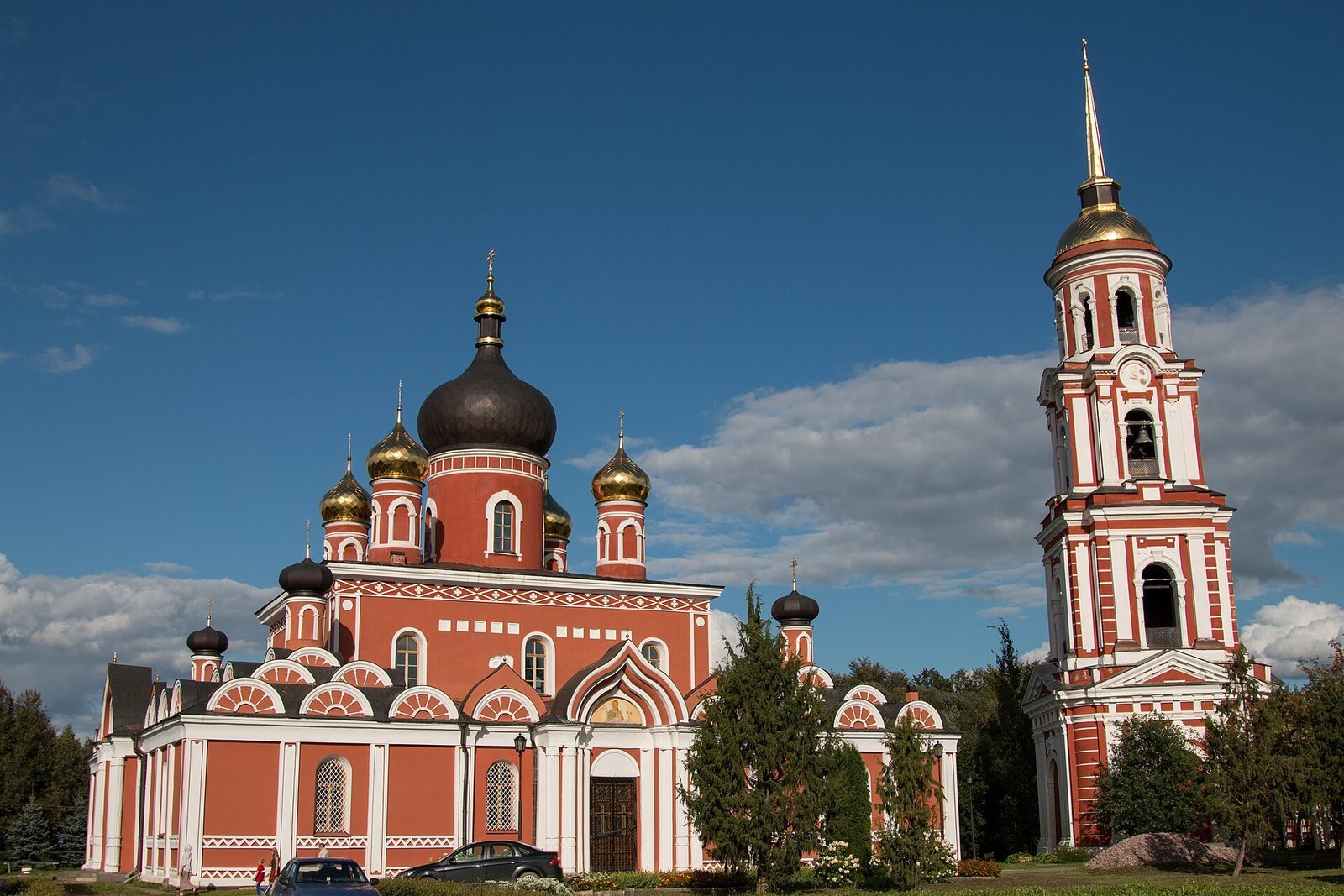
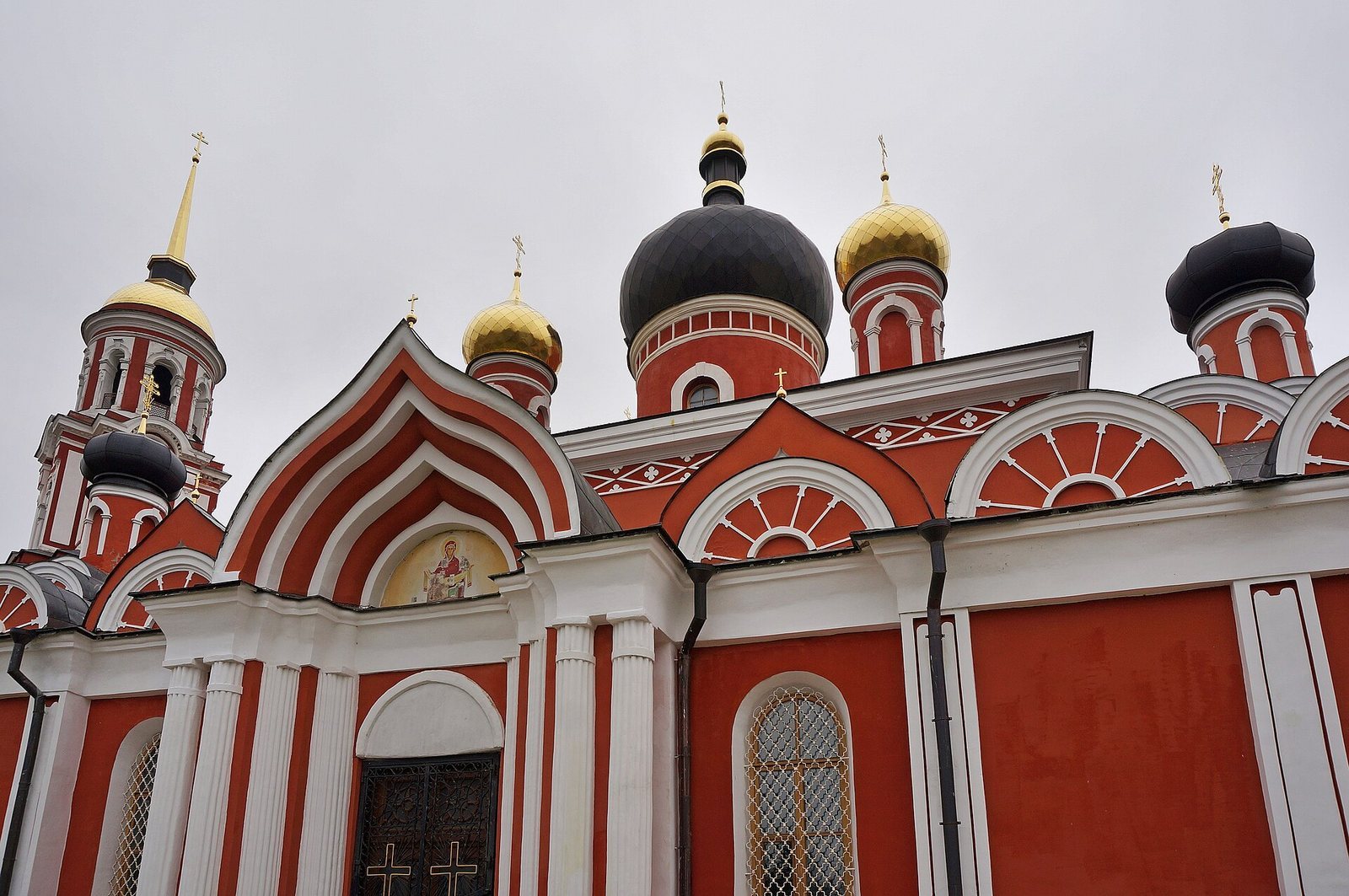
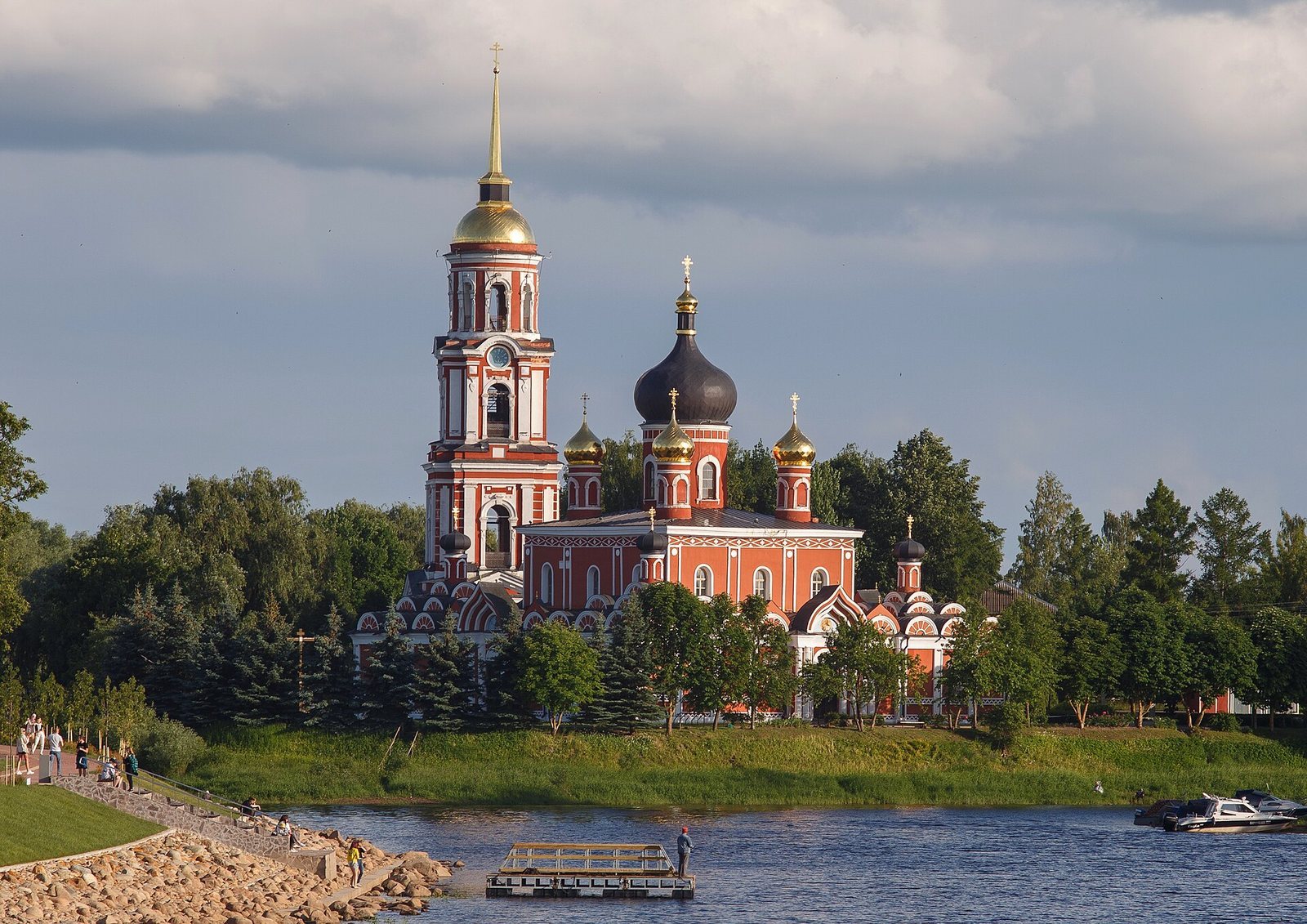
The cathedral occupies a raised point of land at the meeting of the Polist and Pererytitsa rivers, the latter also known as the Porusya. Its stone church has a large, cubic main block and a broad, lower gallery on three sides. Five cupolas rise on tall drums, the structures supporting domes, while a separate four-tier bell tower ends in a spire. The building’s present form reflects its nineteenth-century reconstruction in the Russian Empire style.
The main church
Plan and surviving fabric
The seventeenth-century church was almost square, measuring 16 by 17.7 meters without its apses. It had three chapels, including two external side chapels, and a gallery around the building. Its facades featured raised vertical bands, large windows with decorative surrounds, arched forms at the top, and a band of square niches. The roof may have ended in a tent-shaped form and carried five domes. The nineteenth-century rebuilding retained the north, south, and west walls of the original main block, while altering the windows and covering earlier decoration. In 1956, architectural researcher Leonid Yevgenyevich Krasnorechyev identified traces of nine earlier windows and their surrounds, as well as vertical wall strips. His examination indicated that the original vaults were slightly lower and the galleries narrower and lower than those seen today.
Chapels, interior, and icon
The central chapel is dedicated to the Resurrection of Christ, the right-hand chapel to John the Baptist, and the left-hand chapel to the Intercession of the Mother of God. Inside, a five-tier iconostasis, an icon-covered screen separating the sanctuary from the main worship space, dates to the nineteenth century. A copy of the Staraya Russa Icon of the Mother of God, an Orthodox image of Mary traditionally believed to be associated with miracles, was brought to the cathedral in 1788. Commissioned by churchwarden Ilya Petrovich Krasilnikov, it became one of the cathedral’s principal sacred objects.
Bell tower
The original two-story stone bell tower was dismantled in 1797 and replaced in 1801 by a four-tier structure. Its upper round tier was added in 1835 for fire observation. A clock installed on the third tier in 1811 struck eight bells at quarter-hour and hourly intervals; its weight rope was 85 meters long, and its internal wire measured 128 meters. By the mid-nineteenth century, the tower held ten bells, including bells weighing 265, 120, and 60 poods, traditional Russian units of weight. Eight replacement bells cast in the Urals arrived in 1992.
Exterior finish and restoration
The cathedral and bell tower were whitewashed from 1890; before then, their color was an uncertain shade of gray. A restoration program begun in 2007 left the cathedral painted red. In 2008, a cross was consecrated and raised onto the gilded bell-tower spire. In May 2009, nine crosses were consecrated and placed on the restored gilded cupolas.