Visconti Castle of Cassano d’Adda: A Medieval Fortress
Site at a Glance
- Popularity
- Medium
- Country
- Italy
- Primary era
- Medieval
- Eras represented
- Medieval, Modern
- Civilizations
- Carolingian, Duchy of Milan, Holy Roman Empire, Venetian
- Site type
- Military
- Remains
- Castle
On this page17 sections
History
Visconti Castle of Cassano d’Adda is a medieval fortress in Italy, built in the Gothic style, a medieval architectural tradition associated with pointed arches. Its earliest known written reference dates to 877. An origin around 808, in the Carolingian era of the eighth and ninth centuries, has been proposed but remains uncertain. Other records indicate that a fortification stood there during the tenure of Anspert, archbishop of Milan.
Early fortress and Visconti rule
In the thirteenth century, Cassano was a small agricultural holding belonging to the Monastery of St. Ambrose in Milan, with a few peasant homes nearby. The castle and an adjoining fortified refuge for local people are attributed to Ottone Visconti, archbishop of Milan. He used the stronghold against the Della Torre family after they were driven from Milan and took refuge in the Gera d’Adda, a district around the Adda.
On 27 September 1259, Milanese factions supporting Ezzelino da Romano fought Martino Della Torre’s forces near the castle. Ezzelino was defeated, confirming the Della Torre family’s rule of Milan. In 1294, Ottone expanded the fortress on three sides and changed it from an archiepiscopal stronghold into a secular state fortress under his family’s control. During the Middle Ages, Guelf and Ghibelline factions, broadly aligned with papal and imperial interests, contested the castle; later struggles pitted the Della Torre and Visconti families against each other.
The Visconti took the castle in 1313 after defeating the Della Torre. In 1355, it passed to Bernabò Visconti in a division of family territory with his brothers Matteo II and Galeazzo II. From 1355 to 1370, Bernabò strengthened and enlarged it as part of a defensive line along the Adda, guarding the Visconti lands to the east.
Venetian and Sforza control
In 1406, Antonio Visconti was imprisoned and strangled at the castle. Pope Martin V took possession in 1426 while attempting to mediate between Milan and Venice. In 1446, Venetian troops crossed the Adda, surprised the forces of Filippo Maria Visconti, and seized the fortress. After the Visconti dynasty ended, Francesco Sforza recaptured it in ten days.
Sforza assigned further fortification work to the military architect Bartolomeo Gadio. Financial constraints slowed the project: Sforza raised taxes on salt and transferred workers from construction at Milan Castle to Cassano. Although Gadio’s full plan was not completed, the fortress became the most heavily fortified stronghold on the Duchy of Milan’s eastern frontier.
Noble ownership and military decline
In 1538, Charles V granted the fief, land held under a superior’s authority, to the D’Adda family. In 1549, it became a marquisate, a territory associated with the title of marquis, when it passed to Giambattista Castaldo. He held it until his death, after which it passed to the Bonelli family. It was sold in 1781 to a member of the D’Adda family and later came into the hands of the Borromeo family.
Firearms introduced from the sixteenth century reduced the castle’s military importance, and its strategic role ended around 1700. In 1703, it became a military prison for 4,500 Piedmontese soldiers commanded by Eugene of Savoy, allies of Austria in its war against France. The prisoners were confined there and left to die of starvation. Demolition of the adjoining fortified refuge began in 1764.
Later uses and restoration
In the nineteenth century, the castle’s right wing became a factory. The building later served as a district prison until 1959, then as a warehouse, dance hall, and shelter for people without homes. After a period of abandonment, twentieth-century restoration returned parts of the castle to earlier forms. Exterior restoration was completed in 1993, and further work uncovered interior decoration. By the end of the twentieth century, the castle had been converted into a hotel.
Remains
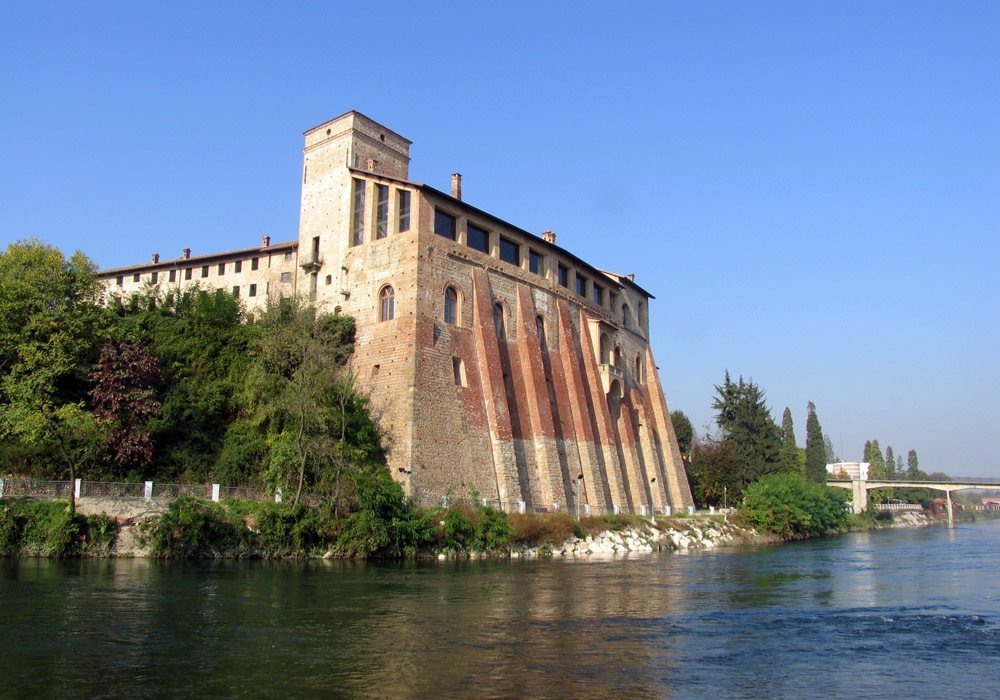
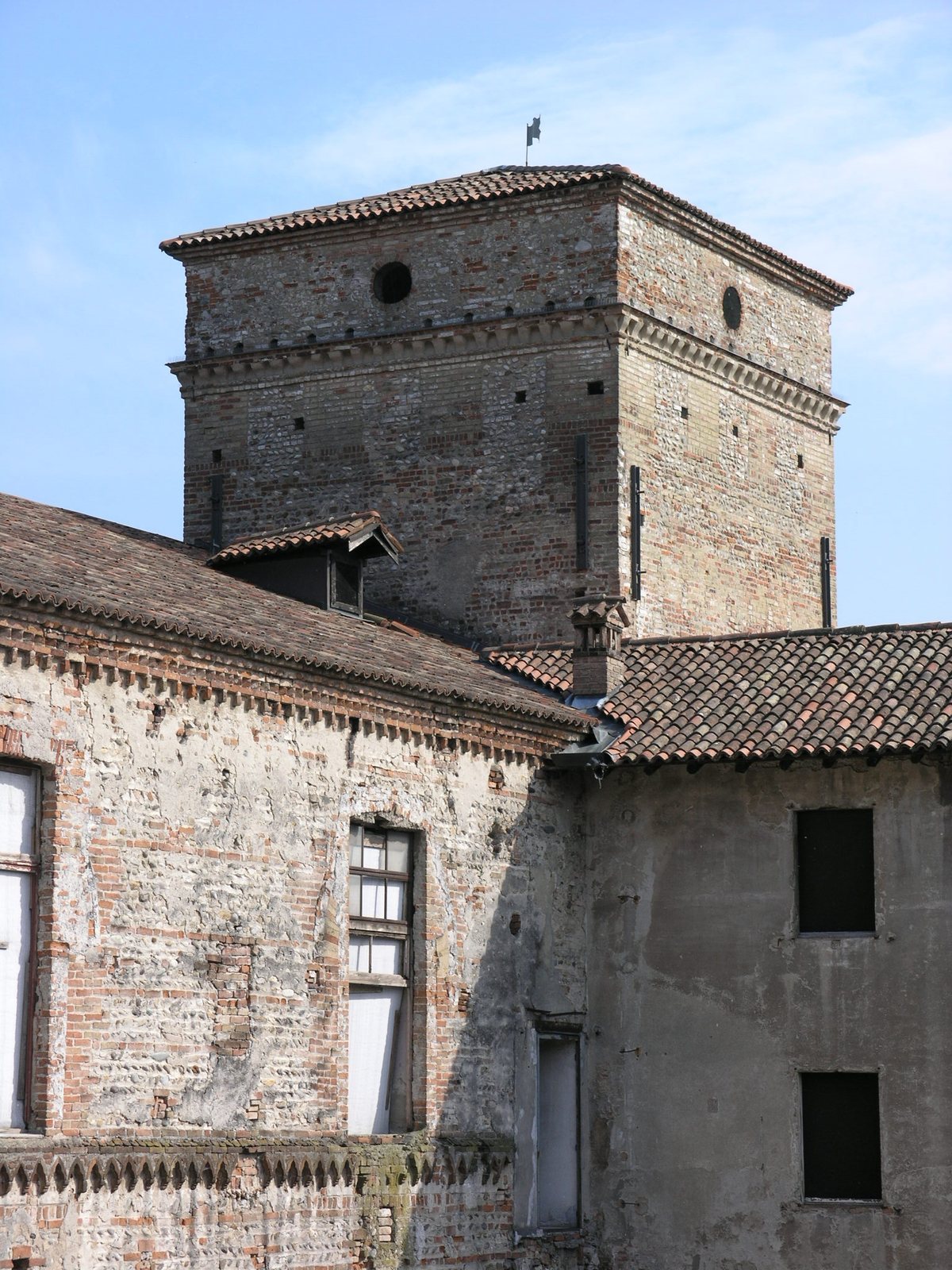
The castle occupies high ground on a river escarpment at a broad eastward bend of the Adda, overlooking the Muzza canal, diverted from the river in 1220. Its position commanded the river crossing and the movement of goods. The building’s Gothic design combines brick, stone, and river cobbles.
Setting and fortifications
Site and construction
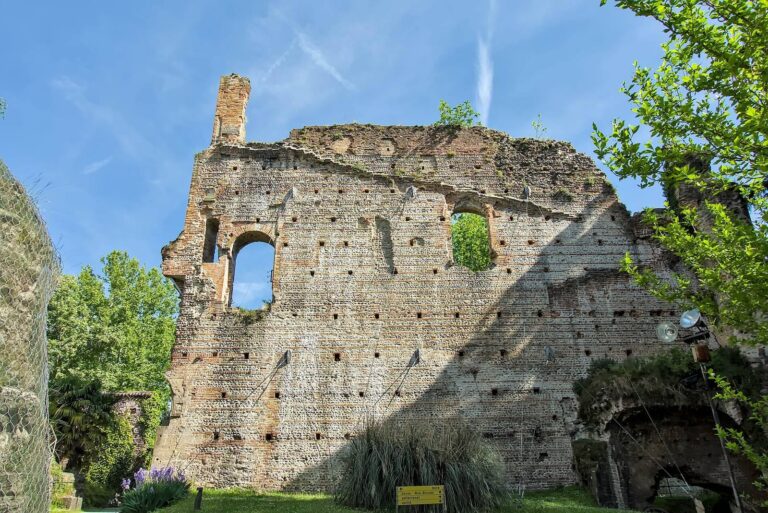
Exposed wall sections show Adda pebbles arranged in alternating rows with brick, a building method used in medieval river defenses. The south, north, and west ranges are attributed to Francesco Beneduso, while the east range is attributed to Bartolomeo Gadio.
Defensive works
The defenses included a double wall with outer buttresses and casemates, protected chambers built into fortifications, descending to the level of the Muzza. Venetian works included a moat around the castle and refuge, a star-shaped bastion at the canal entrance, small forts on an islet between the waterways, a wooden drawbridge, and wooden defenses on the opposite riverbank. Gadio widened the canal mouth to increase the flow of defensive water and added raised wall defenses and positions for small guns to the ramparts.
Fortified refuge entrance
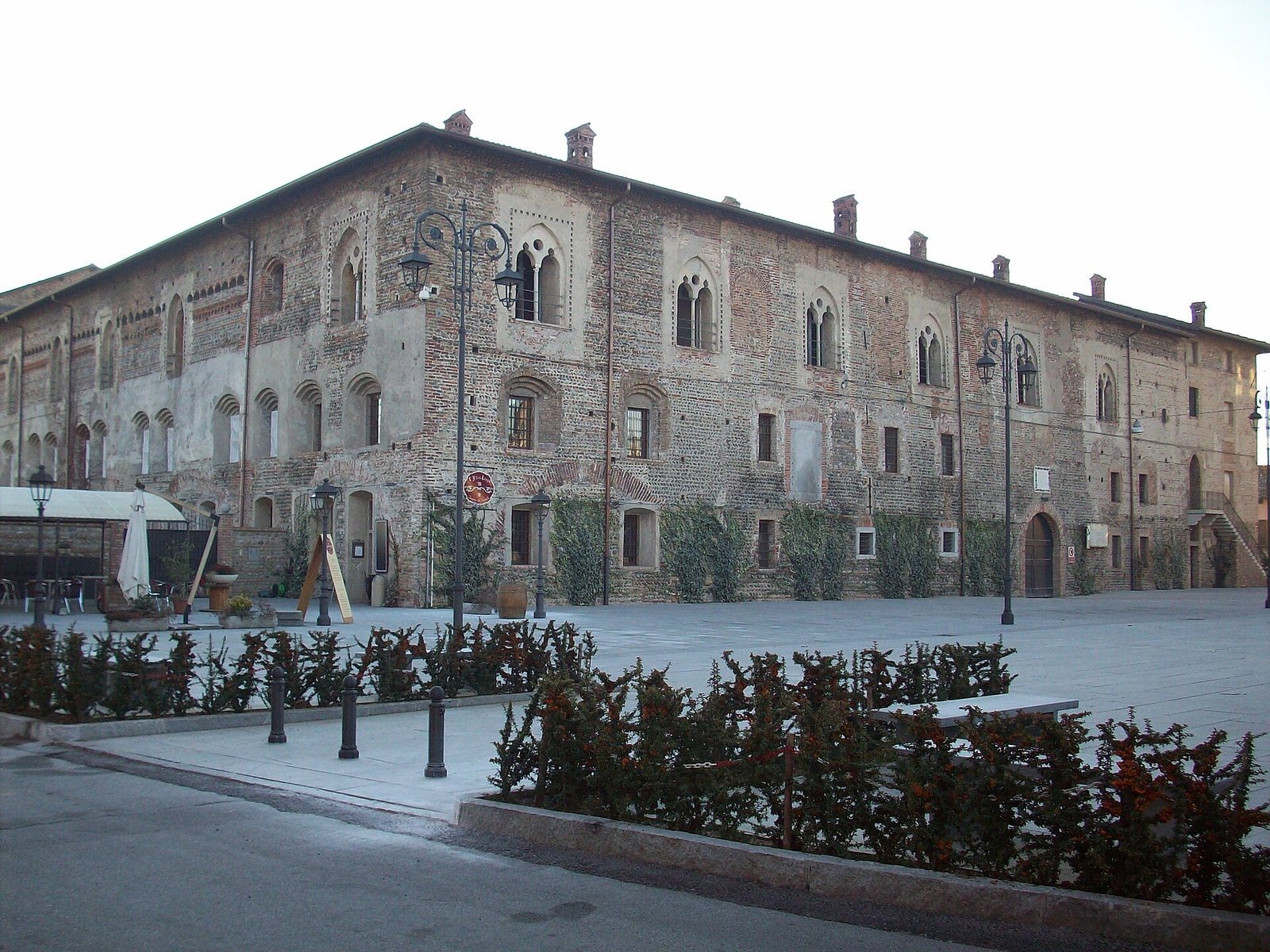
The entrance to the demolished refuge remains identifiable as a large gate opening onto present-day Piazza Garibaldi. Its visible forms date to the nineteenth century.
Castle ranges and courtyard
Exterior elevations
The façade facing the square has a Visconti character. Substantial brick buttresses attributed to Gadio rise above the Muzza. The exterior retains original mullioned windows, divided by vertical supports, alongside later square windows at a lower level.
Courtyard
A portico, or covered gallery, with pointed arches runs around the courtyard, with a loggia, a covered gallery open on one or more sides, above it. Both were closed during the nineteenth-century conversion of the right wing. The portico’s decoration includes painted panels imitating multicolored marble.
Painted interiors and chapels
First-floor chapel
Commissioned by Ottone Visconti in the late thirteenth century, the first-floor chapel has wall paintings of rows of angels and saints, the Virgin Mary enthroned, and Moses receiving the Tablets of the Law. A floor added later cuts across the painted walls. Four curved sections divide the ceiling, with medallions of prophets. The paintings have been associated with Giotto’s artistic tradition; Giovanni da Milano and the unidentified artist known as the Master of Viboldone have been proposed as possible painters. Some medieval paintings on walls and ceilings have also been linked to a commission by Bernabò Visconti and his wife, Regina della Scala.
Other interior decoration
Restoration uncovered painted imitation drapery and geometric designs in a ground-floor apartment, as well as faux-marble panels along the courtyard portico. Work restored 2,500 square metres of wall decoration, much of it previously little known.
Chapel of the Revellino
The Chapel of the Revellino stands beside the Muzza. A plaque set into the chapel commemorates the deaths of the soldiers imprisoned at the castle in 1703.