Church of Saint Francis of Assisi in Meldola: A Catholic Church
Site at a Glance
- Popularity
- Very Low
- Country
- Italy
- Primary era
- Early Modern
- Eras represented
- Medieval, Early Modern, Modern
- Civilizations
- Italian, Papal States
- Site type
- Religious
- Remains
- Church
On this page17 sections
History
The Church of Saint Francis of Assisi is a Catholic church in Meldola, Italy, dedicated to Saint Francis, the medieval founder of the Franciscan movement. It belongs to the parish of Madonna del Popolo in the Diocese of Forlì-Bertinoro. An inscription in its loggia dates the original church to 1249, while its appearance largely reflects extensive Baroque rebuilding in 1670.
Medieval foundation and convent
The church was established in a naturally appealing setting that later acquired the name Paradiso. By 1455, the church complex included a cemetery, a vegetable garden, and a reed bed, as well as a convent for Conventual Franciscans, one branch of the Franciscan religious family. The bell tower was erected in 1486.
Baroque rebuilding and parish role
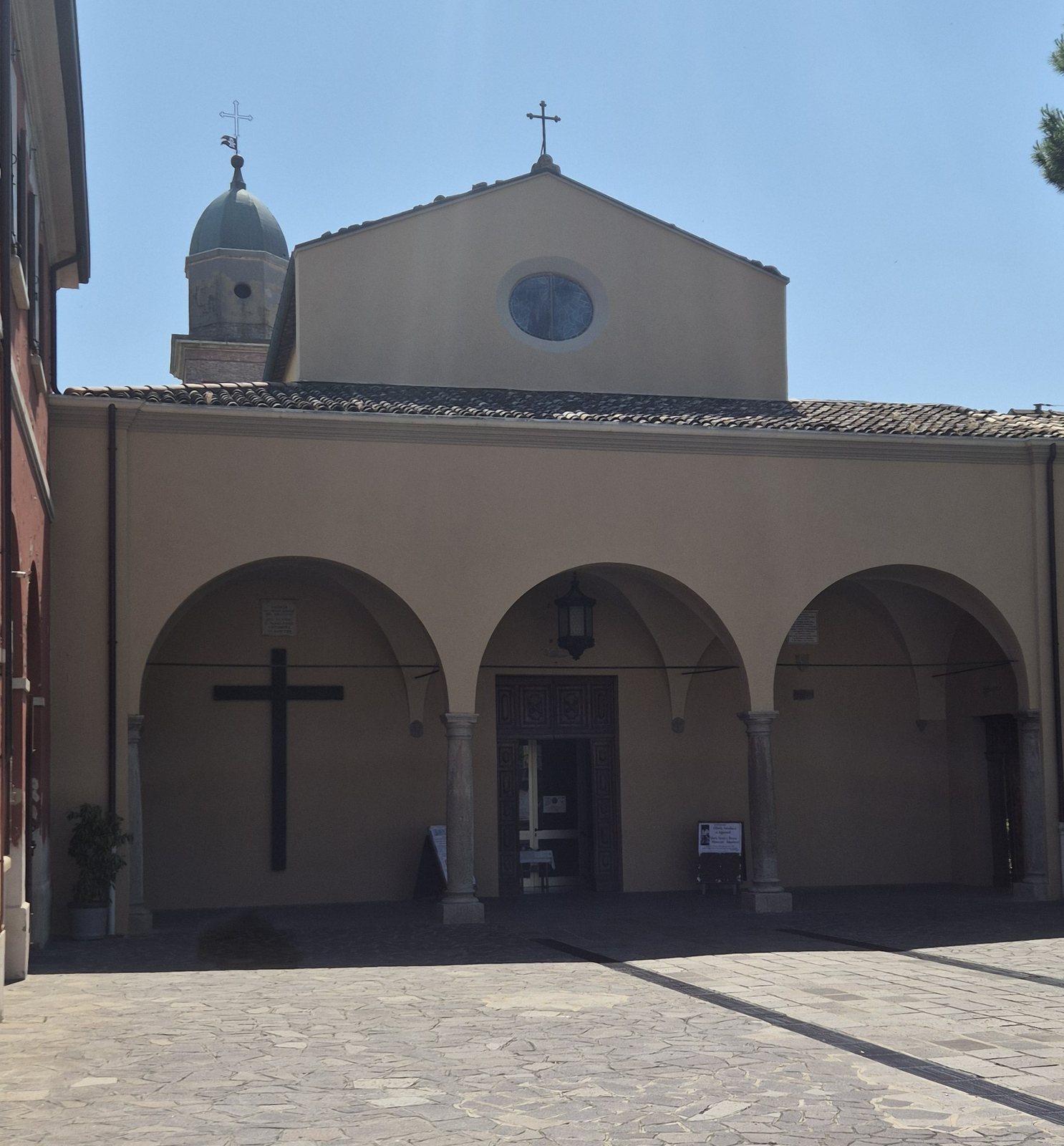
In 1670, Father Bartolomeo Mastri initiated major work that altered, rebuilt, and modernized the church in the Baroque style. An inscription on a capital dates the addition of the loggia to 1687. In 1806, the parish title of Sant’Andrea, whose church had been destroyed, was transferred to San Francesco.
Earthquake, war, and later work
A severe earthquake in 1870 made repairs necessary. Mario Camporesi decorated the apse in 1929. During the Second World War, damage destroyed two arches of the portico; they were later rebuilt. Interior decoration was also renewed in the postwar period.
Remains
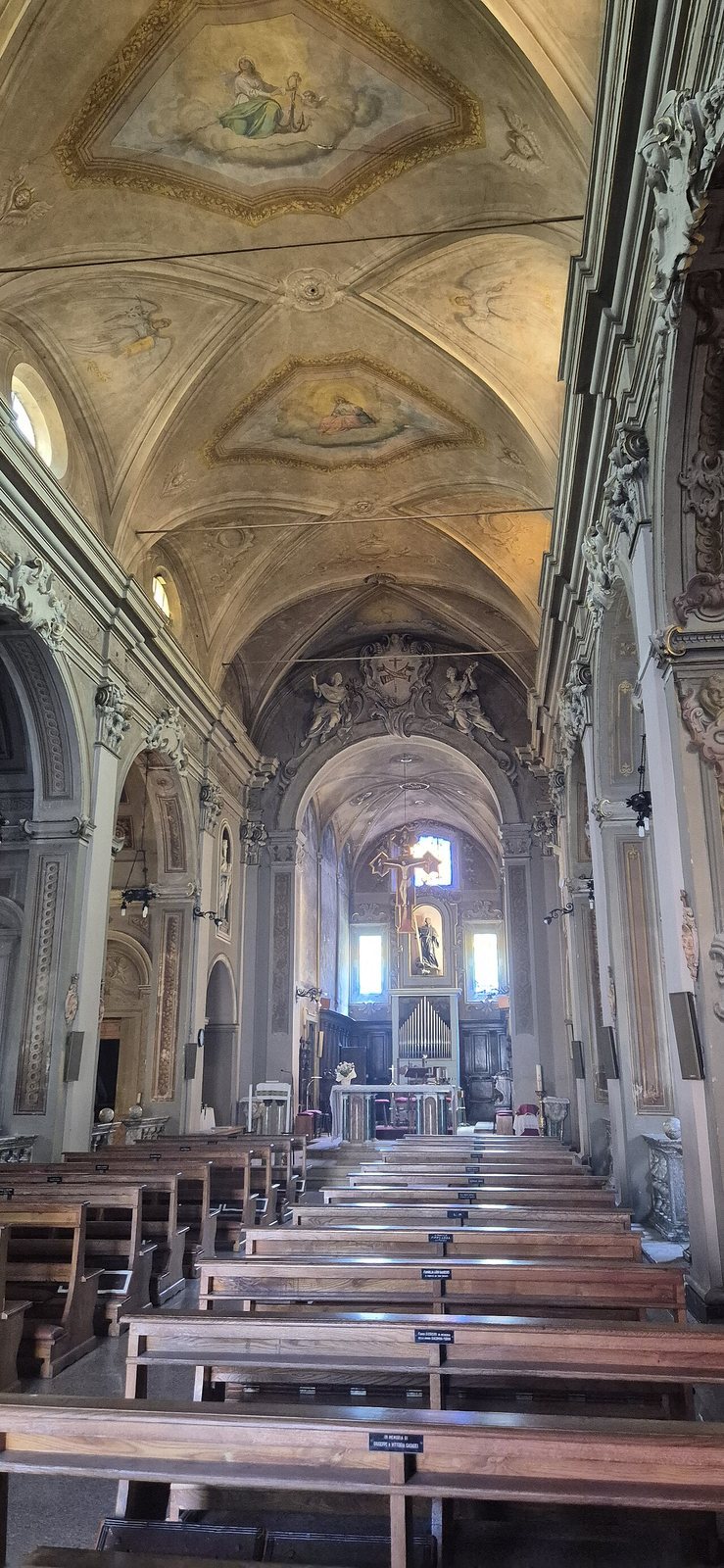
The church has a lengthwise plan, with a single nave and side chapels divided from it by marble balustrades. A forecourt stands between the road and the front of the church, while the convent cloister lies to its right. The surviving fabric brings together early elements, including pointed arches, and later Baroque forms.
Exterior and convent
Facade and portico
Part of the façade belongs to the early church and is built of fired brick, while the exterior is now plastered in subdued beige. A simple rose window is edged in white. In front of the façade, a seventeenth-century portico uses the Tuscan order, a simplified classical style with plain columns and capitals. The covered, open-sided gallery is also known as a loggia. Its forecourt sets the church back from the road.
Bell tower
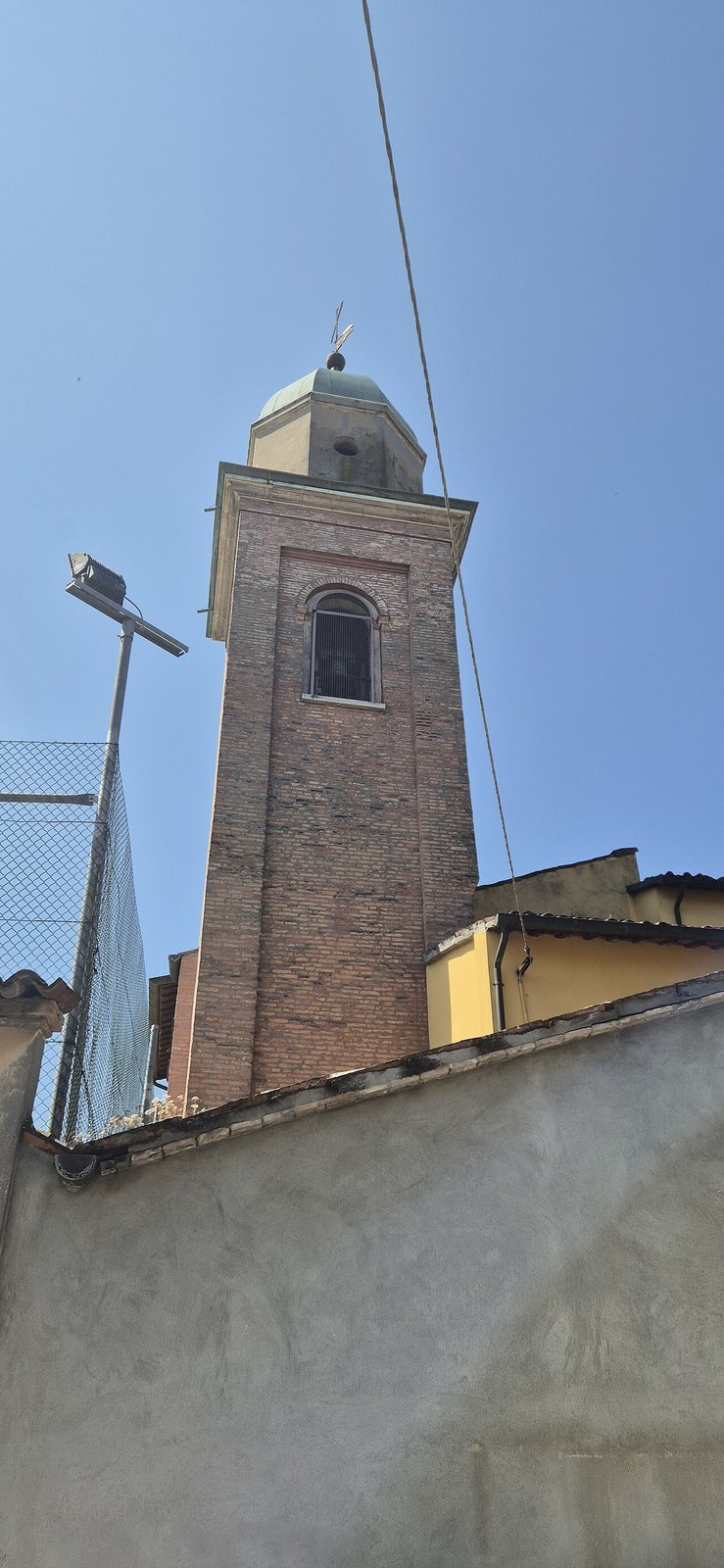
Behind the church, the tower has a square base and an octagonal upper section. A round-arched opening occupies the bell chamber, and four small circular openings pierce the upper part. A small copper dome, also octagonal, crowns the tower. Its original arrangement has been altered more than once.
Convent cloister
The sixteenth-century cloister of the attached convent stands to the church’s right. Its Tuscan-order design incorporates fragments of earlier church fabric, including pointed-arch elements and decorative pieces.
Interior and chapels
Nave and ceiling
The single nave opens onto side chapels with a Baroque character, seventeenth-century paintings, and abundant stucco decoration. The ceiling carries painted Neobaroque decoration by Mario Pesarini, a later revival of Baroque forms.
Presbytery and choir
The presbytery, the area around the main altar, retains pointed-arch features from the early church, although later alterations gave the space a more Baroque appearance. The apse has an umbrella vault, whose curved sections spread like the ribs of an open umbrella. A fifteenth-century choir made of walnut remains in the apse.
Right-hand chapels
The first chapel on the right is dedicated to Our Lady of Fire, a devotional title for the Virgin Mary. Its altarpiece shows the Madonna with Saint Michael the Archangel and Saint Rose. Two side paintings depict Saints Mercuriale and Francis of Paola, and Saints Francis de Sales and Anthony of Padua. Giuseppe Marchetti painted all three works. In the second chapel, an altarpiece by the eighteenth-century Meldola painter Matteo Ronconi shows the Education of the Virgin with Saint Clare, a bishop, and a Franciscan saint; Domenico Barbiani of Ravenna painted the illusionistic architectural setting. The next chapel contains a statue of Saint Anthony of Padua in a gilded structure. The final chapel is dedicated to Saint Andrew and has an altarpiece depicting him from the Bolognese school.
Left-hand chapels and adjoining space
The first chapel on the left is dedicated to the Immaculate Conception, the Catholic teaching that Mary was preserved from original sin from the moment of her conception. Its richly decorated Baroque altar holds a polychrome wooden Madonna made in 1688 and brought from the church of San Rocco. The next chapel contains a small painting of Our Lady of Grace in a manner associated with the seventeenth-century painter Carlo Cignani. A statue of the Sacred Heart stands in the third chapel. The fourth, dedicated to Saint Joseph, contains an eighteenth-century statue of the saint and postwar paintings by Pesarini showing episodes from his life. A postwar space beside the presbytery is dedicated to Our Lady of Fatima and contains a painting of the Annunciation, the Christian account of the angel Gabriel telling Mary she will bear Jesus.
Historic images and crucifix
Fifteenth-century crucifix
The church’s fifteenth-century wooden crucifix is a work from the Romagnol artistic sphere, painted in tempera on a shaped poplar panel measuring 240 × 163. After restoration, it was moved from a side chapel, where it had been displayed until the 1970s, to the main altar. An eighteenth-century engraving links it to the church of Sant’Andrea in Meldola and records its ownership by the Ginanni family of Ravenna. The date of its transfer between the churches is uncertain.
The frame was entirely replaced during restoration. Small traces in the red bole, a clay layer used beneath gilding, became visible after the gold was removed and suggest that the background was originally gilded. Incised lines define the figures against the background. Decorative impressions made with four punches, small tools for marking a surface, appear on the haloes, the figures of God the Father and the Madonna, and the background. Initials at Christ’s feet refer to the work’s commission.
The image presents Christ as Christus Patiens, or suffering Christ, with his head slightly inclined and his wounds visible. Stylized anatomy and shading suggest the body’s volume, while the loincloth is translucent. Mary and John appear beside him at half-length, rather than in separate panels, wearing dark clothes and expressing grief. Mary Magdalene stands at the cross’s foot, distinguished by her intense sorrow, loose blond hair, and red robe. Above, God the Father blesses with one hand and holds a book. Beneath him, a pelican wounds its breast with its beak, recalling a Christian tradition that associated the bird’s blood-feeding of its young with Christ.
Fresco of Blessed Andrea da Meldola
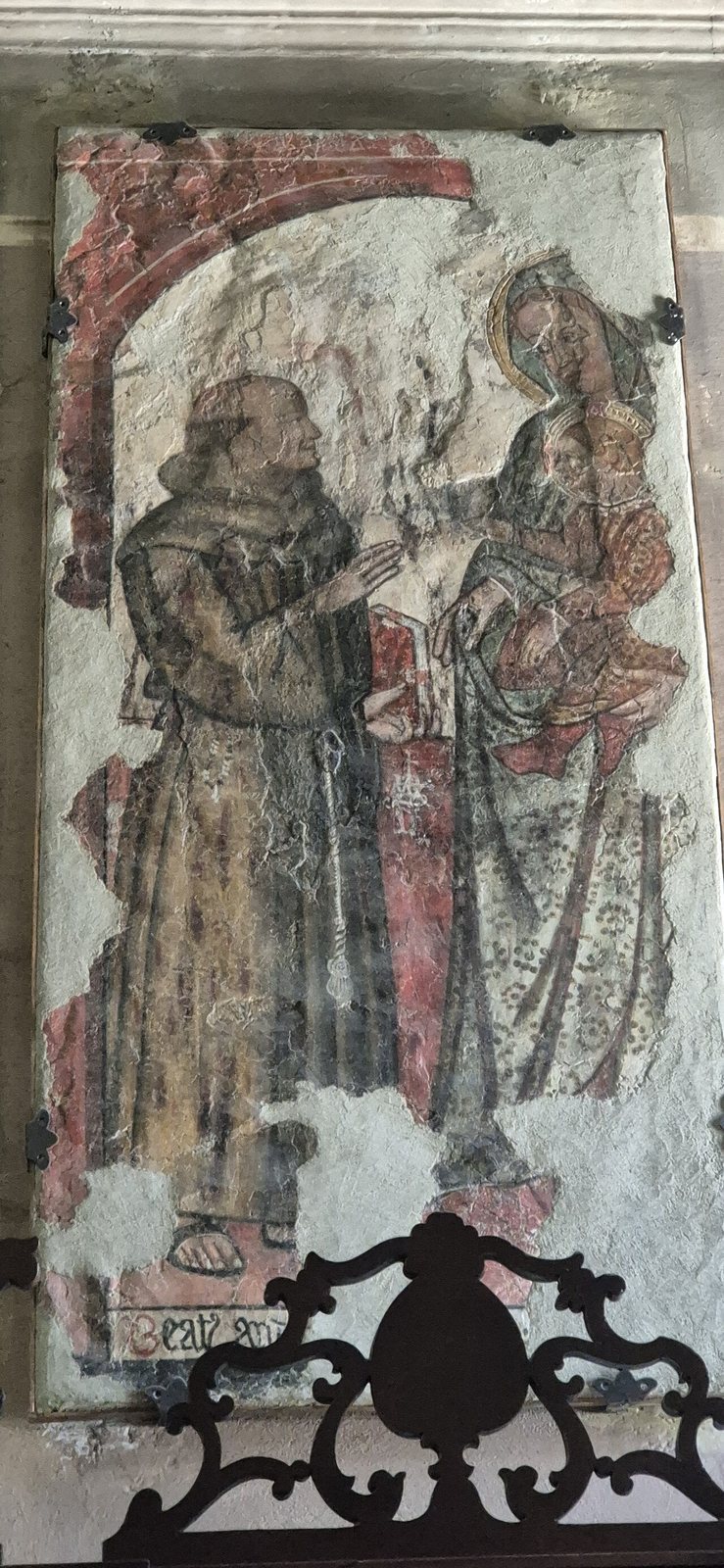
A fresco dated 1455 shows Blessed Andrea da Meldola, a Franciscan friar from the town whose title reflects formal beatification, praying before the Madonna and Child. A Gothic inscription below identifies him. He wears a Franciscan habit and tonsure, the traditional haircut associated with religious life. Andrea and the Child appear in profile, while Mary is turned partly toward the viewer. The rich clothing and precious haloes of Mary and the Child contrast with Andrea’s plain habit. The image was covered with whitewash during seventeenth-century alterations, later recovered, transferred to a new support, and placed in a chapel.