Rocca di Meldola: A Medieval-Renaissance Fortress in Italy


Site at a Glance
- Rating
- 4
- Popularity
- Low
- Country
- Italy
- Primary era
- Medieval
- Eras represented
- Medieval, Early Modern
- Civilizations
- Venetian
- Site type
- Military
- Remains
- Castle
On this page12 sections
History
Rocca di Meldola is a medieval-Renaissance fortress in Italy overlooking the historic center of Meldola, about 12 kilometers from Forlì. Its exact construction date is unknown, but the stronghold is generally dated to the tenth or eleventh century, while records of a defensive settlement at Meldola predate the year 1000. From the Middle Ages onward, its elevated position made it a contested stronghold in the political struggles of Romagna.
Early ecclesiastical and communal rule
During the eleventh and twelfth centuries, control of the fortress was disputed by the Church of Ravenna, the descendants of Count Lamberto of the Counts of Giaggiolo, and the counts of Bertinoro. In 1158, Bonifacio, Lamberto’s son, settled the dispute with the counts of Bertinoro by transferring the castle and its court to Archbishop Anselmo of Ravenna. The fortress thereby entered the authority of the Church of Ravenna, although local nobles continued to challenge that control.
Meldola was a free commune in 1214, but it remained subject to the vicar of Ravenna. In 1229 it was regarded as imperial territory, and the people of Meldola submitted to the archbishop of Ravenna. In 1283 the fortress became a possession of the Church of Rome. It changed hands repeatedly, yet the papacy recovered it several times within only a few years. The stronghold was also linked with the Severi, Montefeltro, Ordelaffi, and Malatesta families, among other noble powers that competed for influence in Romagna.
Guelf, Ghibelline, and Malatesta struggles
Rocca di Meldola became the last Romagnan refuge of Guido da Montefeltro after his victory over papal troops at Forlì. Guido, a medieval military commander and political leader associated with the Ghibelline cause, was forced to relinquish command of the communal forces. He negotiated his exile and departure from the region while protected by the walls of Meldola. The fortress consequently became an important position in the conflicts between Guelfs and Ghibellines, the rival medieval factions broadly associated with papal and imperial authority. Both the Ordelaffi and the Orgogliosi sought to control it.
In 1334 Francesco Ordelaffi, lord of Forlì and Cesena, besieged the fortress for four months. He was supported by the marquis of Ferrara, the Malatestas, and Ostasio da Polenta. The attacking forces surrounded the walls with three trebuchets and powerful lifting engines. The pope appealed to Florence for assistance and rewarded the Florentines with the fortress.
The fortress returned to papal protection in 1341. The Ordelaffi seized it again in 1350 and strengthened its defenses, but Cardinal Albornoz brought about its loss in 1359. Galeotto Malatesta then captured it, and the Malatestas held Meldola from 1379 until the sixteenth century, when Romagna came definitively under papal control. During this long period, the castle was further fortified and served as a residence for Novello Malatesta during the plague in Cesena in 1457. Vannetta Toschi, the wife of Sigismondo Malatesta, also used the fortress as a residence.
Venetian occupation and the Pio residence
After Cesare Borgia conquered Imola and Forlì, Pandolfo IV Malatesta sold the entire fief to Borgia, known as the Valentino. In October 1503, the population expelled Borgia’s troops and raised the banner of Saint Mark. Venetian authorities then occupied the castle for six years. Their control ended with the War of the League of Cambrai, a conflict arising from a coalition formed against the Republic of Venice, after which Meldola returned to the Papal States, the territories governed directly or indirectly by the pope.
During the Venetian period, the castle was restored and the Gate of Saint Andrew was reconstructed. On 11 March 1518, Pope Leo X granted the territory as a fief to Alberto III Pio da Carpi and later to his brother Leonello. Leonello transformed the fortress from a defensive work into a princely residence and made Meldola the capital of his small Romagnol fief, which included Sarsina, Bertinoro, Verucchio, and Scorticata.
Before undertaking these improvements, Leonello endured the violence of the Landsknechts in April 1527. These German-speaking mercenary infantry were widely employed by European rulers during the late medieval and Renaissance periods. His program for Meldola included restoring the aqueduct, establishing a Mount of Piety, a charitable lending institution that provided loans against pledges, creating a Calvary, and building the Church of Saint Roch. The castle probably reached its greatest splendor during Leonello’s period, although little of the work associated with its transformation survives.
Aldobrandini, Pamphilj, and later decline
In 1597, the fief of Meldola and Sarsina was valued at 140,000 gold scudi and sold by Rodolfo Pio to the Aldobrandini family, represented by Cardinal Pietro Aldobrandini, his sister Olimpia, and his brother Giovanni Francesco. On 3 December 1598, Pope Clement VIII visited the castle and blessed a new bell installed on the keep.
During the seventeenth century, Olimpia Aldobrandini became the family’s sole heir. After the death of her first husband, Paolo Borghese, she married Camillo Pamphilj in 1647. The Borghese-Aldobrandini and Pamphilj families made no substantial changes to the property, apart from repairs required after the earthquake of 1661.
Before the arrival of Napoleonic troops, the Borghese-Aldobrandini and Doria Landi Pamphilj families of Genoa became the castle’s feudal lords through a decision of the Sacred Roman Rota, the highest judicial tribunal of the Catholic Church. The castle then lost its residential importance, was converted into barracks for French soldiers, and was stripped of its furnishings.
After the restoration of the pre-Napoleonic order, the abandoned and no longer habitable castle returned to the Doria Pamphilj. The severe earthquake of 1870 heavily damaged the buildings on the northeast side of the courtyard, and those structures were completely demolished. On 17 October 1995, the Municipality of Meldola became the owner of the castle. Rocca di Meldola is recognized as Italian national heritage and is partially restored.
Remains
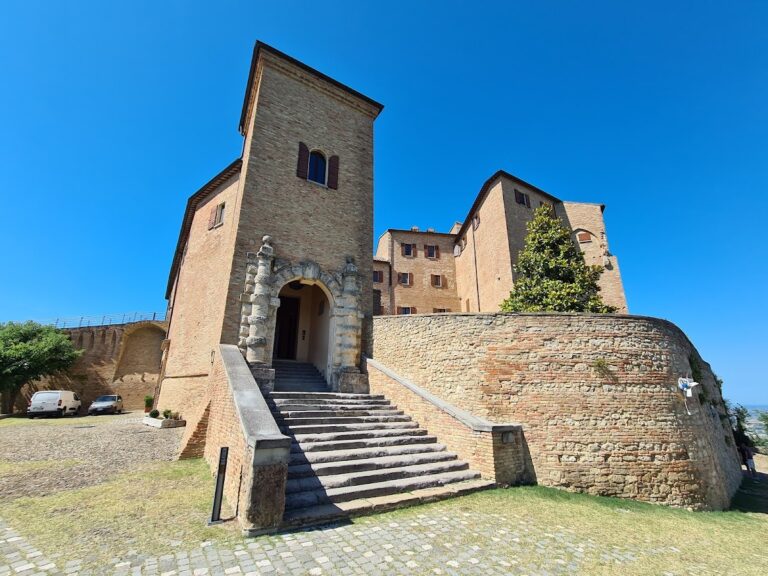
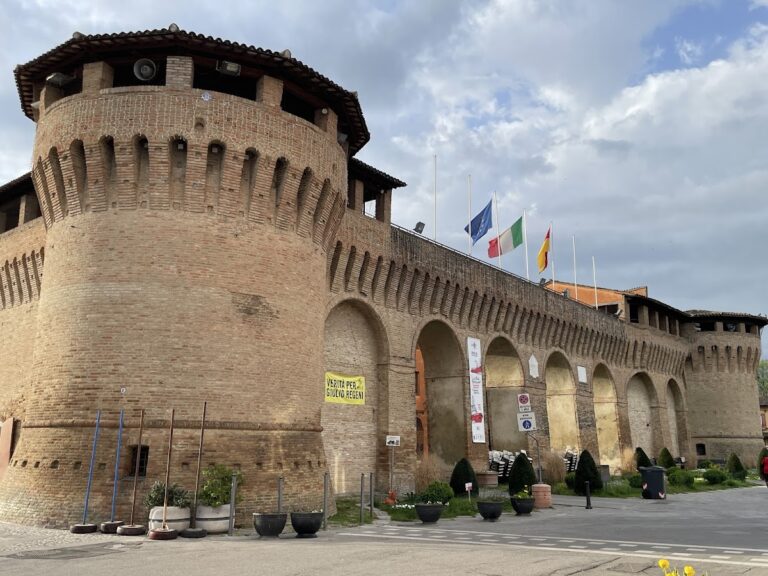
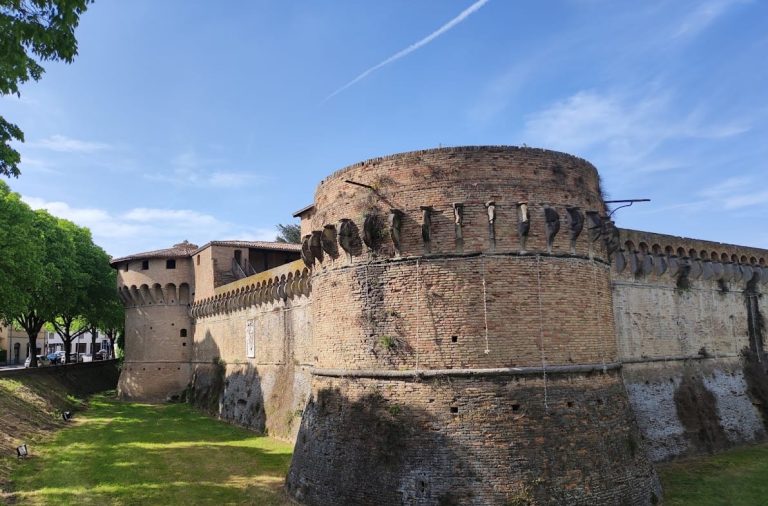
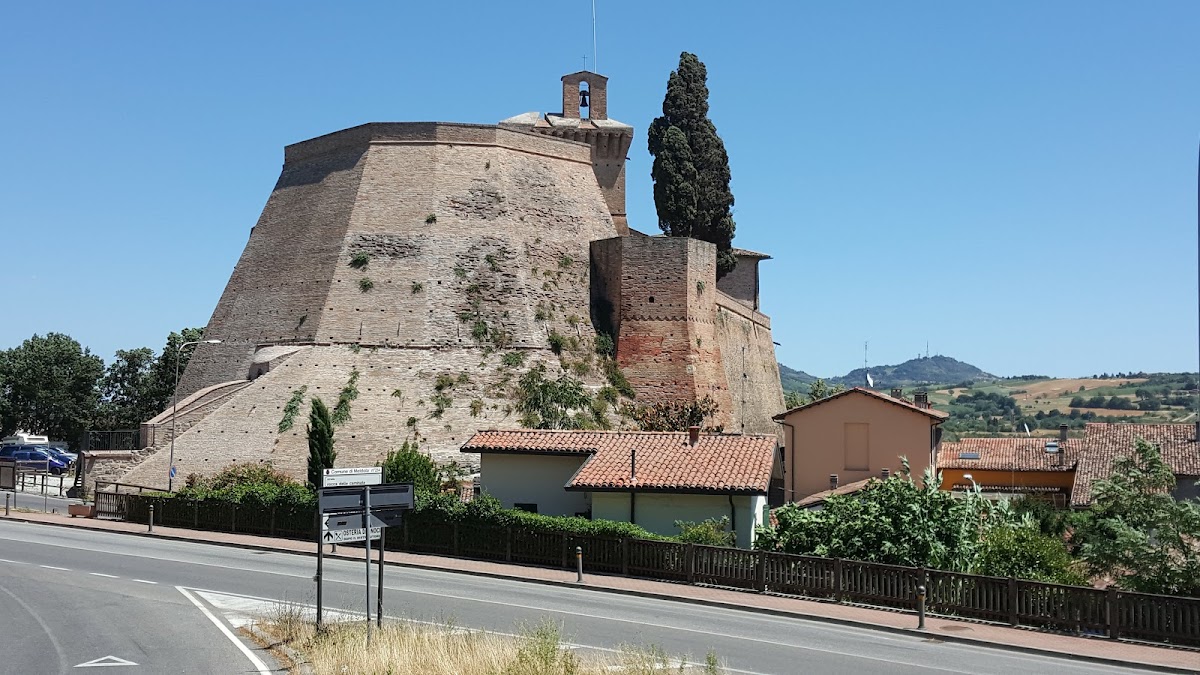
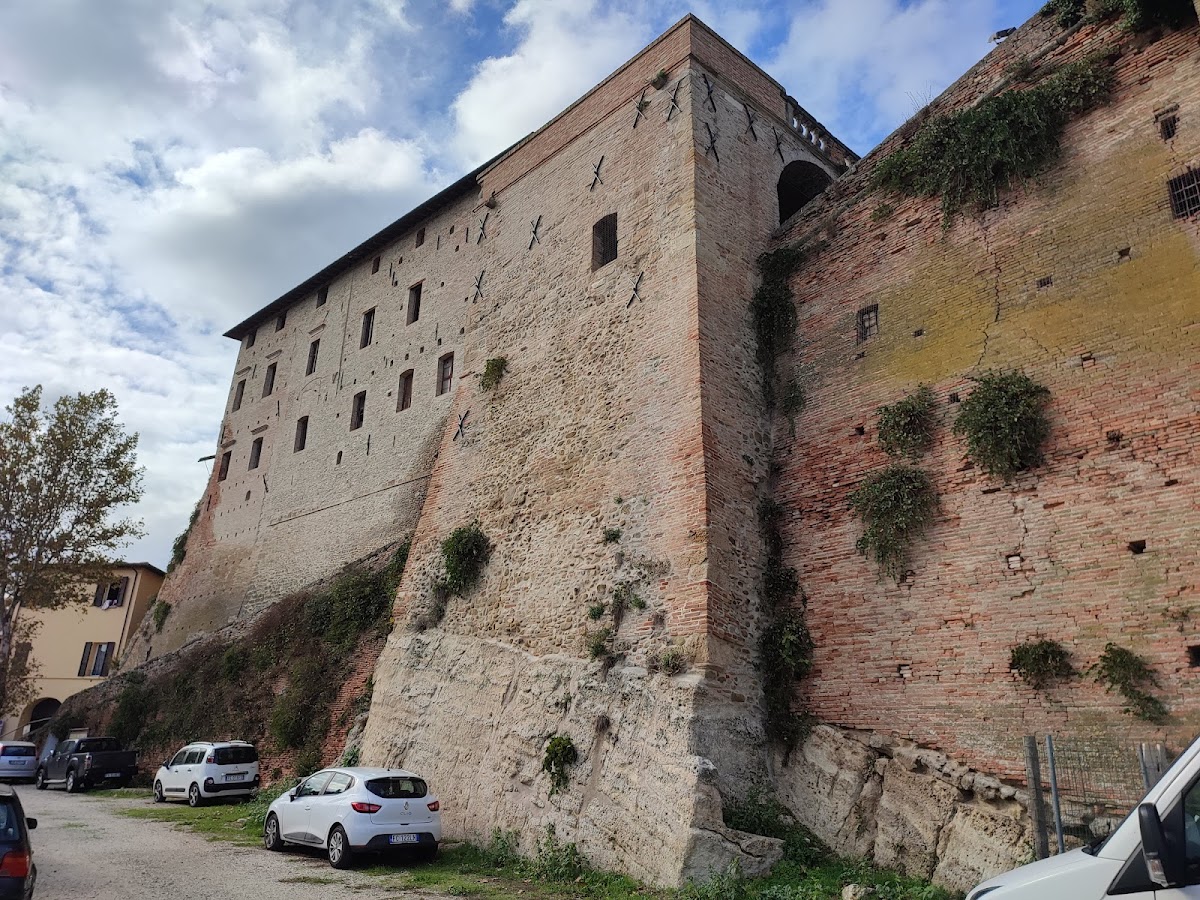
The surviving Rocca di Meldola is a partially restored medieval-Renaissance fortress built in brick masonry on elevated ground above Meldola’s historic center. Its documented complex consisted of defensive walls, a courtyard, a keep or main tower, and the Gate of Saint Andrew. The fortress was later adapted as a residence, but little of the physical work associated with that transformation remains.
Fortified enclosure
Walls and courtyard
The defensive walls enclosed a courtyard and formed the principal fortified body of the stronghold. Brick masonry gave the complex its characteristic construction, while later strengthening reflected the military importance of the site during the struggles among papal authorities and the noble families of Romagna. The buildings on the northeast side of the courtyard were severely damaged in the earthquake of 1870 and were subsequently demolished.
Gate of Saint Andrew
The Gate of Saint Andrew formed part of the fortified complex and was reconstructed during the Venetian occupation. Its rebuilding belongs to the period when Venetian authorities restored the castle before Meldola returned to the Papal States after the War of the League of Cambrai.
Keep and later residence
Keep
The keep, or main tower, carried a bell that Pope Clement VIII blessed on 3 December 1598. This association links the surviving tower with the late sixteenth-century phase of Aldobrandini control and with the ceremonial use of the castle during that period.
Princely residence
Under Leonello Pio, the defensive complex was reshaped into a princely residence and became the center of his Romagnol fief. That residential phase followed the fortress’s earlier military use, but only a small amount of the associated alteration survives in the partially restored complex.