Castle of Giaggiolo: Medieval County Seat and Hilltop Fortification in Italy


Site at a Glance
- Rating
- 4.2
- Popularity
- Very Low
- Country
- Italy
- Primary era
- Medieval
- Eras represented
- Medieval
- Civilizations
- Holy Roman Empire
- Site type
- Military
- Remains
- Castle
On this page5 sections
History
The Castle of Giaggiolo is a medieval hilltop fortification in Italy, near Voltre in the municipality of Civitella di Romagna. Built no later than the eleventh century, it served as the principal seat of the ancient County of Giaggiolo, a fief whose territory extended across areas corresponding to present-day Romagna and Tuscany.
The County of Giaggiolo
The castle is documented by 1021, while an earlier investiture in the early tenth century granted Severo II, also known as Sigizo Guardasigilli, authority over the family’s possessions. Severo II belonged to the Severi lineage associated with Giaggiolo. He was the son of Severo I, regarded as the founder of the family, and the brother of Pietro, Duke and Count of the Exarchate and the Pentapolis, Byzantine administrative regions in Italy. Both brothers also held the title of Counts of Bertinoro.
In September 1021, Henry II, the medieval Holy Roman emperor, Pope Benedict VIII, and Eriberto, Archbishop of Ravenna, invested Severo II’s descendants with the possessions of the extensive County of Giaggiolo. An archbishop was the senior bishop of a major ecclesiastical province. The Severi were described as descendants of Ravenna’s aristocracy, appointed by imperial authorities and originating in the Byzantine Empire, the Eastern Roman Empire.
Montefeltro and Malatesta Rule
In 1263, Guido I da Montefeltro married Manentessa di Ghiaggiolo. After the death of his brother-in-law Uberto, Guido received the title of Count of Ghiaggiolo. His position in the northern Apennines enabled cooperation with the Ghibelline faction in Forlì. The Ghibellines supported imperial authority in the medieval conflicts between the empire and the papacy in Italy, and the comital title helped Guido obtain citizenship in Forlì.
By the medieval period, the castle had become the seat of the Giaggiolo branch of the Malatesta, a powerful noble family based in Romagna and the Marche. The branch’s founder was Paolo Malatesta, whose relationship with Francesca da Polenta was treated by Dante Alighieri in Canto V of the Inferno. Orabile Beatrice, daughter of the Counts Severi of Giaggiolo and Paolo’s wife, was born at the castle. She lived from 1255 to approximately 1303.
Paolo’s son Uberto Malatesta became Count of Giaggiolo and was killed treacherously in 1324 after joining the Ghibelline faction. A copy of the castle’s 1376 statute is preserved in the Episcopal Archive of Sansepolcro. The Castle of Giaggiolo is listed as Italian national heritage.
Remains
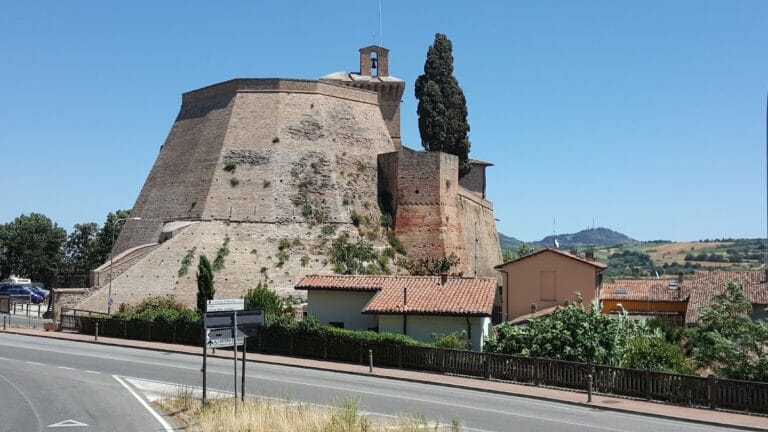
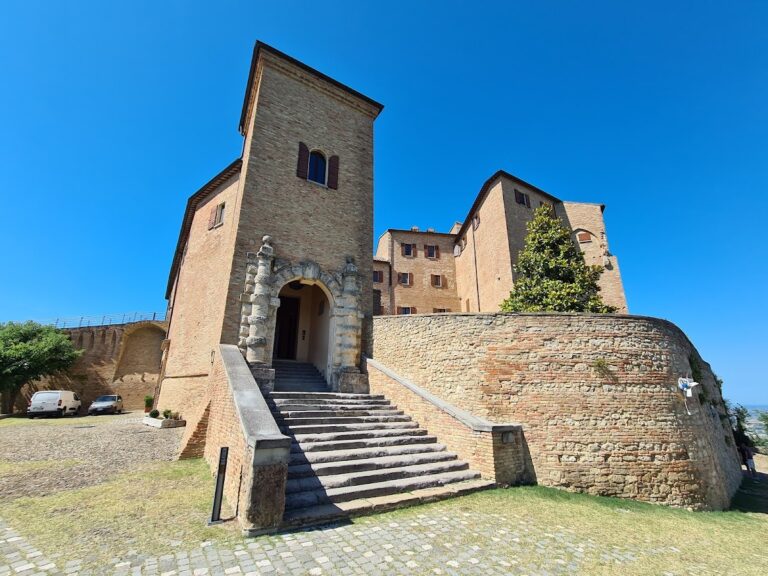
The Castle of Giaggiolo occupies a hilltop in the Tusco-Emilian Apennines, within the territory associated with the former County of Giaggiolo and the ancient locality of Romanula. Its elevation is given as between 468 and 495 metres above sea level, and the site lies approximately 30 kilometres from Forlì. The surviving ruin consists of a small group of masonry remains associated with both defensive and residential use. Brick and rubble stone are identified among the building materials.
Fortification Remains
The most notable surviving feature is a substantial octagonal bastion, a projecting fortified structure designed to strengthen a fortification’s defenses. It forms the principal visible remnant of the medieval castle and preserves evidence of the site’s defensive character within the wider hilltop complex.