Rocca di Bertinoro: A Medieval Fortress and Episcopal Palace in Italy


Site at a Glance
- Rating
- 4.6
- Popularity
- Low
- Country
- Italy
- Primary era
- Medieval
- Eras represented
- Medieval, Early Modern
- Civilizations
- Holy Roman Empire, Papal States
- Site type
- Religious
- Remains
- Palace
On this page12 sections
History
Rocca di Bertinoro is a tenth-century fortification in Italy that developed from the seat of the Counts of Bertinoro into a papal administrative centre and later an episcopal palace. Its earliest surviving documentary mention concerns a noble and ecclesiastical assembly held on 27 November 995 at the stone-built fortress called castrum Cesubeum, where a keep already stood. The meeting dealt with the assignment of feudal rights over Celincordia.
The comital fortress
A separate fortress also appears to have existed around the year 1000. Excavation during the construction of a sewer conduit found traces of walls and layers of deposited material along the avenue leading to the surviving building. From the tenth century, the fortress served as the seat of the Counts of Bertinoro.
In 1004, the archbishop of Ravenna assigned the feudal rights over Bertinoro to Ugo degli Onesti, a medieval nobleman who founded the family that governed the county until the end of the twelfth century. After the death of Countess Aldruda Frangipane in 1177, the fortress became a fief of Emperor Frederick Barbarossa, the German king and Holy Roman Emperor who repeatedly intervened in the politics of northern and central Italy. Barbarossa stayed at Bertinoro with his court and troops for approximately six months.
Papal and lordly control
In 1278, after the end of Hohenstaufen, or Swabian, rule in Italy, Bertinoro entered the Papal States, territories governed by the pope before Italian unification. The fortress became the residence of papal representatives who governed Romagna as both political administrators and ecclesiastical officials.
Powerful local lordships continued to contest the stronghold. The Ordelaffi occupied it in 1306, and Dante Alighieri later found refuge there while serving as an ambassador for the family. In 1357, Cardinal Egidio Albornoz, the papal legate who led the military and political recovery of much of the Papal States, recovered the fortress and made it the headquarters of the military command during the reconquest of Romagna.
Following the partial destruction of Forlimpopoli, Bertinoro became an episcopal seat in 1361. In 1379, the fortress was granted as a fief to the Malatesta family of Rimini, a powerful lordly dynasty based in the Romagna and Marche.
From fortress to episcopal palace
From the mid-fifteenth century, first under the Malatesta and later under the bishops of Bertinoro, the complex lost its military function. In 1450, Domenico Novello Malatesta transferred part of the archive of the convent of San Francesco to the fortress. This collection became the original nucleus of the future Malatesta Library in Cesena, a fifteenth-century historic library known for its humanist furnishings and collections. The bishops later used the building for education and training.
Bishop Giovanni Andrea Caligari established his residence there in 1584. In 1598, Pope Clement VIII converted the complex into the episcopal palace of the Diocese of Bertinoro. Corradino Romano completed a cycle of frescoes for the bishop’s dining room in 1613, and further alterations continued until 1800.
War, restoration, and modern use
After the death of the last bishop in 1969, the Diocese of Bertinoro was merged with the Diocese of Forlì. The building ceased to function as an episcopal palace in 1986. Restoration completed in 2000 brought the complex into use by university institutions, and since 2005 it has housed the Interreligious Museum of Bertinoro, devoted to Islam, Judaism, and Christianity. Rocca di Bertinoro is recognized as Italian national heritage.
Remains
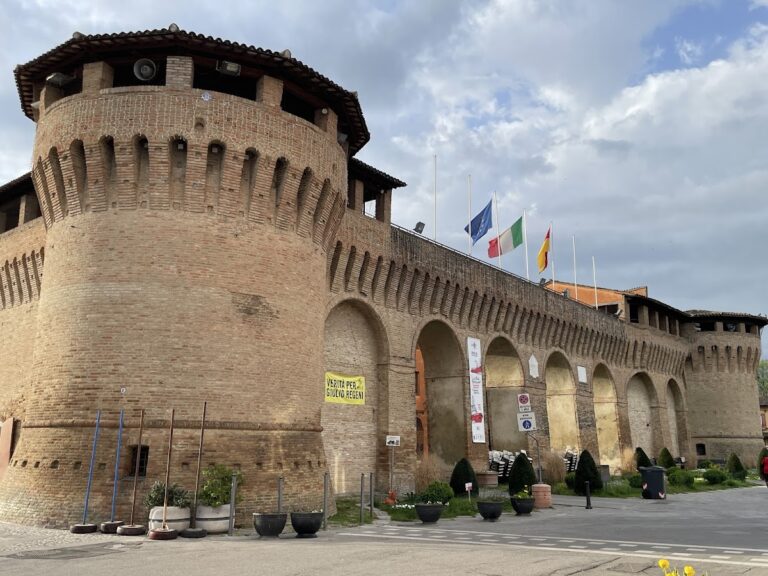
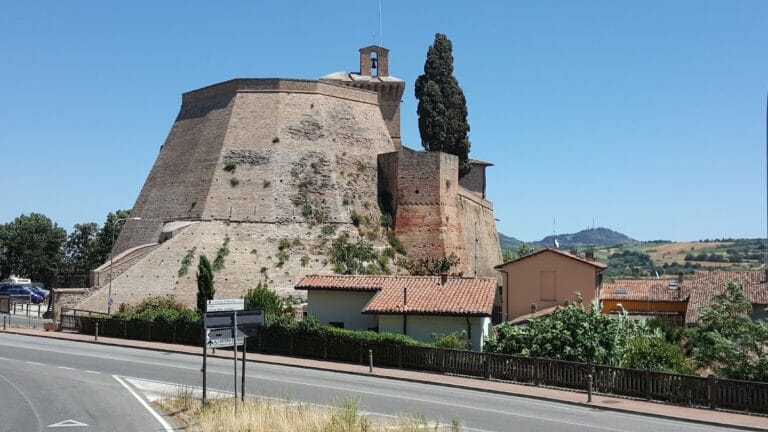
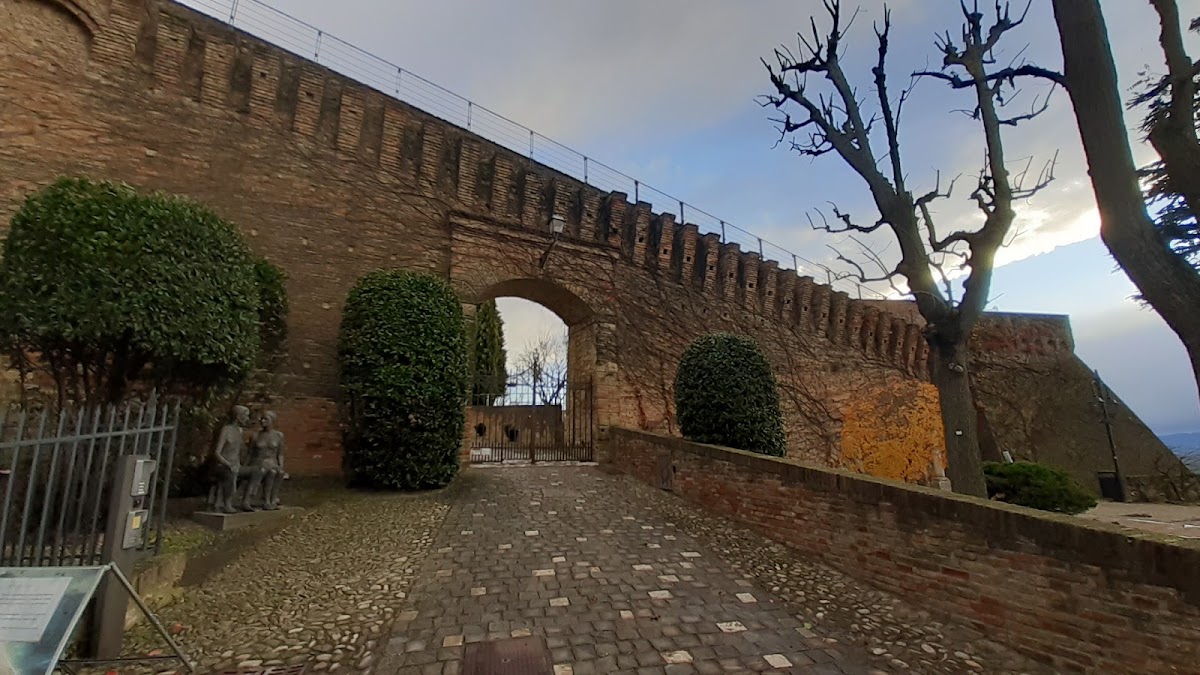
The surviving complex preserves elements of a medieval fortified enclosure together with the later episcopal residence. The original tenth- and eleventh-century arrangement consisted of a wall circuit enclosing the settlement’s dwellings and a central castle. Four towers occupied the corners of the enclosure, while the medieval perimeter remained in place when the fortress was transformed into an episcopal residence in 1584.
Medieval enclosure
Walls, towers, and entrances
The wall circuit survives in part and was organized around four corner towers. It had three entrances named Porta Cardinalis, Porta Francha, and Porta Sancte Marie. The principal entrance was aligned with the tower on the southern side. Excavation along the avenue leading to the present fortress also revealed wall traces and fill material associated with an apparently separate fortress dating around the year 1000.
Military rooms
The fortress contained barracks and several rooms used as prisons. These spaces belonged to the complex’s military phase, before its conversion into an episcopal residence substantially changed the building while retaining the medieval wall perimeter.
Later structures and survival
Bell tower
The bell tower collapsed in 1927 because of inadequate maintenance. A replacement tower was reconstructed in 1931, forming part of the later visible complex.
War damage and restoration
Anglo-American bombing in October 1944, during the Second World War, almost completely destroyed the fortress interior. Postwar restoration introduced important modifications, and the work was completed in 1949.
Nearby sites