Ahmed Bey Evrenosoglu School: An Ottoman Monument with a Disputed Original Use
Site at a Glance
- Popularity
- Very Low
- Country
- Greece
- Primary era
- Medieval
- Eras represented
- Medieval, Early Modern
- Civilizations
- Ottoman
- Site type
- Religious
On this page4 sections
History
Ahmed Bey Evrenosoglu School is an Ottoman monument in Greece. Its date is uncertain: one proposed dating places it in the second half of the 15th century, when Ahmed Bey Evrenosoglu governed Yenice Vardar, while another places it in the late 18th century. The title bey was used for Ottoman leaders and officials.
The building was long remembered as Ahmed Bey’s mausoleum, but it is not his tomb. His grave is thought to be at Sheikh Ilahi Mosque in the city’s northwest. The 17th-century Ottoman traveler and writer Evliya Çelebi’s account connects Ahmed Bey’s burial with that mosque and the building with use as a school.
The building’s original purpose remains disputed. It may have served as an elementary school or a small neighborhood mosque in the 15th century, or as a school for Quranic instruction in the 18th century. Older residents instead recalled it as a religious lodge. The building has been restored. It received protected cultural-monument status in 1976 and is recognized by the Ministry of Culture as a historic preserved monument.
Remains
Form and materials
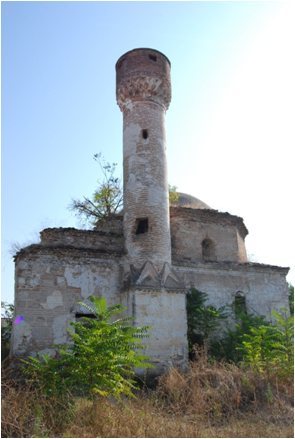
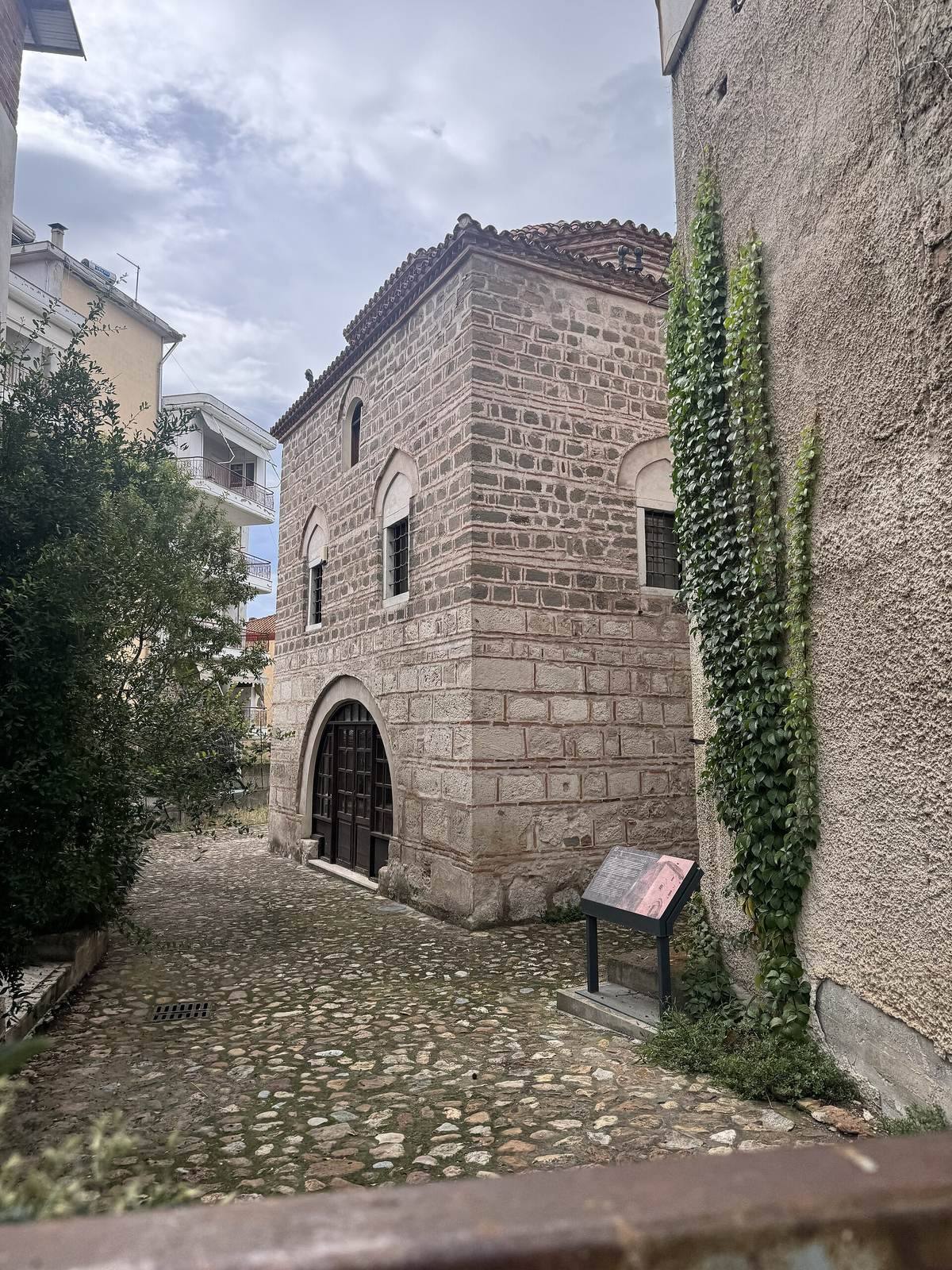
The two-storey building has a square plan, with each wall measuring 8.8 metres. A low brick dome rests on an eight-sided base. Its walls are made of squared limestone blocks framed with brick in a pattern modeled on Byzantine stone-and-brick masonry. Ten pointed-arched windows bring light into the building.
Entrances and internal arrangement
The floors did not connect internally. An open arcade on the ground floor provided a passage because a paved road ran through the site. Two vaulted doorways, one on the north and one on the south, also opened onto the ground floor. An external wooden staircase on the north side provided access to the upper floor, where a room contains a mihrab, a niche indicating the direction of prayer.
The building stands at the end of Strandzha Street, opposite St George’s Church and a few metres north of the Clock Tower.