Vysotsky Monastery: A Russian Orthodox Monastery in Serpukhov
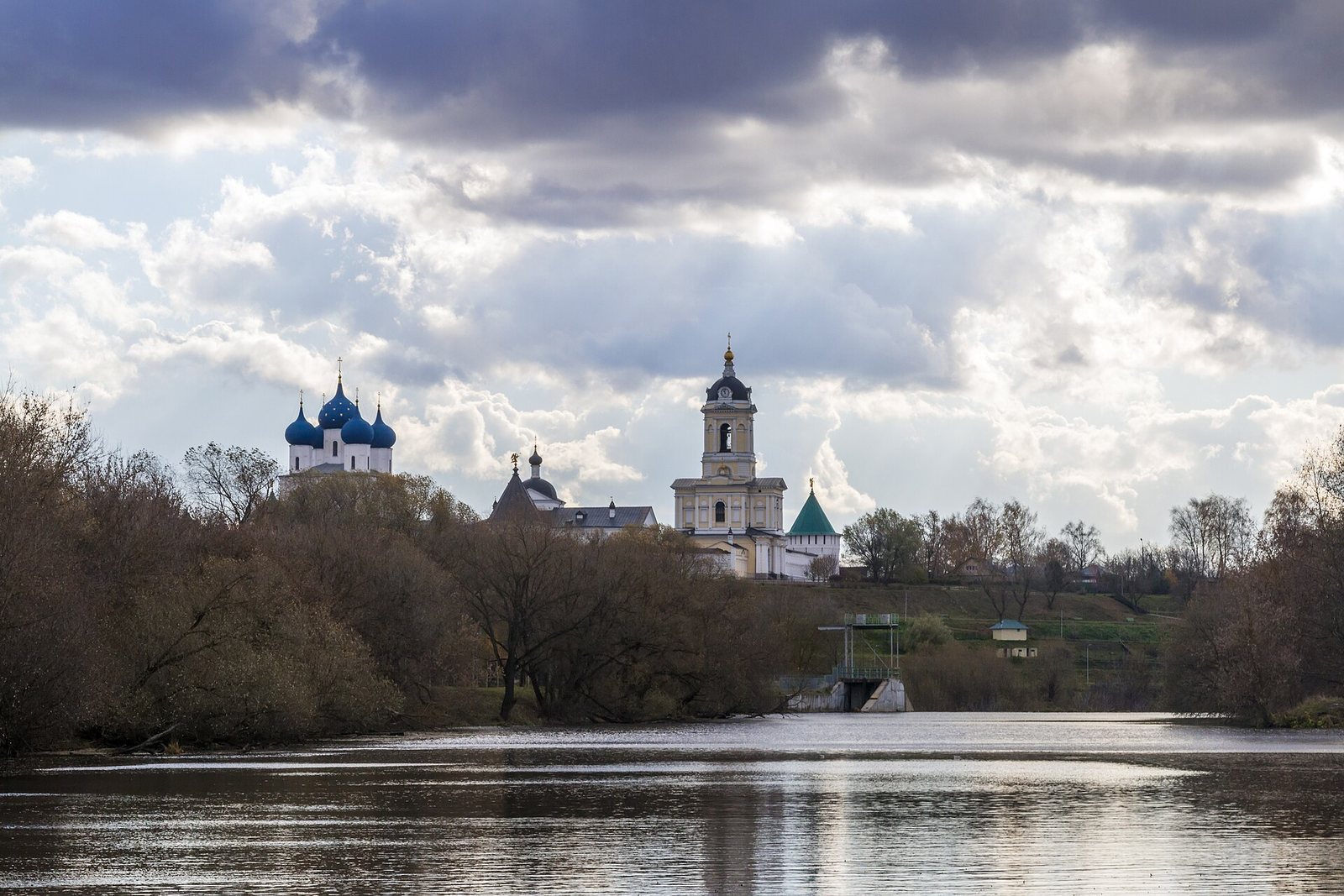
Site at a Glance
- Popularity
- High
- Country
- Russia
- Primary era
- Early Modern
- Eras represented
- Early Modern, Modern
- Civilizations
- Russian
- Site type
- Religious
- Remains
- Fortified Monastery
On this page22 sections
History
Foundation and early development
Vysotsky Monastery is a Russian Orthodox monastery in Serpukhov, Russia, founded in the 1370s by Prince Vladimir Andreevich, known as Vladimir the Bold, with the blessing of Sergius of Radonezh. After Golden Horde forces led by Mamai attacked the Ryazan principality in 1373, the frontier needed stronger defenses. The monastery was part of a plan to protect the route from the middle Oka River toward Moscow and Vladimir’s residence on the Oka.
Sergius and his disciple Athanasius the Elder helped select the site. Sergius prayed there and left Athanasius to supervise construction. From its beginning, the community followed a shared monastic rule, with the monks living together under common discipline. Under its early abbots, the monastery became a center for monastic life and manuscript copying, and an important channel of Byzantine influence in Rus’. Its distinctive tier of icons is thought to have influenced the painter Andrei Rublev.
Victory, raids, and rebuilding
After the Battle of Kulikovo in 1380, in which forces of the Rus’ principalities defeated the Golden Horde, Vladimir arranged for Serpukhov warriors to be buried at the monastery, including forty boyars, members of the high-ranking nobility. Churches were built in commemoration of the victory and in gratitude for the community’s prayers. In 1381, Sergius returned with Metropolitan Cyprian for the consecration of the Cathedral of the Conception and the refectory Church of the Intercession.
Golden Horde forces under Tokhtamysh plundered the monastery in 1382. In 1387, Athanasius the Elder travelled to Constantinople with Cyprian to copy books for church services; Athanasius the Younger then became abbot. After his death in 1395, Nikita, a relative and disciple of Sergius, took charge and led the community for nineteen years. The monastery was devastated again during the 1408 raid by Edigey, a Golden Horde commander, and rebuilt under Nikita.
Vysotsky’s history remained closely connected to Serpukhov’s military role. Troops were often reviewed nearby, and rulers, nobles, and commanders came to the monastery, which maintained special chambers for royal visitors. It received donations of money, land, books, church vessels, and vestments.
Expansion and royal patronage
During the sixteenth century, the monastery added churches dedicated to St Nicholas and St Sergius, a chapel for the Nativity of the Virgin, and a gallery around the cathedral. By mid-century, its holdings included four local church districts, 89 villages, and the Vysotsky forest. In 1542, Ivan IV granted it judicial authority over peasants on its estates, the right to mine iron ore there, and protection for its forests from unauthorized cutting. He visited in 1556, 1571, and 1574. In 1570, shops belonging to the monastery’s peasants received an exemption from a specified levy.
In 1571, the Crimean Tatar forces of Devlet-Giray plundered the monastery and desecrated its churches. A charter issued the following year exempted the damaged community from taxes and dues for five years. Polish troops under Colonel A. Mlotsky burned the monastery in 1610, after which it was restored.
The monastery prospered again under the Romanov dynasty, especially with support from the Naryshkin family and Natalia Naryshkina, the mother of Peter I. Many churches and icon screens were renewed by the end of the seventeenth century. Patriarch Filaret donated books, a carved wooden cross, and money in 1627 and 1628; in 1697, Prince O. V. Zasekin paid for the Intercession church’s icon screen.
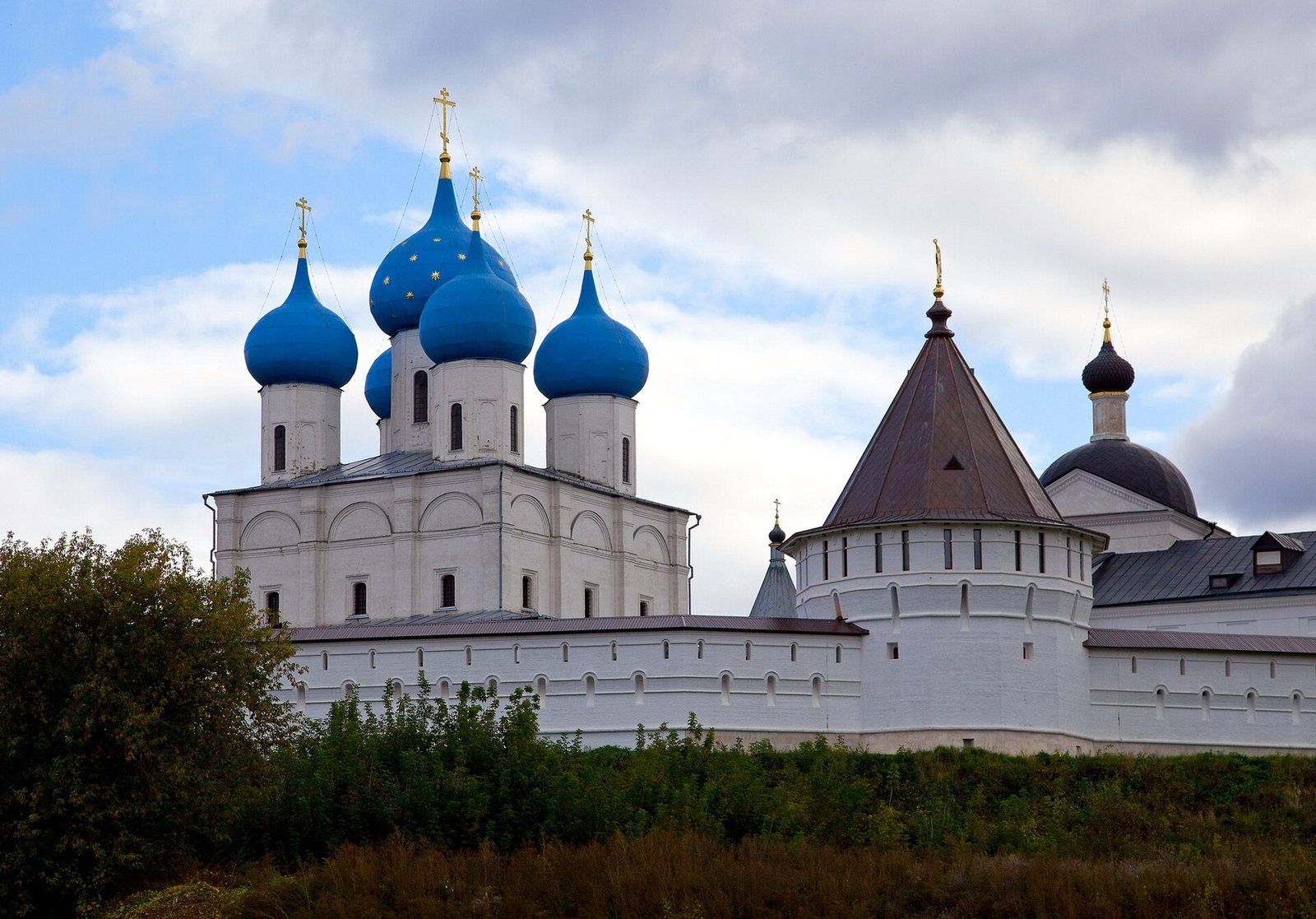
In 1647, Tsar Alexei Mikhailovich ordered a stone enclosure to protect the monastery against Crimean attacks and provided 1,000 rubles for its construction. By the end of the century, the monastery had a stone wall and towers. It also held dependencies, including the Vladychny Monastery, two chapels, and a wooden courtyard in Moscow, as well as extensive estates and a mill on the Nara River. Its holdings included 400 households and income of 90 rubles in 1678, 379 households in 1700, and 2,963 peasants on its estates in 1744.
Secularization and renewed activity
Catherine II’s 1764 secularization of church property deprived the monastery of its landed estates. Thereafter it relied on state support and donations, and its prosperity declined. Its community then included an archimandrite, a senior monastic rank, 70 monastic residents, 57 administrative and other staff, and 22 disabled military veterans.
Its fortunes improved from the early nineteenth century as old churches were restored, new ones built, and pilgrimage grew. The monastery established a boys’ school and a hospital. In 1902, Archimandrite Nikon, treasurer of the Trinity Lavra of St Sergius, paid for work on the Intercession church. Industrialist Nikolai Konshin had funded a family burial church in 1896.
Closure and reopening
In November 1918, a company of the 5th Zemgale Latvian Rifle Regiment occupied the monastery. For about a year, people suspected of desertion or loyalty to the former regime were executed beneath its walls. After the regiment departed, parts of the complex became a camp for prisoners and people suspected of supporting the monarchy. Monks continued to hold services in a small section of the monastery.
Patriarch Tikhon visited and held services in 1924. The authorities closed the monastery in 1928, leaving only the Intercession church open as a parish church. Many monks were arrested between 1928 and 1931, and the monastery ceased all activity when it was fully closed in 1931. For about fifty years, its buildings served secular purposes, including as offices, barracks, warehouses, garages, communal housing, and livestock pens. Three towers and much of the wall were lost. The church dedicated to Athanasius of Athos and Sergius of Radonezh was demolished during repair work in 1967.
The monastery reopened in 1991 by decision of the Russian Orthodox Church’s Holy Synod, and restoration followed. Work on the Intercession church began in 1992; its chapel dedicated to the Praise of the Virgin was consecrated in 1993, and its main altar in 1994. The relics of Athanasius the Younger were recovered in 1994. Restoration of the Sergius church began in 1996, and work on the Church of All Saints began in 2001. A restored residential building received a church dedicated to the icon of the Mother of God called “Quick to Hearken” in 1998. A chapel dedicated to “The Inexhaustible Chalice” was also established in the pilgrims’ building, and the monastery became a pilgrimage center associated with a revered copy of that icon.
On 17 June 2021, the Holy Synod placed the monastery directly under the Moscow Patriarch, rather than the local diocesan bishop, making it stauropegial. It is also a federal-level cultural heritage site in Russia.
Remains
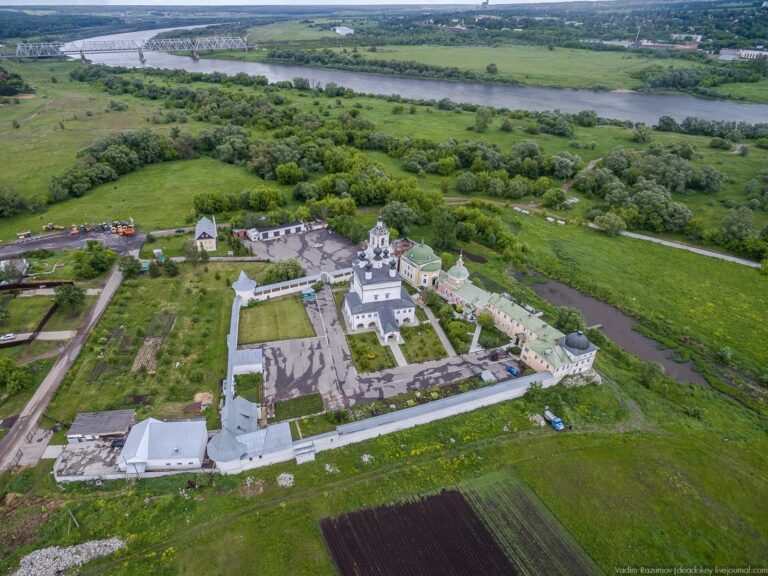
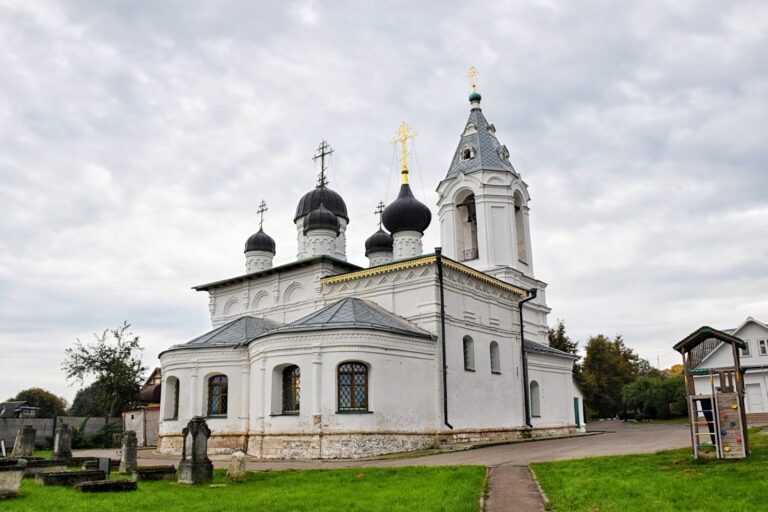
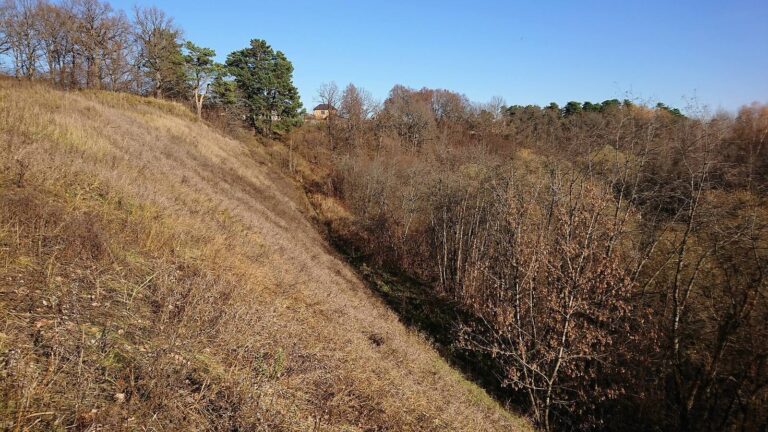
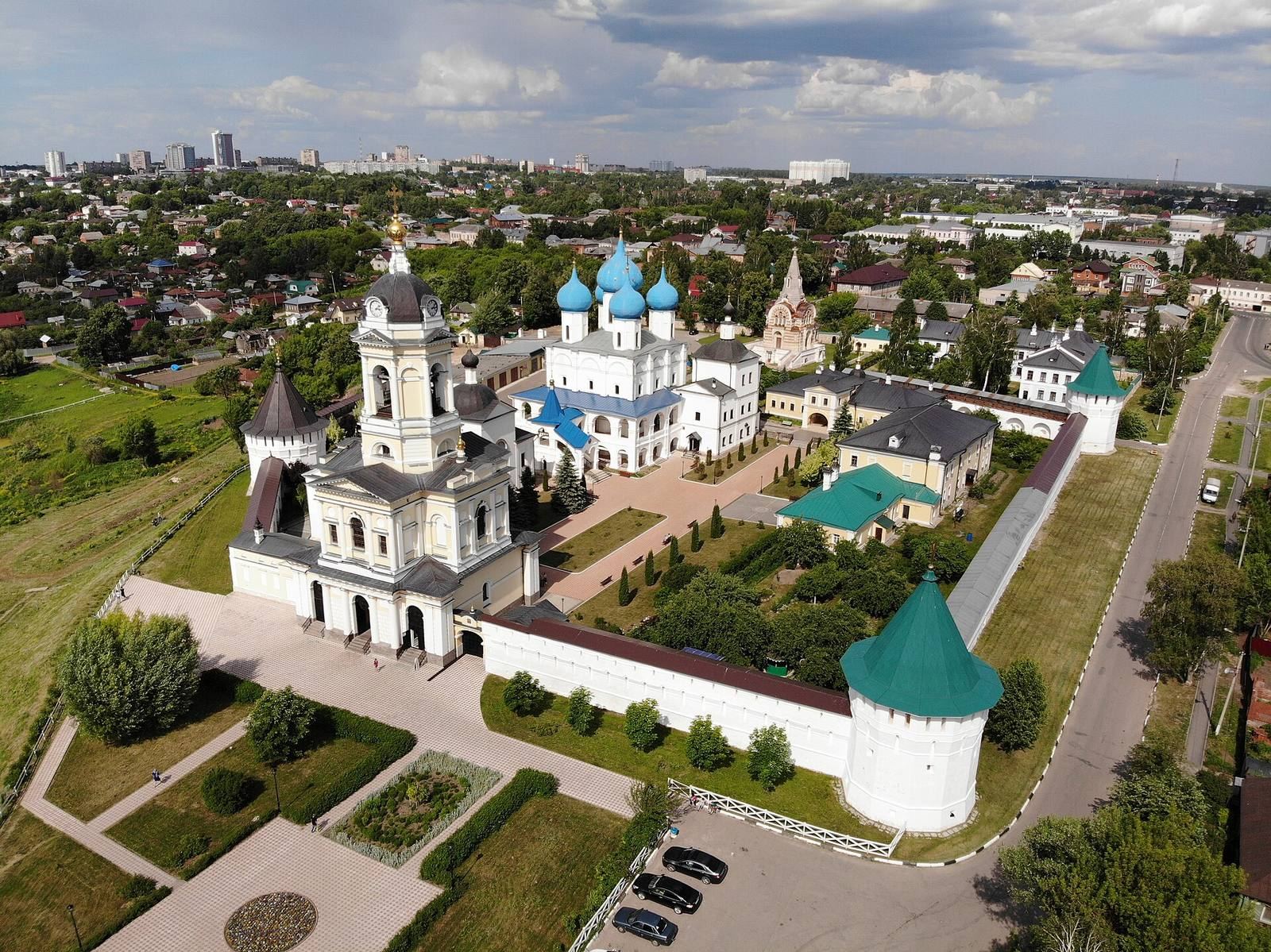
The walled complex stands on the high left bank of the Nara River in Serpukhov, about two kilometres from its meeting with the Oka. Its name refers to heights. Brick and stone buildings occupy the monastery grounds, with the Cathedral of the Conception and adjoining churches forming the principal architectural group.
The cathedral and monastic churches
Cathedral of the Conception
The Cathedral of the Conception is a five-domed building raised on a high basement level and surrounded by an open gallery with two tiers. Its present building is associated with the period of Boris Godunov and followed the monastery’s devastation in 1571. The vaults and domes were remade in 1697. Wall paintings survive only to a limited extent beneath later repainting applied in 1800 and 1899. A crypt, an underground burial chamber, lies beneath the cathedral.
Church of the Intercession
The refectory Church of the Intercession of the Virgin has a single dome and stands over cellars dating to the sixteenth century. The present church dates from the late seventeenth century and was renewed and rebuilt in 1834. A large chapel dedicated to the Praise of the Virgin was added on its north side in 1872–78, replacing the former hospital building. The church lost its dome during the Soviet period and was repaired in the 1990s.
Church of St Sergius
The small, three-storey Church of St Sergius is attached to the cathedral. It replaced the cathedral’s chapel dedicated to St Nicholas in the late seventeenth century.
Former Church of St Nicholas
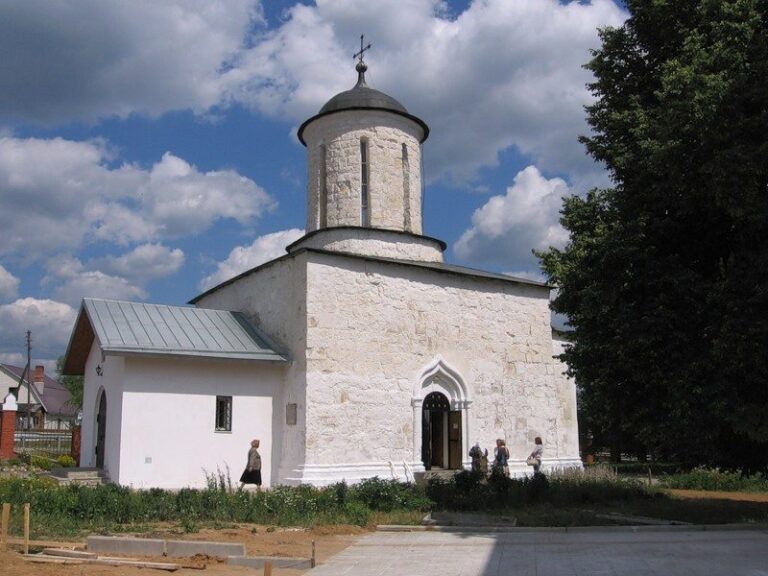
The sixteenth-century Church of St Nicholas was used as a sawmill during the Soviet period. The monastery’s treasury was located above it.
Walls, towers, and later buildings
Bell tower and gateway church
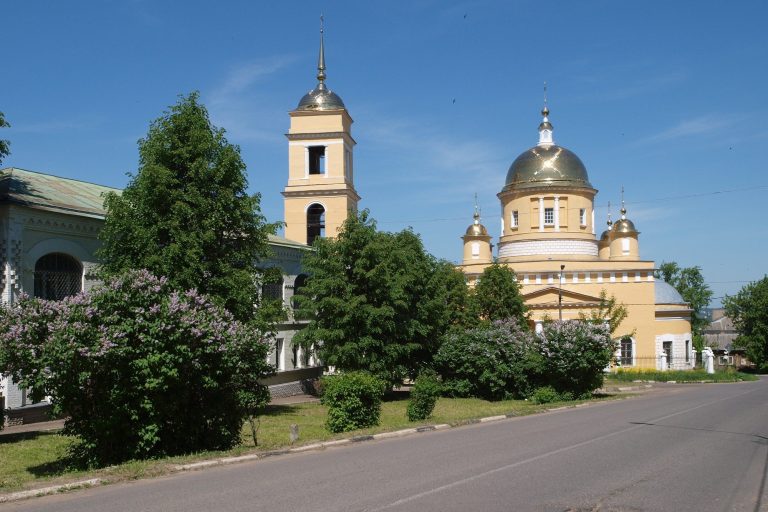
A three-tier bell tower was built in 1831–40 to replace an older tower that had collapsed. It contains a gateway church dedicated to the Three Holy Hierarchs, the early Christian teachers Basil the Great, Gregory the Theologian, and John Chrysostom. Architect D. F. Borisov designed the tower, and Metropolitan Philaret of Moscow consecrated the church in 1843.
Church of All Saints
Built in 1896 to a design by Roman Klein, the Church of All Saints has a family crypt on its lower floor. The church is in an unsafe condition, and its crypt graves were opened and looted after the Revolution.
Former Athanasius and Sergius church site
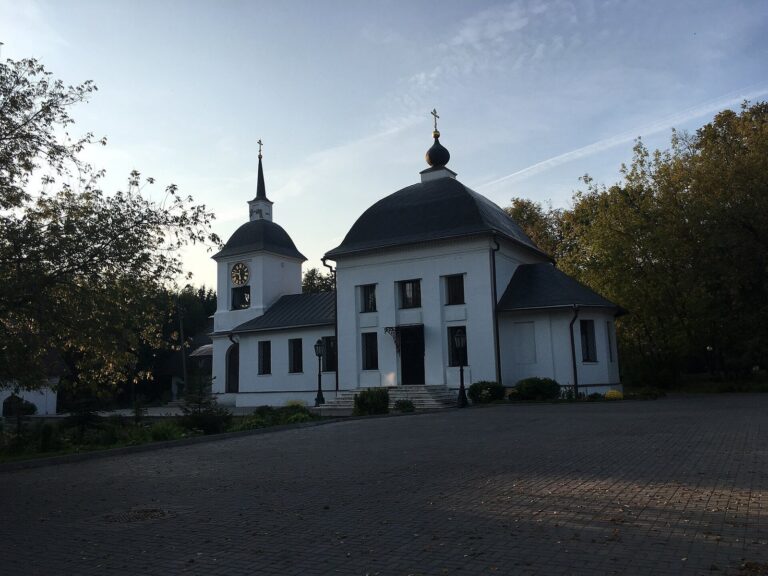
A church dedicated to Athanasius of Athos and Sergius of Radonezh was built in 1878 over the burial place of Athanasius the Younger, replacing a wooden church erected in 1697 with donations from the Naryshkin family. After the church was demolished in 1967, a covered porch in an old Russian style, topped with a small dome and cross, occupied its site.
Other chapels
The pilgrims’ building contains a church dedicated to the icon “The Inexhaustible Chalice,” while the abbot’s building contains a church dedicated to “Quick to Hearken.” A dependency on the former Tula road had a chapel dedicated to the Iveron Mother of God, established in 1853.
Treasury, devotional objects, and burials
The Vysotsky tier
Seven icons painted in the Byzantine manner were sent from Constantinople by Athanasius the Elder in 1395 for the cathedral’s icon screen, the partition separating the sanctuary from the main worship area. The row, called a Deesis tier, centered on Christ and included other sacred figures. The icons remained above the screen’s central doors until 1920. Six are now in the Tretyakov Gallery and one in the Russian Museum.
Icons and relics in the Intercession church
The Intercession church holds the revered copy of “The Inexhaustible Chalice.” A small container for sacred relics, bearing a fragment associated with the Virgin Mary’s belt, is set into the icon’s lower-left corner. The church also holds the relics of Athanasius the Younger and a fifteenth-century icon of St George, painted in the Novgorod style and carried by Serpukhov militia on campaigns. Other icons include a fourteenth-century “Nicholas of Mozhaisk,” a fifteenth-century image of Nicholas the Wonderworker, and works from the seventeenth century.
Treasury and sacred objects
The cathedral treasury included two vestments belonging to Sergius of Radonezh, embroidered coverings from the seventeenth century, and more than twenty processional crosses made of silver, gilded materials, or carved cypress wood. It also held church vessels and abbots’ mitres. The monastery preserves more than 200 fragments of relics. Among the largest is a silver reliquary shaped like a mitre that contains fragments associated with Sergius. Other containers hold relics linked to saints, apostles, Russian rulers, and the Kiev Caves Monastery and Optina elders.
Other preserved objects include fragments associated with the True Cross and the Holy Sepulchre, and a fragment of a Crucifixion nail set into the head of a silver replica of the nail held in a Moscow Kremlin museum. The monastery also has a chalice, stole, service cross, and inscribed book belonging to John of Kronstadt, as well as part of a shirt stained with the blood of Seraphim of Sarov.
Monastery cemetery
The extensive cemetery includes the graves of Chancellor Gavrila Golovkin, a statesman under Peter I, and navigator and hydrographer Fyodor Soimonov.