Former Palace of the Province of Cremona: A Historic Residence in Crema
Site at a Glance
- Popularity
- Very Low
- Country
- Italy
- Primary era
- Early Modern
- Eras represented
- Medieval, Early Modern
- Civilizations
- Venetian
- Site type
- Domestic
- Remains
- Elite Residence
On this page10 sections
History
The Former Palace of the Province of Cremona is a historic residence in Crema, Italy. It originated in the fifteenth century and is Baroque in style, with an eighteenth-century renovation likely preserving some earlier rooms. Its origins and early ownership remain uncertain, but it later became a residence for the Vimercati family and served a succession of public and political institutions.
Origins and family ownership
Restoration work in the late 1990s uncovered decorated wooden ceiling panels, prompting a reassessment of the building’s origins as probably fifteenth-century. The residence may have belonged to the Colleoni family, or to a local family, possibly the Benzoni. A proposed connection with Bartolomeo Colleoni, a professional military commander, is tentatively associated with 1466–1475, when his ties with the Cremasco area grew stronger before his death in 1475.
By 1595, the palace comprised two adjoining houses, occupied by the Premoli and by a family descended from a branch of the Vimercati. The same arrangement continued in 1685 and 1736. The Vimercati became the sole owners in 1753. They probably renovated the property rather than rebuilding it, retaining some fifteenth-century rooms.
Public and political uses
In 1815, the last Vimercati owner, Giulia, assigned part of the palace as rental housing. From 1859, it housed the subprefecture, an administrative office for a district below the prefecture, until that office was abolished in 1926. In July 1878, an early Italian telephone test linked an office there with Achille Dapino’s pharmacy, about 350 metres away. Silk-covered copper wires connected the two stations; the voices came through distinctly, though faintly. Crema’s first telephone exchange opened nearly 26 years later in Palazzo Degrada.
In a handwritten will dated 16 January 1902, Giulia Zucchelli, widow Corolli, left the palace to Opera Pia Cronici, a charitable institution. The institution sold it to the Provincial Administration in 1907. The building continued to house the subprefecture until its abolition, then became the local headquarters of the National Fascist Party. The party moved to Palazzo Benzoni-Frecavalli in 1936. The Voluntary Militia for National Security, the party’s paramilitary force, remained in the palace until 1943; the National Republican Guard, which served the Italian Social Republic, occupied it from 1943 to 1945. In summer 1945, the city command of the Committee of National Liberation, an anti-Fascist resistance coalition, was based there. The local headquarters of the Christian Democracy party followed.
Provincial offices and sale
The Province of Cremona oversaw a major restoration from 1998 to 2003, and some of its branch offices occupied the palace from 1999. In 2011, the provincial council included the property in a plan to dispose of provincial real estate. The building stood unused from late 2015 and was sold to private owners in 2022. It remains unused and privately owned.
Remains
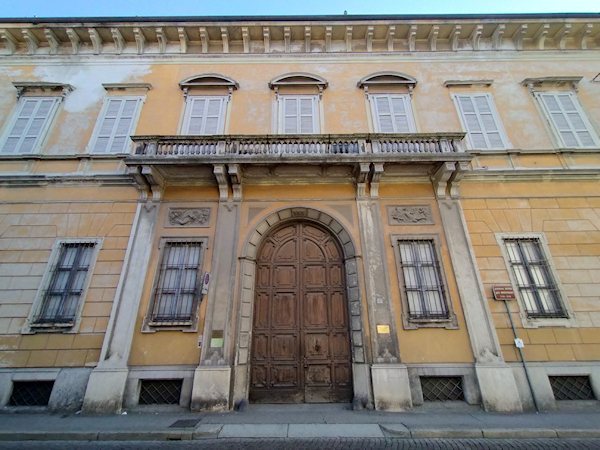
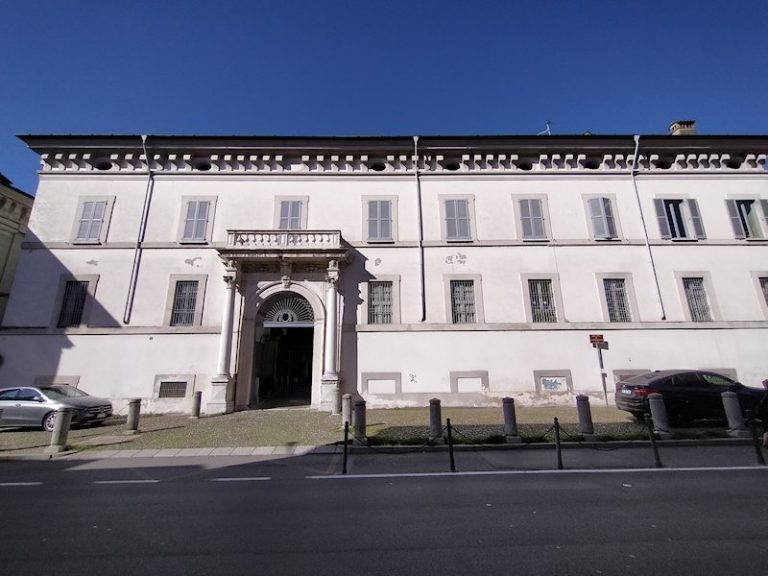
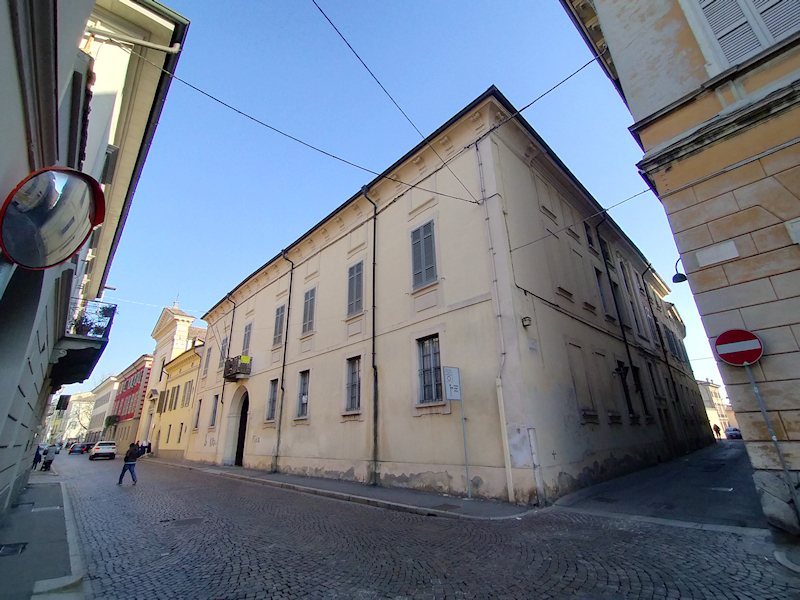
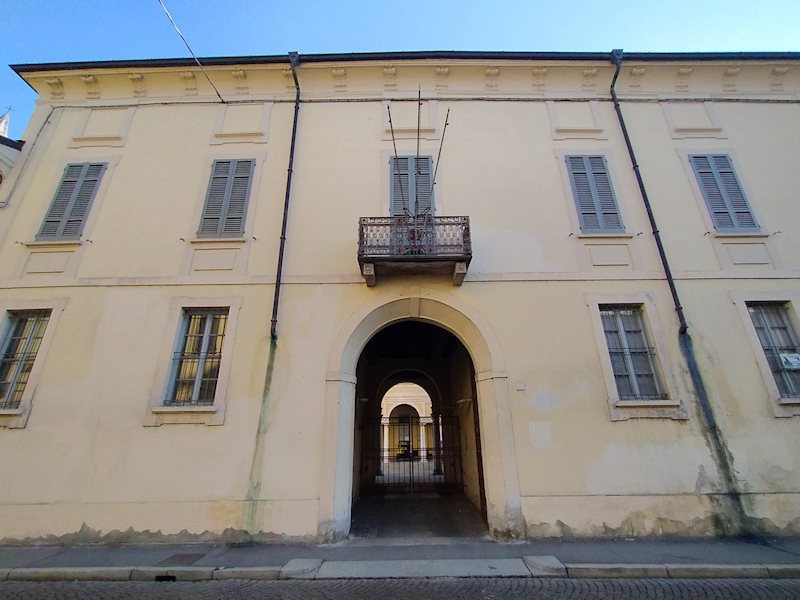
The two-storey Baroque palace is organized around an entrance hall and a cobbled inner courtyard. A horizontal band divides the exterior storeys, and the main entrance is set off-centre to preserve a fifteenth-century hall on the upper floor. A small balcony with a wrought-iron railing sits above the entrance.
Exterior and courtyard
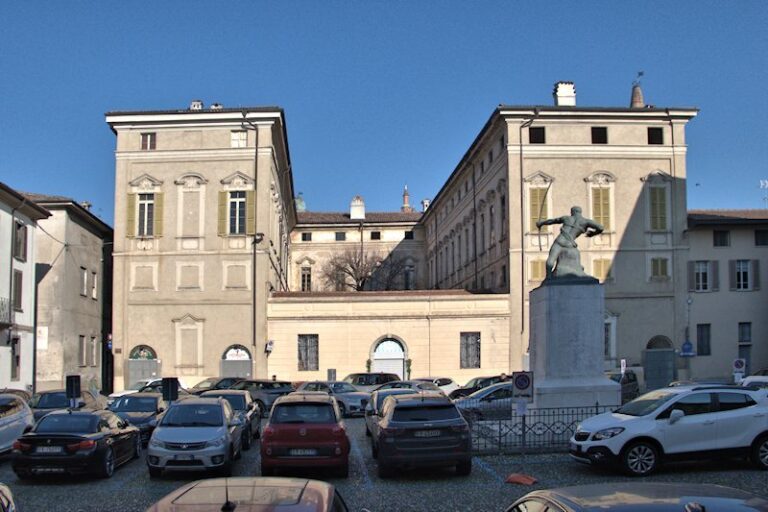
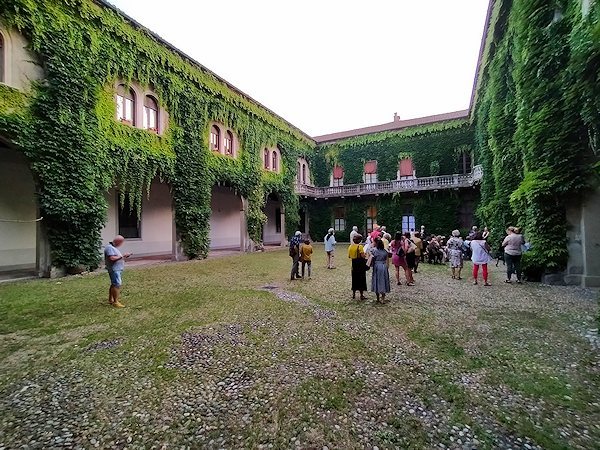
The windows have simple surrounds. Those on the upper floor rest on rectangular decorative forms, while the small attic windows are blind, meaning they are framed but sealed. Two porticoes run parallel across the cobbled courtyard. Each has three arched bays supported by paired Doric columns, a classical form with plain capitals, and a ceiling carried on horizontal joists. On the principal floor, windows with triangular decorative tops alternate with sealed rectangular frames. Openings in the left wing are blocked, leaving its plain balcony unusable. Across the courtyard, the eastern portico has three upper openings alternating with niches.
Fifteenth-century rooms
Ceiling with twenty panels
A room to the right of the entrance hall has a fifteenth-century wooden ceiling decorated with 20 small rectangular panels, some flat and some curved, fitted at an angle between the joists. They depict coats of arms, portraits, and animals. Twelve panels bear the Colleoni emblem, often placed centrally; one also carries the initials “B” and “C”, identifying Bartolomeo Colleoni. An adjoining panel shows the Benzoni emblem and initials interpreted as those of Giovanni Antonio Benzoni. The painted borders share a motif with ceilings at Malpaga Castle, a resemblance taken to suggest a connection with Colleoni and the same artisan workshop. This kind of ceiling ornament was widespread in Lombardy and the Canton of Ticino from the late fourteenth to the early sixteenth century.
Large hall ceiling
The adjoining hall measures 6.60 by 11.80 metres and is 4.90 metres high. Its fifteenth-century ceiling contains 130 wooden panels, each about 21 by 40 centimetres. The panels show noble family arms, animals, and scenes with real or imaginary creatures inspired by ancient fables. Double painted borders surround each panel, with an inner white border of three-lobed scrolls alternating in blue and red. The coats of arms include those of the Capitani, Berlendis, Castelli, Benvenuti, and Verdelli families, among others. Three openings with elaborate Baroque forms occupy the hall’s rear wall.
Staircase and painted hall
A staircase to the left of the entrance hall leads to the principal floor and passes a hall in the Neoclassical style. Its frescoes depict four labours of Hercules, each paired above with an episode from the life of Alexander the Great. Monochrome portraits above the doors portray Julius Caesar, Torquato Tasso, Homer, Marcus Tullius Cicero, Alexander, Socrates, and Virgil. Hercules is a hero of Greek mythology, and Alexander was king of Macedon and a major conqueror; the other portraits represent Roman leaders, Greek thinkers and poets, and the Italian poet Tasso.