Walls of Viseu: Historic Fortifications in Portugal
Site at a Glance
- Popularity
- Low
- Country
- Portugal
- Primary era
- Medieval
- Eras represented
- Classical, Medieval, Early Modern
- Civilizations
- Portuguese, Roman
- Site type
- Military
- Remains
- Wall
On this page9 sections
History
The Walls of Viseu are historic defenses in Portugal, expanded into a fifteenth-century urban enclosure completed in 1472 under Afonso V. Settlement on the elevated site reaches back to a prehistoric hillfort, a defended settlement on high ground. Viriathus, the Lusitanian leader who resisted Rome, is thought to have been born in the region.
From Roman rule to Muslim rule
In 137 BC, the Roman commander Decimus Junius Brutus Callaicus conquered the area. He was also a consul, one of the Roman Republic’s chief elected magistrates. As Roman rule and culture spread across the Iberian Peninsula, Viseu grew in importance as a junction of Roman roads. Milestones found in the region attest to this road network. In the late third century, the city’s fortified perimeter may have been reduced to make it easier to defend.
Under Visigothic rule from the sixth century, Viseu acquired city status and became the seat of a diocese, a church district under a bishop’s authority. Coins were minted there in the seventh century. Muslim rule began in the early eighth century. The city was then known as Castro Vesense, a name associated with the Visigoths, and remained fortified.
Reconquest and civic privileges
During the Christian Reconquest, the long expansion of Christian kingdoms into Muslim-ruled Iberia, forces of Alfonso I of Asturias captured Viseu in the mid-eighth century. They later abandoned the city to prevent it from supporting further Muslim attacks. Viseu was subsequently reoccupied, and control changed between Muslim and Christian powers as the frontier shifted. Ferdinand the Great, king of León and Castile, took the city permanently in 1057.
After the County of Portugal, the medieval polity that preceded the Portuguese kingdom, was established, Viseu served several times as a residence for its counts. In 1123, Teresa of León granted the city its first charter, a formal grant of rights and privileges, following the death of her husband, Henry of Burgundy. Sancho I issued a charter in 1187 that referred to an identical earlier grant by Afonso Henriques; Alfonso II confirmed it in 1217. The charter distinguished the old town from a newer settlement that had grown in population and economic activity.
A royal charter issued on 5 January 1370 under Ferdinand I of Portugal transferred Viseu’s “castle” to its inhabitants. Here, the term meant the fortified area around the original cathedral and old town, rather than a separate castle.
War, expansion, and change
Viseu suffered attacks during the Fernandine Wars, conflicts associated with the reign of Ferdinand I of Portugal. Castilian troops pillaged and burned the city in 1385, during the Portuguese political crisis of 1383–1385. Castilian forces attacked and burned it again in 1396.
Work to enlarge the defenses was under way during the reign of John I and was completed in 1472 under Afonso V. The reorganization combined Afonso V’s enclosure with two earlier enclosures. By then, the built-up city had spread beyond the defensive perimeter. After the capture of Ceuta in 1415, the lands of Viseu were granted to Prince Henry the Navigator, who was raised to ducal rank.
During Manuel I’s reign, Viseu received a new charter in 1513 as urban expansion began. The dismantling of the defenses started in the sixteenth century with the enlargement of the former episcopal palace. In 1844, the municipal council ordered the old gates demolished as part of a drive to modernize the city. The walls and gates received National Monument status in 1915, under a decree published on 31 December.
Remains
The medieval enclosure
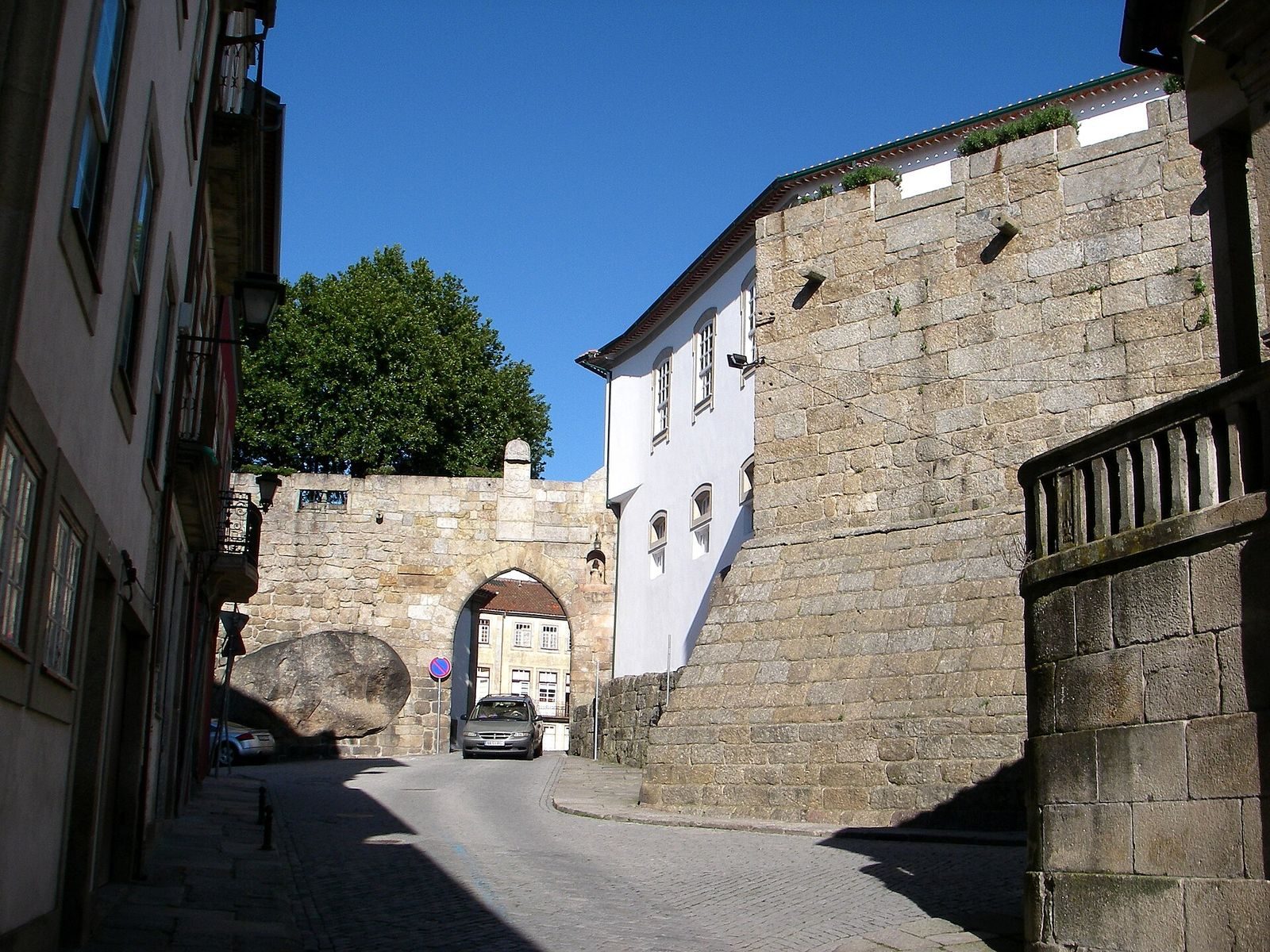
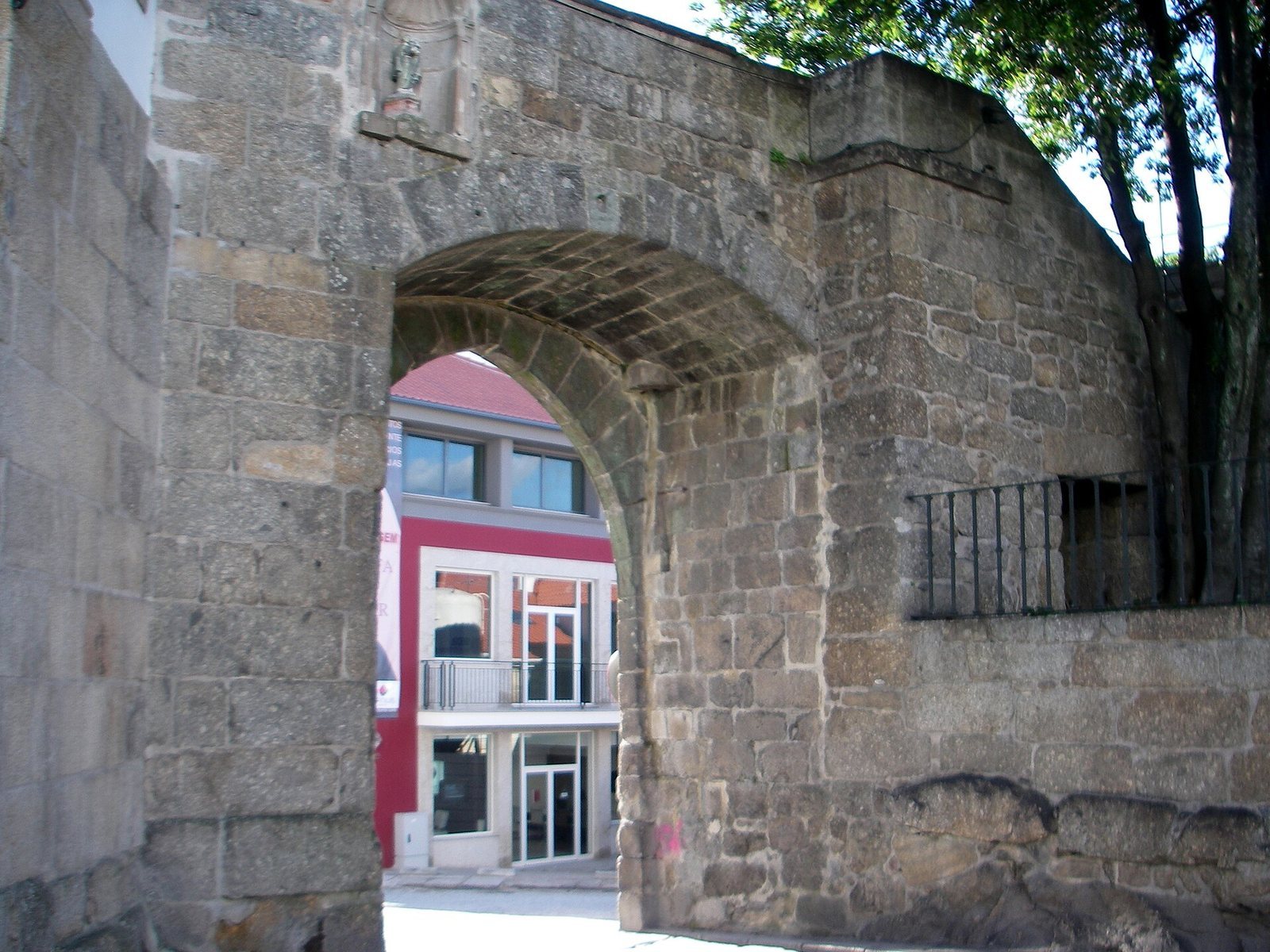
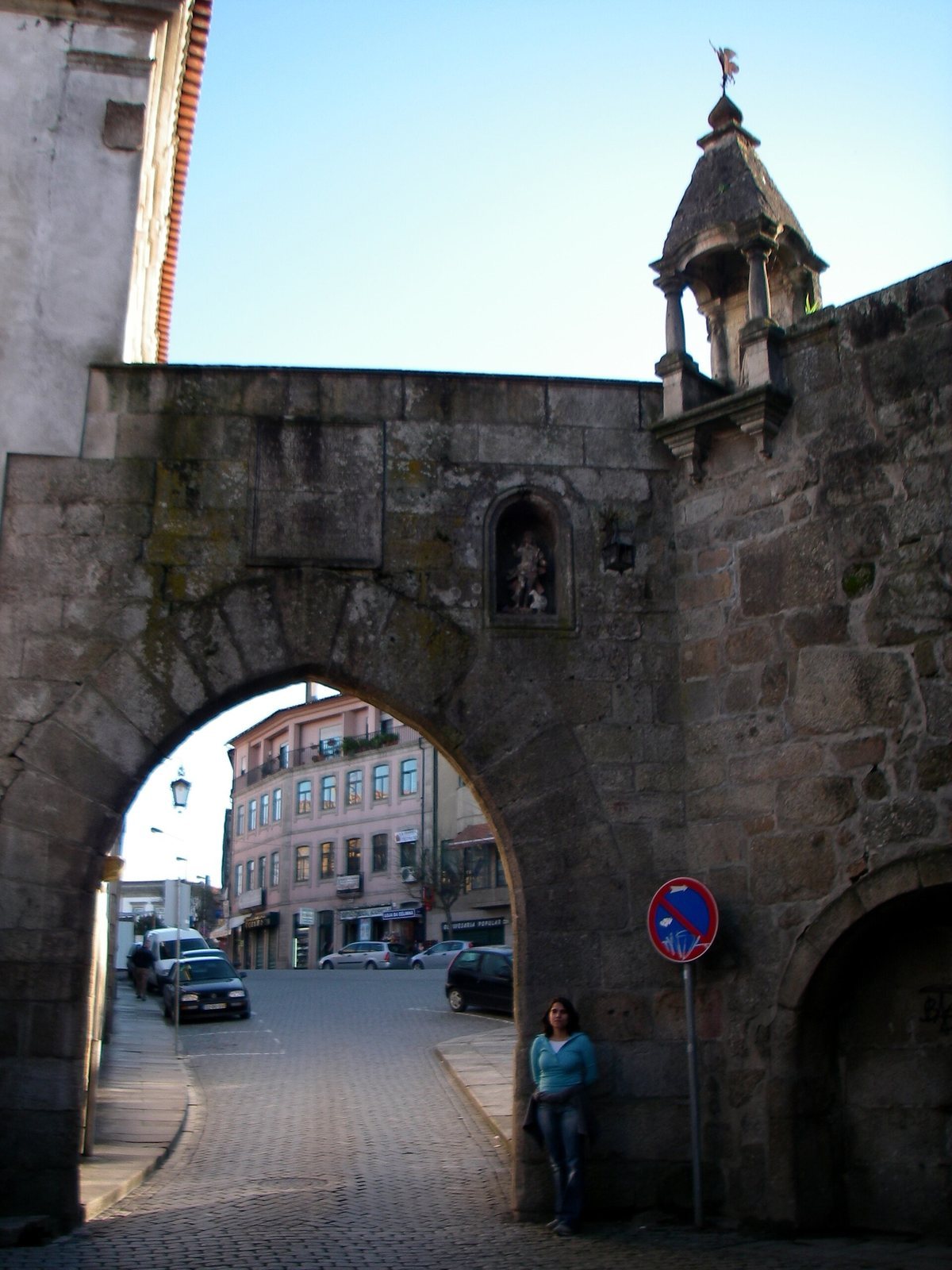
The fifteenth-century fortification had an irregular plan, and its perimeter can be traced through surviving remains within the urban area. The enclosure originally had seven gates. Two, Porta do Soar and Porta dos Cavaleiros, survive along with a few stretches of wall.
Porta do Soar
Also called Porta de São Francisco, this gate has a pointed arch and a short adjoining section of wall. It marks the old town’s main circulation axis. A niche inside the entrance holds an image of its patron, Saint Francis of Assisi, founder of the Franciscan order. Placing images of protective saints in niches at fortress entrances was customary in the late Middle Ages.
Porta dos Cavaleiros
An inscription on this surviving gate is dated 1646 and records later construction work.
Roman remains on Rua Formosa
Renovation work on Rua Formosa in March 2004 is believed to have uncovered part of a Roman wall and a semicircular tower. They are presented as a museum feature beneath a glass panel set at ground level. Three child burials, a coin, and pottery were also found in association with the wall.