Bargone Castle: A Medieval Fortress in Italy
Site at a Glance
- Popularity
- Medium
- Country
- Italy
- Primary era
- Early Modern
- Eras represented
- Medieval, Early Modern, Modern
- Civilizations
- Duchy of Parma and Piacenza, Italian
- Site type
- Military
- Remains
- Castle
On this page12 sections
History
Foundation and medieval contest
Bargone Castle is a fortress in Italy, begun toward the end of the 10th century at the initiative of the Diocese of Parma, the Catholic Church’s territorial institution in the area. It served both defensive and residential purposes and may have been built over earlier remains.
In 1144, King Conrad III of Swabia granted Bargone and Borgo San Donnino, the historical name of present-day Fidenza, to Count Bertoldo IV of Zähringen as fiefs, or lands held under a grant from a superior authority. Parma, Borgo San Donnino and Piacenza contested the territory during the 12th century. In 1191, Emperor Henry VI sold the two fiefs to Piacenza for 2,000 imperial lire. Parma regained the castle in 1198, and in 1249 Emperor Frederick II formally granted it to Oberto Pallavicino.
Parma retook Bargone in 1267 and dismantled it over the following years. In 1298, Parma’s podestà, a civic magistrate, occupied the area after a series of sackings at the valley’s saltworks.
Rebuilding and shifting control
In the early 14th century, Gherardo de’ Rangoni rebuilt the castle while rebelling against Guelf Parma. Guelfs and Ghibellines were rival Italian political groupings broadly associated with papal and imperial interests, respectively. Parma attacked and captured the rebuilt fortress in 1325, taking members of the Rangoni family prisoner. The castle was in the possession of the Bertoldingi in 1343. In 1360, Emperor Charles IV of Luxembourg granted the fief to Oberto III Pallavicino.
In 1374, Niccolò, lord of Tabiano, murdered his uncle, Marquis Giacomo Pallavicino, and Giacomo’s son Giovanni, thereby gaining Bargone. Milanese duke Bernabò Visconti used the conflict to seize Castello di Tabiano and drive Niccolò from his lands. Rolando de’ Medici, who had withdrawn to the area in 1360, died at Bargone in 1386. He was later buried in the Oratory of the Holy Trinity at Busseto.
After Gian Galeazzo Visconti took power in 1390, Niccolò recovered his fiefs and received formal recognition from King Wenceslaus of Luxembourg in 1395. Niccolò, then a marquis, died by poisoning at Castello di Tabiano in 1401. In 1405, Ottobuono Terzi attacked and destroyed Bargone Castle.
Fifteenth-century struggles
In 1441, the military commander Niccolò Piccinino attacked the Pallavicino state, forcing Marquis Rolando il Magnifico to flee. Duke Filippo Maria Visconti seized Rolando’s lands and granted Bargone to Piccinino in 1442. In 1457, Duke Francesco I Sforza restored the fiefs of Bargone and Busseto to Marquis Gian Ludovico Pallavicino.
Private ownership and recent condition
The Farnese dukes of Parma captured the castle in 1587. It was sold to the Genoese marquis Felice Mari in 1650, then passed to the Lomellino marquises in 1711. They later sold it to the Genoese Pallavicino family. In the first half of the 18th century, it passed to the Pratolongo family. Carlo Farioli bought the property toward the end of that century, and it remained with his descendants.
After Silvio Farioli’s death in 2017, the castle and its large park fell into abandonment, and the building was declared unfit for use. The castle is designated Italian national heritage.
Remains
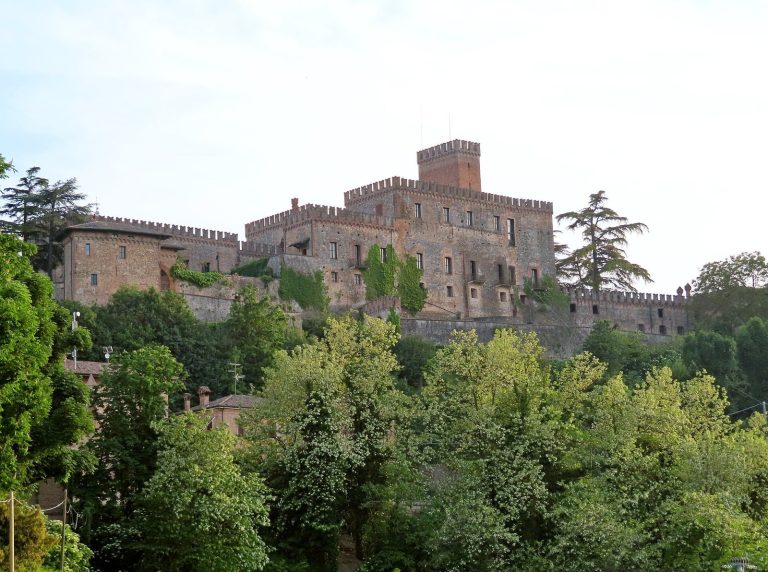
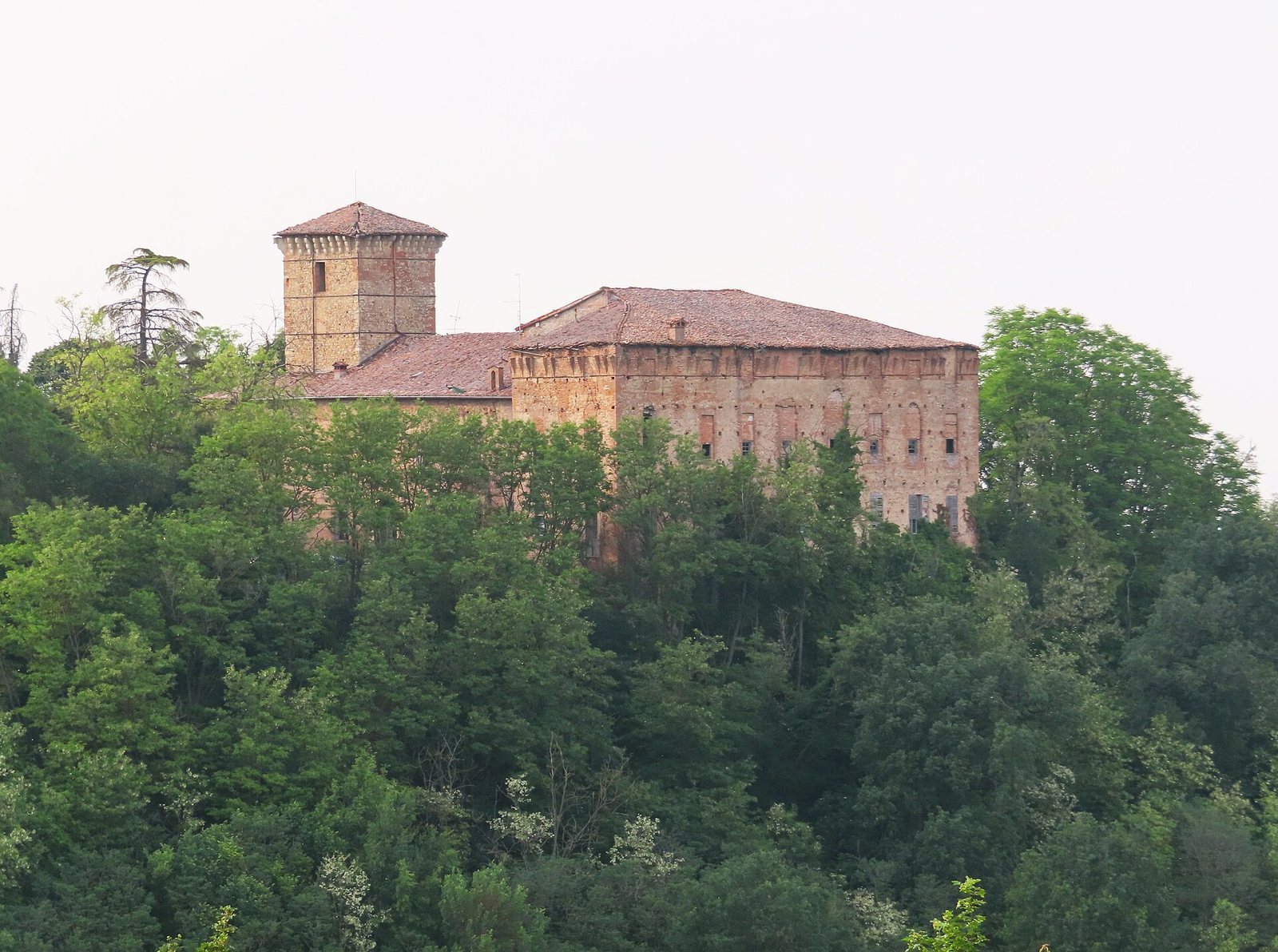
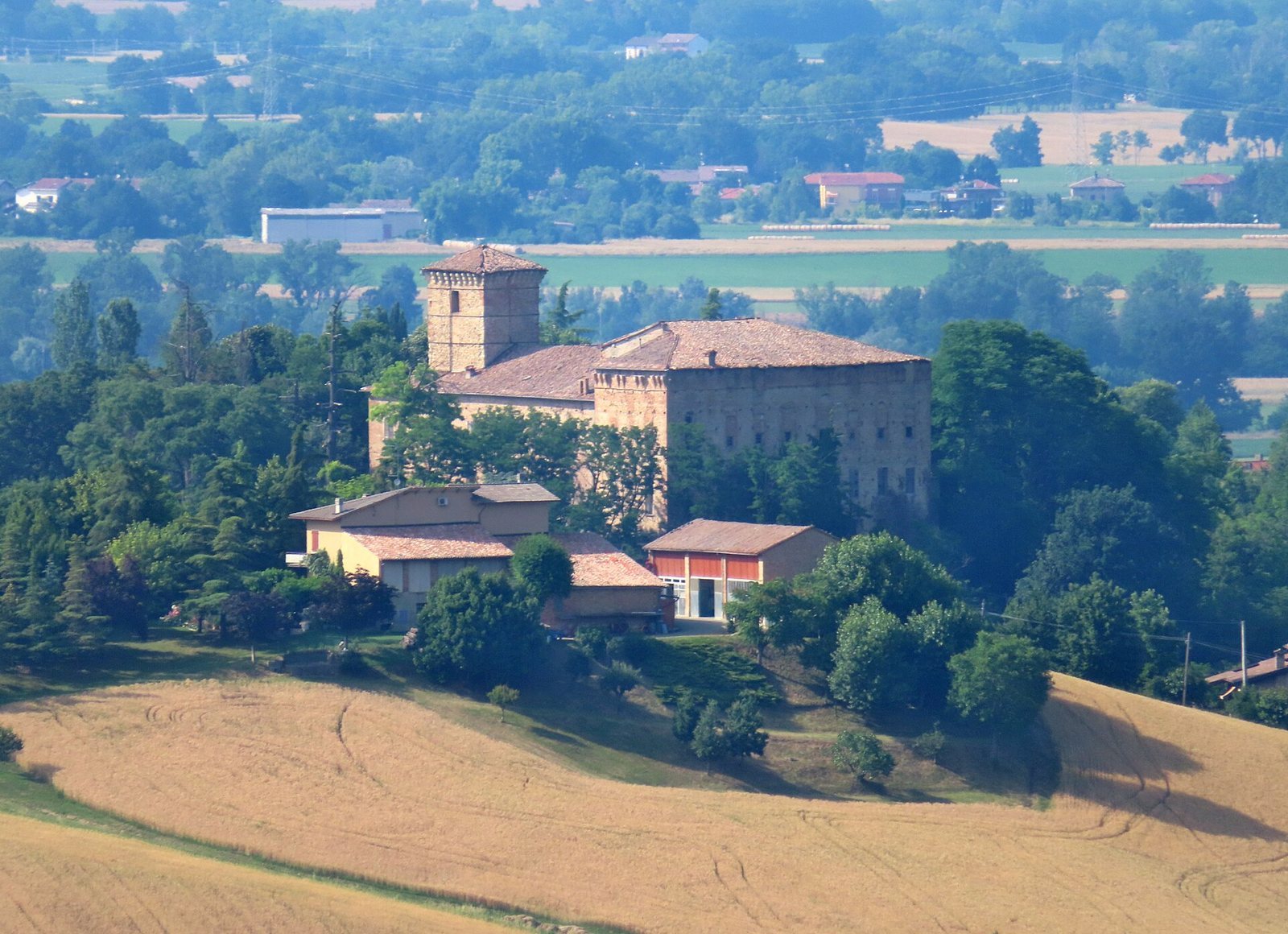
The castle stands on a wooded hill above cultivated vineyards, with woodland rising beyond them. Its buildings are arranged around a square central courtyard, while defensive features and later interior decoration reflect the site’s different phases of use.
Entrance and hillside setting
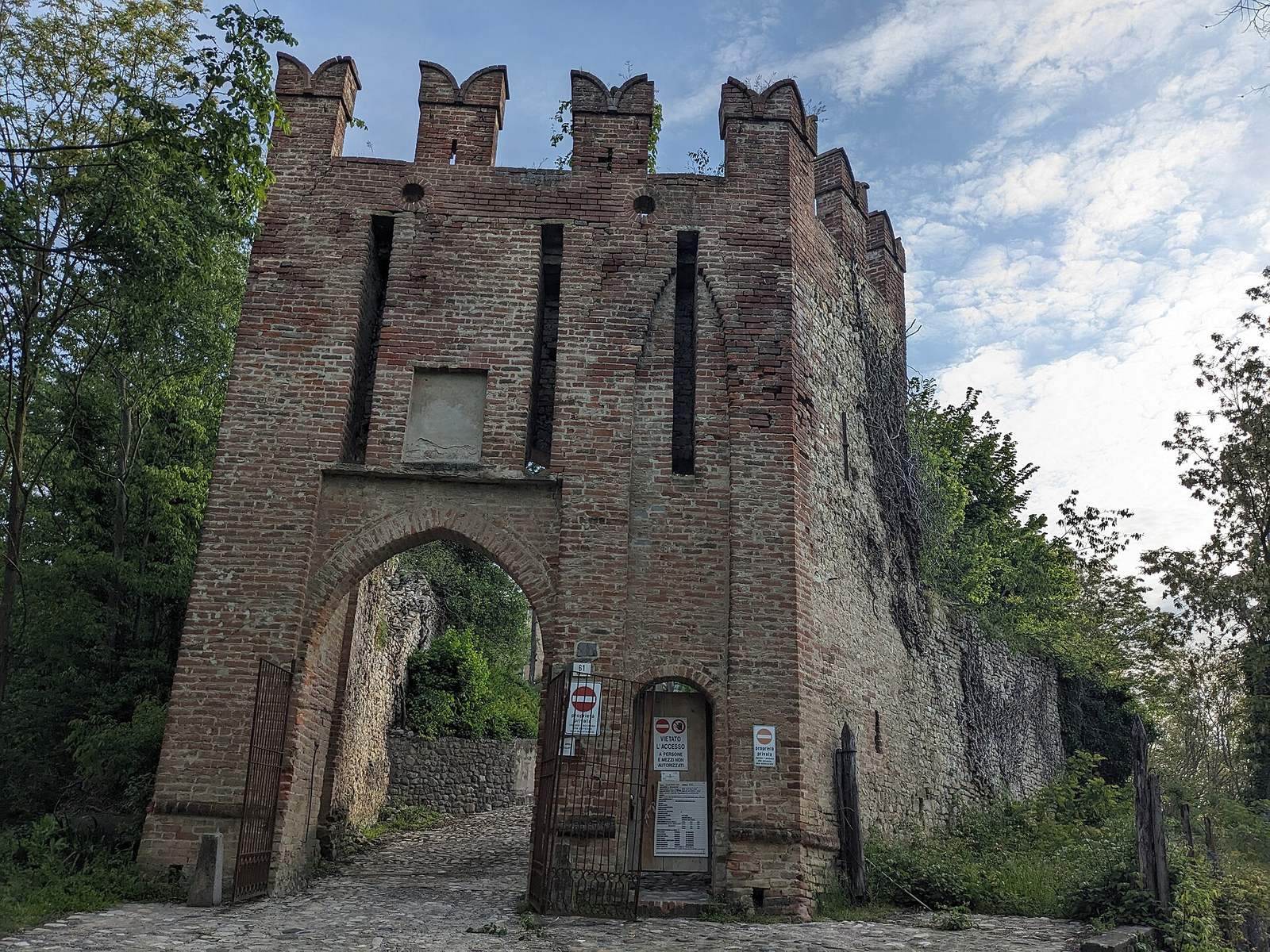
At the foot of the hill, where the vineyards meet the higher woodland, a small medieval ravelin, an outwork placed before a fortress entrance, has a pointed arch and notched battlements associated with the Ghibellines, the faction broadly aligned with imperial interests. Tall slots in its facade held parts of the drawbridge mechanism; only traces of the bridge survive.
Courtyard and exterior
The central Renaissance courtyard dates to around the middle of the 16th century. A portico runs along two sides, supported by plain Tuscan-style columns and Serlian openings, each with a broad central arch and narrower openings on either side. The stone-and-brick facades contain numerous windows, especially on the east side, which rises through five levels. A tall keep, the castle’s main defensive tower, stands in the southwest wing and overlooks the surrounding valleys.
Interior spaces
Armory Hall
Interior decoration was added mainly during the 18th and 19th centuries. In the Armory Hall, a colonnade divides the room into two aisles beneath stucco-decorated cross vaults, ceilings formed where curved vault sections intersect.
Reception rooms and salon
Adjacent reception rooms have vaulted, frescoed ceilings, old wall tapestries and antique furnishings. Girolamo Magnani painted the salon’s decoration between 1864 and 1884. It includes views of the castle at different times of day and four landscapes representing the seasons.
Cellars and former prisons
On the basement level, extensive cellars lie beside the former prisons. The cellars are used for the estate’s wine production.