Sanctuary of Saint Catherine in Siena: A Shrine to Catherine of Siena
Site at a Glance
- Popularity
- High
- Country
- Italy
- Primary era
- Medieval
- Eras represented
- Medieval, Early Modern, Modern
- Civilizations
- Grand Duchy of Tuscany, Italian, Republic of Siena
- Site type
- Religious
- Remains
- Sanctuary
On this page20 sections
History
The Sanctuary of Saint Catherine in Siena, Italy, is a Roman Catholic complex incorporating the Benincasa family home where Catherine of Siena was born. Catherine was a fourteenth-century Italian Catholic mystic associated with the Dominican lay movement. The sanctuary grew from a working household in the city’s Fontebranda district into a place of devotion, with buildings added and adapted over several centuries.
The Benincasa house and the first sanctuary
Fontebranda was a water-rich neighborhood where wool workers lived and worked among homes, workshops, and dye works. Siena’s Arte della Lana, the woolworkers’ guild, owned the Benincasa house and assigned it to Jacopo Benincasa, Catherine’s father, for use as both a residence and a workplace. The dyer Antonio Minuccio of San Gimignano later occupied the property.
After Catherine’s canonization in 1461, the formal recognition of her as a saint by the Catholic Church, Siena’s government acquired her house and adjoining buildings from the guild for conversion into a sanctuary. The purchase is dated 28 January 1466 and cost 90 gold florins. Sienese banker Marco di Pietro di Antonio and merchant Pier Paolo di Cecco Sozzini contributed to the funding. Conversion work is dated to 1464, and residents of the Oca contrada, one of Siena’s historic neighborhood communities, promoted the transformation.
The family dye works became an oratory, a small chapel or place of prayer, between 1465 and 1474. Francesco di Duccio del Guasta and Corso di Bastiano are associated with its construction. In 1482–1483, the Confraternity of Santa Caterina, a devotional religious association, turned the room identified as the Benincasa kitchen into a meeting hall. The hall was enlarged through the removal of dividing walls in 1546 and the addition of adjoining rooms in 1550–1555. Work was completed in 1661.
The Church of the Crucifix
Between 1614 and 1623, a church was built on land traditionally identified as the Benincasa family garden. It was intended to house a crucifix associated with the tradition that Catherine received the stigmata in Pisa in 1375. In Christian belief, stigmata are marks corresponding to Christ’s wounds. The crucifix came from the Church of Santa Cristina in Pisa, where Catherine is traditionally said to have received them. It remained in the lower Oratorio della Camera until the new church was consecrated on 23 April 1623 by Alessandro Petrucci, Archbishop of Siena.
Restoration and commemoration
The Camera della Santa was restored in 1874 without a fundamental change to its structure. Architect Giuseppe Partini substantially renewed the façade of the dye-works oratory in 1877, and Alessandro Franchi decorated the Camera with frescoes in 1896.
Pope Pius XII proclaimed Catherine patron saint of Italy on 18 June 1939, following a campaign led by Siena’s archbishop, Mario Toccabelli. The city commissioned the Portico dei Comuni d’Italia to mark the proclamation. Construction began in 1941, with Italian municipalities contributing symbolic sums equivalent to the cost of a brick. The work was interrupted by the Second World War and completed in 1947. The portico occupies the site of the demolished Church of Sant’Antonio Abate, whose church was transferred to the Basilica of San Domenico.
The portico commemorates several papal recognitions of Catherine. Pius II canonized her in 1461, Pius XII named her patron saint of Italy, Paul VI declared her a Doctor of the Church in 1970, and John Paul II proclaimed her patron saint of Europe in 1999. The title Doctor of the Church recognizes a saint’s contribution to Christian teaching. Mothers of soldiers killed in the Second World War commissioned a bronze votive lamp for the church; on designated annual commemorations, an Italian municipality or association supplies oil for its flame.
Remains
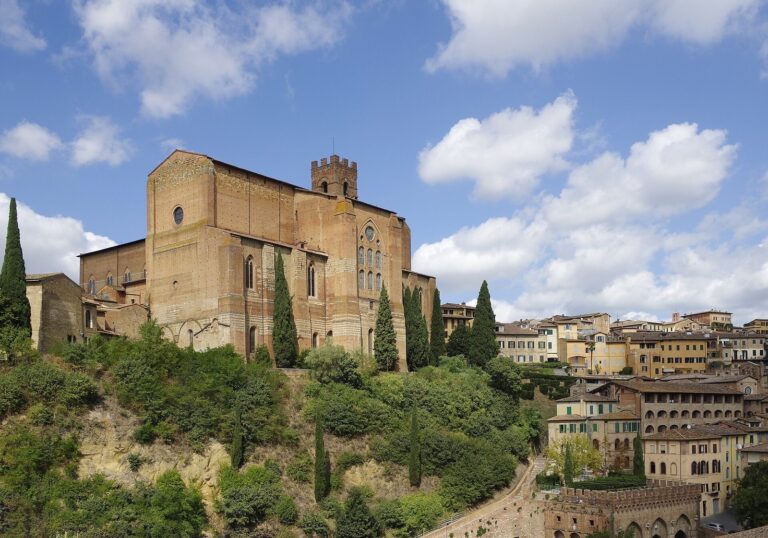
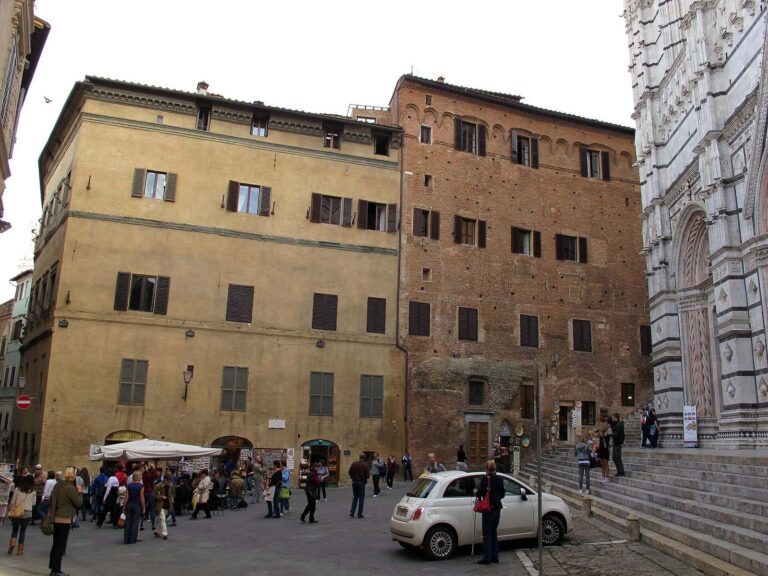
The sanctuary occupies a compact area within Siena’s city walls, in the Terzo di Camollia, one of the city’s three historic districts. The complex lies in Oca, between the Drago community to the north and Oca to the south. Vicolo del Campaccio, Via Camporegio, and Via Santa Caterina border the site; the last was formerly called Via dei Tintori. Vicolo del Tiratoio passes through the complex. The entrance is at Costa di Sant’Antonio, and the buildings include a courtyard, covered galleries, the Camera della Santa, several oratories, a sacristy, and the Church of the Crucifix.
Entrance and porticoes
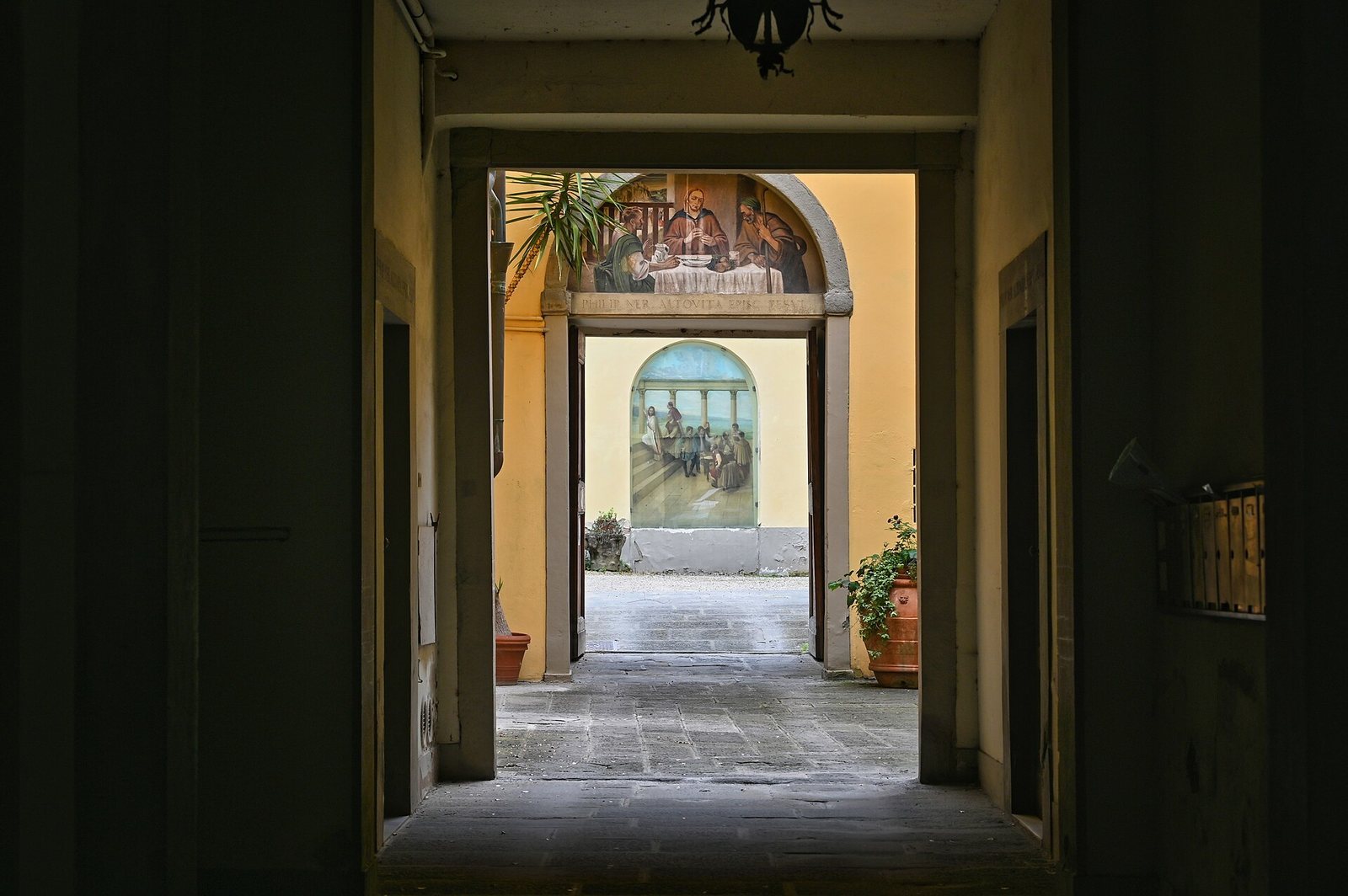
Courtyard and Portico dei Comuni d’Italia
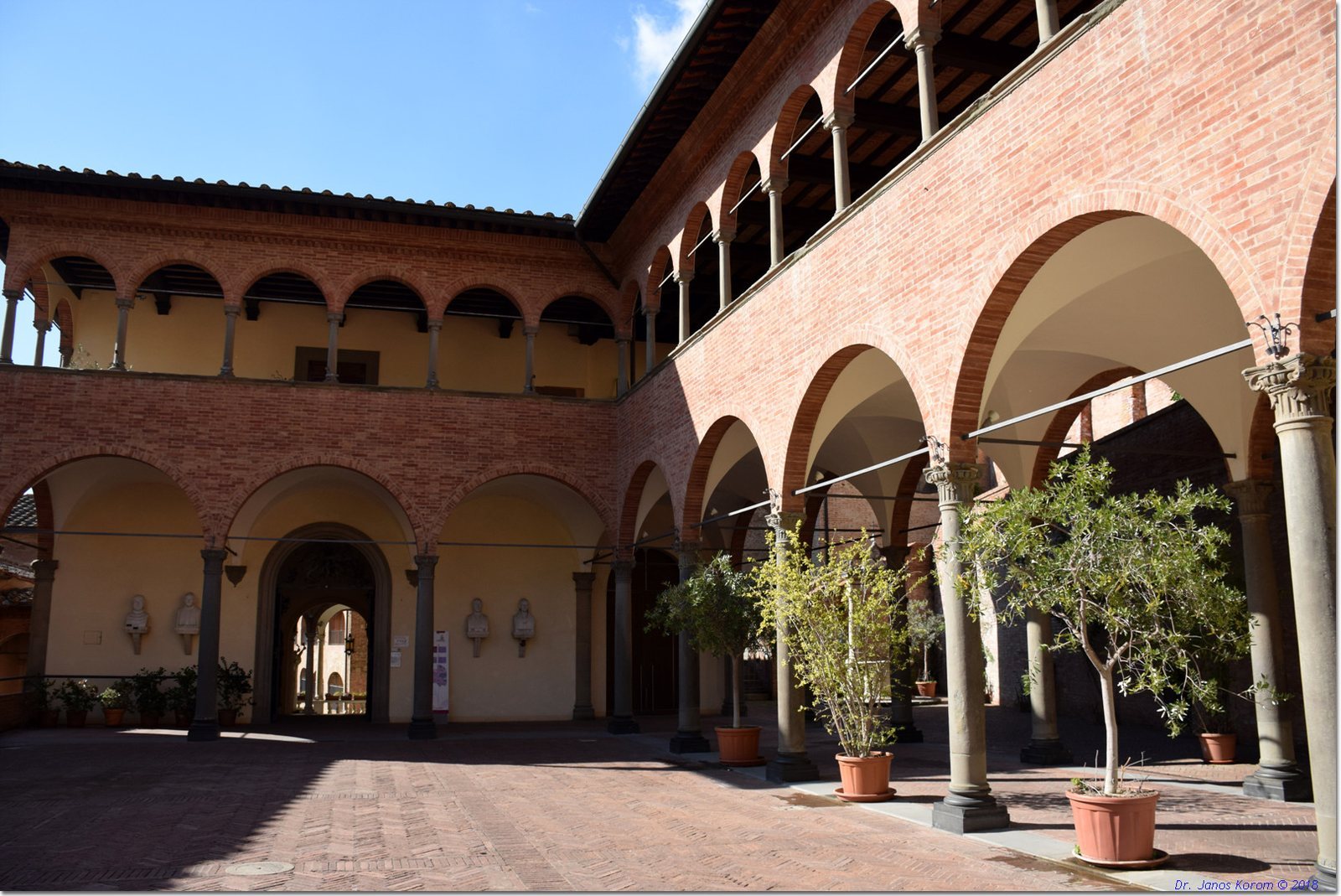
The entrance courtyard now forms the Portico dei Comuni d’Italia. Busts of the popes connected with Catherine’s canonization and later recognitions stand within it, alongside a Renaissance well attributed, possibly, to Baldassarre Peruzzi. The courtyard and its portico provide the entrance to a complex that continues through further covered galleries and devotional spaces.
Loggias
Two more loggias, or covered galleries open along one or more sides, lie beyond the entrance. The older gallery was built by Giovan Battista Pelori, a pupil of Peruzzi. A modern loggia contains a large stucco statue of Catherine, made as a model for a statue on Siena’s fortress.
Benincasa house
The Benincasa house faces Vicolo del Tiratoio. Its Renaissance stone doorway carries the inscription Sponsae Kristi Catherine Domus. A small loggia with terracotta columns rises above the entrance.
Church of the Crucifix
Crucifix and altar
Entered from the third portico, the Church of the Crucifix contains the Pisan-school crucifix on its main altar. The Pisan school was an artistic tradition associated with Pisa and the surrounding region; this wooden work dates to the second half of the twelfth century and is set in a gilded frame. Sixteenth-century painted shutters by Bartolomeo Neroni, showing Catherine and Saint Jerome, flank it. The marble altar was made by the Florentine Tommaso Redi.
Paintings and church decoration
The church holds paintings from several periods. High on the right aisle are Niccolò Franchini’s The Pope’s Return to Rome (1769) and Alessandro Calvi, known as Il Mutolo, Saint Catherine Urges the Pope to Return to Italy (1768). On the left are Libero Guerrini’s Almsgiving of Saint Catherine (1777) and Galgano Perpignani’s Saint Catherine Attacked by Florentine Soldiers (1765). In the presbytery, the area around the main altar, Rutilio Manetti’s Apotheosis of Saint Catherine occupies the left altar, while Sebastiano Conca’s Saint Catherine and Gregory XI is on the right. Manetti’s Stigmatization of Saint Catherine is near that altar.
Giuseppe Nicola Nasini’s Ecstasy of Saint Catherine and Saint Catherine Writing, Inspired by Saint John the Evangelist and Saint Thomas Aquinas are also at the main altar. Other works include Conca’s Saint Catherine before the Pope in Avignon, Rutilio and Domenico Manetti’s The Madonna Welcoming Saint Catherine in Glory (1638), Nasini’s Glory and Exaltation of Saint Catherine, and Francesco Vanni’s Meditation (1591).
Nasini painted most of the church vault between 1701 and 1703. Its scenes include Glorification of Saint Catherine in the dome, Stigmatization above the main altar, Ascent to Heaven in the presbytery, and Assumption into Paradise in the nave. The church also holds the bronze lamp commissioned in memory of soldiers killed in the Second World War.
Oratorio della Cucina
Kitchen, hearth, and altar
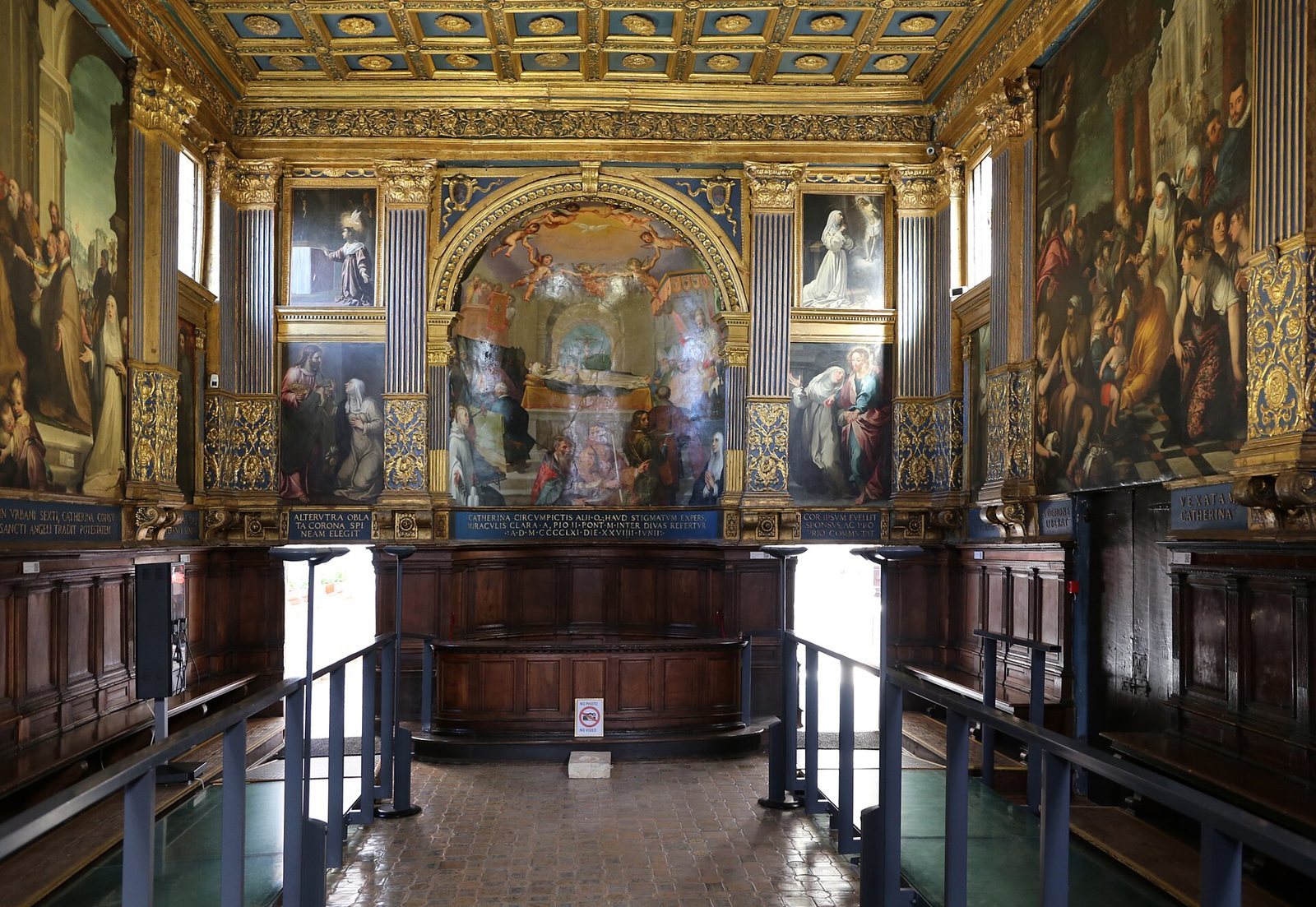
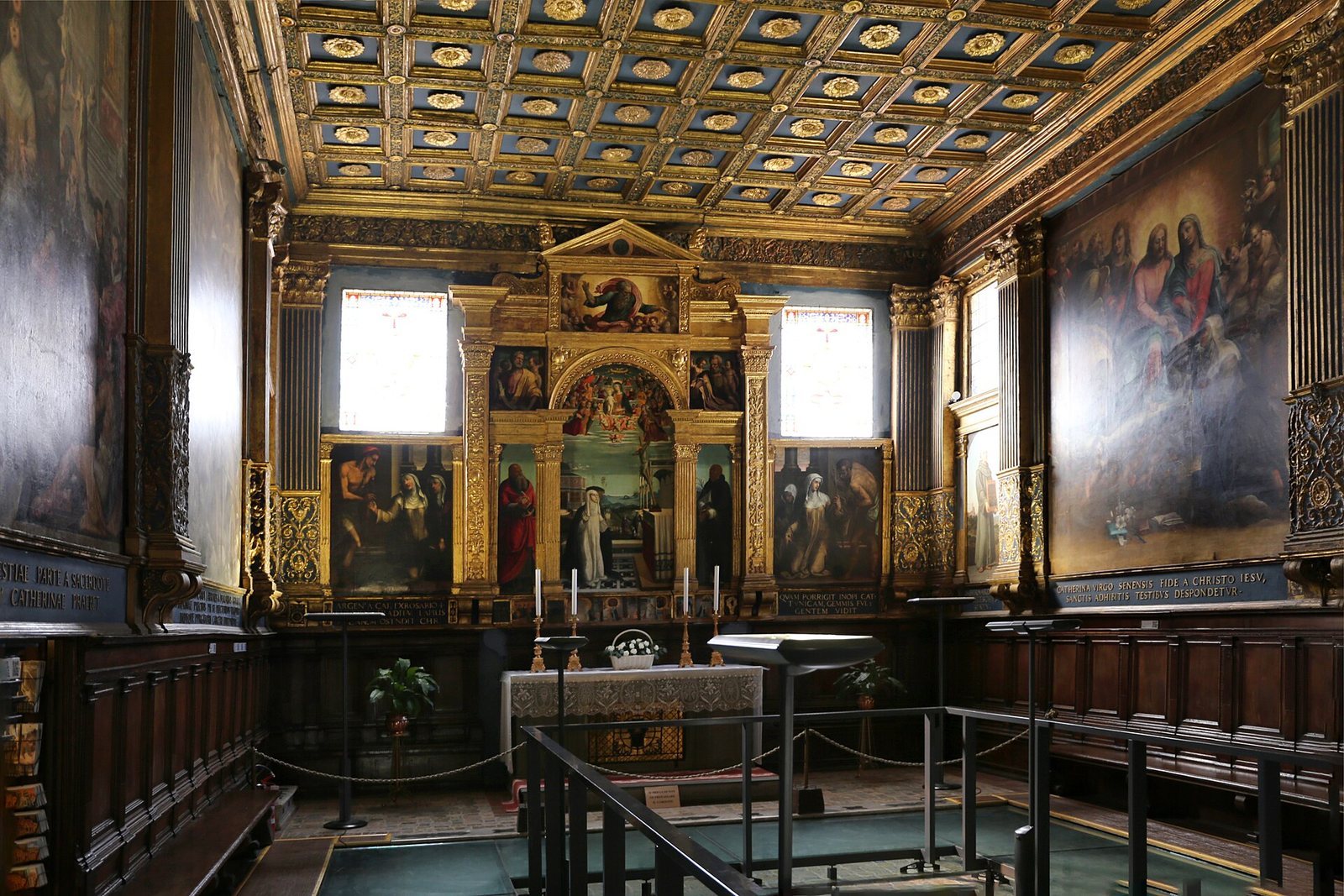
Opposite the Church of the Crucifix is the Oratorio della Cucina, or Kitchen Oratory, in the room traditionally identified as the Benincasa family kitchen. Beneath its altar are remains of a hearth associated with the story that Catherine fell onto burning embers while in ecstasy and was unharmed. The oratory has a floor of maiolica, tin-glazed earthenware tiles, a ceiling divided into panels with gilded rosettes, and a wooden choir. The floor was remade in the seventeenth century, and the ceiling rosettes were restored in 1594.
Altarpiece
Bernardino Fungai’s painted altarpiece, a work placed at an altar, dates to 1495–1497. Its scenes show Catherine receiving the stigmata between Saints Jerome and Dominic and Catherine in glory among saints, with episodes from her life on the predella, the lower section of an altarpiece. Panels dated to 1496 include Four Brothers of the Confraternity, Saint Catherine before the Pope, and Vision of Saint Catherine. Bartolomeo Neroni added the Eternal Father and two prophets above the altarpiece in 1567–1571, as well as side scenes of Catherine giving a garment to Jesus dressed as a pilgrim and Jesus returning the small cross she had given him.
Wall paintings
Paintings on the side and rear walls range mostly from 1578 to 1635. On the left wall are Alessandro Casolani’s Blessed Giovanni Colombini (1582), Pietro Sorri’s Saint Catherine Frees a Possessed Woman (1587), Cristoforo Roncalli’s Saint Catherine Receives Communion Miraculously (painted in Rome in 1582–1583), Lattanzio Bonastri’s Saint Catherine Prays for Two Men Sentenced to Death (1580), and Gaetano Marinelli’s Blessed Ambrogio Sansedoni (1872).
The right wall includes Casolani’s Blessed Andrea Gallerani and The Delivery of the Keys of Castel Sant’Angelo to Pope Urban VI (both 1582), Roncalli’s Saint Catherine Persuades Gregory XI to Return from Avignon to Rome (painted in Rome in 1582–1583), Arcangelo Salimbeni’s Mystical Marriage of Saint Catherine (1578), and Pietro Aldi’s Saint Bernardino of Siena (1872). Salimbeni’s painting includes the Madonna, King David, and Saints Paul, John the Evangelist, and Dominic.
The rear wall brings together works by several Sienese painters. They include Sorri’s Saint Catherine Chooses the Crown of Thorns Instead of the Jeweled Crown (1606); Rutilio Manetti’s Saint Catherine Prays, Inspired by the Holy Spirit in the Form of a Dove and Saint Catherine Prays before the Crucifix (both 1635); and Francesco Vanni’s Canonization of Saint Catherine (1600) and Saint Catherine Exchanges Hearts with Jesus (1585).
Oratorio della Camera
Paintings and altar
Stairs from the same loggia descend to the Oratorio della Camera. Paintings by Alessandro Franchi and Gaetano Marinelli depict episodes from Catherine’s life, including her mystical marriage with the Christ Child, the Madonna giving her Jesus, and her mother seeing her ascend stairs while suspended. Other scenes show Catherine having her hair cut, her father seeing a white dove above her head, her gift of a garment to Jesus dressed as a pilgrim, and Christ offering her a crown of thorns and a jeweled crown. Franchi’s 1896 frescoes, paintings made on plaster, show Catherine cutting her hair, giving a garment to Jesus, and her mystical marriage.
An older altar painting by Girolamo di Benvenuto shows Catherine receiving the stigmata from the crucifix. It is an oil painting on panel dating to about 1505.
Cubiculum
The Oratorio della Camera contains the Cubiculum, a small chamber measuring about one by two metres. Catherine is believed to have rested there on the bare stone floor, and a stone projection on the floor is identified as her pillow. The room also preserves relics, meaning remains of saints or objects associated with them. A cabinet holds ex-votos, objects offered in fulfilment of a vow or in gratitude, and books listing members of the International Association of Caterinati. Pietro Repossi made a marble statue of Catherine in ecstasy for the chamber in 1940.
Oratorio di Santa Caterina in Fontebranda
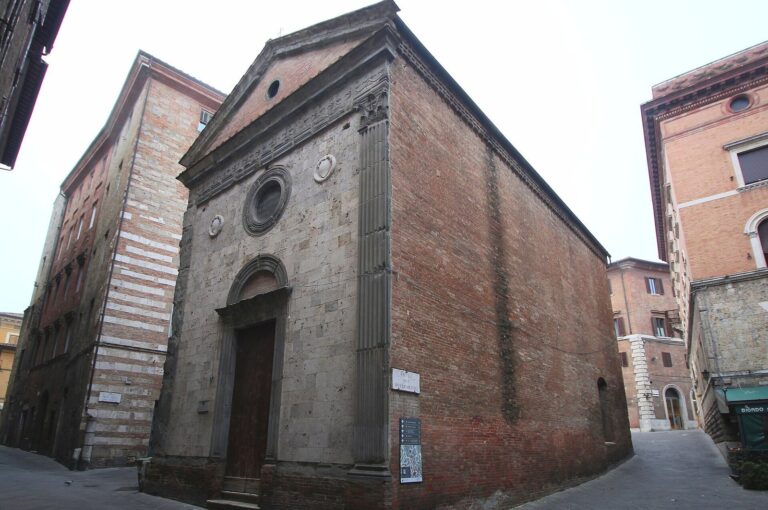
Further stairs lead to the Oratorio di Santa Caterina in Fontebranda, also called the Oratorio della Tintoria. It occupies the site of Jacopo Benincasa’s dye works and is used by the Oca community; its façade faces Via Santa Caterina. Its artworks include Neroccio di Bartolomeo di Benedetto de’ Landi’s wooden statue of Catherine (1475), Girolamo del Pacchia’s fresco Stigmatization of Saint Catherine (1525), and Sebastiano Folli’s frescoes Reconciliation with the Florentines Achieved by the Sienese Saint and Catherine’s Return to Florence; Her Mission to Avignon to Pope Gregory XI (both 1607). Ventura Salimbeni’s Saint Catherine Attacked by Florentine Soldiers dates to 1604.